Can Inflammation Cause Weight Gain? Genetic Studies Point the Arrow From Fat to Inflammation

“Yes, chronic inflammation can contribute to weight gain,” says Google’s AI answer to this question, and the pages it cites agree: a functional-medicine clinic and a pain clinic both answer yes, and a lab that sells blood tests says chronic inflammation can make weight loss a struggle [1]. Plenty of people are asking. “Can inflammation cause weight gain” is searched about 4,400 times a month in the United States, the database’s yearly figure, and about 3,600 in each of the latest three months (from a paid keyword database, pulled 20 October 2026) [1].
Mostly, it runs the other way. Gaining body fat raises inflammation markers, and genetic studies of CRP built to tell the two directions apart found the arrow pointing from fat to inflammation, not back [2] [3]. Anti-inflammatory drugs mostly did not take weight off. Some did: diacerein in a 14-week trial of 42 adults with obesity [4], and the PDE4 inhibitors, pills for psoriasis and lung disease whose labels count weight loss as a side effect [5] [6]. Another added 3.0 lb (1.34 kg) against a dummy pill over 48 weeks in 286 adults with type 2 diabetes [7]. So can inflammation make you gain weight? Not in the way it is sold. What can show up on the scale is water, after an operation, for instance, and an inflamed thyroid can add a few pounds, most of it salt and water [8] [9].
This is journalism, not medical advice. Weight that comes on fast with swelling of the legs or belly, breathlessness, or breathlessness when lying flat needs a clinician promptly: it can be fluid from the heart, the kidneys or the liver [10] [11]. Gain you cannot explain, with tiredness, feeling cold or a slow pulse, is worth a thyroid test [12]. And if you take a steroid or another anti-inflammatory medicine, do not stop it to lose weight; talk to whoever prescribed it.
A few words before the numbers, the same ones our coffee and inflammation verdict uses. Inflammation is the body’s response to injury or infection; the kind in this question is the slow, low-grade kind, which a blood test can only hint at. CRP, C-reactive protein, is a protein the liver makes more of when inflammation is under way, and it is the marker most of these studies measure. IL-6 (interleukin-6), TNF-alpha and IL-1-beta are cytokines, signalling molecules that immune cells release to drive inflammation. None of them, on its own, is a diagnosis. BMI, body mass index, is weight divided by height squared; for someone 5 ft 9 in tall, one BMI point is about 7 lb (3 kg), by our arithmetic.
Does inflammation cause weight gain, or does weight gain cause inflammation?
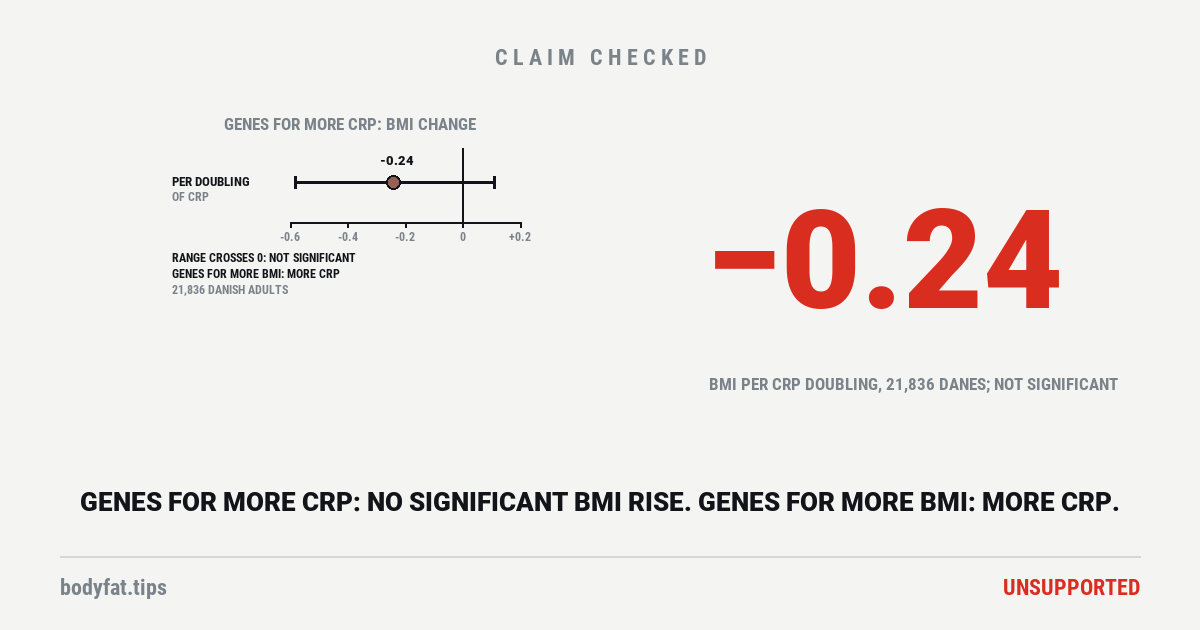
People with more body fat have more CRP. That much is not in dispute. In 21,836 Danish adults, each doubling of CRP went with a BMI about one point higher [2]. The question is which comes first, and an ordinary survey cannot answer it.
A genetic study can try. Mendelian randomisation compares people by inherited variants that change one thing, here CRP or body weight, and so is less exposed to the habits that travel with both. The Danish team did it in both directions. People who inherited a variant that raises CRP were not significantly heavier; if anything, the estimate was 0.24 BMI points lower per doubling of CRP, with a confidence interval, the range the true average probably sits in, from 0.58 lower to 0.11 higher. People who inherited a variant that raises body weight had more CRP [2]. A study of 5,804 people aged 70 to 82 found the same pattern: the variants that raise CRP made no significant difference to BMI, and the variants that raise BMI raised CRP [3]. A 2023 genetic study, with body-size data from up to 1.3 million people and inflammation data from about 13,000, found a higher BMI raised ten circulating markers, CRP among them [13].
The other direction has been looked for beyond CRP too. A 2024 genetic screen of 41 cytokines turned up nine “suggestive” links with measures of obesity, none of which survived the statistical correction for testing so many at once; the one cytokine that came up for more than one measure went with less obesity [14]. CRP is a marker, and a variant that changes it says nothing directly about the cytokines upstream of it. So the two-way genetic studies of CRP, and the 2023 study of ten markers, point from fat to inflammation; the 2024 screen tested only whether cytokines raise obesity, and none of its nine leads held up. White blood cells are less clear: the same 2024 study found that a genetic tendency to higher white-cell counts, neutrophils among them, went with a slightly higher waist-to-hip ratio, allowing for BMI, which is a measure of where fat sits rather than how much there is [14].
Trials say the same from the other end. A 2007 review of 33 weight-loss studies found CRP fell about 0.13 mg/L for every 2.2 lb (1 kg) lost [15]. A 2025 review of 12 randomised trials lasting a year or more found IL-6 fell where people kept off more than 5% of their weight; for TNF-alpha, none of its trials reported a significant effect [16]. The drugs sold for weight loss are compared on our tirzepatide and semaglutide page.
Does high inflammation predict weight gain later?
Some studies say yes. They measured inflammation in thousands of people and weighed them years later.
| Study | Who, and for how long | What it found |
|---|---|---|
| US, 2000 [17] | 13,017 adults aged 45 to 64, about 3 years | The top quarter for fibrinogen gained about 0.5 lb (0.23 kg) a year more than the bottom quarter; white cells and two other clotting proteins pointed the same way |
| Sweden, 2003 [18] | 2,821 men aged 38 to 50, 6.1 years | A large gain, 8.4 lb (3.8 kg) or more: 21.0% of men with no raised marker, 28.3% with three or more |
| Germany, 2010 [19] | 2,792 adults aged 25 to 74, about 10 years | Large yearly gains more likely in the top quarter for fibrinogen and for CRP; strongest in people who quit smoking during the study |
| US, 2006 [20] | 4,757 adults aged 65 and over, 3 years | Higher CRP, fibrinogen and another clotting protein at the start in those who gained more than 5%; higher CRP also in those who lost more than 5% |
| Finland, 2019 [21] | 3,735 adults aged 25 to 75, 7 years | CRP, IL-6 and TNF-alpha did not predict gain once starting weight was allowed for |
| Finland, 2022 [22] | 3,143 adults aged 30 to 75, 11 years | CRP was not associated with gaining 5% or more (odds 0.99, range 0.96 to 1.01) |
The four that found a link are the older ones. The largest, 13,017 Americans aged 45 to 64, found people in the top quarter for fibrinogen, a clotting protein that rises with inflammation, gained about 0.5 lb (0.23 kg) a year more than those in the bottom quarter [17]. In 2,821 Swedish men, a large gain was more common the more raised markers a man had [18], and in 2,792 Germans the link was strongest in people who stopped smoking during the study [19]. In 4,757 Americans over 65, those who went on to gain more than 5% of their weight over three years started with more CRP, fibrinogen and another clotting protein, though higher CRP also came before a loss of more than 5% [20].
The two most recent, both Finnish, found no significant link once starting weight was allowed for: in 3,735 adults over seven years, CRP, IL-6 and TNF-alpha did not predict who gained [21], and in 3,143 adults over 11 years, the odds of gaining 5% or more were 0.99 per step up in CRP, where 1 would mean no link at all [22]. We read the four older studies as summaries.
So the population studies conflict, and even the ones in favour cannot show cause: someone whose weight is already creeping up may have raised markers before the scale shows it.
If you lower inflammation with a drug, does weight come off?
This is the most direct test. Take the inflammation away and watch the scale. It has been done with several drugs, in people with obesity and in people with inflammatory diseases.
| Drug, and the trial | Who, and for how long | Weight |
|---|---|---|
| Salsalate, a relative of aspirin, against a dummy pill [7] | 286 adults with type 2 diabetes, average BMI 33; 48 weeks | 3.0 lb (1.34 kg) more weight on the drug |
| Etanercept, a TNF-alpha blocker, against dummy injections [23] | 56 adults with metabolic syndrome; 4 weeks | CRP fell; BMI moved by 0.0 points in both groups |
| Etanercept against dummy injections [24] | 40 adults with obesity and metabolic syndrome; 6 months | Body composition, CRP and IL-6 not altered, the authors report |
| Tocilizumab, an IL-6 blocker, against salt-water drips [25] | 53 adults with abdominal obesity who finished; 12 weeks, with or without cycling | Without exercise, both groups gained 1.3 to 1.5 lb; with exercise, the drug cancelled the loss of visceral fat |
| Colchicine, a gout drug, against a dummy pill [26] | 40 adults with obesity and metabolic syndrome; 3 months | CRP fell; 0.2 lb lost against 2.4 lb gained on the dummy, a gap not statistically significant |
| Canakinumab, an IL-1-beta blocker (CANTOS) [27] | 10,061 people after a heart attack; median 3.7 years | Large falls in CRP and IL-6; new diabetes no less common; weight not reported |
| Diacerein, an osteoarthritis drug that dampens IL-1, against a dummy pill [4] | 42 adults with obesity; 14 weeks | 6.56% of body weight lost on the drug, 0.59% on the dummy |
| Diacerein added to a weight-loss drug, against a dummy pill [28] | 19 adults with obesity who finished; 12 weeks | 15.4 lb (7.0 kg) lost against 10.1 lb (4.6 kg), a gap not statistically significant |
| Diacerein added to diabetes treatment, against a dummy pill [29] | 71 adults with type 2 diabetes analysed; 12 weeks | 6.0 lb (2.7 kg) lost against 3.1 lb (1.4 kg), a difference not statistically significant; CRP did not differ significantly |
| Hydroxychloroquine, added to two diabetes drugs, against a dummy pill [30] | 304 adults with type 2 diabetes in India; 12 weeks | 1.5 to 4.6 lb (0.7 to 2.1 kg) lost on three doses, 0.9 lb (0.4 kg) gained on the dummy; not statistically significant; no inflammation marker measured |
| Roflumilast, a PDE4 inhibitor used for lung disease, against a dummy pill [31] | 205 adults with newly diagnosed type 2 diabetes and no lung disease; 12 weeks | Both groups lost weight; 1.5 lb (0.7 kg) more on the drug, a difference not statistically significant |
| Roflumilast added to metformin, a diabetes drug, against metformin alone, with no dummy pill [32] | 31 women with obesity and polycystic ovary syndrome who finished; 12 weeks | 9.3 lb (4.2 kg) lost against 2.0 lb (0.9 kg) gained |
| Roflumilast against metformin, with no dummy pill [33] | Women with obesity and polycystic ovary syndrome, 41 who finished across three groups; 12 weeks | 4.6 lb (2.1 kg) lost against 0.4 lb (0.2 kg), a difference not statistically significant |
| TNF-alpha blockers [34] | 26 studies, 1,245 people, nearly all with arthritis, bowel or skin disease, one trial in cancer; 4 to 104 weeks, mostly with no comparison group | Up 2.0 to 5.2 lb (0.90 to 2.34 kg) on average, depending on the drug |
| Psoriasis drugs against older psoriasis treatments [35] | 6 studies, 862 people with psoriasis | 3.1 lb (1.40 kg) more on TNF-alpha blockers; no significant gain on IL-12/23 or IL-17 blockers (one study of the IL-17 kind) |
| Infliximab, a TNF-alpha blocker, in a national registry [36] | 851 people starting it for bowel disease; about 9 months | Most showed no long-term gain on maintenance treatment; the biggest gains in people who started underweight |
| IL-6 blockers [37] | 10 studies, 1,531 people, most with rheumatoid arthritis | A small rise overall; the largest study, 805 people, found no significant change |
| Low-dose steroid tablets against a dummy or no steroid [38] | 1,112 people with rheumatoid arthritis in five two-year trials | 2.4 lb (1.1 kg) more |
| Apremilast, a PDE4 inhibitor, against a dummy pill: its US label [5] | Adults with psoriasis (784 on the drug, 382 on the dummy) or psoriatic arthritis (497 and 495); the placebo-controlled weeks of the trials | 5 to 10% of body weight lost by 12% against 5% in psoriasis, and by 10% against 3.3% in psoriatic arthritis |
| Roflumilast against a dummy pill: its US label [6] | People with COPD, a lung disease, in two one-year trials | 5 to 10% of body weight lost by 20% against 7%; more than 10% by 7% against 2% |
| Roflumilast against a dummy pill (PSORRO) [39] | 46 adults with psoriasis; 12 weeks | Median weight change −2.6% on the drug, 0.0% on the dummy; reduced appetite more common on the drug |
Start with the people who had no inflammatory disease, because the claim is about them. In a 48-week trial, 146 adults with type 2 diabetes took salsalate, a relative of aspirin, and 140 took a dummy pill. The salsalate group’s white blood cell counts fell, a sign the drug was working on inflammation; their CRP did not differ significantly from the dummy group’s. Their weight went up: 2.1 lb (0.94 kg) on the drug, against 0.9 lb (0.40 kg) lost on the dummy, a difference of 3.0 lb (1.34 kg), with a confidence interval from 1.9 to 4.1 lb [7]. Their blood sugar improved and their insulin rose, and the trial’s authors point out that insulin increases weight, that salsalate raises it, and that salicylates are not known to add fat [7]. So this is a result in type 2 diabetes, and possibly an insulin effect, not a clean test of the claim. The trial was paid for by a US public institute; its corresponding author listed a board seat and stock options in a start-up company whose chemists were, by 2016, publishing anti-inflammatory drug candidates built from salicylic acid, the drug family salsalate belongs to [7] [40].
Etanercept blocks TNF-alpha, the cytokine at the centre of the fat-and-inflammation story. In 56 adults with metabolic syndrome, a cluster of a large waist, high blood sugar, high blood pressure and high blood fats, four weeks of it lowered CRP by 2.4 mg/L while CRP on dummy injections rose 0.5; BMI moved by 0.0 points in both groups, and body fat did not differ significantly [23]. Six months of the same drug in 40 adults with obesity left body composition, CRP and IL-6 not altered, the authors report [24]. The drug’s maker paid for the first trial and gave a research grant toward the second [23] [24].
Colchicine, a gout drug, cut CRP in 40 adults with obesity over three months; on it they lost 0.2 lb (0.1 kg) while the dummy group gained 2.4 lb (1.1 kg), a gap of 2.6 lb that was not statistically significant, with a range from 6.2 lb in colchicine’s favour to 0.7 lb against [26]. That leans the claim’s way, and it is small and uncertain.
Diacerein did take weight off in a trial. An osteoarthritis drug that dampens IL-1 signalling, it was given to 42 adults with obesity for 14 weeks, against a dummy pill, with lifestyle changes in both groups: weight fell 6.56% on the drug and 0.59% on the dummy [4]. The trial’s summary credits lower body fat, the fat around the organs included, for the loss; it does not say whether CRP or the usual inflammation markers fell, and we read only that summary [4]. The drug’s other trials are weaker. In 19 adults with obesity who finished a 12-week trial, all of them also on a weight-loss drug, those on diacerein lost 15.4 lb (7.0 kg) and those on the dummy 10.1 lb (4.6 kg), a gap that was not statistically significant [28]. In type 2 diabetes, two poolings of the small diacerein trials report BMI a little lower on the drug [41] [42], but the one that also pooled body weight found the difference in weight not statistically significant [42]. The first pooling also found CRP lower on diacerein, by 1.49 mg/L, from two trials of 155 people, one of them the trial below [41]. And in the larger of the two trials behind the first pooling’s BMI figure, 71 adults over 12 weeks, weight fell 6.0 lb (2.7 kg) on diacerein and 3.1 lb (1.4 kg) on the dummy, a difference that was not statistically significant, and CRP did not differ significantly either [29]. Diarrhoea and nausea were more common on the drug, and the first pooling’s authors could not tell whether that explained the lower BMI [41].
Hydroxychloroquine, a drug used for rheumatoid arthritis, lupus and malaria, was added to two diabetes drugs in 304 adults with type 2 diabetes in India, against a dummy pill, for 12 weeks. Weight fell 1.5 to 4.6 lb (0.7 to 2.1 kg) on its three doses and rose 0.9 lb (0.4 kg) on the dummy, but the difference between the groups was not statistically significant, though the authors’ discussion says weight “decreased significantly” on the drug; the trial’s outcomes did not include an inflammation marker [30].
Roflumilast is a pill for severe COPD, a lung disease, and one of a class of drugs called PDE4 inhibitors; a 2012 trial, three of whose seven authors worked for the drug’s maker, calls it the first of a new class of anti-inflammatory treatment for severe COPD. That trial gave it or a dummy pill for 12 weeks to 205 adults with newly diagnosed type 2 diabetes and no lung disease. Both groups lost weight, the roflumilast group 1.5 lb (0.7 kg) more, a difference that was not statistically significant [31]. Two small trials in women with obesity and polycystic ovary syndrome, a hormonal condition, set roflumilast against metformin, a diabetes drug, with no dummy pill and everyone knowing what they took. Added to metformin for 12 weeks, it took off 9.3 lb (4.2 kg) while metformin alone put on 2.0 lb (0.9 kg), a statistically significant difference, in the 31 women who finished [32]; taken on its own, it took off 4.6 lb (2.1 kg) against 0.4 lb (0.2 kg) on metformin, a difference that was not statistically significant [33].
So the drug trials in people without an inflammatory disease do not all point one way. Weight rose significantly on salsalate; it fell significantly in one small diacerein trial and in one small open-label roflumilast trial against metformin; in the others that reported weight, the differences were not statistically significant, though, by our count, more of them leaned toward loss than toward gain.
The biggest anti-inflammatory trial of all, CANTOS, gave canakinumab, which blocks IL-1-beta, or a dummy injection to 10,061 people after a heart attack for a median of 3.7 years. CRP and IL-6 fell a long way. Among the 4,960 who had prediabetes at the start, new cases of diabetes, which inflammation is said to drive through insulin resistance, ran at 4.2 per 100 people a year on the dummy and 4.1 to 4.4 on the three doses [27]. The drug’s maker funded the trial [27].
In people treated for an inflammatory disease, weight often goes up on TNF-alpha blockers and steroids, depending on the drug and on the patient; on the PDE4 inhibitors, below, it comes off. Across 26 studies of TNF-alpha blockers, nearly all in arthritis, bowel disease or psoriasis and one in cancer, people gained 2.0 to 5.2 lb (0.90 to 2.34 kg) on average, depending on the drug; most of those studies had no comparison group, and the authors note that some patients were also taking methotrexate, an arthritis drug, or prednisone, a steroid, which can add weight themselves [34]. Against older psoriasis treatments, TNF-alpha blockers added 3.1 lb (1.40 kg), while two newer kinds of psoriasis drug, which block IL-12/23 or IL-17, showed no significant gain, though only one study measured the IL-17 kind [35]. In a Danish national study of 851 people starting infliximab, a TNF-alpha blocker, for bowel disease, most showed no long-term gain on maintenance treatment; the biggest gains, 16.5 lb (7.5 kg) on average, were in women with Crohn’s disease, a bowel disease, who had started underweight, and the authors conclude that the gain is unlikely to be the drug’s own effect [36]. IL-6 blockers showed a small rise across 10 studies, though the largest, 805 people with rheumatoid arthritis, found no significant change [37]. In 21 people on an IL-6 blocker for a year, weight rose while fat mass did not change significantly, and lean mass went up [43]. Low-dose steroid tablets added 2.4 lb (1.1 kg) over two years in 1,112 people with rheumatoid arthritis [38]; what steroids do to blood pressure and cortisol is on our prednisone page and our high-cortisol page.
The PDE4 inhibitors go the other way. In the placebo-controlled weeks of the trials behind its US label, apremilast, a pill for psoriasis and psoriatic arthritis, the joint disease that can come with it, took 5 to 10% of body weight off 12% of adults with psoriasis against 5% on a dummy pill (96 of 784 against 19 of 382), and off 10% of adults with psoriatic arthritis against 3.3% (49 of 497 against 16 of 495) [5]. In two year-long trials behind roflumilast’s US label, in people with COPD, 20% on the drug lost 5 to 10% of their weight against 7% on a dummy pill, and 7% lost more than 10% against 2%; most of those who lost weight regained some after stopping [6]. In a Danish trial of 46 adults with psoriasis, weight fell by a median of 2.6%, the middle person’s figure, over 12 weeks on roflumilast, against a median of 0.0% on a dummy pill, and reduced appetite was more common on the drug; that analysis was done after the trial, in small numbers, as its authors say [39]. Both labels treat the weight loss as a side effect to watch, with diarrhoea and nausea among the commonest side effects of both drugs and decreased appetite among the others, and neither prints a test of the weight difference [5] [6]. So these drugs take weight off people being treated for psoriasis or lung disease, alongside stomach upsets and less appetite; whether lowering inflammation has anything to do with it, these sources do not show.
Inflammation and belly fat: the IL-6 trial
Visceral fat, the fat packed around the organs inside the belly, is the fat Google’s answer singles out as giving off inflammatory chemicals [1]. So what happens to it when you block an inflammatory signal? A Danish trial gave 53 adults with abdominal obesity three drips of tocilizumab, an IL-6 blocker, or salt water over 12 weeks, with or without regular cycling. Without exercise, both groups gained 1.3 to 1.5 lb (0.6 to 0.7 kg). With exercise, the salt-water group lost 8% of its visceral fat and the tocilizumab group gained 10%, a statistically significant difference; their weights differed by 3.3 lb, which was not statistically significant [25].
The reason is that IL-6 is not only an inflammation signal. Working muscle releases it, and it helps release fat from storage [25]. Block it, and in this trial exercise stopped shrinking belly fat. How exercise does shrink it is on our visceral fat page.
Anti-inflammatory diet for weight loss: what the trials found
An anti-inflammatory diet is usually some mix of fish, olive oil, vegetables, fruit, nuts, whole grains and spices, with less sugar, processed food and red meat. Does it take weight off?
| Trial | Who, for how long, against what | Weight |
|---|---|---|
| Gum inflammation, Germany [44] | 30 adults; 4 weeks; against their usual diet | Fell significantly on the diet; blood inflammation markers did not differ between the groups |
| A pooling of arthritis trials [45] | 5 of its 7 studies, 231 people with osteoarthritis or rheumatoid arthritis, for weight; 2 to 4 months; against usual diets | More lost on the low-inflammatory diets or supplements; its authors rate the certainty very low |
| Obesity clinic, Croatia [46] | 81 adults with obesity who finished, 74 of them women; 24 weeks; against the clinic’s standard calorie-cut diet, itself Mediterranean-style | 7.1% against 6.2% of body weight lost; the difference was not statistically significant |
| Knee arthritis, Iran [47] | 60 women; 2 months; both groups on a low-calorie diet | 8.9 lb (4.02 kg) more lost on the anti-inflammatory version |
| Prediabetes, Iran [48] | 98 adults; 12 weeks; open-label; against a low-calorie diet | About 2.2 lb (1.02 kg) more lost |
Against what people normally eat, yes, a little: a pooling of arthritis trials found more weight lost on low-inflammatory diets or supplements over two to four months, in the five of its seven studies that measured weight, 231 people, though its authors rate that evidence very low [45]. That is no surprise; a diet that swaps processed food for vegetables usually means eating less.
The fair test is against a diet with the same calorie cut. In Croatia, 125 adults with obesity were randomised to an anti-inflammatory diet or the clinic’s standard calorie-cut diet for six months; the standard diet was itself based on the Mediterranean diet, which the authors call anti-inflammatory in its own right. Of the 81 who finished, those on the anti-inflammatory diet lost 7.1% of their weight and the others 6.2%, a difference that was not statistically significant; both groups cut their calories by about 31%, and 44 of the 125 were excluded, mainly for not keeping to the diet [46]. So it compared two diets that both lean anti-inflammatory, which makes it a weaker test than it looks. In Iran, 60 women with knee arthritis on a low-calorie diet lost 8.9 lb (4.02 kg) more when it was also anti-inflammatory, over two months [47], and 98 adults with prediabetes lost about 2.2 lb (1.02 kg) more on an anti-inflammatory diet than on a low-calorie one, over 12 weeks, knowing which diet they were on [48]. The summary we read of the knee trial does not say whether its two groups ended up eating the same number of calories [47].
Did the weight come off because inflammation fell? In a German trial, 30 adults with gum inflammation who switched to an anti-inflammatory diet for four weeks lost weight, while their blood inflammation markers did not differ from the group that ate as usual [44]. The weight moved; the markers did not.
Two of the studies here score diets with the Dietary Inflammatory Index, a 2014 scoring system that rates 45 food parameters by their published effects on six inflammation markers [46] [49]. In 7,027 Spanish graduates followed for about eight years, those whose diets scored most inflammatory had a 32% higher rate of becoming overweight or obese than those whose diets scored least, an association, not a trial [50]. By then the index’s inventor held a controlling interest in a company planning to license it, which the paper disclosed [50]. Turmeric and fish oil have verdicts of their own: our turmeric verdict and our fish oil verdict; our ultra-processed food verdict covers the trials of processed food and weight.
I gained 3 pounds overnight. Should I be worried?
Usually not, and it is not fat. Three pounds on a 200 lb person is 1.5% of body weight, our arithmetic, and ordinary weight swings that much. In 1,421 people weighing themselves on smart scales, weight rose over each weekend and fell over the week, by 0.35% on average, and rose 1.35% over Christmas [51]. Stored carbohydrate holds water: in 22 men, three days of moderate rather than high carbohydrate after exercise left less glycogen, the starch-like fuel stored in muscle, and 1.5 lb (0.7 kg) less body weight [52]. Creatine adds weight that is not fat, too.
This is what “inflammation weight” can honestly mean: fluid. Injured or operated tissue swells with fluid [11], and the fluid given in hospital shows up on the scale: in a trial of 20 people after bowel surgery, those given standard hospital fluids took on enough salt and water to gain about 6.6 lb (3 kg), by the authors’ summary [8].
Can you gain more weight than the weight of the food you eat? Not in one sitting: the scale can rise only by what goes in, food and drink, minus what leaves; that is arithmetic, not a study. A carbohydrate-heavy meal can hold on to water you drank, as the glycogen study above shows, which is why the jump can look bigger than the plate. The warning sign is different: a gain of more than 2 to 3 lb in a day, or 5 lb in a week, with swelling or breathlessness is the pattern a heart association’s self-check for people with heart failure flags [10].
Can autoimmune disease or chronic pain cause weight gain?
One inflammatory disease plainly can. The commonest cause of an underactive thyroid is thyroiditis, an inflammation of the gland that can come from the immune system attacking it [12]. An underactive thyroid can add weight, usually about 5 to 10 lb, mostly salt and water, by the thyroid association’s account; treatment returns weight to where it was before, and weight that stays after treatment was probably not only the thyroid’s doing [9]. The weight comes from the missing thyroid hormone, not from inflammation in general.
Other inflammatory diseases can take weight off. In one body-scan study, people with rheumatoid arthritis had less lean mass than matched people without it, and over a year of treatment their weight rose while fat mass did not change significantly and lean mass went up [43]; the drug table above shows the same rise across many studies [34]. Steroid tablets, used for rheumatoid arthritis among other diseases, add weight of their own [38].
Pain and weight are tied in both directions. A 2025 genetic study found a higher BMI raised the risk of widespread and multisite pain, and a genetic tendency to pain in many places went with a larger waist and hips; the routes it tested were schooling and smoking [53]. In a two-year weight-loss trial of 397 adults, the 130 with chronic pain lost about as much as the others at six months, 15.4 lb (7.0 kg) against 17.0 lb (7.7 kg), but kept off less at two years, 7.9 lb (3.6 kg) against 11.5 lb (5.2 kg), because they regained more [54]. Losing weight with pain is possible; keeping it off took more.
Can grief cause weight gain? And does muscle weigh more than fat?
Grief and stress change sleep, appetite and how much people move, and those are the routes we have checked elsewhere: sleep and weight, and what lowers cortisol. We do not rate grief here. And does muscle weigh more than fat? By volume, yes: muscle is denser, so a pound of it takes up less room than a pound of fat, which is why a flat scale can hide fat loss.
Who these studies were done on
The genetic studies were in white Danish adults and older Europeans with, or at risk of, vascular disease [2] [3]. The population studies were in Americans, Swedes, Germans and Finns aged 25 to 75, with one study of people over 65 [17] [18] [19] [20] [21] [22]. The drug trials were in adults with obesity, metabolic syndrome or type 2 diabetes, people who had had a heart attack, and people with arthritis, bowel or skin disease [7] [23] [25] [27] [34]. The diet trials were mostly in women: 74 of the 81 in Croatia, all 60 in the Iranian knee trial [46] [47].
So read yourself against them. If you carry extra weight and your CRP is up, the evidence says the weight is more likely raising the CRP than the other way round, and losing weight brings it down. If you are being treated for an inflammatory disease and gaining, that is common on treatment, and worth raising with whoever treats you. If the scale jumped overnight, it is most likely water.
If inflammation doesn’t put the weight on, why do the two travel together?
This section is the desk’s own reasoning, and it is labelled as such. The evidence above says inflammation markers and body fat go together, and that lowering the markers with a drug mostly did not lower the weight. Here are three ways to fit that together, each rated.
Answer one: the fat makes the markers. Genetic studies in both directions found fat raising CRP and not the reverse, and weight loss lowers CRP and IL-6 [2] [3] [15] [16]. That is measured.
Answer two: serious inflammation takes weight off, and treating it often puts weight back. Higher CRP came before weight loss in older Americans [20], and people treated for inflammatory diseases often gain on TNF-alpha blockers and steroids [34] [35] [38], though not on the PDE4 inhibitors, whose labels list weight loss as a side effect [5] [6]. That the gain is recovery rather than new fat is a surmise with one small body-scan study on its side, in which people on an IL-6 blocker gained lean mass and no significant fat [43], and a national study in which the biggest gains on infliximab came in people who had started underweight [36].
Answer three: the same signals do other jobs. IL-6 comes from working muscle as well as from inflamed tissue, and blocking it cancelled the visceral fat that exercise took off [25]. That is a surmise with one trial on its side, of 53 people.
Put the three together and here is what we think is true, stated plainly so you can disagree with it: inflammation is mostly something extra fat does, not what puts the fat there, and lowering the markers with a drug has mostly not moved the scale.
What we would like to see, and could not find: the weights of the 10,061 people in CANTOS. Neither its diabetes report nor its registry record gives a change in weight [27] [55]. And a trial of a year or more, in people without an inflammatory disease, that lowers inflammation with a drug against a dummy and measures body fat by scan. If you know of either, the corrections line on this site is open.
Where “inflammation causes weight gain” came from
The research behind it is real, and it found the arrow the other way round. In 1993, a lab reported that fat tissue from four kinds of obese rodents made more TNF-alpha, and that blocking it in obese rats helped insulin work [56]. Fat, in other words, makes an inflammatory signal. The 2000 US population study then asked whether inflammation predicts weight gain [17], and in 2014 the Dietary Inflammatory Index gave every diet a number on an inflammatory scale [49].
Somewhere between those papers and the search results, the question became an answer. Google’s answer today calls the link two-way and opens with the yes, citing ten pages [1]. A functional-medicine clinic’s blog, dated January 2025, says the question has a one-word answer; a pain clinic’s article of October 2025 says the answer is yes; a lab-test seller’s article of December 2023 lists CRP among the tests that can help assess whether inflammation is behind weight gain [1]. We could not trace who first said that inflammation causes weight gain [55].
And it sells. For this search, the AI answer cites a lab that sells inflammation blood tests, a clinic that sells memberships and runs a supplement store, and a pain clinic whose menu lists weight-loss injections [1]. On the evidence here, a raised CRP in someone carrying extra weight mostly reflects the weight [2] [3].
None of this is aimed at anyone who has wondered whether inflammation is why the scale won’t move. Fat and inflammation really do go together. It is the arrow, drawn backwards and then sold, that we could not let stand.
What this is rated, and what the rating covers
Unsupported — for the claim that inflammation causes weight gain, as it circulates.
It is Unsupported, of the tested kind: it was tested, and did not hold up. Genetic studies built to separate the two directions found fat raising CRP, and no statistically significant effect of CRP on weight [2] [3], and trials that lowered inflammation with a drug mostly found weight rising or no significant difference, in people with and without inflammatory disease [7] [23] [25] [26] [34]. The exceptions are weaker tests of the claim than they look. One 14-week trial of diacerein in 42 adults with obesity does not say in its summary whether inflammation fell, and the same drug’s other trials found no significant difference in weight [4] [28] [29]. The PDE4 inhibitors take weight off people being treated for psoriasis or lung disease, with stomach upsets and less appetite among their side effects; in 205 adults with type 2 diabetes and no lung disease, roflumilast’s edge over a dummy pill was not statistically significant, and against metformin in women with polycystic ovary syndrome one small open-label trial found more weight lost and another’s difference was not statistically significant [5] [6] [39] [31] [32] [33]. That drug evidence is mixed, and it is rated on its own below. One genetic study found a small effect of white-cell counts on waist-to-hip ratio, which is where fat sits rather than how much there is [14]. Four older population studies did find raised markers before weight gain, one of them before weight loss as well, and the two newest did not [17] [18] [19] [20] [21] [22]. Associations of that kind, and drug results that conflict, with several of the losses coming alongside stomach upsets or less appetite, cannot outweigh the genetic tests of CRP, which are built to tell cause from consequence and went the other way, or the trials that blocked TNF-alpha or IL-6 in people without an inflammatory disease and did not take weight off. The rating is about low-grade inflammation and fat; it does not cover fluid after an injury or an operation, or an underactive thyroid.
Each narrower claim, rated alone, in words. That gaining body fat raises inflammation markers: Established; genetic studies in both directions and trials of weight loss agree [2] [3] [13] [15] [16].
That an anti-inflammatory diet makes you lose weight: Preliminary; against usual diets the people on it lost more, in small trials rated very low certainty, and against an equal calorie cut one trial, whose comparison diet was itself Mediterranean-style, found the two about level, and two small ones found it ahead [45] [46] [47] [48]. In the trial that measured both, the weight fell while blood inflammation markers did not differ [44].
That anti-inflammatory drugs make you lose weight: Preliminary; the results conflict. Weight rose on salsalate, TNF-alpha blockers and low-dose steroids, in a trial of 286 people and poolings of 1,245 and 1,112; it did not fall significantly on etanercept, tocilizumab, colchicine, hydroxychloroquine, or roflumilast in type 2 diabetes; it fell on diacerein in one 14-week trial of 42 adults with obesity, though not significantly in that drug’s other trials, where stomach upsets were more common; and it fell on the PDE4 inhibitors apremilast and roflumilast in people treated for psoriasis or lung disease, whose labels count it as a side effect beside diarrhoea, nausea and less appetite, and on roflumilast in one small open-label trial against metformin [7] [34] [38] [23] [25] [26] [30] [4] [28] [29] [41] [31] [5] [6] [39] [32] [33]. That is a rating of the evidence, not a reason to take one of these drugs for your weight, or to stop one.
What is not rated here: grief, sleep and cortisol, which have their own pages; whether particular foods or supplements lower inflammation; and the frame above, which is this desk’s reasoning from the evidence rather than a result the evidence delivered. It is marked as ours so that you can weigh it as ours.
This is journalism, not medical advice. Fast weight gain with swelling or breathlessness needs a clinician promptly, and nobody should stop a prescribed medicine to lose weight without talking to the prescriber. How we read a study, and what each tier means, is set out here.
- Is Skinny Fat Dangerous? At a Normal Weight, a Large Waist Went With More Deaths. The Study That Best Fits the ‘Three-Fold’ Claim Found 1.9.
supported - Body Recomposition: In a 114-Trial Review, Lifting Alone Took Off 2.2 lb of Fat and Added 1.8 lb of Lean Mass, No Diet. It’s Not a Protocol. It’s the Default.
established - Are Body Fat Scales Accurate? One Reading Can Be 14.5 Points Off
unsupported