How to Lower Cortisol: 87 Trials Say You Can. Cortisol May Not Be Why It Helps.

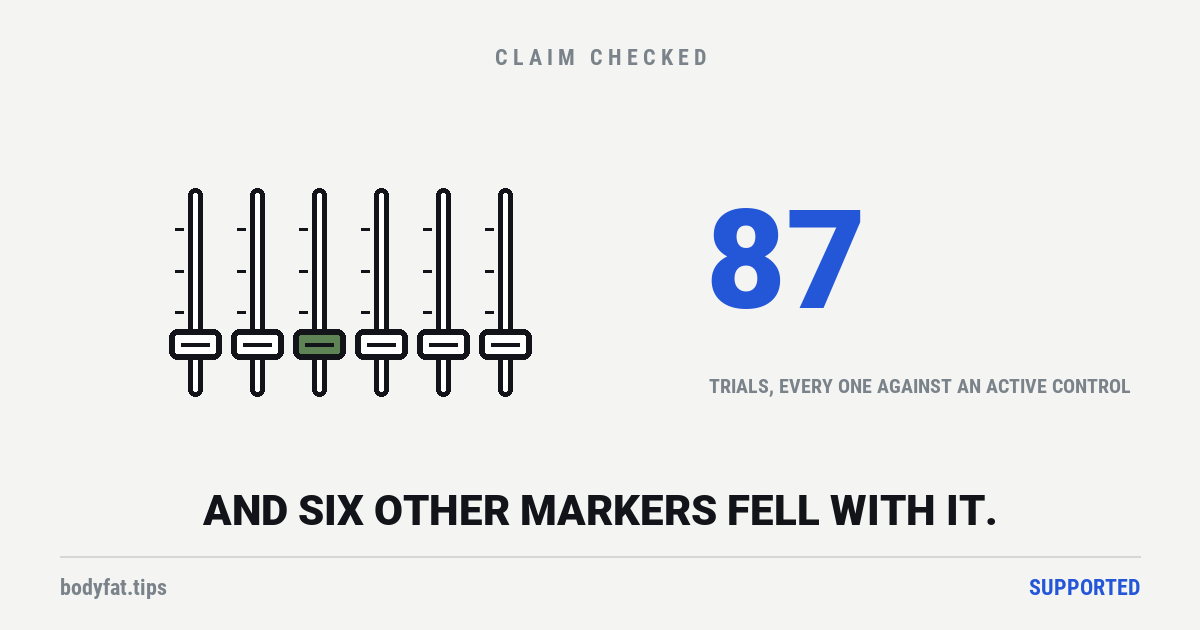
You can lower it. Eighty-seven randomised trials say so, and they used the hard version of the test — every one compared against another activity rather than against doing nothing. [1][2]
Whether that is why you feel better is a different question, and the same trials give you good reason to doubt it.
Because cortisol was not the only thing that moved. And a “cortisol detox” — the thing seventy-four thousand people a month go looking for — is not a procedure that exists.
The evidence is stronger than the topic deserves
Two meta-analyses, published in 2017, pooled 87 randomised controlled trials between them — 45 of meditation, 42 of yoga. [1][2]
And they did the hard version of the test. Every trial included was compared against an active control: another activity, not a waiting list. That matters enormously. Compare meditation to doing nothing and you measure the effect of having something to do. Compare it to a different structured activity and you measure the meditation.
The researchers were explicit about why, noting that studies in this field “commonly fail to include an active control group.” [1]
Both found cortisol went down.
| Meditation · 45 trials | Yoga · 42 trials | |
| Cortisol | down | down |
| Blood pressure | down | down |
| Resting heart rate | down | down |
| Inflammation markers | down | — |
| Cholesterol · blood sugar | triglycerides | both |
Look at the other rows
This is the part that changes what the answer means.
Cortisol was not the only thing that moved. In the meditation trials, blood pressure fell, heart rate fell, C-reactive protein fell, triglycerides fell, and so did an inflammatory signalling protein called TNF-alpha. [1] In the yoga trials: evening and waking cortisol, blood pressure, resting heart rate, fasting blood sugar, cholesterol and LDL. [2]
Everything moved together, in the direction you would expect from calming somebody down.
Which means nothing here shows cortisol is the lever. It is one dial on a dashboard where all the dials moved at once. You cannot tell from this whether lowering cortisol did anything, or whether cortisol simply fell along with everything else because the person was less stressed.
So how much is the prize worth?
If you are chasing cortisol specifically, it is worth knowing how loosely it connects to the things people actually want changed.
Across 146 cohorts and 34,342 people, the correlation between long-term cortisol measured in hair and body mass index was 0.10. [3] Squared, that is about one percent of the variation. We took that apart in our verdict on cortisol face and cortisol belly.
And the daily cortisol curve — the thing “rhythm resets” are sold against — relates to health outcomes across 80 studies at an average effect size of 0.147, which its own authors call small and say may be a marker rather than a cause. [4] That one is covered in our cortisol rhythm verdict.
So: an intervention that reliably moves a number that is weakly attached to the outcome. The intervention still looks good. The number is just a bad way to judge it.
A detail that got flattened everywhere else
Worth pulling out, because almost every summary of this research loses it.
The meditation analysis split practices into subtypes, and they did not all do the same thing. Focused-attention meditation reduced cortisol. Open-monitoring meditation reduced heart rate instead. All of them reduced blood pressure. [1]
Only when every form was pooled together did the overall analysis show cortisol falling. [1] “Meditation lowers cortisol” is therefore true of the average, and not equally true of whichever practice you happen to have downloaded.
What we are not going to tell you
A dose. The yoga authors state plainly that “the reported interventions were heterogeneous” [2] — different practices, lengths and frequencies. Neither paper gives a schedule, so neither do we.
An effect size. Neither abstract reports a pooled magnitude for cortisol. We could estimate one. We are not going to, because an estimate printed next to real numbers becomes a real number by morning.
A supplement. Ashwagandha is the one most often sold for this and it has its own verdict, including what it did and did not move.
The verdict
Meditation and yoga measurably lower cortisol. That is Supported — 87 randomised trials, all against active controls, which is a better standard of evidence than most wellness claims ever face.
Whether lowering cortisol is why they help is unknown, and the same trials give you good reason to doubt it, because six other measures moved at the same time.
Here is the practical version. If you took up meditation or yoga and felt better, that is a real effect with real evidence behind it. If you took it up to move a hormone, you picked the least informative reason available — and if you are buying something to move that hormone, you are paying for the dial rather than the driving.
Related: cortisol face and cortisol belly · cortisol rhythm and fat loss · ashwagandha benefits · box breathing · all the habits we have checked