Does Coffee Cause Inflammation? Trials Found No Significant Rise in CRP

Coffee gets sold both ways. Anti-inflammatory diets put it on the list of things to cut, next to sugar and alcohol; coffee sellers put “anti-inflammatory” on the bag. Plenty of people want to know which: “does coffee cause inflammation” is searched about 6,600 times a month in the United States (from a paid keyword database, pulled 20 October 2026), by the database’s figure for the year to August 2026, and about 5,400 times in each of the last three months of that year [1].
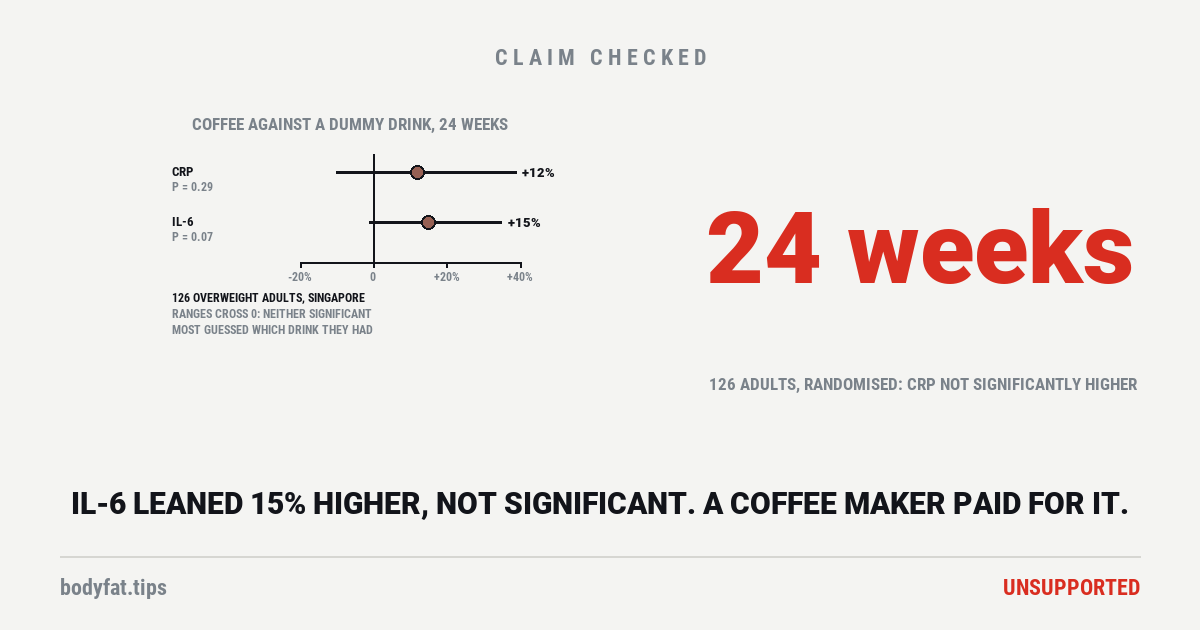
In trials that gave people coffee or none for four to 24 weeks, at up to eight cups a day, CRP, the blood marker of inflammation most studies measure, was not significantly higher on coffee in their main comparisons; in one it was lower [2] [3] [4] [5] [6] [7]. One small trial found a second marker, IL-6, 60% higher [3]. And coffee drinkers in population studies tend to have slightly lower CRP, not higher [8]. Where coffee does seem to cause trouble, it is local and it is timed: it can bring on reflux in people prone to it [9] [10], and in one study reported at a medical meeting, a sudden extra few caffeinated drinks went with gout attacks [11].
This is journalism, not medical advice. If you have a stomach ulcer, reflux that wakes you at night, an inflammatory disease such as rheumatoid arthritis or inflammatory bowel disease, or a heart-rhythm problem, ask your clinician about coffee rather than going by a general finding like this one. Vomiting blood, black stools or severe stomach pain need care at once, not a change of drink.
A few words before the numbers. Inflammation is the body’s response to injury or infection; the worry with coffee is the slow, low-grade kind, which a blood test can only hint at. CRP, C-reactive protein, is a protein the liver makes more of when inflammation is under way, and it is the marker most of these studies measure. IL-6 (interleukin-6), IL-18 and TNF-alpha are cytokines, signalling molecules that immune cells release to drive inflammation. None of them, on its own, is a diagnosis.
What happened to inflammation markers when people drank coffee in trials?
The cleanest tests are randomised trials: people are assigned by chance to coffee or to none, so the groups differ in the coffee and, as far as chance allows, in nothing else. Some are crossover trials, in which the same people take each turn, so each is compared with themselves.
| Study | What people drank | What the markers did |
|---|---|---|
| 47 coffee drinkers at raised risk of diabetes, a month at each step, in a fixed order, not randomised [2] | None, then 4 cups a day, then 8 (cups of 150 mL, 5 fl oz) | At 8 cups against none: CRP and IL-6 not significantly different; IL-18 8% lower |
| 45 overweight adults, US, randomised, 8 weeks [3] | Five 6-oz cups a day of instant coffee (16 people), the same in decaf (14) or water (15) | CRP not significantly different; IL-6 60% higher on caffeinated coffee than on water |
| 126 overweight adults, Singapore, randomised, 24 weeks [5] | Four sachets a day of instant coffee premixed with non-dairy creamer (62 people), or a coffee-like dummy drink of creamer (64) | CRP, IL-6 and IL-18 not significantly different; CRP averaged 12% and IL-6 15% higher on coffee |
| 49 overweight men with raised blood sugar, Japan, randomised, 16 weeks [4] | Five cups a day of instant coffee, the same in decaf, or none (17, 16 and 16 people) | Change in CRP not significantly different between the groups |
| 160 healthy adults, Norway, randomised, 8 weeks [12] | 3 or 5 cups a day, or water | Inflammatory markers “were unchanged”, in the authors’ summary |
| 52 adults, Spain, randomised crossover, 8 weeks each [6] | 3 cups a day of an instant blend made with 35% unroasted beans, or water or a sports drink | CRP lower after the coffee |
| 40 young women, Jordan, randomised, 4 weeks [7] | Three 40 mL (1.4 fl oz) cups a day of unfiltered Turkish coffee, or none | CRP and TNF-alpha not significantly different |
| 16 men, Greece, randomised order, one morning each [13] | Caffeinated coffee, decaf or water with breakfast | No significant difference over the next three hours |
Start with the three-month study. Forty-seven habitual coffee drinkers, most of them women and most of them obese, gave up coffee for a month, then drank four cups a day for a month, then eight, each cup 150 mL (5 fl oz) of filtered coffee. At eight cups against none, CRP and IL-6 were not significantly different, and IL-18 was 8% lower [2]. In one subgroup, the 24 people with the lower insulin-resistance scores, the authors report CRP higher after the month of four cups a day than after the month of none, though not after eight; they did not show those figures, and found no evidence that coffee’s effect differed between the subgroups [2]. The order was fixed and nobody was randomised, a weakness the authors name themselves [2].
The trial that found something was American. Forty-five overweight adults were assigned to five 6-oz (177 mL) cups a day of instant coffee, the same in decaf, or water, for eight weeks: 16, 14 and 15 people. CRP did not differ significantly between the groups. IL-6 was 60% higher on caffeinated coffee than on water, with a confidence interval, the range the true average probably sits in, from 8% to 138% higher [3]. On decaf it was 37% higher, with a range from 8% lower to 103% higher, which includes no difference at all [3]. The authors add two cautions of their own: IL-6 varied a great deal from person to person, and the caffeinated group happened to start with the lowest IL-6 of the three [3].
The two longest trials were set up to study blood sugar and insulin, and measured inflammation markers on the side. In Singapore, 126 overweight adults were assigned by chance to four sachets a day of instant coffee premixed with non-dairy creamer, or to a dummy drink of creamer made to look, taste and smell like coffee, for 24 weeks; most of them guessed which drink they had. Averaged over the 24 weeks, CRP was 12% higher on coffee than on the dummy drink, with a range from 10% lower to 39% higher, and IL-6 15% higher, with a range from 1% lower to 35% higher. Neither difference was statistically significant, and IL-18 did not differ significantly either [5]. The IL-6 result’s p-value, a measure of how easily chance alone could produce a gap that size, is 0.07: just the wrong side of the line researchers use for “probably not chance” [5]. In Japan, 49 overweight men with raised fasting blood sugar were assigned to five cups a day of instant coffee, the same in decaf, or none, for 16 weeks; the change in CRP did not differ significantly between the three groups at 8 weeks or at 16, when 43 of them were still in the trial [4].
A Norwegian trial randomised 160 healthy adults to three or five cups a day or water for eight weeks; in the authors’ summary, the inflammatory markers “were unchanged” [12]. We read only that summary and the paper’s declarations, so we cannot say which markers it measured.
A Spanish crossover gave 52 adults three cups a day of an instant coffee made partly from unroasted beans, or water or a sports drink, for eight weeks each. CRP was significantly lower after the coffee than at the start or after the control drink, in people with normal and with mildly raised cholesterol alike [6]. It is one trial, of a blend that is 35% green coffee, not an ordinary cup.
In Jordan, 40 young women were assigned to three small cups of unfiltered Turkish coffee a day, or none, for four weeks, and CRP and TNF-alpha did not differ significantly [7]. In Greece, 16 men drank caffeinated coffee, decaf or water with breakfast on three mornings, and their inflammation markers over the next three hours showed no significant difference between the drinks [13].
Two Brazilian trials compared coffees with each other rather than with no coffee. In one, 20 healthy volunteers drank three or four cups a day of two roasts for four weeks each, and sVCAM-1, a marker of irritated blood-vessel lining, rose 14% to 18% from where it started, with fibrinogen and E-selectin up after one roast each [14]. In the other, 53 adults drank one of two coffees for eight weeks, and their CRP did not move significantly [15]. Without a group that drank no coffee, neither can say whether the coffee or something else in those weeks moved the numbers.
Caffeine on its own has been tested for longer. In Iran, 101 adults with type 2 diabetes and fatty liver took 200 mg of caffeine, a chlorogenic acid capsule, both, or a dummy pill every day for six months; CRP and TNF-alpha did not differ significantly from the dummy [16]. Over shorter tests, a 2019 review counted IL-6 raised by caffeine in three of the five caffeine studies that measured it, and by caffeinated coffee in one of the four coffee trials that did [17].
At least three reviews have gathered the coffee trials, in 2019, 2021 and 2023, and none of the three pooled them into one number [17] [18] [19]. None of them lists every trial on this page either: the 2019 and 2021 reviews came out before the newest trial here, and the 2023 review’s table of inflammation trials holds five, without the American, Japanese or Singapore trials [19]. In the 2019 review, none of the five coffee studies that measured CRP found it changed [17]. The 2021 review’s verdict: “we cannot confidently conclude that an anti-inflammatory effect of coffee is a major contributing factor” to the longer lives of coffee drinkers [18].
So, in the trials on this page known to have measured CRP against no coffee, six of them, it was not significantly higher in any of their main comparisons, and lower in one [2] [3] [4] [5] [6] [7]; the exception is the three-month study’s unshown subgroup at four cups [2]. IL-6 was significantly higher in one trial of 45 people; in the 24-week trial it averaged 15% higher, a difference that was not statistically significant; in the three-month study it was not significantly different [3] [5] [2]. All of them are small, and the longest ran 24 weeks.
A word on who paid. The three-month study was paid for by an information institute run by European coffee companies, with its coffee from a coffee roaster and one author declaring paid lectures on coffee and health [2]. The 24-week trial was funded by a coffee maker’s research company, which made both drinks and employed three of its 11 authors [5], and the 16-week trial by a national coffee association, with the coffee from a coffee maker’s Japanese arm [4]. The Norwegian trial was funded by a coffee maker’s research arm and the University of Oslo, and two of its authors worked for that company at the time [12]. A coffee maker supplied the Spanish blend free [6], and the coffee in the American trial, which US public grants paid for [3]. The industry-backed studies are among those that found no significant rise; the one that found IL-6 significantly higher used a coffee maker’s coffee too. And one trial set up to measure exactly this has not reported: a University of Chile trial, with a coffee maker as collaborator, gave 116 older adults no coffee or one of two coffees for 30 days, with inflammatory status among its main outcomes. It finished in February 2010, has posted no results, and we found no paper from it [20] [21]. Money does not make a result wrong, but you should know it when you weigh them.
Do coffee drinkers have more inflammation or less?
Trials are small. The big numbers come from population studies, which compare people who drink coffee with people who don’t, at a single blood test. They show an association, which cannot by itself prove that one thing causes another: coffee drinkers differ from non-drinkers in a great many ways, smoking among them.
The study the worry rests on came from Greece in 2004. Among 3,042 adults around Athens, men who drank more than 200 mL (about 7 fl oz) of coffee a day had 30% higher CRP, 50% higher IL-6 and 28% higher TNF-alpha than men who drank none; in women the figures were 38%, 54% and 28% [22]. The authors were clear about the limit: the study was a snapshot, so “assumptions for causal relations cannot be drawn” [22].
Most of the studies since point the other way. A 2024 pooling of 11 such studies, 66,691 people, found CRP lower in the heaviest drinkers, a median of four and a half cups a day, than in non-drinkers: a standardised difference of 0.14, the gap expressed in units of how much people varied, where 0.2 is what researchers call small [8]. None of its 11 studies found the heaviest drinkers significantly higher [8]. Before printing a pooled figure we look for the biggest study inside it. By the weight the pooling gives each study, it is the US nurses’ cohort, 12.2% of the weight, whose own row shows the same 0.14 gap [8]. Two other studies carry 11.9% each, so no one study dominates the result. The row furthest from no difference, 0.44 lower, is a European cohort; the other ten sit between 0.33 lower and 0.07 higher, and weighted as the chart weights them they average about 0.10 lower, by our arithmetic [8]. Across the nurses and a second cohort, of 7,397 male health professionals, CRP was measured in 14,439 people and IL-6 in 9,098: those drinking four or more cups a day had 16.6% lower CRP and 8.1% lower IL-6 than non-drinkers, and decaf showed the same pattern [23].
Not every pooling agrees on how much. A 2020 review of 11 studies, 61,047 people, measured coffee by the volume drunk, pooled the 10 whose CRP figures could be compared, and found no statistically significant link overall: CRP 2.4% lower for each 100 mL (3.4 fl oz), with a range from 8.7% lower to 4.4% higher [24]. Its three largest studies split: CRP lower with more coffee in American and European women and Japanese men, higher in European men [24]. It left the Greek survey out, because its numbers could not be compared [24].
A genetic study, Mendelian randomisation, which compares people by inherited variants that change how much coffee they drink and so is less exposed to the habits that travel with coffee, looked at 41 inflammatory signalling molecules. Coffee was tied to three of them, two lower and one higher, at levels the authors call “potentially associated” [25].
Does coffee cause inflammation in the joints?
Gout is the joint inflammation most people have in mind. It happens when uric acid, a waste product in the blood, forms crystals in a joint, and an attack is inflammation you can see and feel. Here the large studies point away from the worry. Over 12 years, 45,869 American men who drank four to five cups of coffee a day got gout 40% less often than men who drank none, and those drinking six or more 59% less often [26]. In 89,433 women over 26 years, four or more 8-oz cups a day went with 57% less gout [27], and in 447,658 adults in UK Biobank more than six cups a day went with 40% less, and both caffeinated and decaf drinking went with lower risk [28].
A 2025 pooling of 13 studies, 936,827 people, put coffee drinkers’ odds of high uric acid or gout about a quarter lower [29]. Its biggest study is the UK Biobank one, and a second, smaller row in its table comes from the same biobank, so many of the same people may be counted twice [29]. Genetic studies agree less: a Japanese one found coffee lowered gout risk, and found no significant effect in European data once the disagreement between the genetic variants was allowed for [30].
Then there is the jump. In an experiment in 51 healthy men, three weeks of caffeinated coffee nudged uric acid up in those who started in the normal range, from 5.9 to 6.2 mg/dL, while decaf nudged it down [31]. And in 2010 a rheumatology society reported a study of 633 people who had had a gout attack in the past year, recruited online, each compared with themselves at different times, a case-crossover design: “three or four more servings of caffeinated beverages in the prior 24 hours” went with a 40% to 80% higher risk of an attack, while drinks without caffeine, decaf coffee among them, were not linked to attacks [11]. We found that study only as the society’s news release about a meeting presentation; a PubMed search for a journal version found none [21], and a 2021 review co-written by its lead investigator says there are “no published studies to date on caffeine intake in patients with gout to assess effects on flares and tophi”, tophi being the chalky deposits long-standing gout can leave [32]. So steady coffee drinkers get gout less often, and a sudden extra few cups may set off an attack in people who already have it. The second half rests on one unpublished study.
Rheumatoid arthritis is different: an autoimmune disease, in which the immune system attacks the joints. A 2022 pooling of five cohorts, 266,985 people, found the heaviest coffee drinkers about 30% more likely to develop it, and the heaviest decaf drinkers 89% more likely; caffeinated coffee on its own was not significantly linked [33]. The decaf figure leans on one Iowa study of 31,336 older women [34]: without it, the pooled result was no longer significant [33]. The biggest cohort in the pooling, 83,124 American nurses, found no significant link for either kind [35]. A pooling of genetic studies did tie genetically predicted coffee drinking to rheumatoid arthritis, and very slightly to osteoarthritis, the wear-and-tear kind [36].
All of these studies are about who develops a joint disease. None of the joint studies on this page tested whether coffee makes existing arthritis or joint pain worse.
Does coffee cause inflammation in the stomach?
Two different things get called stomach inflammation. Reflux is stomach acid coming up into the gullet and causing heartburn; gastritis is inflammation of the stomach lining itself.
On reflux, there is something. Following 48,308 American nurses, women who drank more than six cups of coffee a day were 34% more likely to develop weekly reflux symptoms than women who drank none; tea and soda showed the same pattern, and the authors report “similar results when we stratified patients according to caffeine status” [9]. A 2026 pooling of 40 studies, most of them one-time surveys, found reflux in 34.9% of coffee drinkers against 30.7% of non-drinkers, a difference its authors call “of unclear clinical significance” [37].
Small laboratory tests show how it varies from person to person. In 17 people with reflux disease, a cup of regular coffee with breakfast left the gullet acidic for a median 17.9% of the next three hours, against 3.1% after decaf [10]. In seven patients and eight healthy volunteers, filtered coffee after meals did not significantly increase reflux in either group, though on an empty stomach it did increase it in the patients [38].
On the stomach lining itself, the evidence leans the other way. In 8,013 Japanese adults examined by endoscopy, coffee drinking was not significantly linked to stomach or duodenal ulcers, or to inflammation of the gullet from reflux [39]. In 147,263 adults in UK Biobank, people who drank unsweetened coffee were less likely to be diagnosed with a digestive disease, least likely at two to four cups a day, and the authors report lower risk for gastritis and for diagnosed reflux disease among them [40], which cuts against the nurses’ result on reflux symptoms. Pointing the other way, a European study of 267 people with indigestion and H. pylori, the stomach bacterium behind most gastritis, found coffee drinking linked to the atrophic kind, which thins the lining, with odds 2.35 times higher [41].
Does decaf coffee cause inflammation?
On the blood markers, decaf looks like regular coffee. In the American trial, IL-6 on decaf was 37% higher than on water, a result whose range included no difference, and CRP did not differ significantly [3]; in the nurses and health professionals, decaf drinkers had lower CRP and IL-6, like coffee drinkers generally [23]. Decaf brought on less reflux than regular coffee in the 17-patient test [10], and decaf drinkers got gout less often in the large cohorts [26] [27] [28]. The one place decaf looks worse is rheumatoid arthritis, and that leans on a single study [34] [33].
Does coffee with milk or sugar cause inflammation?
Google’s answer says sugar does: “Loading coffee with refined white sugar, flavored syrups, and ultra-processed creamers triggers inflammatory cytokine production, completely offsetting coffee’s natural benefits” [1]. The evidence on coffee itself is thinner than that sentence. In 9,337 Korean adults, two to three cups a day of black coffee went with 39% lower odds of a high CRP, while the same amount with sugar or cream went with 8% lower odds, a result that could be chance [42]. An Italian survey of 1,855 adults found a similar gap between people who drank their coffee unsweetened and people who sweetened it [43]. Both are snapshots, and people who take their coffee black may differ in other ways.
A trial that changed what went into the cup did not find the difference either. In India, 210 adults with type 2 diabetes either swapped the sugar in their coffee or tea for a sucralose sweetener or kept the sugar, for 12 weeks; the authors report “no change” in the inflammatory markers, CRP and TNF-alpha, “between or within groups” [44]. The sweetener’s maker paid for the trial and supplied the sweetener [44].
Milk has the opposite reputation. In January 2023 a health-news site reported that “Coffee With Milk May Fight Inflammation”. The study behind it gave mouse immune cells in a dish coffee acids bound to an amino acid; nobody drank anything [45]. No trial we found set black coffee against the same coffee with milk or sugar and measured inflammation in people [21]. A Canadian university’s trial of black coffee against coffee with ghee and MCT oil, due to finish at the end of 2020, has posted no results [21].
Does coffee cause inflammation with endometriosis?
Endometriosis is a condition in which tissue like the lining of the womb grows outside it, with inflammation and pain. A 2021 pooling of ten studies found no significant link between caffeine and endometriosis overall: a risk 12% higher, with a range from 3% lower to 28% higher. Above 300 mg of caffeine a day, about three 8-oz cups of coffee, the risk was 30% higher [46]. A study that recorded 473 women’s habits before their surgery found no significant link [47], and a genetic study found none for coffee [48]. These studies asked who gets diagnosed. None of them tested whether cutting coffee eases endometriosis pain.
Is there an anti-inflammatory coffee?
Sellers say so. Two coffee sellers cited by Google’s answer sell low-acid coffee, one of them “mold-free” too. One says standard coffee “irritates the esophageal lining, stomach lining, and intestinal wall”, and that a genuinely low-acid coffee “delivers the anti-inflammatory benefits of coffee without the gastric inflammation risk” [1]. The other tells readers that a 2020 pooling of 11 studies and 61,047 people “found that higher coffee consumption was associated with lower levels of C-reactive protein” [1]. That pooling’s own summary says “no statistically significant associations were observed among all participants” [24].
Has anyone tested a gentler coffee? In 30 people whose stomachs react to coffee, a coffee roasted by a different process brought on heartburn, regurgitation and indigestion with no significant difference in how often or how badly [49]. The one blend on this page that lowered CRP in a trial was an instant coffee made with 35% unroasted beans, supplied by a coffee maker [6].
What drinks make inflammation worse?
Going by CRP, the blood marker the trials measured most, coffee is not one of them on this page’s evidence. IL-6, a second marker, was higher on coffee in two of the trials here, significantly in one, and we rate that Preliminary below. We rate only coffee here. Other foods sold as inflammatory have their own verdicts, seed oils among them, and so do things sold to calm inflammation, such as turmeric.
Who these studies were done on
The coffee trials were small groups of mostly healthy adults: overweight Americans [3], overweight adults in Singapore, most of them men [5], overweight Japanese men with raised blood sugar [4], obese adults at raised risk of diabetes, most of them women [2], Norwegians [12], Spaniards [6], young Jordanian women [7] and Greek men [13]. The population studies were of Americans, Europeans, Koreans and Japanese [8]. None of the coffee trials on this page enrolled people with rheumatoid arthritis, inflammatory bowel disease or another inflammatory disease.
So read yourself against them. If you are healthy and drink a few cups a day, the trials were about people like you, and their CRP was not significantly higher on coffee. If you have gout, the large studies were about getting it, not about attacks; the one study of attacks points at sudden jumps in caffeine. If you have reflux, coffee may bring it on, and decaf less so. If you have an inflammatory disease, the evidence here was not collected on people like you, and that is a conversation for your clinician.
If CRP doesn’t show it, why do so many people feel that coffee inflames them?
This section is the desk’s own reasoning, and it is labelled as such. The trials find CRP not significantly higher on coffee; plenty of people are sure coffee flares something in them. Here are three ways those fit together, each rated.
Answer one: the stomach, not the bloodstream. Coffee can bring on reflux in people prone to it: in the nurses, more than six cups a day went with a 34% higher risk of weekly symptoms [9], and in people with reflux disease regular coffee left more acid in the gullet than decaf [10]. Heartburn feels like inflammation, and none of it would show in a CRP test. The reflux is measured; that it is what people mean when they say coffee inflames them is our surmise.
Answer two: the jump, not the habit. Steady coffee drinkers get gout less often [26] [27] [28]; in the one study of attacks on this page, a sudden extra few caffeinated drinks went with more of them [11]; and three weeks of caffeinated coffee nudged uric acid up in men who started in the normal range [31]. A person who has more coffee than usual and then has a flare is not imagining the link. That is one unpublished study and one small experiment; the step from them to the folk belief is a surmise.
Answer three: the diet around it. Elimination diets cut coffee in the same weeks as other foods [50]. If people feel better, coffee gets its share of the credit whether it earned it or not. That is a hunch, not a measurement.
Put the three together and here is what we think is true, stated plainly so you can disagree with it: coffee does not light up CRP, the blood test for inflammation the trials used most, and on IL-6 the trials are unsettled; what it can set off is local and timed, reflux in people prone to it and possibly a gout attack after a sudden extra few cups.
What we could not find, and would like to: a randomised trial lasting a year or more, of coffee against none in a few hundred people, measuring CRP and IL-6; and a trial of black coffee against the same coffee with milk or sugar. The coffee trials we found that measured these markers lasted from one morning to 24 weeks [5] [21]. If you know of the longer one, the corrections line on this site is open.
Where “coffee causes inflammation” came from
The research the worry rests on is the 2004 Greek survey: coffee drinkers with higher CRP and IL-6, in a snapshot whose authors said it could not show cause [22]. Two of the later trials discuss it beside their own results [2] [3].
The diet advice came separately. An autoimmune-protocol diet blog, a style of elimination diet, explained in February 2017 that coffee is cut in the first phase because it is a seed, and added that caffeine “acts as an immune stimulant, having the potential to cause autoimmune flares in some folks” [50]. Sixteen days earlier Stanford Medicine’s news office had headlined the opposite, “Caffeine may counter age-related inflammation”, about a study of blood samples from more than 100 people [51]. We could not trace who first told people to cut coffee to calm inflammation [21].
Today the two versions sit side by side. Ask Google and its AI answer says plain black coffee “does not cause systemic inflammation” for most people, then that “coffee can increase inflammation or cause irritation in certain situations”, citing two health-information sites, a San Diego medical group and two coffee sellers [1]. One of the health sites says coffee “may increase inflammation for some people” [1]; the sellers sell the fix.
None of this is aimed at anyone who has cut coffee to see whether they feel better. That is a fair experiment to run on yourself. It is the label we could not let stand: a seller quoting a pooling for a result it did not report, and another selling a coffee “without the gastric inflammation risk”, when the one test of a differently roasted coffee on this page found no significant difference in heartburn [49].
What this is rated, and what the rating covers
Unsupported — for the claim that coffee causes inflammation, as it circulates. Of the tested kind: it was tested, and did not hold up.
In trials of coffee against none, at up to eight cups a day for up to 24 weeks, CRP was not significantly higher in the main comparisons of any that we know measured it, and one found it lower [2] [3] [4] [5] [6] [7]; population studies mostly find coffee drinkers’ CRP lower [8] [23]. In the claim’s favour: one trial of 45 people found IL-6 60% higher on caffeinated coffee [3]; in the 24-week trial CRP and IL-6 averaged 12% and 15% higher on coffee, neither difference statistically significant [5]; the three-month study reports CRP higher at four cups in one subgroup, in figures it did not show [2]; a four-week trial of two roasts, with no group that drank no coffee, found markers of irritated blood-vessel lining up from where they started [14]; and the 2004 Greek survey found coffee drinkers’ markers higher [22]. That does not turn the rest around. The trials are small and short, which is why we say what they tested and no more.
Each part, rated alone, in words. That coffee lowers inflammation: Preliminary; population studies point that way [8] [23], one eight-week trial of a green and roasted blend found CRP lower [6] and the three-month study found IL-18 lower [2], but the other trials found CRP not significantly different, and one found IL-6 higher [3] [4] [5] [7]. That coffee raises IL-6: Preliminary; it was 60% higher on caffeinated coffee in one trial of 45 people, 15% higher in the 24-week trial, a difference that was not statistically significant, and not significantly different in the three-month study [3] [5] [2]; in population studies it was lower in US health professionals drinking four or more cups a day and higher in the Greek survey’s heavier coffee drinkers [23] [22]. It is one marker; on CRP, the one most of the trials measured, the claim did not hold up.
That coffee causes gout: Unsupported, of the tested kind: three large cohorts and a pooling of 13 studies found coffee drinkers got gout less often, not more [26] [27] [28] [29]. That a sudden jump in caffeine can set off a gout attack: Preliminary, on one study reported at a meeting [11]. That coffee raises the risk of rheumatoid arthritis: Preliminary; a pooling of five cohorts and a pooling of genetic studies point that way, the biggest cohort found no significant link, and the decaf result leans on one study [33] [35] [36].
That coffee brings on reflux: Preliminary; a large study that followed people over time and a pooling of mostly snapshot surveys find a modest link, a larger UK cohort found less diagnosed reflux disease in drinkers of unsweetened coffee, and small laboratory tests are mixed [9] [37] [40] [10] [38]. That coffee inflames the stomach lining: Preliminary, with the evidence leaning against it: endoscopy found no significant link to ulcers, and a large cohort found less gastritis in coffee drinkers, against one small study of atrophic gastritis [39] [40] [41].
That caffeine causes endometriosis: Preliminary, at most for intakes above about three cups a day [46] [47] [48]. That sugar or creamer turns coffee inflammatory: Preliminary; two surveys found the link between coffee and lower CRP weaker in people who sweeten it, and a trial that swapped sugar for a sweetener in coffee or tea found the markers did not differ [42] [43] [44].
What is not rated here: whether coffee makes existing arthritis worse; inflammation of the face, one of the searches that brings people here, on which we read nothing; coffee and blood sugar, weight and dehydration, which have their own verdicts; and the frame above, which is this desk’s reasoning from the evidence rather than a result the evidence delivered. It is marked as ours so that you can weigh it as ours. How we read a study, and what each tier means, is set out here.