Does Green Tea Help You Lose Weight? About 1.4 lb in Short Extract Trials, Less in the Best-Run Ones

Ask Google whether green tea can help you lose weight and its AI answer goes straight to the mechanism. Green tea’s caffeine and its catechins, the bitter plant compounds it is richest in, “can slightly increase your resting metabolic rate and help your body burn more calories (about 3% to 4% more daily)”, it says, and the trials show “about 1 to 2.5 pounds over 12 weeks” [1]. Plenty of people ask: “can green tea help you lose weight” is typed into Google about 9,900 times a month in the US, the database’s figure for the past year, and each of the latest three months read 8,100 (from a paid keyword database, pulled 23 October 2026) [1].
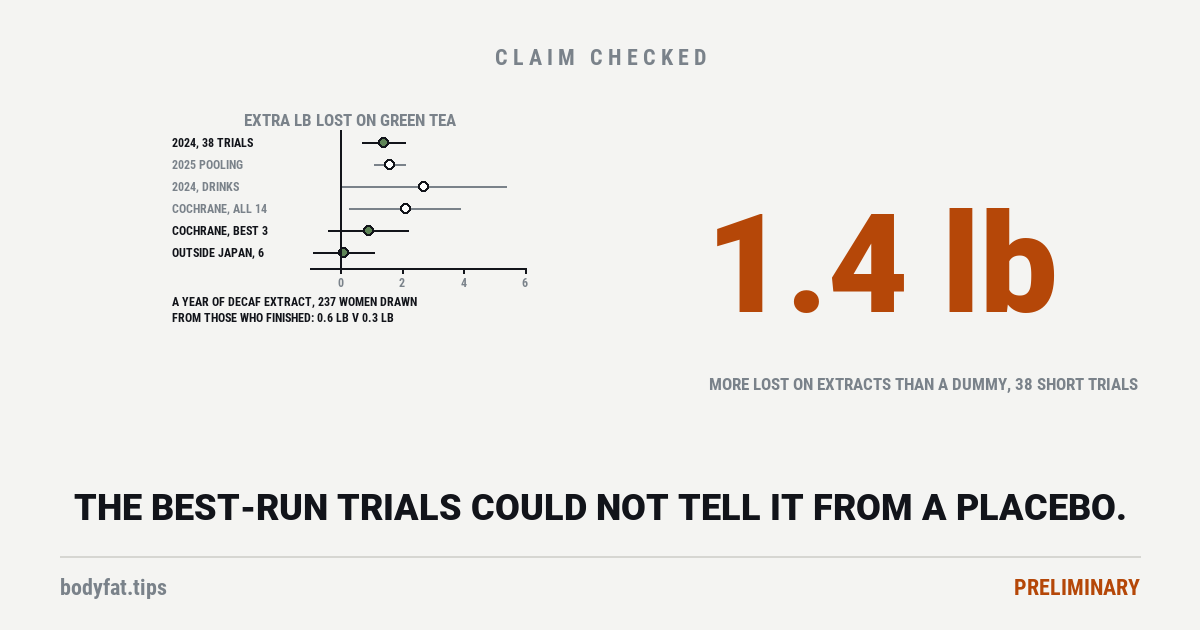
Google’s number is about right. What it leaves out is where the number comes from. Across 38 short trials of green tea extracts and catechin-rich drinks, people lost about 1.4 lb (0.64 kg) more than people on a dummy [2]. The trials best guarded against bias could not tell green tea from a placebo [3]. In 237 overweight women drawn from those who finished a year of a strong decaffeinated extract or a dummy, the extract came to 0.6 lb lost, against 0.3 lb on the dummy [4]. And the extra calorie burn is real, small, and about what plain caffeine produced in the same kind of test [5].
One thing first, because it matters more than a pound and a half. Concentrated green tea extracts have been linked to liver injury. If you take one and develop “yellowing of the skin/eyes (jaundice), stomach pain, dark urine, sweating, nausea, unusual tiredness and/or loss of appetite”, in the label wording Canada’s health regulator sets for these products, stop and see a clinician promptly [6]. The European Union bans foods and supplements from carrying 800 mg or more of EGCG, green tea’s main catechin, from green tea extracts in a daily portion, and requires labels saying such products “should not be consumed by pregnant or lactating women and children below 18 years old”, nor “on an empty stomach”, nor on a day you have other green tea products [7]. If you take heart, blood-pressure or cholesterol medicines, or any other medicine, ask before taking an extract: the US government’s integrative-health centre says green tea at high doses lowered blood levels of nadolol, a beta-blocker for high blood pressure and heart problems, and that green tea extract can lower blood levels of atorvastatin, a cholesterol drug, and it advises anyone who takes any medicine to talk to their provider first [8]. Brewed tea in ordinary amounts is a different matter, and there is more on all of this below.
Can green tea help you lose weight?
A little, on average, in short trials. A 2024 pooling, or meta-analysis, which combines trials into one estimate, gathered 59 randomised trials of green tea extract, catechin-enriched drinks and pure EGCG, 3,802 people in all [2]. Thirty-eight of them weighed people. On green tea, people lost 1.4 lb (0.64 kg) more than on a placebo, a dummy pill or drink. The confidence interval, the range the true average probably sits in, ran from 0.7 to 2.1 lb (0.30 to 0.97 kg) [2]. By our count from its chart, 26 of the 38 trials ran 8 to 12 weeks, and the authors graded the weight result as moderate certainty [2].
| Pooling | What went in | Extra weight lost on green tea |
|---|---|---|
| 2024 [2] | 38 trials of extracts, catechin drinks and pure EGCG that measured weight | 1.4 lb (0.64 kg); range 0.7 to 2.1 lb |
| 2025 [9] | Trials of green tea supplementation, searched to February 2024; read as its summary | 1.6 lb (0.74 kg); range 1.1 to 2.1 lb |
| 2024 [10] | 22 trials of tea and coffee drinking; green tea against a placebo drink | 2.7 lb (1.23 kg); range 0.04 to 5.4 lb; low certainty |
| 2012, all 14 weight-loss trials [3] | Extracts and catechin drinks, 12 to 13 weeks | 2.1 lb (0.95 kg); range 0.3 to 3.9 lb |
| 2012, the three best guarded against bias [3] | The same review’s sensitivity analysis | 0.9 lb (0.41 kg); range from 2.2 lb lost to 0.4 lb gained |
| 2012, the six outside Japan [3] | The same review’s trials outside Japan | 0.09 lb (0.04 kg); range from 1.1 lb lost to 0.9 lb gained |
That sits inside Google’s range. So does the newest full pooling of green tea trials we found, published in 2025 with a search that ended in February 2024: 1.6 lb (0.74 kg) [9]. We could read only its summary and declarations, so its list of trials is not checked here [9].
Before leaning on a pooled figure, we look for the biggest trial inside it, and for the trials that carry the most weight. In the 2024 pooling the biggest is 240 Japanese adults given a tea drink with extra catechins for 12 weeks [2], and all three of its authors worked in a Japanese consumer-products company’s health-food research laboratories, though the trial was run at seven medical institutions and the paper says it had no funding or outside support [11]. It is the trial at the centre of our visceral fat page. The heaviest row is something else. Four of the 38 trials carry half the pooled weight, and one of them a fifth on its own: 43 Japanese adults with type 2 diabetes on a catechin drink for 12 weeks, with a range on the chart narrower than trials five times its size [2]. That trial was paid for by the same company, and six of its eight authors work in its laboratories [12]. We could not read its weight table to check the row: in the copy we reached it is an image [12].
What do the trials best guarded against bias show?
The Cochrane review, from the network of reviewers that grades each trial’s design, looked at 18 trials of 12 to 13 weeks in adults carrying extra weight [3]. Pooling the 14 weight-loss trials gave 2.1 lb (0.95 kg). But their results spread far more than chance would explain: 95% of the spread between them was more than chance would produce [3].
So the reviewers looked harder. Three trials had been judged at low risk of bias on at least one of the three points that matter most, meaning their design guarded well against results being nudged, for instance by people knowing who got the real thing. Pooled alone, they gave 0.9 lb (0.41 kg), and the range ran from 2.2 lb lost to 0.4 lb gained, so “no difference at all” stayed on the table [3]. Split by country, the six trials outside Japan averaged 0.09 lb (0.04 kg); the eight in Japan found losses of 0.4 to 7.7 lb (0.2 to 3.5 kg), too different from each other to pool [3]. Having analysed the trials in and outside Japan separately, because the Japanese ones differed so much in size, the review’s verdict is that green tea preparations “appear to induce a small, statistically non-significant weight loss”, “not likely to be clinically important” [3].
Who ran them? By the review’s own notes on each trial, 12 of the 18 had a company that sells tea, extracts or health products paying for the work, making the drink or employing at least one author: seven linked to one Japanese consumer-products company, two to a multinational food company, one to a Japanese tea company, one to a vitamin and nutrition-ingredients maker and one to a drug company’s consumer-health arm [3]. In a 13th, three authors worked for a company that runs trials for others, with which the volunteers had registered [3]. The split is not simply company against independent: four of the six trials outside Japan, where the loss vanished, were paid for or co-written by companies too, and so were two of the three best guarded against bias, one of them through the trial-running company [3]. Our visceral fat page follows the same split for belly fat.
Two more poolings add to the picture. A 2009 one found an average difference of 2.9 lb (1.31 kg), in weight lost or kept off, about half as large in white participants as in Asian ones, 1.8 lb against 3.3 lb (0.82 and 1.51 kg), though that gap was not significant [13]. And a 2020 Australian pooling of herbal medicines for weight loss, with a government research grant behind it, could not separate green tea taken on its own from a placebo [14].
What happened when people took it for six months or a year?
Trials that ran for six months or a year tell a plainer story, at least in adults. The long trials we found that weighed adults were all run for cancer research: three American ones, paid for wholly or partly by the US National Cancer Institute, a British one and a Korean one [15]. Three more were in children and young adults; they come after the adults.
In the Minnesota Green Tea Trial, 1,075 women past menopause were randomised, 538 to a decaffeinated extract carrying 843 mg of EGCG a day and 537 to a placebo, for a year [16]. That dose is roughly four to five cups of brewed tea a day, by the authors’ two estimates [16] [17]. Its weight analysis took 237 overweight or obese women from the 937 who finished the year: 162 picked at random and 75 more from a body-scan substudy. Among them, the women on the extract lost 0.6 lb (0.28 kg) in the year and the women on the dummy 0.3 lb (0.14 kg), a gap well within chance (p = 0.13, the chance of a gap at least this big if the extract had no real effect) [4]. The authors say the results for all 937 who finished were consistent with these, without showing them [4]. In the 121 who had body scans, fat mass fell 0.7 lb (0.30 kg) against 0.3 lb (0.12 kg), again not a significant difference [17]. A supplement maker supplied the capsules; the authors say it played no part in the design or the writing [17].
In 97 men at risk of prostate cancer, 49 given a decaffeinated catechin extract with 400 mg of EGCG a day and 48 given a placebo for a year, the extract did not reduce weight, body-mass index or waist-to-hip ratio significantly [18]. And in 54 overweight women who had finished breast cancer treatment, 29 were given four cups a day of decaffeinated brewed green tea and 25 a herbal tea for six months; among the 39 who finished, 23 and 16, the green tea group’s weight fell 2.6 lb (1.2 kg) and the herbal group’s rose 0.4 lb (0.2 kg), a difference that was not statistically significant in a pilot this size [19]. A Korean trial that gave 88 adults an extract for a year, against 88 given nothing, found no significant difference in body-mass index between the groups, by its summary [20]. And in 133 British men at risk of prostate cancer, given three cups a day of green tea from ordinary tea bags, EGCG capsules or dummy capsules for six months, weight stayed comparable between the groups, by its authors’ account, in a trial built to test whether men would stick to it rather than to detect a difference [21].
Three long trials were in children and young adults, and they do not agree. In 77 young adults with Down syndrome, given EGCG capsules or a placebo for a year alongside memory training, the placebo group gained weight and the EGCG group did not. In the men, the results table in the authors’ manuscript puts the difference at 4.8 lb (2.18 kg), just the wrong side of the line researchers use for “probably not chance” (p = 0.051), and the authors call it a trend; the published summary, like the manuscript’s own, gives 5.2 lb (2.34 kg) and calls it significant (p = 0.015). In the women the difference was not significant [22]. In 40 Japanese children with obesity or near it, given a catechin-rich tea drink or a weaker one for 24 weeks, body fat was not significantly different between the groups; two of its five authors worked in the laboratories of the same consumer-products company as the 240-person trial above [23]. And in Israeli adolescents with obesity, all given diet counselling, three cups a day of ordinary green tea for six months went with a median 2.3% fall in body-mass index, against a 0.8% rise on a caffeine-free herbal drink; the paper’s table marks only coffee, the trial’s third drink, as significantly better than the others, though its discussion also credits green tea, and body fat fell less on green tea than on the herbal drink [24].
Notice what the adult trials share: all three American ones took the caffeine out. That matters for the next question.
Does green tea boost your metabolism?
For about a day, yes, measurably. The study that two of the pages behind Google’s answer point to put ten men, in turn, into a respiration chamber, a sealed room that measures every breath to work out how many calories the body burns [25]. On three separate days they took a green tea extract carrying 150 mg of caffeine and 375 mg of catechins, the same 150 mg of caffeine alone, or a dummy, with their three meals [25]. On the extract, their 24-hour burn was 4% higher than on the dummy: 328 kilojoules, about 78 calories, the kilocalories on a food label [25]. It rose in six of the ten men. The caffeine on its own did not raise it significantly [25].
That was 1999, and the extract’s maker helped pay for it [25]. Twelve years later a pooling of six such chamber studies found that catechin-and-caffeine mixtures raised the 24-hour burn by 4.7%, about 102 calories (428 kJ), and caffeine alone by 4.8%, about 103 calories (429 kJ) [5]. The doses were not matched: the caffeine-only conditions gave 150 to 1,604 mg of caffeine a day, the mixtures 135 to 600 mg [5]. The mixtures did raise the fat burned as fuel, by about 12 g a day (16%), where caffeine alone did not significantly [5].
Does the burn turn into weight without the caffeine? A 2010 pooling found the catechins took off 3.0 lb (1.38 kg) more than caffeine alone when the catechins came with caffeine, but trials of catechins given without caffeine “did not show benefits” on weight or waist [26]. That is what the three long decaffeinated trials above found too [4] [18] [19].
Does green tea burn belly fat?
Barely, and the poolings disagree. In the 2024 pooling, 26 trials measured the waist, and the average difference, 0.17 inches (0.44 cm), was not significant [2]. The 2025 pooling found about 0.4 inches (1.04 cm) off the waist, a significant difference [9], and so did the Cochrane review across its 13 trials with waist data, 0.4 inches (0.99 cm), though 90% of the spread between their results was more than chance would produce [3]. Split by country, that loss sat in the Japanese trials, which ran from a gain of 0.4 inches to a loss of 1.3 inches (1 cm and 3.3 cm); outside Japan it was 0.08 inches (0.2 cm), not significant [3]. And with caffeine in both arms, the 2010 pooling found catechins took 0.76 inches (1.93 cm) more off the waist than caffeine alone [26]. Under half an inch in the three general poolings, then, and in the Cochrane review mostly in trials run in Japan. Whether the catechin drinks shrink the fat packed around the organs is the subject of our visceral fat page, whose verdict on the green tea trials is in its title: the evidence comes mostly from the drinks’ makers.
During exercise, the extract does seem to tip the fuel mix. A 2026 pooling of nine trials found people on green tea extract burned about 0.2 g more fat a minute while exercising [27]. Burning more fat as fuel during a workout is not the same as losing body fat, and when trials ran for weeks, adding green tea to exercise made a difference its own pooling’s authors call “quite minimal”: a standardised difference of 0.30, the gap in units of how much people varied, where 0.2 is what researchers call small and 0.5 moderate [28]. Our page on caffeine before a workout covers the part caffeine plays, and our fat burner verdict the pills that put green tea extract beside it.
Brewed green tea or extract: does the cup you drink count?
Google’s answer says “most studies use 2 to 4 cups of brewed green tea per day” [1]. In the Cochrane review’s 18 trials, seven gave capsules and eleven gave a drink, most of them described as catechin drinks; the biggest compared a tea with added catechins against the same tea without [3]. Europe’s food safety agency puts the EGCG people in the EU get from brewed tea at 90 to 300 mg a day on average; supplements run from 5 to 1,000 mg [6].
For the drink itself, the pooled evidence is a 2024 network meta-analysis, a pooling that compares several drinks at once, including pairs no trial tested head to head, of 22 trials of tea and coffee drinking [10]. Green tea came out ahead of a placebo drink by 2.7 lb (1.23 kg); its credible interval, the Bayesian version of the same range, ran from 0.04 to 5.4 lb (0.02 to 2.45 kg), and the authors rated the certainty low [10]. In the trials of people with overweight or obesity, the people most likely to be asking, no drink in the network was effective for weight loss, green tea included [10]. Most of its trials were at high risk of bias [10], and they are not all the cup you brew: its reference list includes a Japanese trial of a catechin drink against a placebo drink [10] [3]. The same pooling is the backbone of our coffee and weight verdict.
What’s the best time to drink green tea for weight loss?
We found one trial that has asked [15]. In Tokyo in 2025, 45 adults aged 65 or over, of normal weight on average and told to keep to their usual diets, drank a powdered green tea carrying 394 mg a day of the kind of catechin EGCG belongs to, for eight weeks: 15 in the morning, 15 in the middle of the day and 15 in the evening [29]. Weight fell a little in all three groups, by 0.4 to 1.1 lb (0.2 to 0.5 kg), and the time of day made no significant difference (p = 0.75) [29]. No group went without tea, so the trial cannot say the tea caused the fall, as its authors note [29]. A tea foundation paid for it; by the foundation’s own website, its office is in the head-office building of the company that made the tea [29].
The “worst time”, another phrase people search, was tested by that same small trial, and no time of day did significantly worse than another; we found no other trial that compared times [29] [15]. What the EU and the US Pharmacopeia do say about timing is about safety: take an extract with food, not on an empty stomach [7] [30].
Can green tea help with bloating?
We found no trial of green tea for the everyday bloating people ask about [15]. The nearest tests are elsewhere. In a Chinese trial of 116 people drinking a bowel-cleansing laxative before a colonoscopy, those who also drank a litre of green tea were less often bloated, 61% against 77%, a gap just the wrong side of the line researchers use for “probably not chance” (p = 0.06) [31]. In a Brazilian trial of 59 adults with excess weight on a weight-loss diet, those who also drank kombucha, a fermented drink made from green tea, scored lower than those on the diet alone on “having a stomach full of air” at the end of ten weeks, though the paper’s chart marks no significant difference between the groups in how much that score fell [32]. In a third trial, 39 healthy Brazilian adults, almost all women, drank a blueberry kombucha brewed from green tea for four weeks, either live or heat-sterilised; the paper describes bloating easing more on the live drink, in percentages, without a statistical test between the groups, and since both groups drank the tea, it tested the live cultures rather than the tea [33]. And there is a 2026 Korean trial of a capsule made from green tea seed and leaf, given to 50 adults with indigestion against a placebo in 50 more for eight weeks: their overall stomach-symptom score improved more than on placebo, and the summary picks out reflux and stomach pain, not bloating [34]. We read only its summary. In the other direction, the US integrative-health centre lists nausea, constipation and abdominal discomfort among the side effects of green tea extract supplements [8].
Green tea weight loss in 1 week or 1 month: what to expect
People also ask how to lose 2 kg in seven days. Not with green tea. The trials on this page ran from weeks to a year, and the pooled averages printed on this page run from 0.09 lb to 3.0 lb (0.04 to 1.38 kg), over trials lasting about three months [3] [26]. That is a group average across many people, not a forecast for any one of them; and nothing in these trials comes near 2 kg (4.4 lb) in a week.
What are the side effects of green tea?
For the tea in your cup, few. Europe’s food safety agency concluded in 2018 that catechins from green tea brewed the traditional way are “in general considered to be safe” at the amounts Europeans drink, while noting “rare cases of liver injury” after drinking it, most probably an individual reaction [6].
Extracts are another thing. The same agency found evidence from clinical trials that 800 mg or more of EGCG a day, taken as a supplement, raises the liver enzymes that leak into the blood when liver cells are damaged [6]. In the Minnesota trial, at 843 mg a day, 6.7% of the women on the extract had a rise in ALT, one of those enzymes, against 0.7% on placebo, and 1.3% had a rise serious enough to count as a serious adverse event, against none on placebo [16]. The EU’s ban on 800 mg or more a day followed in 2022 [7]. Liver injury has also been reported at lower doses, and the US Pharmacopeia’s review of the case reports led it to a label caution: “Do not take on an empty stomach. Take with food. Do not use if you have a liver problem” [30]. The same review adds a point that bears on this page: people trying to lose weight may be eating less, which can mimic taking the extract fasting, when more of it reaches the blood [30].
Medicines and pregnancy are covered above, in the words of the EU and the US health agency [7] [8]. Green tea also carries caffeine, and the US centre’s advice in pregnancy is to keep caffeine to moderate levels [8].
What herbal tea can I make at home to help with weight loss?
None that the drink trials can vouch for. In the 2024 network pooling, black tea and sour tea, the hibiscus kind, were not effective for weight loss [10]. Hibiscus has its own verdict, on blood pressure, and so do detox teas.
Who these studies were done on
Mostly adults carrying extra weight, for a few months. Half the trials in the Cochrane review were in Japan [3]; the 2024 extract pooling’s 59 trials came from 16 countries, 17 of them from Iran, seven from Taiwan and six each from Japan and the US [2]. The long trials were in women past menopause, almost all of them white, in men at risk of prostate cancer, in breast cancer survivors and in Korean adults who had had bowel polyps removed [16] [18] [21] [19] [20]; the long trials in young people were in adults with Down syndrome, Japanese children and Israeli adolescents with obesity [22] [23] [24].
So read yourself against them. If you are trying to lose weight and carry extra pounds, the drink trials of people like you found no drink that worked, green tea included [10]. If you are past menopause, a 2026 pooling of three trials in women like you found no significant effect on weight: 0.35 lb (0.16 kg) the other way, with a range that includes zero [35]. If you already drink a lot of coffee, the 2009 pooling found a smaller effect in people taking more than 300 mg of caffeine a day, 0.6 lb against 3.5 lb (0.27 against 1.60 kg), though that gap was not significant [13]. And if you take a medicine or are pregnant, the advice near the top of this page is the part that applies.
If green tea raises the calorie burn, why does the scale barely move?
This section is the desk’s own reasoning, and it is labelled as such. The chambers say a caffeine-carrying extract burns about 100 extra calories a day; the weight trials say about a pound and a half over a few months, and less in the best-guarded ones. Here are three ways to fit those together, each rated.
Answer one: the arithmetic was always small. About 102 extra calories a day for 12 weeks is about 8,600 calories, or about 2.4 lb by the old rule of 3,500 calories to a pound [5], a rule our own verdict says overpredicts. The pooled 1.4 lb sits below even that [2]. The chamber studies on this page each measured a day or so [5]. That is arithmetic, not a measurement.
Answer two: much of it is the caffeine. Plain caffeine raised the chamber burn about as much [5], catechins given without caffeine showed no benefit on weight in a 2010 pooling [26], and the three long decaffeinated trials found no significant loss [4] [18] [19]. Against it: in the Cochrane review, the trials with no caffeine in either arm, or the same caffeine in both, showed the larger difference, 2.4 lb (1.11 kg), and the three with caffeine in the tea arm only showed the smaller, 0.2 lb (0.10 kg) [3]; and in the 2010 pooling, catechins taken with caffeine took off 3.0 lb (1.38 kg) more than the caffeine alone [26]. That is a surmise, with several findings on its side and two against it.
Answer three: it depends where the trial was run, and by whom. The loss sat in the Japanese trials, most of them linked to one company, and shrank to nothing distinguishable from chance in the trials outside Japan and in the ones best guarded against bias [3]. That split is measured. Company money on its own does not explain it, since four of the six trials outside Japan were paid for or co-written by companies too [3]. Whether it comes from how the Japanese trials were run and reported, six of the eight with one consumer-products company’s researchers among their authors, or from who took part, since the Japanese trials also differ in diet, dose and people, is a surmise: the review could not separate the two [3].
Put the three together and here is what we think is true, stated plainly so you can disagree with it: green tea extract turns up the calorie burn for about a day, much as caffeine does, and the weight that should follow shows up most in the Japanese trials, six of the eight with one consumer-products company’s researchers among their authors, and least in the trials outside Japan and in those best guarded against bias.
What we could not find, and would like to: a trial of a year or more giving ordinary caffeinated green tea, at the three or four cups a day people actually drink, against water or a decaffeinated look-alike, in adults trying to lose weight, run without a tea or extract company. The year-long trials we found gave decaffeinated extracts, an extract against nothing, or EGCG to young adults with Down syndrome [15] [4] [18] [20] [22]. The nearest to the cup ran six months: four cups a day with the caffeine taken out, in breast cancer survivors [19]; three cups a day of ordinary green tea in men at risk of prostate cancer, in a trial built to test whether they would stick to it [21]; and three cups a day of ordinary green tea in adolescents with obesity on diet counselling, with the tea and the herbal look-alike supplied by a tea company [24]. If you know of the trial we describe, the corrections line on this site is open.
Where “green tea boosts your metabolism” came from
The research is real, and it starts with one company’s capsule. The 1999 chamber study gave its ten men a green tea extract “commercially prepared in capsular form” by a French maker of herbal medicines, which helped pay for the study and is listed among its authors’ affiliations [25]. Its conclusion framed what followed: green tea “has thermogenic properties and promotes fat oxidation beyond that explained by its caffeine content per se” [25].
The capsule was sold for weight loss. In April 2003 French and Spanish authorities suspended it, after 13 cases of liver injury, one of which ended in a liver transplant in a patient also taking other drugs and drinking regularly, according to Europe’s food safety agency [6]. The metabolism claim outlived the product. A women’s health charity’s page from 2015, one of the pages Google’s answer cites today, says “the increase in calorie output was equal to about 100 calories over a 24-hour period” [1]. Google’s “about 1 to 2.5 pounds over 12 weeks” is the same range, to the half pound, as a meal-delivery company’s blog from 9 October 2026, another page the answer cites, which puts it down to “pooled results from controlled trials” without saying which [1]. We could not trace who first said that green tea boosts your metabolism.
And it sells. For this search Google’s answer cites a UK health-food retailer whose article links the retailer’s own green tea extract tablets, the meal-delivery blog, which sits beside the company’s weight-loss meal plan, and a video whose description opens with affiliate shopping links [1]. Fairly, several of those pages say the effect is small, and the meal-delivery blog warns that extracts “carry a real liver injury risk” [1].
None of this is aimed at anyone who drinks green tea and hopes it helps. The cup is cheap and, by the regulators’ account, safe at ordinary amounts [6]. It is the capsule sold on a metabolism story that this page is about.
What this is rated, and what the rating covers
Preliminary — for the claim that green tea helps you lose weight, as it circulates.
It is rated Preliminary because the effect is small and the evidence conflicting. Poolings of short trials find an average extra loss of about 1.4 to 2.9 lb [2] [13]; but the trials best guarded against bias, and those outside Japan, could not tell green tea from a placebo [3]; an independent pooling of herbal medicines could not either [14]; and the year-long decaffeinated trials found no significant loss [4] [18], while a year of EGCG in young adults with Down syndrome found less weight gain in the men, a difference the authors’ own table puts just short of significance [22]. It is not Unsupported because the poolings that find a small loss are real, and most of their trials are randomised against a placebo.
Each narrower claim, rated alone, in words. That green tea extract raises the calories you burn: Supported, for a day in a chamber, with the caffeine it carries, by about 4% [25] [5]. That the catechins add to what the caffeine does: Preliminary, on one chamber study for and a pooling in which caffeine alone did about as much [25] [5]; for weight, a 2010 pooling found catechins with caffeine took off more than caffeine alone [26].
That brewed green tea, the drink, helps weight loss: Preliminary, on one network pooling of low certainty whose trials in people with overweight found no drink effective [10], a six-month decaffeinated pilot whose difference was not significant [19], a six-month trial in men whose weight stayed comparable to dummy capsules [21], and a six-month trial in adolescents in which body-mass index fell a little on green tea and rose a little on a herbal drink, a gap the paper’s table does not mark as significant [24].
That green tea extract makes you burn more fat during exercise: Preliminary, on a pooling of nine trials we read only as a summary [27].
That green tea extract can harm the liver at high doses: Supported, on randomised trials showing liver-enzyme rises at 800 mg of EGCG a day or more, case reports of injury, and a regulator’s ban on those doses [6] [16] [7].
That there is a best time of day to drink it for weight loss: Unsupported, of the tested kind: it was tested once, in 45 older adults of normal weight on average who were told to keep to their usual diets, and no time of day did significantly better or worse [29] [15]. That green tea helps with bloating: Unsupported, of the untested kind, for the everyday bloating people ask about: no trial we found has tested green tea for it, and none of the nearest tests counts as support. With a bowel-cleansing laxative, fewer were bloated on green tea, but not significantly so, and that was bloating brought on by the laxative. The one significant result was for kombucha, a fermented drink rather than green tea, on one question of 15 at the end of a diet trial, and the paper’s chart marks no significant difference in how much that score fell in each group. A second kombucha trial gave the tea to both groups, live or heat-sterilised, so it tested the live cultures, and it did not test bloating statistically. And the one extract trial nearby does not report bloating in its summary [15] [31] [32] [33] [34].
What is not rated here: visceral fat, which has its own verdict; acne, blood pressure, cholesterol and cancer, which people also search and none of which this page examined; matcha as a separate product; and the frame above, which is this desk’s reasoning from the evidence rather than a result the evidence delivered. It is marked as ours so that you can weigh it as ours.
This is journalism, not medical advice. If you are thinking of taking a green tea extract, and especially if you take any medicine, have a liver condition, or are pregnant or breastfeeding, talk to a clinician who knows your history first. How we read a study, and what each tier means, is set out here.