Does Creatine Make You Gain Weight? Yes — 1.9 Pounds. The Fat Didn’t Move.

Yes. About two pounds.
That is the honest headline, and we are not going to bury it under four paragraphs of throat-clearing. Creatine puts weight on you. The scale goes up and it stays up.
The interesting question is the one underneath, and it is the one you were actually asking: what kind of weight?
The numbers, from 143 trials
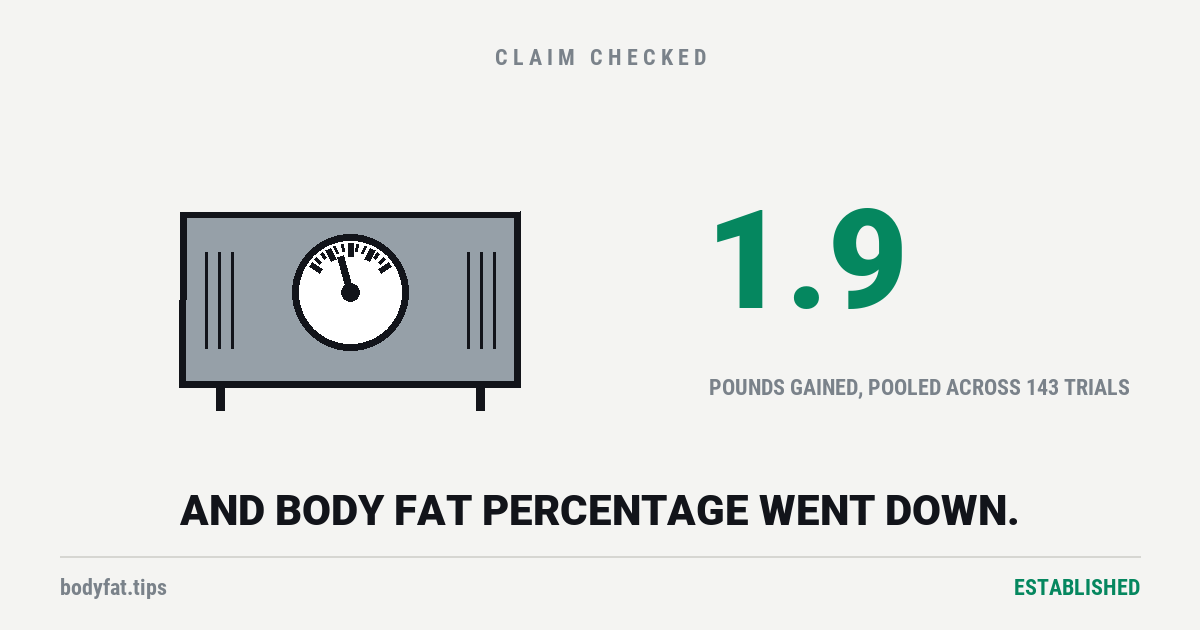
In 2024 a group screened 4,831 search results and pooled the 143 randomised trials that measured what creatine does to body composition [1]. Here is the whole answer.
| What the scale says |
+1.9 lb (0.86 kg) plausible range 1.7 to 2.1 lb |
| Everything that isn’t fat |
+1.8 lb (0.82 kg) plausible range 1.3 to 2.3 lb |
| Fat |
+0.1 lb (0.05 kg) range −0.5 to +0.8 lb — no change detected |
| Body fat percentage |
−0.28 points it went down |
Read the third row twice. Fat did not move. Not “moved a little” — the pooled estimate is a tenth of a pound, and the range of plausible answers runs from half a pound down to three-quarters of a pound up [1]. When a range straddles zero like that, “nothing happened” is the answer the data is giving you.
And body fat percentage went down — because the top of the fraction stayed put while the bottom got bigger.
One fence around the second row. Most of these trials paired creatine with exercise, and the authors found the changes in body composition “more robust when combined with resistance training” [1]. In the trials with no exercise at all, the scale still went up, by about 1.1 lb (0.50 kg), but no gain in everything that isn’t fat could be detected — though only seven comparisons measured it [1]. Take creatine without training and expect the weight; do not count on the muscle.
A thing we are deliberately not doing
You will notice we have not said “1.9 pounds on the scale minus 1.8 pounds of fat-free mass, so 0.1 lb was fat.” That arithmetic looks irresistible and it is wrong.
Each row in that table was pooled from a different set of trials — fat mass came from 62 separate comparisons, body fat percentage from 89 [1]. They are four independent answers to four questions, not four slices of one pie. Subtracting one from another produces a number that describes no group of people who ever existed.
We are flagging it because it is the single easiest way to get misled on this page, and because we have made a close cousin of this mistake ourselves and had to correct it in public.
What makes this evidence unusually good
One number in that meta-analysis deserves a moment, because it almost never looks like this in nutrition.
Researchers report a statistic called I-squared, and all it measures is how much the studies disagreed with each other. High I-squared means the trials pointed in different directions and the average is papering over a mess. Low means they broadly agreed.
For body mass, fat-free mass, fat mass and body fat percentage, the I-squared was 0% [1].
A hundred and forty-three trials, run by different teams in different countries over about three decades, and essentially none of them disagreed. You can go a long way in nutrition research without seeing that.
They also stress-tested it. Every study was pulled out of the analysis one at a time to see whether any single trial was carrying the result — none was. And they checked for publication bias, the tendency for boring null findings to quietly never get written up, and found no sign of it on any outcome [1].
That, and the review’s own verdict on its evidence, is why this page is rated Established rather than Supported. The authors graded it with GRADE, a standard system for rating how far a finding can be trusted, and put the evidence on body weight in the top grade, High [1].
So is it water? Here is where honesty costs us the clean answer.
Every article you have ever read on this says the same thing: it is water, it is inside the muscle, it does not make you look puffy. We would like to say that too. But the meta-analysis above declines to, and it says why in its own limitations section.
Verbatim, it lists as a limitation “the absence of adequately structured RCTs that have assessed water retention, hence impeding our ability to elucidate the specific processes behind the increase in body mass and lean mass” [1].
Translated: nobody has run the trial that would settle it. The best review available on this subject openly says the mechanism is not established, while a thousand articles state it as fact.
What we can tell you is what the studies that actually measured body water found, and it is reassuring without being conclusive.
In 2003, thirty-two resistance-trained men and women were split evenly between creatine and a placebo for four weeks while researchers measured muscle creatine by needle biopsy and body water by deuterium dilution — a tracer method, not a bathroom-scale estimate. Total body water rose more on creatine than on the placebo, where it also rose. But the split between fluid inside the cells and fluid outside them did not change: “fluid distribution was not changed” [3].
In 2020, twenty-seven trained men lifted four times a week for eight weeks. Muscle mass, total body water and intracellular water all rose more on creatine than on placebo, while the water outside the cells rose the same amount in both groups [4]. The ratio of muscle to intracellular water never shifted — the water tracked the muscle, step for step, and the two changes correlated strongly.
So: extra water, arriving in the same proportions as the water you already had, moving in lockstep with muscle. That is a good deal more than nothing and rather less than proof. We would rather hand you that than a confident sentence the research does not support.
Skipping the loading phase does not skip the weight
Now the part almost nobody traces, and it is the most useful thing on this page.
Where did the “loading phase” come from? Twenty grams a day for a week, four or five times the normal dose, printed on the tub as though it were a rule.
It came out of the laboratory. In 1992 a team including Eric Hultman gave 17 volunteers 5 grams of creatine four or six times a day — 20 to 30 grams — and found the creatine in their thigh muscle rose within days, by as much as half in some [8]. Four years later, some of the same researchers ran the study this page leans on [2]. Hultman and colleagues gave thirty-one men creatine on various schedules and measured what it did to the creatine actually inside their muscle. Twenty grams a day for six days raised it by about 20%.
And in the same paper, on a different schedule: three grams a day for twenty-eight days raised it by the same 20% [2].
Their conclusion, in their own words: three grams a day “is in the long term likely to be as effective at raising tissue levels as this higher dose.”
So why did loading become the ritual? Partly because the researchers themselves proposed it. The same 1996 paper calls twenty grams a day for six days “a rapid way to ‘creatine load’ human skeletal muscle”, and closes by suggesting that loading, followed by a small daily dose, may be “an effective way to obtain immediate and sustained performance benefits” [2]. Speed was the argument, and speed is real: loading filled the muscle in six days where three grams took twenty-eight. In 2003 a university trial loaded its volunteers on a supplement company’s own product, EAS’s Phosphagen, at 5 grams five times a day, with the creatine supplied by the company [3]. Who first printed the schedule on a tub as an instruction to you, we could not trace. We used to say a laboratory’s need to save time and money put it there; that was our guess, and we had no source for it.
And here is where this page used to overreach. We told you the loading dose is what produces the weight gain, and that skipping it avoids the bloat. The evidence does not support that. In the 143-trial analysis, trials that never loaded — a steady daily dose, usually taken for more than a month — ended with people 2.2 lb (0.98 kg) heavier, no less than in trials that loaded, and the authors report the effect on body weight as “independent of” the loading protocol [1].
And the 2003 water study, which loaded at 25 grams a day for its first week, did not find the jump in that week. Body water rose, but the creatine group was only 1.7 lb (0.75 kg) heavier after seven days — too little to rule out chance, and barely more than the placebo group’s 1.5 lb (0.67 kg). The clear gain came at four weeks: 2.9 lb (1.32 kg), against 0.7 lb (0.34 kg) on the placebo [3].
So what does loading change? The timing, we think — and that is our reasoning, not a measurement. Loading fills the muscle in about a week, and the earlier loading trials the 1996 paper rounds up put 1.1 to 2.2 lb (0.5–1.0 kg) on people in five or six days [2]. Three grams a day fills the muscle to the same level in about four weeks [2], so the same gain most likely arrives spread across the month instead of in one lump. Loading changes when the weight arrives, not whether.
Will creatine make you bloated? Here is what has actually been measured.
Nobody types that question because they are curious about fluid compartments. They type it because they are worried about the mirror.
So let us take it apart properly, because “bloating” is doing two completely different jobs in that sentence. One of them is water. The other is your gut. They have separate causes, separate evidence and separate answers — and almost every article on this subject runs them together.
Does creatine bloat your face?
“Creatine face” has its own photo galleries, its own before-and-after threads and its own search results. What it does not have is a study.
We went looking rather than assuming. The PubMed index returns nothing at all for creatine and subcutaneous water retention — the fluid that sits under the skin, which is the only kind that could show up in a face. Searches for creatine and facial swelling return case reports about unrelated conditions. There is no trial that measured this and came back inconclusive. There is no trial.
That cuts both ways, and we are going to say so. We cannot tell you creatine will not puff up your face, because nobody has put a tape measure on one. What we can tell you is what happened every time researchers measured the water everywhere else — and two of those studies are worth your time.
Does creatine cause bloating in women?
This one has a real answer, and it is more interesting than the usual reassurance.
Start with the weight, because the big analysis answers it for women too. In the 143-trial analysis, the 27 comparisons made in women found the same average gain as everyone else: 1.9 lb (0.86 kg) [1]. The part that isn’t fat looked smaller in women than in men — 1.2 lb (0.54 kg) against 2.6 lb (1.20 kg) — though a gap that size between the sexes could still be chance [1]. Where the extra fluid sits is a different question, and one short trial has looked at it closely.
In 2023, thirty moderately active women took either the full loading protocol — 20 grams a day, split into four doses, for five days — or a placebo. They were measured in both halves of the menstrual cycle using bioimpedance spectroscopy, which estimates the fluid inside and outside your cells separately [5].
In that trial, body weight did not measurably change. The gap between the creatine group and the placebo group came out at roughly 0.9 lb (0.40 kg), with a margin wide enough that zero sat comfortably inside it — p = 0.427, nowhere near the line researchers use for “probably not chance” [5].
Now the half that does not flatter the story, which is exactly why it is here. In the luteal phase — the stretch after ovulation — creatine raised every fluid compartment they measured. Total body water rose by about three and a half cups (0.83 L). Water inside the cells rose about three cups (0.74 L). And water outside the cells rose about two cups (0.46 L), against a small fall on placebo [5].
Sit with that last one. Extracellular fluid is the compartment closest to what people actually mean by bloat. It moved.
So the fair reading is this: fluid went up, including the kind that sits outside your cells, and the scale still did not register it. Both facts are in the same paper. It is also thirty people, which is small enough that a real difference in body weight could hide inside it — a study that fails to find something is not the same as a study showing there is nothing there.
Does creatine upset your stomach?
Different mechanism entirely, and here the evidence is unusually practical.
In 2008, fifty-nine top-flight male soccer players were assigned at random for 28 days, double-blind, to one of three groups: 10 grams of creatine split into two 5-gram doses, the same 10 grams in a single serving, or a placebo. Then they were asked directly about their guts [6].
Start with the number nobody ever quotes. In the placebo group — the men taking nothing — 35% reported diarrhoea.
Read that again before you blame a supplement for anything. Take a group of elite athletes, follow them for a month and ask them point-blank about their digestion, and a third of them have something to report on no creatine at all.
Split into two doses, creatine was statistically indistinguishable from placebo. Taken as a single 10-gram serving, diarrhoea ran at 55.6% against 28.6% for the very same daily amount split in two [6].
Same substance. Same daily dose. The only thing that changed was whether it arrived all at once. If creatine is upsetting your stomach, that is the first thing to change, and it costs nothing to try.
How far does that generalise? In 2026 a group pooled the side-effect reports from 684 randomised trials covering more than 12,800 people across the creatine and placebo arms. Side effects were infrequent, and across all kinds taken together the authors found no consistent increase at higher doses or longer durations, with placebo groups often reporting the same or more [7].
One limitation the authors put in themselves, which we are not going to skip past because the sample size is impressive. That analysis counted whether studies reported side effects — not how many individual people had them. It is not the same as a trial that asked every participant, and 12,800 is a bigger-sounding number than the method can quite cash.
Counted that way, though, it did find a signal on the stomach, and we should have told you. Gut complaints turned up in the creatine groups of 6% of the trials that gave the least creatine in total, against 16% of those that gave the most; and, allowing for who was studied, a creatine group had about two and a half times the odds of a placebo group of reporting a gut problem [7]. That is counted trial by trial, not person by person, and the authors call the effects small. But it points the same way as the soccer study: the more creatine, the more stomach trouble.
So why did the scale move ten pounds?
It is one of the most-asked questions on this whole subject, so it gets a straight answer: ten pounds is not what creatine typically does.
The pooled figure across 143 randomised trials is 1.9 lb, and the range of plausible answers for that average runs from 1.7 to 2.1 [1]. As we said further up, those trials essentially did not disagree with each other. That is about as settled as a number gets in nutrition research.
So if your scale moved ten pounds, creatine is unlikely to explain most of it. But that 1.9 lb is an average, not a ceiling, and we should not have written it as one. Some trial groups averaged more — 2.9 lb (1.32 kg) after four weeks in the 2003 water study [3], and 3.7 lb (1.7 kg) after four weeks at 20 grams a day in a trial the 1996 paper cites [2] — and people scatter around every average. In the 2003 study, one volunteer put on 10.6 lb (4.8 kg) in the first week, nine-tenths of it measured as water, while four of the sixteen on creatine had gained nothing by the end of the month [3].
We are not going to tell you what the rest of your ten pounds was, because we do not know you — a new training block, the extra food that goes with it, a change in salt, or simply the ordinary day-to-day swing of a body that is mostly water. What the research will not support is assuming all ten are creatine’s doing.
What to actually do
Skip the loading phase. Three to five grams a day gets you to the same place in about four weeks [2]. It will not spare you the weight — trials that never loaded gained as much [1] — but on our reading it should arrive spread across the month rather than in one week, which makes it easier not to decide the stuff is making you soft.
If it upsets your stomach, split the dose before you quit. Ten grams in one serving roughly doubled the rate of diarrhoea compared with the same ten grams taken as two [6]. At three to five grams a day you are already below the dose that caused trouble — which is one more reason the loading phase is the part worth dropping.
Then keep taking it. This one surprises people: in the 1996 study, men who stopped were tested again thirty days later, and their muscle creatine was no longer measurably above where it started [2]. It is a standing order, not a course of treatment.
Stop weighing yourself for the first month. Expect the number to go up — by about two pounds on average, more for some people and less for others — and the trials say that, on average, none of it is fat. Watching it happen daily will only make you doubt something the data settled across 143 trials.
And use the tape measure or the mirror instead. A pound of muscle and a pound of fat weigh the same but take up very different amounts of room, which is precisely why the scale is the worst instrument for the question you are asking.
Buy monohydrate. The meta-analysis split its trials by creatine type — plain monohydrate against the alternative forms — and found the effect on body mass was independent of which one people took. Its own summary of the wider literature is blunter: “other forms of creatine are not superior to creatine monohydrate” [1].
Which puts the premium versions in an awkward spot. If a product is sold to you as the one that will not bloat you, that same comparison leaves it nothing to stand on: the form made no measurable difference to the weight people gained [1].
We rate creatine Supported for safety, have checked whether it does anything for fat loss, and found the hair loss claim unsupported.
An independent editorial review on 18 September 2026 found that this page’s most practical advice rested on a claim its own sources contradict. We said the loading phase is what produces the weight gain, that skipping it avoids the bloat, and that in the 2003 water study body weight climbed during the loading week. It did not: body water rose that week, but the gain on the scale was not clear until four weeks. And in the 143-trial analysis, trials that never loaded ended up no lighter than trials that did. On our reading, loading changes when the weight arrives, not whether; the section, its heading, the advice and the search description now say so, with the timing labelled as our inference. We also treated the range around the 143-trial average as a ceiling on what creatine can add to one person. It is not one: some trial groups averaged more, and individuals vary widely.
The funding row said every industry tie was reported on this page, and three were missing. A supplement company, EAS, supplied the creatine for the 2003 study; the manufacturer AlzChem donated it for the 2023 study; and the 2026 side-effect analysis has authors on the advisory boards of AlzChem and other creatine makers, with its trial database first published in a paper whose publication fee AlzChem paid. They are now listed by role, and where we could not read a paper’s funding statement, the source entry says so. Also changed: that analysis did find more stomach complaints in trials that gave more creatine, which we had called no signal; the answer for women now starts from the 27 comparisons in women in the 143-trial analysis, which found the same 1.9 lb; the loading dose dates to a 1992 study, not the 1996 one, and our explanation of why labs loaded was a guess, now withdrawn; the not-fat gain is scoped to trials with exercise; the 2003 study split its 32 volunteers between creatine and placebo; the 1996 washout now says what was measured, and that study’s follow-up is given as the 35 days it ran; the entries for the 1992 and 1996 studies now note patents naming their authors, as our dosing verdict does; the safety verdict we link to is rated Supported, not Established; and a misquoted word is fixed. The rating is unchanged: Established.