B12 Shot Benefits: Real for Deficiency. Energy: Dummy Shots Kept Up. Weight: No Published Trial

“B12 vitamin shot benefits” and “benefits of b12 vitamin injections” carry the same figure, month by month: searched about 12,100 times a month in the United States, the database’s figure for the past year, which read the same in each of the latest six months (from a paid keyword database, pulled 23 October 2026) [1]. Two phrasings with identical figures may be counted together, so we read it as one figure for both, not 12,100 each. The shots are sold at medical spas, dermatology and chiropractic practices, walk-in clinics and weight-loss programmes, for energy, mood, skin and weight [1], and sometimes mixed with other ingredients and sold as “lipotropic” or “MIC” shots [2].
Do vitamin B12 shots work? For a deficiency, yes: they are a real treatment, and for people who cannot absorb B12 from food they are the standard one. For energy, in people who are not short of B12, dummy shots did about as well in the trials we found that compared the two. For weight loss, we found no published trial of B12 shots at all.
This is journalism, not medical advice. If you have numbness or tingling, balance problems, a sore red tongue, memory changes or unusual tiredness, have your B12 measured by a clinician rather than buying a shot: a shot first can push the test result up without fully treating a deficiency, which muddies the answer [3]. If you have been prescribed B12 injections, do not stop them without talking to your doctor; for pernicious anaemia, and after removal of the whole stomach or the end of the small intestine, Britain’s guideline calls that treatment lifelong [3]. And a shot followed by swelling of the face or wheezing needs care at once: severe allergic reactions are on the label, and deaths have been reported [4].
What does a vitamin B12 shot do, and who needs one?
B12 is the vitamin your body uses to make red blood cells and DNA and to keep nerves working [5]. Normally you absorb it from food in the last stretch of the small intestine, with the help of a protein made in the stomach called intrinsic factor [4]. A shot skips all of that. The injection goes into a muscle or under the skin; given into a muscle, it reaches its peak in the blood within an hour [4].
Skipping the gut is the whole point, and the US prescribing label lists who needs that: people who cannot absorb B12 because of pernicious anaemia, an autoimmune condition that destroys the stomach cells making intrinsic factor; disease or surgery of the stomach or bowel, including removal of part or all of the stomach; a fish tapeworm; or cancer of the pancreas or bowel [4]. For people who simply need more than usual, the label says, the need “can usually be met with oral supplementation” [4]. In the United States the injection is a prescription medicine [4] [5].
Britain’s 2024 guideline from NICE, the body that advises its health service, draws the same lines. It says to offer lifelong injections when the cause is autoimmune gastritis, its name for the condition behind pernicious anaemia, or after removal of the whole stomach or the end of the small intestine; to consider injections over tablets for other problems with absorption, such as coeliac disease, partial removal of the stomach or some weight-loss operations; to offer either, by clinical judgement and the person’s preference, when a medicine such as metformin is the cause; and to consider tablets when the diet is short of B12 or the cause is unknown [3]. Who needs B12 at all, and why vegans and people on metformin are on the list, is in our B12 supplement verdict.
So the benefit of a B12 shot is real, and specific: it fixes a shortage. In pernicious anaemia the label says prompt injection “prevents progression of neurologic damage”, and that a deficiency left for more than three months “may produce permanent degenerative lesions of the spinal cord” [4]. That is the reason to get tested, not to guess.
Do vitamin B12 shots give you energy?
This is the promise on most of the pages Google’s answer cites. A dermatology practice: “even for those without deficiencies, B12 injections can provide a range of health benefits, including radiant skin and improved vitality”. An ear, nose and throat practice: injections “provide an immediate boost”. A UK pharmacy: “improved energy levels are often the main reason people seek out vitamin B12 injections” [1]. A medical spa: “After a B12 injection, you can expect an almost immediate boost in energy” [1].
Tiredness is a real symptom of B12 deficiency, and fixing a deficiency is what shots are for [3]. The question is everybody else, and the test is a placebo, or dummy: an injection that looks the same and contains nothing active, so that hope and expectation are working on both sides of the comparison. Here are the placebo-controlled trials of B12 shots on their own in people who were not clearly short of B12 that we found [6].
| Trial | Who, and what they were given | What happened |
|---|---|---|
| BMJ, 1954 [7] | 86 people without signs of anaemia (no blood tests were done): young servicemen with tuberculosis, chronic-ward and orthopaedic patients, and family-doctor patients who had asked for a tonic; 227 single injections, one to six each, mostly a week apart, of 50 mcg of B12, a liver extract or salt water, coloured alike and labelled by random number | Asked a week later whether they felt better: yes after 49% of the B12 injections, 48% of the liver extract and 43% of the salt water, not a significant difference; the answers on energy, appetite and sleep did not differ significantly either |
| England, 1973 [8] | 29 tired adults with normal blood tests finished (48 started); 5 mg of hydroxocobalamin, one form of B12, twice a week for two weeks and dummy injections for two weeks, in random order | Better “general well-being” on B12, but only in the 14 given the dummy first, a group picked after the results were in; in the 15 given B12 first, more of their ratings favoured the dummy (38) than B12 (36); tiredness itself was not significantly better on B12, even in the 14 |
| Burma, 1978 [9] | 31 healthy male medical students aged 18 to 21, none anaemic: 1 mg of cyanocobalamin, the usual US form, or a dummy injection three times a week for six weeks | No significant difference in aerobic fitness, strength or coordination; B12 levels not reported |
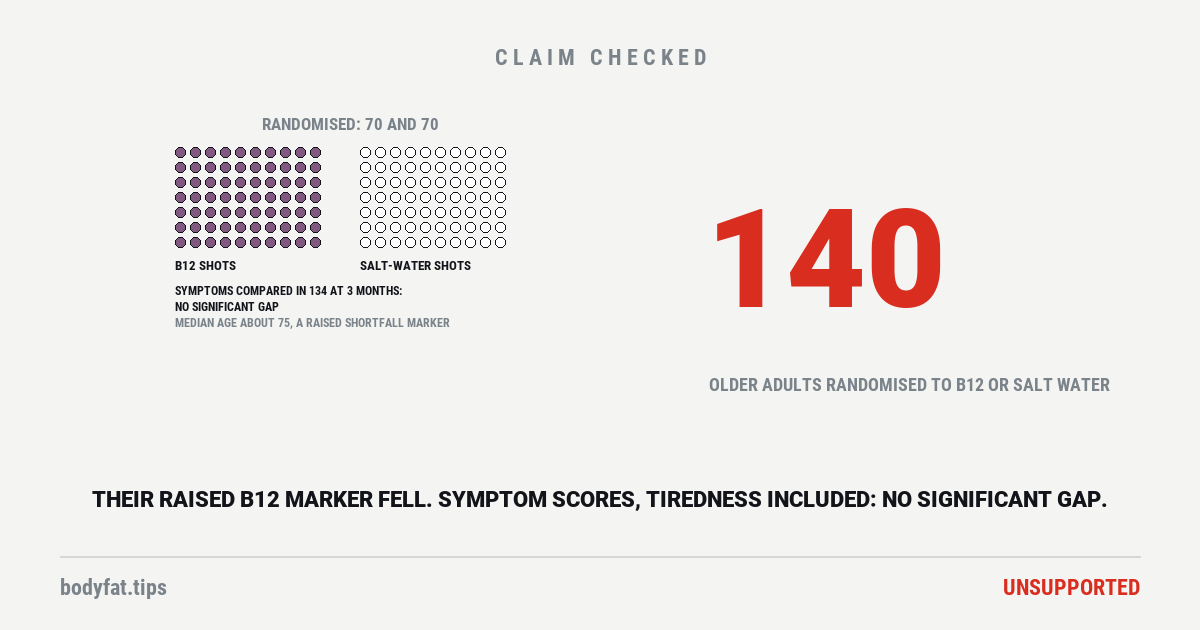
| Denmark, 2001 [10] | 140 adults, median age about 75, with a raised blood marker of B12 shortfall, though in both groups the median B12 level sat inside the lab’s normal range: four weekly 1 mg shots (70 people) or salt-water shots (70); symptom scores compared in 134 | The marker fell on B12; symptom scores, daily tiredness among them, did not differ significantly at three months. Later reports from the same trial: one of eight quality-of-life areas better on B12, general health, while vitality, its energy scale, was not significantly better [11]; thinking and depression scores not significantly better [12]; nerve-symptom scores better on B12 in the people with the most raised markers [10] |
| United States, 2021 [13] | 20 singers with mild vocal symptoms such as tiring easily, no known deficiency: one 1,000 mcg shot and one salt-water shot, in random order | “The improvements after either placebo or vitamin B12 injections were comparable”; 4 of the 20 felt a meaningful improvement 72 hours after each |
Read across, the dummy kept up, and no trial found tiredness itself significantly better on B12. The positive results were narrower. In 1973, general well-being and happiness came out better on B12, but only in half of the volunteers, chosen after the data were in, and tiredness was not significantly better even in them; its authors still wrote that it seemed to support “the widely held belief that vitamin B12 has a definite ‘tonic’ effect” [8]. The Danish trial is the largest of the five and the most telling. Its volunteers had a raised level of methylmalonic acid, a substance that builds up in the blood when cells run short of B12, so if anyone was going to feel a lift, they were. The shots brought the marker down, and the volunteers did not feel significantly better than those on salt water [10]. Its authors’ conclusion: people like them “may have only limited clinical benefit from vitamin B12 treatment, at least in the short term” [10]. Two narrower findings from the same trial did favour B12. A later report found one of eight areas of a quality-of-life questionnaire, general health, better on B12; vitality, its measure of energy, was not significantly better [11]. And when the authors split the groups by their starting markers, the people with the most raised markers reported fewer nerve symptoms on B12 than on salt water, on a standard list of questions about weakness, numbness, prickling and other nerve complaints. The authors call the improvement slight and say it was not down to any one symptom. In the same people, total symptom scores and a doctor’s nerve examination did not differ significantly, and the authors write that, with no improvement on the examinations, they hesitate to make much of it [10]. These were people with a marker of shortfall, and 18 of the 140 had blood B12 at or below the bottom of the lab’s normal range [10].
Mood is the other promise. In a 2013 trial in Pakistan, 73 adults with depression and B12 levels in the low-normal range, 190 to 300 pg/mL, all took antidepressants, and 34 of them also had a 1,000 mcg shot every week for six weeks. At three months every one of the 34 had improved by at least a fifth on a depression scale, against 69% of the 39 on antidepressants alone [14]. Nobody in the comparison group had a dummy shot, though; the trial stopped at 73 of its planned 292 people when the grant ran out; and its authors wrote that “A placebo response due to injections may be responsible” [14]. In the blinded Danish trial, where both groups had injections, depression scores did not improve significantly more on B12 than on salt water [12].
For athletes, the US fact sheet’s verdict is that B12 “appears to have no beneficial effect on performance in the absence of a nutritional deficit” [5]. A trial published since, in 18 amateur cyclists, found about 4% more peak sprint power after three days of 1 mg a day of methylcobalamin, a form of B12, than after a dummy; the company whose product it tested paid for it [15]. B12 by mouth for tiredness, rather than by needle, has its own trials, and our B12 supplement verdict sets them out; they point the same way.
Do vitamin B12 shots help you lose weight?
This is the second half of the pitch. An integrative-health practice tells readers that B12 “helps your body fine-tune your metabolism and use food more efficiently, so you can drop those pounds”; a weight-management clinic says it “is recognized to boost metabolism” [1]. The two academic medical centres in Google’s answer say the opposite: “B12 shots themselves aren’t associated with weight loss”, says one, and “There’s no solid proof” that they help, says the other [1].
We found no published trial that tested B12 shots for weight loss [6]. We did find one registered trial. Registered with a physician as its sponsor, it started in September 2012: 22 adults with obesity and no B12 deficiency, randomised, all taking the appetite drug phentermine: half were to have a B12 shot every week and half a salt-water shot, with weight measured at 24 weeks. The registry says it was completed in April 2013. It has posted no results, and we found no paper from it [16] [6].
Pages that come up in an ordinary web search tell a different story. Searched on 23 October 2026 for B12 injections, weight loss and randomised trials, the first page of results summarised three pages on B12 shots and weight that cite research: a “2025 systematic review of 12 randomized trials involving over 1,400 participants”; a 2024 trial of 60 people in Nutrition & Metabolism in which, the summary says, four weekly B12 shots raised the energy burned at rest by 6% against a dummy; and a 2024 trial in what the page calls The Journal of Clinical Endocrinology in which monthly shots are said to have modestly lowered body mass index against a dummy [17]. The three sat on the websites of an accommodation business, a family doctors’ society and a press service, and each answered “page not found” when we opened it [17]. On the same page of results, a clinic’s blog says an “NIH-referenced analysis” of 12 clinical trials found modest drops in body mass index; it names none of the trials, and the one review it links, from 2020, pools no trials and reports no trial of B12 with a weight result [17] [18]. We could not find any of these studies: not in PubMed, Europe PMC or Crossref, and not in the records of the journals the pages name [6].
The controlled tests of B12 and body weight in our searches were not of shots. A Dutch trial gave 2,919 people aged 65 and over with raised homocysteine, a blood marker that rises when B12 or folate runs short, among other causes, a daily tablet of 500 mcg of B12 with 400 mcg of folic acid, or a dummy, for two years, and measured them. Their BMI, body mass index, rose 0.042 points on the vitamins and 0.049 on the dummy, not a significant difference, and body-fat scans in 1,227 of them found no significant difference in fat or in lean mass [19]. In the authors’ subgroup analyses, the one significant result was in people with one variant of a folate gene, who gained slightly more lean mass, not less fat [19].
Seventy years earlier the hope ran the other way, toward putting weight on. In a 1953 American trial run by a state hospital’s research department, 44 women described as healthy took B12 by mouth on two schedules and a dummy, three months of each in rotating order over a year, and the authors found no significant weight gain attributable to B12 [20]. In that era B12 was also tested on the weight of infants and children, with mixed results, as the 1954 injection study’s author noted [7].
One trial did report lower weight on B12. In Jordan, adults with type 2 diabetes and low B12 levels, all taking dapagliflozin, a diabetes drug, were randomised to add methylcobalamin by mouth every day for a year or to add nothing; the paper reports their BMI at a year as 27.3 on B12 against 28.1 without, from similar starts [21]. It is a weak test even of that. The comparison group had no dummy pill, and in the trial weight fell on the diabetes drug alone too. The paper’s summary says 160 people in each group and, a few lines later, 54 in one of them, while its table gives 80 and 80; it calls the trial double-blind, while its registry record shows only the participants blinded and 80 enrolled; it gives the daily dose as 500 micrograms in some places and 500 milligrams in others; the significance figures it gives for BMI do not agree with one another; and the trial was registered in January 2024, after it ended in June 2023 [21]. Whatever it found, it was in people short of B12, by mouth, beside a drug on which weight also fell, so it says nothing about a shot for someone whose levels are normal.
Why do sellers think it works? Because in surveys, people with obesity tend to have lower B12 levels: the integrative practice’s page cites studies of exactly that [1], and in two Danish population studies, 9,311 people in all, lower B12 went with a higher BMI [22]. A link in a survey does not say which way it runs. The Dutch trial’s own survey data even pointed the other way, with higher active B12 going with more body fat [19]. Genetic studies, which use the genes people are born with as a natural experiment because those genes nudge B12 levels for life, disagree with each other: the Danish study found that genes which raise B12 did not lower BMI [22]; two analyses with the same lead author, both drawing on the UK Biobank, a large British database of genes and health records, found a very small association with less body fat, and in the later one with lower BMI as well: about a hundredth of a standard deviation or less, the standard deviation being the usual spread of a measure between people, for each standard deviation of B12 [23] [24]. The later analysis’s authors called it “strong evidence for the causal effect of vitamin B12 on adiposity” [24]. None of them tested a shot.
Then there is the weight-loss shot that does work, with B12 added to it. Some clinics sell compounded semaglutide, a pharmacy-made copy of the weight-loss drug, mixed with cyanocobalamin. A study from a chain of wellness studios, all seven of whose authors list the company as an affiliation, four of them beside a university or hospital, reported its clients losing an average of about 9 lb (4.11 kg) in three months on weekly injections of the mix [25]. It had no comparison group, so it cannot say what the B12 added, and semaglutide is a weight-loss drug on its own, as our verdict on the two weight-loss drugs sets out. The American Diabetes Association’s 2026 standards advise against the compounded copies, citing among other problems the “incorporation of additional ingredients not clinically tested when mixed with incretin products (e.g., vitamin B12 and vitamin B6)” [26].
What’s in a lipotropic or MIC shot?
MIC stands for methionine, an amino acid; inositol, a sugar-like compound; and choline, a nutrient the body also makes. An express clinic’s “Lipo-B (MIC)” shot adds B12 and says it “may help reduce excess fat in targeted areas of your body, enhance metabolic activity, and boost energy levels” [2]. A men’s-health telehealth clinic’s “Lipo-C” adds L-carnitine and two more B vitamins and calls itself “a compounded lipotropic injection that can encourage fat burning” [2]. Compounded means mixed by a pharmacy rather than made as an approved medicine, and the express clinic’s own page says the shots “have not been evaluated by the Food and Drug Administration” [2].
The word is older than the product, and it meant something else. In a 1942 review, a “lipotropic substance” was “one which decreases the rate of deposition and accelerates the rate of removal of liver fat” [27]. The experiments behind it were on rats fed high-fat diets and on dogs whose pancreas had been removed: choline brought fatty rat livers from 15% fat back to a normal 4 to 5% in three weeks, and methionine in the feed cut liver fat by 41% [27]. Liver fat in laboratory animals, not body fat in people, is where “lipotropic” comes from.
We found no trial of lipotropic or MIC shots for weight loss in people [6]. The nearest thing in our searches was a 1998 trial of a pill, chromium and “other lipotropic nutrients”, in 123 dieters for four weeks: body-fat percentage differed between the groups, and body weight did not differ significantly [28].
An ordinary web search turns up something else. A telehealth weight-loss company’s blog, “Lipo C Studies — What Research Shows About Lipotropic”, describes “A 2019 randomised controlled study published in the Journal of Dietary Supplements” in which 120 people with obesity on MIC injections and a diet lost 7 lb (3.2 kg) more than people on the diet alone [29]. The page names no authors and gives no link or DOI, and elsewhere it credits a 2019 study in the same journal with cutting liver fat by 14% [29]. We could not find that trial: a search of PubMed’s records for the journal turned up no trial of MIC shots, and neither did a search of the journal’s records for 2018 to 2020 at Crossref, the registry of scholarly publications [6]. The search for B12-shot weight trials above turned up one more page of this kind: a pharmacist-review page that describes “a 2023 randomised study of 214 adults” in which MIC shots added 0.9 lb of weight loss over three months against a dummy, not a significant difference, and a review of 12 trials of the injections. It names neither, its reference list holds neither, and we could not find either [17] [6].
Some of the ingredients have been tested alone, by mouth. The telehealth clinic leans on carnitine pills [2], and an umbrella review, a review of earlier pooled analyses, found weight lower on carnitine taken by mouth at 150 to 4,000 mg a day for 8 to 30 weeks [30]. That is a pill, not the shot, and no seller page we read gave the dose in its shot, so the two cannot be compared.
Vitamin B12 pills vs shots
For most people who really are short, swallowing works, because a big tablet does not need intrinsic factor. About 1.3% of a 1,000 mcg tablet is absorbed, the US fact sheet says [5]. By our arithmetic that is about 13 mcg, roughly five times the 2.4 mcg a day adults are advised to get [5].
A 2018 Cochrane review, the kind that gathers every trial it can find, found three trials of tablets against shots, 153 people in all, and judged on low-quality evidence that tablets brought blood levels up about as well; none of the three reported symptoms [31]. The largest randomised trial in the newest review we found, 283 people aged 65 and over in Spain, brought more than 90% back to normal levels on either by eight weeks. At a year, counting everyone who started, 73.6% on tablets and 80.4% on shots were still normal, and the trial could not show that the tablets were as good over that span. 83.4% of the volunteers preferred the tablets [32].
That newest review, published in September 2026, gathered 13 studies, did not pool them, and concluded that the choice of route “should consider patient preference, tolerability, and access” [33]. The biggest study in it is not a trial but a look back through an Israeli health fund’s records of 4,281 people prescribed B12, in which levels rose more on under-the-tongue tablets than on shots [33]. The review was paid for by a Brazilian drug company that makes a B12 product, and one of its authors works there [33]. The exceptions are the ones NICE names: lifelong shots for autoimmune gastritis and after removal of the whole stomach or the end of the small intestine [3].
How long does it take for a B12 injection to work?
On a blood count, within days: in pernicious anaemia the label tells doctors to check for new red cells from the fifth to the seventh day [4]. On symptoms, longer. NICE tells patients that their symptoms “could start to improve within 2 weeks, but this may take up to 3 months”, and that it can take much longer for them to go altogether [3]. If you are not short of B12 there is nothing for the shot to fix: the singers’ improvement 72 hours after a B12 shot was about the same as after salt water [13], and the Danish volunteers’ symptoms were not significantly better at three months [10].
How long does a B12 shot last, and how often should you get one?
Less of it stays than you might think. Within 48 hours of a 100 or 1,000 mcg shot of cyanocobalamin, 50 to 98% of the dose may turn up in the urine, most of it in the first eight hours, the label says; what is kept goes mainly to the liver, the body’s store [4]. How long the level stays high depends on the form and the dose. Researchers studying people having 1 mg wellness shots of hydroxocobalamin write that a single shot raises blood B12 several-fold for at least two weeks, back to the normal range in about four [34]. In the 1973 trial, four 5 mg shots kept levels above 2,000 pg/mL four weeks later in all but three volunteers [8].
How often depends on why you need it. For pernicious anaemia, the US label’s schedule is a loading course and then 100 mcg once a month for life [4], a tenth of the 1,000 mcg in one of its 1 mL vials. The Danish trial gave the loading part of its country’s standard, 1 mg a week for four weeks; the standard then continues with a shot every three months [10]. NICE leaves the interval to each product’s licence and says to give injections more often if symptoms come back [3]. For someone who is not short of B12, there is no medical schedule, because nothing is being treated.
Are B12 injections safe? The side effects on the label
B12 has no official upper limit, because it is generally considered safe even at high doses [5]. The injection’s label still carries a list. Severe allergic reactions: “Anaphylactic shock and death have been reported”, and it recommends a skin test first in anyone who may be sensitive; anyone allergic to cobalt, the metal in the B12 molecule, should not have it. Fluid on the lungs and heart failure early in treatment, and clots in the blood vessels of the limbs. Polycythaemia vera, an overproduction of red cells. Mild, passing diarrhoea; itching; a passing rash; a “feeling of swelling of entire body” [4]. In severe B12-deficiency anaemia treated hard, potassium can fall dangerously, which is why it is watched for the first 48 hours, and people with Leber’s disease, an inherited eye condition, can lose sight quickly on cyanocobalamin [4].
Acne is the side effect people search for. In the 2015 study of 10 healthy people having 1 mg wellness shots, one developed acne a week after the shot; the researchers, four of whom are named on a patent application on B12 and acne, found that B12 changed what skin bacteria were doing [34]. One person in ten is a single case, not a rate.
Two risks are about diagnosis rather than the needle. A large dose of B12 can correct the anaemia of a different shortage, of folate, and hide what was really wrong: “Indiscriminate administration may mask the true diagnosis”, the label says, and it tells doctors to measure B12, folate and iron before treating [4]. And a recent shot can push the B12 test up without fully treating a deficiency, NICE warns [3]. If you might be short, get tested first. Injected wellness products have their own record; our glutathione verdict covers the drips.
Can I get B12 shots at home?
In the United States, B12 injections are prescription-only [4]. People who need them long term may be able to give their own, a health publisher notes [1]; NICE made a recommendation for research on self-injection rather than one for practice [3]. In the Danish trial, a research nurse gave three of the four shots in people’s homes [10]. A US pharmacy chain’s walk-in clinics also give them, on a page that mentions insurance and points to a separate price list [1]. We print no prices.
What are the signs that you are lacking in B12?
NICE’s list of common symptoms and signs: anaemia or unusually large red cells on a blood count; trouble concentrating or short-term memory loss, sometimes called brain fog; eyesight problems; a sore, inflamed tongue; balance problems, falls and an unsteady walk; pins and needles or numbness; and “unexplained fatigue” [3]. Tiredness has many causes, and low vitamin D is another one people test for: our verdict on vitamin D and tiredness covers it. Who is at risk of running short is in our B12 supplement verdict.
Who these studies were done on, and B12 shots for women
The trials of shots for energy were small and varied: in 1954, hospital patients and family-doctor patients who asked for a tonic [7]; tired British adults, 22 of the 29 of them women, mean age 41.5 [8]; young Burmese men [9]; older Danes, 98 of the 140 women [10]; and singers, half of them men, median age 22 [13]. The weight evidence is all by mouth: older Dutch people with raised homocysteine [19], healthy women in a 1953 American trial [20] and Jordanian adults with diabetes and low B12 [21]. What changes the answer for a reader, woman or man, is whether you are short of B12, and why. The label notes that pregnancy and breastfeeding raise the need [4]; if you are pregnant and eat no animal foods, the B12 supplement verdict covers testing and dose, and the conversation belongs with a clinician.
If tablets work for most people who are short, why is it the shot that gets sold?
This section is the desk’s own reasoning, and it is labelled as such. The trials say a big tablet does about as well as a shot for most deficiency in the first months [31] [32], and that shots do little that a dummy does not for people who are not short [10] [13]. Yet the shot is the product. Three possible reasons, each rated.
Answer one: the shot is a visit, and the visit is what is sold. A tablet is bought off a shelf. A shot has to be given, by appointment: “one injection every 28 days, and this must be administered by our doctor”, in the chiropractic clinic’s words; “typically administered monthly” at the dermatology practice; “every week or month” at the UK pharmacy [1]. On the pages we read, the shots sit on the same menus as fillers, intravenous drips and weight-loss programmes [1]. This is an observation from those pages, not a measurement of anyone’s motives.
Answer two: a needle feels like medicine. Across 22 migraine trials, 32.4% of people given a dummy injection had relief at two hours, against 25.7% given a dummy pill [35]. In the 1954 study in the table above, people reported feeling better after 49% of the B12 injections, 48% of the liver-extract ones and 43% of the salt-water ones, and its author concluded that the “‘tonic’ effect of an injection of saline was no less” than after liver or B12 [7]. A third of singers and voice professionals report a benefit from B12 shots, the singers’ trial says; in that trial, salt water did about as well [13]. That injected dummies beat swallowed ones is measured, in migraine. That the same thing is at work in a B12 clinic is our surmise.
Answer three: medicine taught it first. For decades the shot was simply how B12 was given. The US label still calls tablets “not dependable” for pernicious anaemia [4], and the Cochrane review notes that most people with a deficiency are treated with injections in primary care, perhaps because doctors are unaware of tablets or doubt them [31]. In a 1970 survey, as the 1978 paper reports it, 68% of the family doctors questioned believed B12 was effective, “especially in the treatment of tiredness” [9]. That the habit was there is recorded; that today’s market grew out of it is our surmise.
Put the three together and here is what we think is true, stated plainly so you can disagree with it: a B12 shot is the right tool for a body that cannot absorb B12, and for nearly everyone else it is a visit with a vitamin in it.
What we could not find, and would like to: the results of the 2012 weight-loss trial, 22 people given phentermine with B12 or salt-water shots [16]; and a placebo-controlled trial of B12 or lipotropic shots as clinics sell them, weekly or monthly, in people with normal B12 levels, measuring energy and weight for at least six months. The longest placebo-controlled trial of B12 shots in people not clearly short that we found ran three months [10] [6]. If you know of either, the corrections line on this site is open.
Where “B12 shots for energy and weight loss” came from
The shot began as a cure. Injected B12 does for the blood what the liver extracts once used for pernicious anaemia did: the label describes cyanocobalamin’s effect as “apparently identical to that of the antianemia factor in purified liver extract” [4].
The energy claim came from doctors. In a 1970 survey, 68% of the family doctors questioned believed B12 was effective, especially for tiredness [9]. The 1973 pilot set out to test the belief, noting that the earlier claims had no “properly controlled trial” behind them; it found its positive result only in a subgroup chosen after the data were in, and wrote that this seemed to support the “tonic” effect [8]. Five years later, a trial in young men found no significant difference in physical performance [9]. The belief outlived both.
We could not trace who first sold B12 shots for weight loss. The word “lipotropic” came from liver research in rats and dogs [27]; the shots that carry it today are mixed by compounding pharmacies and sold by clinics [2].
Where it lives now: Google’s AI answer for “b12 shot benefits” is careful itself. It says the shots “primarily treat or prevent a diagnosed vitamin B12 deficiency”, and notes that they “do not typically boost energy or cause weight loss” if levels are normal [1]. Then it cites, beside two academic medical centres saying exactly that, a dermatology practice, a chiropractic clinic, an internal-medicine practice, an ear, nose and throat practice and a UK pharmacy, pages that sell the shots and promise energy [1]. The product at the end of the line is the MIC shot for “weight support” [2], and the compounded weight-loss injection with B12 mixed in [25].
None of this is aimed at anyone who has had a B12 shot and felt better. Feeling better is real, and if you were short of B12, the shot was the right call. It is the promise made to people whose levels are fine, by the people selling the appointment, that the trials do not carry.
What this is rated, and what the rating covers
Unsupported — for the claim that B12 shots give you energy and help you lose weight, in people who are not short of B12.
The energy half was tested and did not hold up. In the five placebo-controlled trials of B12 shots on their own in people not clearly short that we found and read, spanning nearly 70 years and 20 to 140 people each, the dummy did about as well on the main measures [7] [8] [9] [10] [13]. Four of them asked how people felt and one measured fitness, and none found tiredness itself significantly better on B12. The positive results were narrower: well-being and happiness in a 1973 subgroup chosen after the results, general health in the Danish trial, and nerve symptoms in its participants with the most raised markers [8] [11] [10]. That Danish trial, the largest, enrolled older adults with a raised marker of shortfall, though 122 of the 140 had blood B12 above the bottom of the lab’s normal range; if anyone was going to feel a lift, they were, which is why we treat it as the strongest test [10]. The weight half is of the untested kind: we found no published trial of B12 shots for weight loss, and no trial in people who are not short of B12 supports it. Two placebo-controlled trials of B12 by mouth in adults with weight among their results, in healthy women in 1953 and, of B12 with folic acid, in older adults with raised homocysteine in 2020, found no significant difference; the one trial that reported lower BMI on B12, published in 2025, was in people short of B12, taking a diabetes drug on which weight also fell, with no dummy pill and a record that disagrees with itself; and the genetic studies point both ways, the favourable ones finding a very small effect [16] [20] [19] [21] [22] [23] [24] [6]. None of them tested a shot. The trials are small and short, and the rating rests on how consistently they point, not on any one of them.
Each narrower claim, rated alone, in words. That B12 shots correct a deficiency: Established. It is what the injection is approved for, the guideline makes it lifelong treatment where absorption has failed, and in the largest trial of shots against tablets in the newest review we found, more than 90% of people on shots were back in the normal range by eight weeks [4] [3] [32].
That tablets work as well as shots for most deficiency: Supported, for the first months, on low-quality evidence in the Cochrane review and in a 2020 trial that could not show tablets as good at a year, and with the guideline’s exceptions [31] [32] [3].
That B12 shots help weight loss: Unsupported, of the untested kind; no published trial that we found, the registered one never posted results, and the trials of B12 by mouth set out above give it no support in people who are not short of B12 [16] [6]. That lipotropic or MIC shots help weight loss: Unsupported, of the untested kind; no trial of the shots for weight loss in people that we found, and the trials described on one seller’s blog and on a pharmacist-review page we could not find [29] [17] [6]. Carnitine pills are a different product and are not rated here.
What is not rated here: mood, where the two trials of shots we found point opposite ways and the favourable one gave no dummy shots [14] [12]; skin, hair, immunity and back pain; and the frame in the section above, which is this desk’s reasoning from the evidence rather than a result the evidence delivered. It is marked as ours so that you can weigh it as ours.
This is journalism, not medical advice. Testing for a deficiency, and treating one, belongs with a clinician. How we read a study, and what each tier means, is set out here.