Does Pilates Build Muscle? Not Clearly. Past 60, It Builds Everyday Strength

“Does Pilates build muscle” is typed into Google about 3,600 times a month in the United States and “is Pilates strength training” about 4,400 times, by the yearly figures for October 2025 to September 2026, though the first read 2,900 in each of the last three months (from a paid keyword database, pulled 22 October 2026) [1]. Google’s AI answer says yes, with limits, and tells beginners that Pilates “will help you build noticeable lean muscle” [1]. Gym chains go further, and sell it as muscle without the bulk [2] [3].
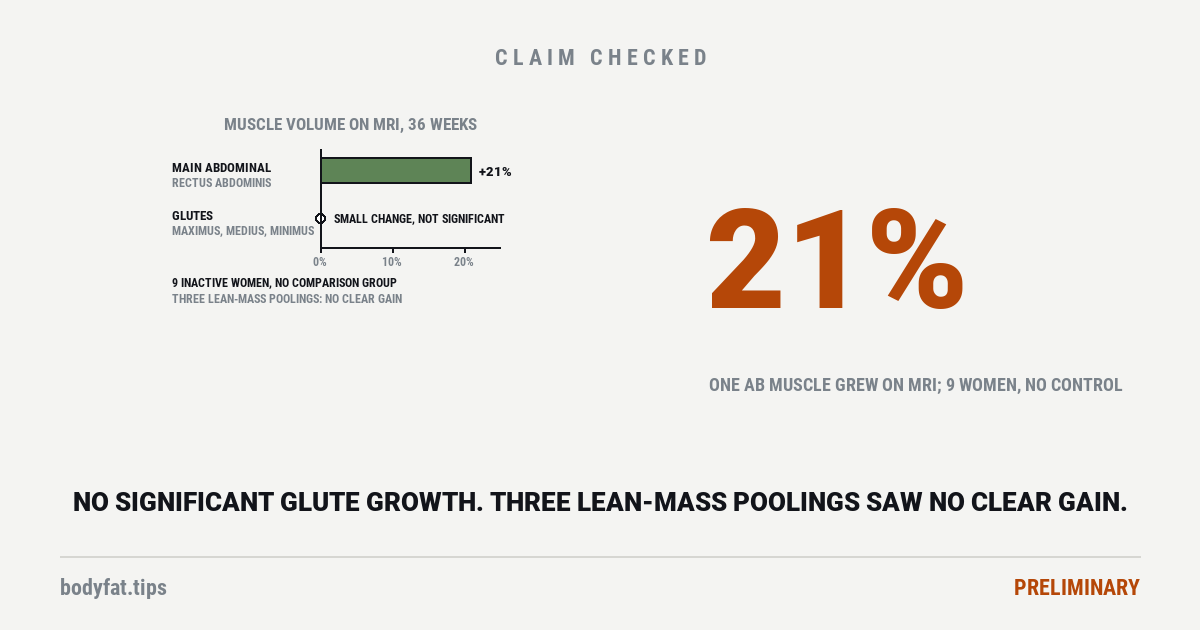
It makes people stronger, and the trials show that fairly consistently in adults over 60, at least on practical tests such as standing up from a chair. Whether it adds muscle you could measure is much less clear. Three poolings found no significant gain in lean mass, and on MRI, the most direct scan, nine months of Pilates grew the abs, while the hip muscles changed too little to tell from chance, in one small study with no comparison group.
So Pilates is strength training of a light kind, and the honest answer to “does Pilates build muscle” is: some, in places, and not much that the better scans could see. Here is what was measured, how Pilates did against weights, and where “long, lean muscle without the bulk” came from.
This is journalism, not medical advice. If you have an injury, osteoporosis, a recent pregnancy or a heart condition, ask your clinician which exercise suits you.
Does Pilates build muscle? What the scans found
Muscle growth, which researchers call hypertrophy, is measured best on an MRI scan, which images a muscle slice by slice and adds the slices up into a volume. The only MRI studies of Pilates training we found are two reports on the same group of women [4] [5] [6].
In 2012 a team in the Canary Islands scanned women who had not exercised for five years, before and after 36 weeks of studio Pilates on a mat and a reformer, twice a week [4]. Twelve started and three were dropped for missing sessions, so nine were scanned before and after [4]. The main abdominal muscle, the rectus abdominis or “six-pack” muscle, grew 21% in volume. The deeper side abdominals grew 8% on one side and not significantly on the other [4]. There was no comparison group, so the study cannot say how much of that time alone would have produced; the scan’s own measuring error was 1.6% [4].
Then the hips. A 2020 paper from the same team measured the programme’s effect on six hip and lower-back muscles, in what its own figures show to be the same nine women: the same ages, heights and weights as in 2012 [5]. Its title is “Hypertrophy of Lumbopelvic Muscles in Inactive Women”. What it found was small changes, none significant, with the glutes measuring slightly smaller after nine months rather than larger [5]. The authors’ reading is that Pilates did not load those muscles hard enough to grow them, and that its benefits come through the nervous system rather than through more muscle [5].
Most trials could not afford MRI. They measured lean mass, everything in the body that is not fat or bone, mostly muscle and water, with a DXA scan, a low-dose X-ray that separates fat, lean tissue and bone, or with bioelectrical impedance, a weak current passed through the body, the principle a body-fat scale uses. Small controlled trials have used ultrasound instead, mostly on the deep trunk and neck muscles Pilates targets, over four to twelve weeks. Most of those we read were in people with back pain, neck pain, Parkinson’s disease or urinary symptoms, or in women after a first childbirth, and most of those reported at least one muscle thicker after Pilates [6]. Two of those we read were in healthy adults and set Pilates against other exercise. In 57 people aged 20 to 29, six weeks of Pilates-based core training thickened three abdominal muscles at the side of the waist, measured at rest, more than walking did; in 34 adults about 30, who did mat Pilates or strength training for eight weeks, the ultrasound was used to gauge how hard two of those muscles worked during exercise, and the authors report that their thickness at rest did not change [6]. These trials say little about muscle elsewhere. Here is what the rest found.
| Trial | Who, how long, against what | Measured with | Muscle result |
|---|---|---|---|
| 2012 and 2020 [4] [5] | 9 women who had not exercised for five years; 36 weeks; no comparison group | MRI | Main abdominal muscle +21% in volume; deep side abdominals +8% on one side; six hip and lower-back muscles, small changes, none significant |
| 2019 [7] | 43 adults with overweight or obesity; 8 weeks; Pilates against walking | DXA | Lean mass +2.9 lb (1.3 kg) within the Pilates group; the groups did not differ significantly at the end |
| 2019 [8] | 60 women aged 60 to 80; 18 weeks; Pilates against light resistance training or nothing | DXA | Lean mass rose within both exercise groups (summary read) |
| 2024 [9] | 20 women aged 60 to 69 finished; six months; against nothing | DXA | Fat-free mass +0.4 lb (0.2 kg) with Pilates, −1.3 lb (0.6 kg) without; no significant difference |
| 2025 [10] | 19 women already doing Pilates; 10 weeks of reformer classes; no non-exercise group | DXA and impedance | DXA: whole-body lean +0.2 and +0.9 lb (0.1 and 0.4 kg), not significant; arm lean mass rose by a small, significant amount across both groups. Impedance: +4.9 and +5.7 lb (2.2 and 2.6 kg) |
| 2015 [11] | 23 women past menopause; 12 weeks; no comparison group | DXA | Trunk lean mass 20.48 kg before, 20.47 after; limb muscle index up 1.65% |
| 2022 [12] | 109 women over 60; 12 weeks; against nothing | Impedance | Muscle index: no significant difference between the groups |
| 2025 [13] | 47 women with overweight or obesity; 8 weeks of reformer; against nothing | Impedance | Muscle +1.5 lb (0.69 kg) with Pilates, +1.4 lb (0.65 kg) without; the paper reports a significant difference after adjusting for where each group started |
| 2026 [14] | 45 women past menopause with obesity; 8 weeks; supervised reformer against home mat and an education group | Impedance | Lean mass +5.1 lb (2.33 kg) on the reformer, on improbably narrow spreads; the authors say it may partly be water |
In the searches we ran, three meta-analyses, studies that combine trials to get one estimate, have pooled lean mass for Pilates, and none found a significant gain [6]. One, of three trials in adults with overweight or obesity, found a difference of 0.00 kg against doing nothing, with a confidence interval, the range the true average probably sits in, of 3.1 lb (1.40 kg) either way [15]. Another, of two studies in women, found 1.0 lb (0.46 kg) more lean mass after Pilates, with a range from 5.2 lb less to 7.2 lb more [16]. Both ranges include no difference at all, and the two poolings share one Turkish trial. The third, a review of 10 studies of mat Pilates whose summary does not say how many it pooled for lean mass, found it “not more effective” than doing nothing or other exercise for lean mass, among other measures; we read it as its summary [17].
Read together, and this is our reading: on the best scan, the muscle the classes work hardest grew, and the others it measured did not grow significantly. On DXA, gains turned up within some groups and not others, and none of the DXA trials we could read reported Pilates significantly ahead of a comparison group. The biggest gains come from impedance, and the one trial in the table that used both tools is the reason to doubt them, as the section on why below explains [10].
Is Pilates strength training?
On strength the picture is clearer. A 2021 pooling of trials in adults over 60 found that Pilates made people stronger than their usual activity or no exercise did, with an effect size of 0.63, range 0.44 to 0.81 [18]. An effect size is the gap measured in units of how much people varied, on a scale where 0.2 is small, 0.5 moderate and 0.8 large: a moderate gain. Its chart has 21 strength rows from 20 trials, and every one’s central estimate sits above zero, though many of the single trials’ ranges cross it [18]. The authors rate the certainty as moderate; their own chart marks every strength trial as at high risk of bias or with some concerns, none at low risk [18]. A 2018 pooling of nine trials of mat Pilates in older adults found the same direction, a larger effect of 1.13 for leg strength [19]. All five of its strength trials are also rows in the 2021 chart, so it is the same evidence counted again, not a second test of it [19] [18].
“Strength” in these trials is often a practical test. Before printing a pooled figure we look for the trial that carries the most weight. The biggest row in the 2021 chart is a 2020 Spanish trial of 107 women over 60, and its strength test was how many times each woman could stand up from a chair in 30 seconds: 12.9 to 15.6 with twelve weeks of Pilates, 12.4 to 11.0 without [20]. That is a real gain in something that matters at 70. It is not a bench press.
Not every pooling agrees. A 2024 review of older adults reported an effect of 1.18 that was not statistically significant [21]. Its charts show that figure is knee strength in three trials, with an I-squared of 93%: the share of the spread between the trials’ results that is more than chance would produce, where zero means they differed no more than luck allows [21]. Three small trials that disagreed sharply, one of them the other way, is why that result is not significant. Its other three strength charts against no exercise, for bending the knee, raising the thigh (hip flexion) and gripping, were not significant either, each from two or three trials [21]. The review files standing up from a chair under endurance, not strength, and there its charts favour Pilates more clearly: its chart for the arms’ endurance favoured Pilates significantly, on evidence the authors rated very low in quality, and their own summary says that evidence “shows that Pilates can improve” the arms’ endurance [21]. Even so, with the evidence rated low or very low in quality, they concluded that “it is not feasible to recommend Pilates exercises as a means to improve strength, endurance and muscle power” in older adults, and asked for more trials [21]. One more thing we found in that review: its chart for leg endurance swaps the two groups of the Spanish chair-stand trial, so the trial’s clear win for Pilates is drawn as a loss. We checked the trial’s own table [21] [20]. As printed, that leg chart’s pooled mean difference, the gap between the groups’ averages in the tests’ own units, was 1.60, with a range from −0.34 to 3.54, not significant. Re-pooled with the Spanish trial’s row set right, by our arithmetic, it is 2.68, range 1.44 to 3.91, in Pilates’ favour [21]. The review’s own summary also prints a 2.68 for the legs, with a range of 0.26 to 5.10; that one is its chart against other exercise, not against doing nothing, and the match with ours is a coincidence [21].
Across adult women of all ages, a 2026 pooling of three trials found no significant difference in grip strength, an effect of 0.04, though its largest trial, in women over 60, favoured Pilates [16]. Single trials of reformer classes have found grip gains: in a 2025 Turkish trial, right-hand grip rose from 46.0 to 51.5 lb (20.88 to 23.36 kg) after eight weeks of reformer classes and fell slightly in the women given no exercise [13].
For scale, the review behind our verdict on resistance training for seniors found an effect of 0.84 on strength from progressive resistance training. Different trials and different tests, so the comparison is rough, but it points where the head-to-head trials below point.
So is Pilates strength training? In the sense most people mean when they ask, yes: against doing nothing, it makes people stronger, adults over 60 most clearly, at the things the classes practise. Whether it is as good as lifting is a different question, and it has been tested.
Pilates vs weights: the head-to-head trials
A 2022 review set out to answer exactly this, pooling randomised trials of Pilates against other exercise [22]. It found no significant difference in strength: an effect of −0.29 for strength through movement, with a range from −0.69 to 0.10 [22]. Read its table, though. Of the 11 trials it pooled, two set Pilates against a strength-training group; the rest compared it with stretching, balance work, water aerobics, yoga, a vibration platform and the like [22]. In both of the two, strength through movement rose more with the resistance training [22].
| Trial | Who, how long | The resistance programme | What happened |
|---|---|---|---|
| 2019, Murcia, Spain [23] [8] | 60 women aged 60 to 80; 18 weeks | Light: chair stands, squats, light dumbbells and bands, 6 to 12 reps | Every hip strength measure taken through movement rose within the resistance group, not significantly more than with Pilates; Pilates beat no exercise on held hip extension; lean mass rose within both exercise groups |
| 2015 [24] | 34 women about 70; 8 weeks | Core resistance and balance work on a computer-controlled machine | Trunk strength, leg power and body composition all favoured the machine |
| 2021, Cyprus [25] | 42 inactive women; 3 months; assigned to groups, not described as randomised | Light-weight, high-rep group classes | Leg power, left-hand grip and body fat improved with the weights class, which beat Pilates on body fat and aerobic fitness; Pilates improved flexibility |
| 2021, Australia [26] | 115 women past menopause with low bone density; 8 months | Heavy: 5 sets of 5 at more than 80 to 85% of the most they could lift once | Leg and back strength rose more with heavy lifting |
| 2026, Korea [27] | 18 women with obesity, average age about 49; 8 weeks; Pilates done as a reformer circuit | A machine weights circuit at about 20-rep loads, raised every two weeks | Lean mass by impedance fell 1.3 lb (0.59 kg) with Pilates and rose 0.9 lb (0.43 kg) with weights; the difference was not significant |
| 2016, as tabulated in [22] | Older women | Strength training | Ten-rep-max score rose 7.5 with strength training and 4 with Pilates |
The heavy-lifting trial is the one with real weights in it, and it was not designed to ask the gym-floor question. It was a bone trial, and Pilates-based classes were its low-intensity comparison [26]. Over eight months, heavy lifting raised leg and back strength more, and raised spine bone density 1.9% against 0.1% [26]; our osteoporosis verdict covers the bone result. Both programmes were well tolerated, with four adverse events counted for heavy lifting and three for the Pilates-based classes [26]. Its senior author co-directs a bone clinic in Brisbane and holds shares in it, as the trial’s protocol declared before the results came in [28]. The trial’s sessions were held at that clinic, and the clinic sells the heavy programme under its own trademark [29] [26]. That is worth knowing when the heavy programme wins.
The rest are small, and most set Pilates against light resistance: chair-based exercises, bands and light dumbbells, the kind of programme a day centre can run. Against those, on strength, resistance training matched or beat Pilates: the machine trial and the heavy-lifting trial found significant advantages for the resistance programme, and in the Murcia trial the difference between the two on strength through movement was not significant [24] [26] [23]. On muscle, none of these trials reports a significant difference in lean mass either way, in the papers and summaries we read; the machine trial’s summary reports a body-composition advantage for the machine without saying which measure, and in the heavy-lifting trial’s full paper, lean mass by DXA did not differ significantly between the groups: about 0.4 lb (0.2 kg) gained with heavy lifting and 0.2 lb (0.1 kg) lost with the Pilates-based classes, among the women who completed the training [24] [8] [27] [26]. Pilates’ clearest strength result came on a held position: in the Murcia trial, hip extension held against a machine rose 35.5% with Pilates and 21.4% with the resistance programme, and only the Pilates group’s gain beat the no-exercise group significantly [23].
The comparison the gym-floor argument is about, reformer Pilates against weights that keep getting heavier, in adults under 60, has been tried once in the trials we found, and briefly. The Korean trial set a reformer circuit against a machine weights circuit, both at about 20-rep loads raised every two weeks, in 18 women with an average age of about 49, for eight weeks [27]. Lean mass by impedance fell 1.3 lb with the reformer and rose 0.9 lb with the weights, and the difference was not significant [27]. Eight weeks, nine women a group and a current-through-the-body measure cannot settle much, and they do not settle this. A 2011 trial set mat Pilates against strength training in 34 adults about 30, unsupervised, for eight weeks, and used ultrasound to gauge how hard two deep abdominal muscles were working rather than how big they were. Its authors concluded that Pilates “appears to increase TrA activity but only when performing Pilates exercises”, the TrA being the deepest abdominal muscle, and report that thickness at rest did not change [6].
Does reformer Pilates build more muscle than mat?
The AI answer says the reformer “offers more potential for muscle development” because its springs can be made heavier [1]. The reasoning holds as far as it goes. Muscle grows on sets that get close to the point where you cannot do another rep, whatever the load, and making an exercise harder is how you get there; our calisthenics verdict sets out the trials. Whether reformer classes do that more than mat classes, the trials we read do not settle.
The one trial in the table with a large reformer gain measured it by impedance. In 45 women past menopause, supervised reformer classes added 5.1 lb (2.33 kg) of lean mass in eight weeks, while the home mat group and an education group each lost a fraction of a pound [14]. The reformer group was supervised in person and the mat group mostly trained at home; the spreads in its lean-mass figures are under 4.4 lb (2 kg) in women weighing about 200 lb; and the authors themselves warn that short-term impedance changes may partly be water rather than muscle [14]. Where machine classes were measured by DXA, the gains were small: ten weeks of reformer work in women who already did Pilates moved whole-body lean mass by 0.2 and 0.9 lb, not significantly, and the São Paulo trial’s studio classes, on machines and mat, added 2.9 lb within the group without beating walking [10] [7]. The MRI study’s programme included the reformer, and the glutes did not grow significantly [4] [5].
Does Pilates make muscles long and lean?
This is the promise inside the word “lean”: Pilates builds long muscle rather than bulky muscle. We found no trial that measured whether Pilates makes a muscle longer [6]. One study did measure a muscle’s length, almost in passing. In the MRI study, the abdominal muscle that grew 21% in volume was 19.5 cm (7.7 in) long before and 19.5 cm after [4]. The measurement covered a fixed stretch of the body, from the pubic bone to the top of the lower back, so it could not have caught much lengthening. What it did catch is how the muscle grew: more volume in the same length. That is the thing “no bulk” promises to avoid.
Can a muscle get longer at all? Its fibre bundles, called fascicles, can. In a human trial of a hard lowering exercise for the hamstrings, the Nordic curl, they lengthened by 19% to 33% in different parts of the muscle after nine weeks, and a 2025 review of how fibres add length concluded that the trigger appears to be high force applied while the muscle is stretched, mostly on animal evidence, with too few human studies to be sure [30]. A reformer’s light springs at full stretch are not obviously that kind of force. That last sentence is our inference, and we mark it as ours.
As for bulk: the trials above found too little added muscle anywhere but the abs for bulk to be the question. The older worry, that lifting itself makes you bulky, is a claim our verdict on lifting and fat traces.
How often should you do Pilates?
The trials that found strength gains mostly ran two or three sessions a week, for one to six months [22] [16]. The abs in the MRI study grew on two sessions a week for nine months [4]. Those are the doses that were tested; more sessions for more muscle is not a comparison these trials made.
What body shape does Pilates give you?
In the nine women scanned for nine months, the abdominal muscles grew, the hips and glutes did not grow significantly, and body weight and body fat did not change significantly [4] [5]. Shape is mostly about fat, and on fat our weight-loss verdict has the measurements: a class burns about what a slow walk does, and the pooled trials that found people a few pounds lighter after Pilates lean on studies we doubt.
Does Pilates build muscle or burn fat?
A little of each, by the measurements, and not much of either. The fat side is our weight-loss verdict‘s question, and it rates Pilates for weight loss as preliminary; the muscle side is this page. If the goal is to keep muscle while losing fat, the Korean trial that set a reformer circuit against weights in women with obesity leaned a little toward the weights, not significantly [27].
What is the 80/20 rule in Pilates?
It is not a Pilates rule and not a research finding. Online it means either that diet does most of the work or that you eat well most of the time, and our weight-loss verdict traces both. This page does not rate it.
Who these studies were done on
Mostly women, and for strength mostly women over 60. The strength poolings are of adults over 60 [18] [21]; the women’s pooling ran from young adults to women over 60 [16]; the MRI study scanned nine sedentary women whose average age was about 36 [4]; the DXA trials enrolled older women, women already doing Pilates, and adults with overweight or obesity, men among them [9] [10] [7]. Most of the head-to-head trials against resistance training were in older women [23] [24] [26].
So read yourself against them. If you are over 60, the strength evidence is about you, and it is reasonably consistent: Pilates makes people better at standing up from a chair, and at holding positions, than doing nothing does. For grip, single trials found gains, but the two poolings we read that measured it found no significant difference, and neither did the newest pooling’s other strength charts [16] [21]. If you are younger and hoping to add size, the trials are few, small and mostly in women, and the best of them found growth in the abs and little elsewhere. Men appear in few of these trials; the São Paulo trial enrolled both sexes [7]. And how much muscle any one person gains varies widely whatever the method, as our verdict on how long muscle takes shows.
If Pilates makes people stronger, why does so little new muscle show up?
This section is the desk’s own reasoning, and it is labelled as such. The strength results and the muscle results do not quite match. Here are three ways they might fit, each rated.
Answer one: strength comes first, through the nerves. When someone starts training, part of the strength they gain is the nervous system learning to drive the muscle harder. In a 2017 trial of 60 older women, a month of Pilates raised knee strength about as much as a physiotherapy method of resisted stretching did, and changed the pattern of the electrical signal in the thigh muscles more [31]. The MRI team read their hip results the same way [5]. That a nerve change happens is measured, in one small trial; that it explains most of the gap between strength and size is a surmise.
Answer two: a light ceiling. Muscle grows from light loads as well as heavy ones on one condition: the set has to get close to the point where you cannot do another rep. That is the mechanism behind our calisthenics verdict, which is rated Supported. The MRI study’s programme was 5 to 10 repetitions per exercise, on two or three springs [4]. Google’s AI answer itself says many Pilates moves bring a burning or shaking feeling rather than true failure [1]. And the muscle that grew, the rectus abdominis, is the one the method curls and holds most often [4]. The near-failure rule is measured, in the trials behind our calisthenics verdict; that most Pilates sets stop well short of it is a surmise, not a measurement.
Answer three: the scale reads water. Several of the trials that report the bigger muscle gains measured them by impedance, the method a body-fat scale uses [13] [14]. In a 2025 trial that measured the same women both ways, ten weeks of reformer Pilates added 4.9 to 5.7 lb (2.2 to 2.6 kg) of lean mass by impedance and 0.2 to 0.9 lb (0.1 to 0.4 kg) by DXA, which was not significant; after the training, impedance read lean mass 6.6 lb (3.0 kg) higher than DXA, as body water rose [10]. That is measured, in 19 women; that the same inflation explains the impedance gains in other trials is a surmise. Our verdict on body-fat scales explains why a single reading on those devices can be far off.
Put the three together and here is what we think is true, stated plainly so you can disagree with it: Pilates is strength training with a low ceiling: it makes you stronger at what you practise, grows the muscle it works hardest, and the cheap scan most trials used flatters the rest. That is a fine reason to do it. It is not a reason to expect it to do a weight room’s job.
What we could not find, and would like to: a trial that sets reformer Pilates against a progressive weights programme for six months or more, in adults under 60, women and men, with muscle measured by MRI or ultrasound in the arms, legs and trunk [6]. The nearest in sight is a Brazilian registration of six months of Pilates against a mixed exercise programme in 100 older adults, with DXA; it was listed as not yet recruiting when we looked [6]. If you know of the trial we describe, the corrections line on this site is open.
Where “long, lean muscle without the bulk” came from
Pilates began as strength training. Joseph Pilates called his method Contrology and aimed it, a 2022 review notes, at building strength with body weight; today it is better known for flexibility and balance [22]. The strength claim is the old one, and the trials largely back it.
The “long, lean” promise we could not trace to a first use [6]. By September 2025 a US national newspaper’s health column called it a promise that has been around “nearly as long as Pilates itself”: muscles that lengthen and tone into a dancer’s physique [32].
The research came after the promise. The 2012 MRI paper, nine women and no comparison group, is titled “Marked effects of Pilates on the abdominal muscles” [4]. The 2020 follow-up on the same women is titled for hypertrophy, and found no significant growth in any muscle it measured [5].
Then the pitch. A national gym chain’s article of January 2026 promises “lean, functional muscles” under a heading about building strength without bulk, and calls holding a leg lift longer than you wanted Pilates’ version of progressive overload [2]. A New Mexico gym chain tells readers Pilates builds strength without putting on much muscle mass [3]. Google’s AI answer, on 22 October 2026, tells beginners Pilates will help them build noticeable lean muscle, which goes further than the prescription-discount site it cites: that site says Pilates may lead to small increases in muscle mass, more likely in someone new to strength training, and its reference list includes a 23-woman pilot study with no comparison group [1] [11].
And it sells. The AI answer cites or links a fitness app offering a seven-day free trial, two gym chains, the prescription-discount site, a clinic chain that sells clinical Pilates, a Pilates instructor-training school and two social-media videos [1]. One of the gym chains’ sites also runs a physician-led arm selling testosterone and peptides [3].
None of this is aimed at anyone doing Pilates. It is a good class, and the trials say it makes people stronger. It is the word “lean”, sold as if it were a kind of muscle, that owes you a correction.
What this is rated, and what the rating covers
Preliminary — for the claim that Pilates builds muscle.
It is rated Preliminary because the evidence that Pilates adds muscle you could measure is small and conflicting. Three poolings found no significant gain in lean mass, against doing nothing or, in one, other exercise as well [15] [16] [17]. On MRI, nine months grew the abdominal muscles of nine women, with no comparison group, while their hips and glutes changed too little to tell from chance [4] [5]. DXA trials found small gains within some groups and not others, and none we could read put Pilates significantly ahead of its comparison group [7] [8] [9] [10] [11]. The larger gains come from impedance, which in a trial that checked it against DXA read 6.6 lb too high after training [10] [14] [13]. There is evidence in its favour, so it is not Unsupported; it is not consistent, so it is not Supported.
Each narrower claim, rated alone, in words. That Pilates makes adults over 60 stronger than doing nothing, at least on practical tests such as standing up from a chair: Supported. Every one of the 21 rows in the larger pooling’s chart points the same way, and an earlier pooling agrees, though its five strength trials are all inside that chart; the trials are small and mostly at high risk of bias, and their “strength” is often a chair-stand test [18] [19] [20]. The limits are real. The newest pooling in older adults found no significant difference on any of its four strength charts against no exercise, each of two or three trials, and its authors concluded that “it is not feasible to recommend Pilates exercises as a means to improve strength, endurance and muscle power” in older adults, on evidence they rated low in quality for strength and very low for the arms’ endurance [21]. Yet it files chair stands under endurance, where its chart for the arms favoured Pilates significantly, and its chart for the legs does too once a swapped row is set right, by our arithmetic [21]. For grip, the two poolings we read that measured it found no significant difference [16] [21]. We keep this rating at Supported because the two reviews differ on how sure to be, not on which way the practical tests point: on those tests the newer review’s own charts lean the same way as the larger pooling, whose authors rated their certainty on strength as moderate [18]. It would move down if a trial at low risk of bias, or a pooling of such trials, found no gain on those tests; the larger pooling’s chart has none at low risk [18]. That Pilates builds as much muscle and strength as lifting weights: Preliminary, with the evidence leaning against; in the small head-to-head trials, resistance training matched or beat Pilates on strength, Pilates led only on a held-position test, and in the one heavy-lifting trial we found, it lost on strength; on muscle, none reported a significant difference in lean mass either way in what we read [23] [8] [24] [25] [27] [26] [22]. That Pilates makes muscles long and lean, without bulk: Unsupported, of the untested kind; we found no trial that measured whether it lengthens muscle, and the one muscle a scan showed growing grew in volume over the same length [4] [6].
What is not rated here: Pilates for back pain, which has its own verdict; weight loss, which has another; and the frame in the section above, which is this desk’s reasoning from the evidence rather than a result the evidence delivered. It is marked as ours so that you can weigh it as ours.
This is journalism, not medical advice. How we read a study, and what each tier means, is set out here.
Corrected on 23 October 2026, shortly after publication. We said the heavy-lifting bone trial’s body-composition results were in a paper we could not read. A copy was open in the Internet Archive, and we have now read it: lean mass did not differ significantly between the heavy-lifting and Pilates-based groups. That fits what this page already said of the other head-to-head trials. No finding or rating changes.
- Does Pilates Help You Lose Weight? A Little, Maybe. It Burns Like a Slow Walk
preliminary - Vibration Plate Benefits: The Three Biggest Randomised Bone Trials We Found With Results, 1,086 People, Showed No Clear Gain. Stronger Legs Are Another Matter.
preliminary - Exercise for Osteoporosis: Lifting and Jumping Left Women About 1% Ahead on Bone Density, by Our Reading. Fewer Fractures Is Less Certain
supported