Tirzepatide vs Semaglutide: Tirzepatide Lost 20.2% to Semaglutide’s 13.7% in the Only Head-to-Head Obesity Trial. Only Semaglutide Has Beaten Placebo on Heart Outcomes.

Two injections, two companies, one question typed fifty thousand times a month. Tirzepatide is Zepbound (and Mounjaro, the diabetes brand), made by Eli Lilly. Semaglutide is Wegovy (and Ozempic), made by Novo Nordisk. Both are copies of a gut hormone that tells your brain you have eaten; tirzepatide copies a second one as well.
The scale has picked a winner, and the margin is not close. But the scale is not the only instrument, and the question a doctor is actually answering when the prescription pad comes out is a different one. This page has both.
Is tirzepatide better than semaglutide for weight loss?
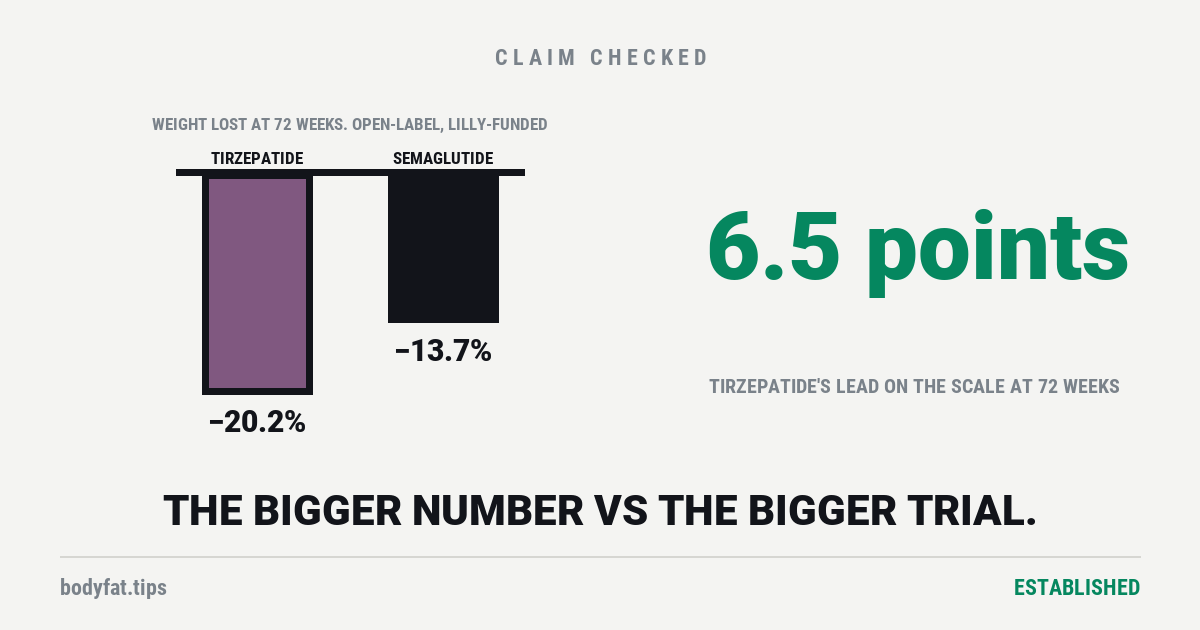
On the scale, yes, by a wide margin. The only trial to put the two drugs head to head in people with obesity and no diabetes enrolled 751 adults, two-thirds of them women, average age 45, and ran each drug up to its highest tolerated dose for 72 weeks [1]. Tirzepatide: −20.2% of body weight. Semaglutide: −13.7% [1]. The plausible ranges — −21.4 to −19.1 against −14.9 to −12.6 — do not come close to touching. Waists: 7.2 in (18.4 cm) off against 5.1 in (13.0 cm) [1]. More people on tirzepatide crossed every line the trial set — 10%, 15%, 20%, 25% of body weight lost [1].
Two things about that trial belong in the same breath. It was open-label: nobody was blinded, every participant and every doctor knew which drug was in the pen. And it was run and paid for by Eli Lilly, the company that makes the winner [1]. Neither fact makes the result wrong. Both are reasons to check it against evidence the sponsor did not control, and there is some.
Before anyone had compared the drugs in obesity, each had been run against a placebo, double-blind, by its own maker. Tirzepatide at its top dose took off 20.9% in 72 weeks [3]; semaglutide took off 14.9% in 68 [4]. Different trials, different people, and you cannot subtract one from the other — but the gap those two blinded trials predicted is almost exactly the gap the head-to-head found. A second head-to-head, in people with type 2 diabetes and also open-label and Lilly-run, found tirzepatide ahead by 4 to 12 lb (1.9 to 5.5 kg) depending on dose, against a lower semaglutide dose than the obesity one [2].
So the direction is as solid as this kind of evidence gets. The exact size of the lead rests on one unblinded trial, and the page will come back to what that means.
What makes you less sick, semaglutide or tirzepatide?
Almost nothing separates them, and the trial’s own results record says so in counts [1].
| Event | Tirzepatide (374) | Semaglutide (376) |
|---|---|---|
| Nausea | 44% (163) | 44% (167) |
| Vomiting | 15% (56) | 21% (80) |
| Diarrhoea | 24% (88) | 23% (88) |
| Constipation | 27% (101) | 28% (107) |
| Injection-site reaction | 9% (32) | 0.3% (1) |
| A serious adverse event of any kind | 5% (18) | 3% (13) |
| Stopped the drug because of a side effect | 6 people | 6 people |
| Finished the 72 weeks | 85% (319 of 375) | 85% (319 of 376) |
Nausea hit 44% of both groups. Diarrhoea and constipation, the same. Vomiting was somewhat less common on tirzepatide, 15% against 21%; injection-site reactions were more common, 9% against a third of one percent [1]. Six people in each group quit over a side effect. Eighty-five percent of each group finished the 72 weeks [1]. If you are choosing on tolerability, the honest answer is that the trial could not tell them apart in any way that would change a decision, and most of what either drug does to your stomach happens while the dose is being stepped up [1].
Do you lose more muscle on semaglutide or tirzepatide?
Neither, and both. A 2025 analysis pooled 22 trials of this drug class that measured body composition [8]. About a quarter of the weight lost was lean mass — everything that is not fat, mostly muscle plus bone and water — which is roughly the share ordinary dieting costs too [8]. Tirzepatide at 15 mg and semaglutide at 2.4 mg were the two most effective drugs for weight and fat, and both sat among the least effective at holding on to lean mass [8]. The bigger the loss, the more lean goes with it, and neither drug has a trick for that. What does have a trick is lifting: a calorie deficit with resistance training held lean mass steady in 114 trials, and protein above the usual recommendation kept an extra 0.79 lb of it. Those apply to a deficit made by a drug exactly as much as one made by a diet.
Why would a doctor prescribe semaglutide instead of tirzepatide?
This section is the desk’s own reasoning, and it is labelled as such. Tirzepatide wins by six and a half points on the scale. Semaglutide is still prescribed every day by people who have read that trial. Here are three reasons that reconcile them, with the evidence for each.
Answer one: the heart trial. Semaglutide has been tested against placebo for the outcome that actually kills people. Seventeen thousand six hundred and four adults aged 45 and over, all with existing heart disease and a body-mass index of 27 or more, none with diabetes, took semaglutide or placebo and were followed for an average of three years and four months [5]. Death from a cardiovascular cause, heart attack or stroke: 6.5% on the drug, 8.0% on placebo — a hazard ratio of 0.80, meaning a fifth fewer events, with a plausible range of 0.72 to 0.90 that never reaches “no effect” [5]. Tirzepatide has a completed heart trial too, and it is worth being exact about what it showed [9]. SURPASS-CVOT gave 13,299 people with type 2 diabetes and existing heart disease either tirzepatide or dulaglutide — a rival injection that had itself already beaten placebo — double-blind. Cardiovascular death, heart attack or stroke: 12.2% on tirzepatide against 13.1% on dulaglutide, a hazard ratio of 0.92 with a range of 0.83 to 1.01, which met the bar for no worse than and missed the bar for better than [9]. So tirzepatide has matched a heart-protective drug in diabetes; it has not beaten a placebo, and it has not been tested at all for heart outcomes in people without diabetes. That trial exists: 15,374 people enrolled, running, no results, and the registry’s estimated completion is October 2027. So in September 2026 the position is this: only semaglutide has beaten placebo on the outcome that actually matters, and it did so in the kind of person this page is about. For a patient with heart disease, that is not a tiebreaker; it is the whole decision, and it is measured, not surmised. One fence: that trial enrolled people who already had cardiovascular disease, and what semaglutide does for a 35-year-old with none is not something it measured.
Answer two: the number after you stop. Both drugs are rented, not bought. Six hundred and seventy people who had lost 20.9% on tirzepatide were randomised to keep taking it or to switch to placebo for a year [6]. The placebo group regained 14.0% of their body weight in that year; the drug group lost a further 5.5% [6]. Only one in six people off the drug kept even 80% of what they had lost [6]. Pooling the semaglutide and tirzepatide trials inside an eight-trial review of stopping these drugs, the average regain was 21 lb (9.69 kg) — the plausible range for that average runs from 13 to 30 lb — and the more you had lost, the more came back [7]. So the comparison that matters is not 72 weeks; it is years, on whichever drug you can stay on and afford. A bigger loss is also a bigger loan. This is measured, not surmised.
Answer three: everyone knew which drug they had. Both head-to-head trials were open-label and both were run by the company whose drug won [1] [2]. Weight on a scale is not a subjective outcome, so blinding matters less here than for pain or mood. But effort, eating and dropout can all move when you know you are on the “stronger” drug — and dropout, at least, did not: 85% of each group finished [1]. The gap also matches what the two blinded placebo trials, run by rival companies, predicted [3] [4]. Our reading, marked as ours: the lead is real, and whether it is exactly six and a half points is not settled, because nobody has run the blinded version.
Put the three together and here is what we think is true, stated plainly so you can disagree with it: tirzepatide has the bigger number. Semaglutide has the bigger trial. Choose by the outcome that has evidence for someone like you — a smaller waist by next year, which both deliver and tirzepatide delivers more of, or fewer heart attacks over the next four, which only semaglutide has been shown to do against placebo, and only in people who already had heart disease; tirzepatide has so far matched a heart-protective rival in diabetes, not beaten a placebo.
What we could not find, and would like to: a blinded head-to-head in obesity; the tirzepatide heart trial in people without diabetes, which the registry dates to late 2027; and a trial that stopped both drugs side by side and watched who regained what. If you know of any of the three, the corrections line on this site is open.
Why are people stopping Wegovy? And what happens when they do
In the heart trial, 16.6% of people on semaglutide stopped permanently because of side effects, against 8.2% on placebo [5] — over three years, in older people with heart disease. In the 72-week head-to-head, six people per group did [1]. Cost, supply and the end of insurance coverage are the other reasons people give, and none of those is in a trial. What happens next is: the weight comes back, most of it, within a year [6] [7] — on either drug.
Which GLP-1 has the fastest weight loss? How long to lose 20 lb on tirzepatide?
At 72 weeks, tirzepatide. On the top dose in its placebo trial the average person, who started at 231 lb (104.8 kg), had lost about 48 lb [3] — our arithmetic from the trial’s percentage. More people on tirzepatide than on semaglutide had crossed 10%, 15%, 20% and 25% by the end of the head-to-head [1]. What none of the published abstracts gives is the week at which the twentieth pound arrives, so this page does not either. Anyone who tells you a week number has either read the full curves or made it up.
Why do people switch from Wegovy to Zepbound?
Because of the six and a half points, mostly, and sometimes because of supply or price. Whether switching gets you the extra points is not something any trial has tested: every head-to-head started people fresh. We could not find a switching trial, and we would rather say so than extrapolate.
Where “Zepbound crushes Wegovy” came from
The first head-to-head was in diabetes, in 2021 — open-label, Lilly-run, semaglutide at a dose below the one later used for weight [2]. Tirzepatide won it. In 2022 its placebo trial in obesity reported 20.9% [3] against semaglutide’s 14.9% from the year before [4], and a comparison nobody had actually run became a headline everybody wrote. This site wrote it too: the page this one replaces was called “Zepbound crushes Wegovy in weight-loss showdown.” The showdown had not happened yet. It happened in 2025, and the number held [1]; the word “crushes” was doing work the evidence never asked it to.
Then the comparison became a sales page. Ask Google (we did, on 14 September 2026) and among the pages its AI Overview cited were the NEJM papers and the Cleveland Clinic — and six telehealth prescribers and weight-loss clinics, and two companies that sell lab tests. The comparison is being answered by the people who sell the prescription. “Nature’s Ozempic” and its fibre cousin are this site’s verdicts on what gets sold to people who cannot get either drug.
None of this is aimed at anyone on either injection. You are taking the best-evidenced weight-loss drugs there have ever been. It is the word “crushes” — ours included — that owes you the rest of the sentence.
What this is rated, and what the rating covers
Established — for the claim that tirzepatide produces more weight loss than semaglutide at the doses used for obesity.
It is rated Established because the one head-to-head in obesity found a gap whose plausible ranges do not overlap [1]; a second head-to-head, in diabetes, points the same way [2]; and the two double-blind placebo trials, run by rival companies, predicted the same gap independently [3] [4]. It is rated with both head-to-heads named as open-label and sponsor-run, on the page and in the panel, because a reader is entitled to weigh that.
What is not rated here: which drug is safer over years, since tirzepatide’s outcomes trial in people without diabetes has not reported, its diabetes trial matched rather than beat a rival drug, and the two were indistinguishable on side effects at 72 weeks [1]; what happens when you switch; compounded versions of either drug, which no trial on this page tested; price; and the frame in the section above, which is this desk’s reasoning from the evidence rather than a result the evidence delivered. It is marked as ours so that you can weigh it as ours. This is journalism, not medical advice; the decision between these drugs belongs in a room with a clinician who knows your heart. How we read a study, and what each tier means, is set out here.
The headline and the derived section understated tirzepatide’s heart-outcomes evidence on the day this page was published, and an independent editorial review caught it. The page said semaglutide had the heart trial and tirzepatide’s was running until 2027. Tirzepatide’s placebo-controlled trial in people without diabetes is still running, but its completed trial in type 2 diabetes, SURPASS-CVOT, was published in December 2025: 13,299 people, double-blind against dulaglutide, a hazard ratio of 0.92 (0.83 to 1.01), which met non-inferiority and missed superiority. The page now says that, and the headline now says what is true: only semaglutide has beaten placebo on heart outcomes.
Also changed: the regain figure of 21 lb was attributed to eight trials when it is the semaglutide-and-tirzepatide subgroup of an eight-trial review, and its 13-to-30 lb range is the plausible range for that average, not the spread of what individuals regained; the side-effect table’s caption now says its rows are a selection from the events reported in at least 5% of either group and explains its denominators; and the AI Overview observation is dated. The rating is unchanged.