High Cortisol Symptoms: Purple Stretch Marks Count for More Than Tiredness.

There is a list of high cortisol symptoms doing the rounds. Tiredness. Belly fat. Poor sleep. Irritability. Cravings.
Here is what a clinical reference says should send a doctor looking. Read it and notice how little it resembles that list.
• Bruising from almost nothing, especially in someone young
• Weakness in the large muscles close to the trunk — struggling out of a chair, or with stairs
• A persistently flushed face
• Osteoporosis, high blood pressure or diabetes arriving unusually early
• An adrenal lump found by accident on a scan
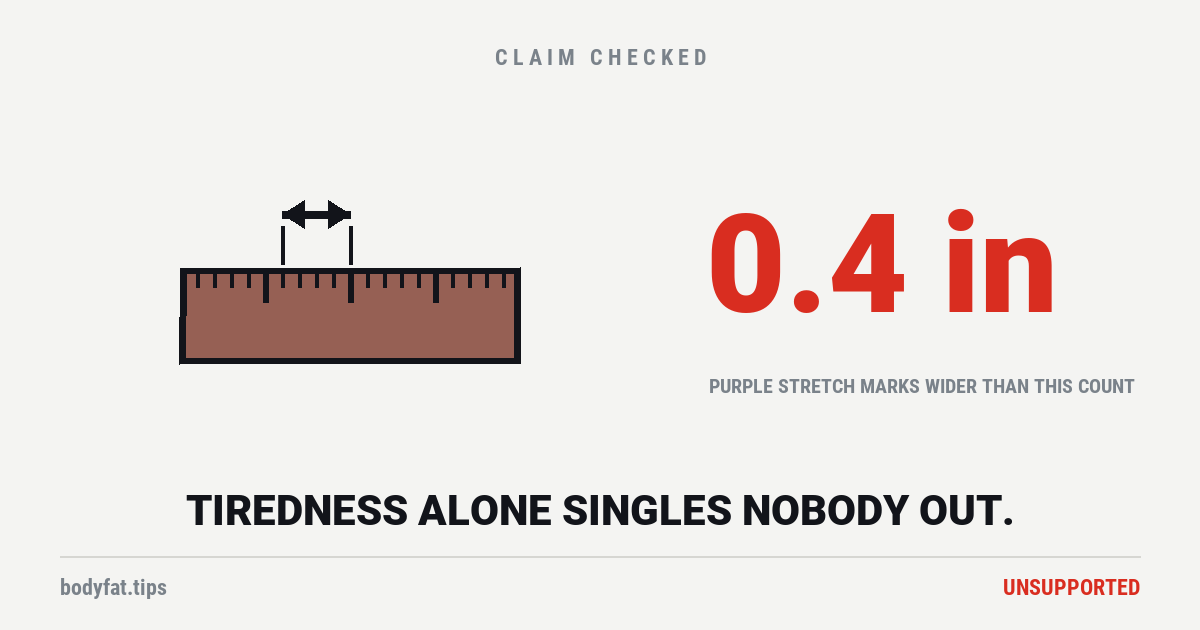
Purple stretch marks wider than about 0.4 in (1 cm). Bruising from nothing. Weakness getting out of a chair. [1]
Tiredness is not on that list. It is on a longer one.
The reference cites the Endocrine Society’s guideline for diagnosing Cushing syndrome for that list, and the guideline sorts the features of the disease into two groups. [3] In one are the signs that best pick it out: easy bruising, a flushed face, weak muscles near the trunk, stretch marks (especially reddish-purple ones more than about 0.4 in, or 1 cm, wide) and, in children, weight gain while growth slows. In the other are features it calls common in the general population and less discriminatory, which is to say they do little to tell the disease from ordinary life. Fatigue is in that group. So are weight gain, insomnia, irritability and changes in appetite. [3]
Which is, near enough, the list doing the rounds. So tiredness is a real feature of the disease. What it cannot do on its own is single anybody out.
Somebody measured that. At a referral centre in Munich, researchers recorded the main reason each of 377 people had been sent in with suspected Cushing syndrome. Tiredness was the main reason for 3 of the 93 who turned out to have it (3%) and for 15 of the 284 who did not (5%), no difference the study could tell from chance. Having more than three typical symptoms at once was the main reason for 15 of the 93 (16%) and for 3 of the 284 (1%). [4]
Two more things from the guideline, and they matter if you are reading this about yourself. The best signs only work in one direction: the heading over them says most “do not have a high sensitivity”, the researchers’ way of saying that many people who have the disease do not show them. So having no purple stretch marks does not rule it out. [3]
And the signs are not the only way in. The guideline names four groups of people doctors should test: those with features unusual for their age, such as osteoporosis or high blood pressure in someone young; those with “multiple and progressive features”, meaning several at once and getting worse; children whose weight climbs while their growth in height slows; and people with an adrenal lump found by chance on a scan. It recommends against widespread testing of anyone else, and the Munich team, checking that advice against their own patients in a study published in 2022, judged it still valid. [3] [4]
How rare is the real thing
Endogenous Cushing syndrome — the body making too much cortisol on its own — is described in a 2026 endocrinology review as, plainly, “a rare disorder”. [2]
How rare depends on who counted, and on how.
Where researchers went through patients’ medical records, the answer is a few people in a million. A 2021 review found three such counts, in Denmark, New Zealand and western Sweden, and they put the disease as a whole at 1.8 to 3.2 new cases per million people a year (the lowest, New Zealand’s, left out the forms caused by cancers). [5]
One US study came out far higher for the disease as a whole: 39.5 to 48.6 new cases per million a year. [6] It did not count from medical records. It counted insurance claims: people under 65 in a database of commercial health plans who had two or more claims carrying the diagnosis. It was paid for by Novartis, which held the US approval for a Cushing’s drug at the time, and its own summary says the figures still need confirming in other databases. [6] [7]
What happens when somebody does check? In Sweden, researchers identified 1,317 people carrying a Cushing’s diagnosis code in the national patient register and went back to their medical records. A quarter of them had a diagnosis that had nothing to do with it. For the commonest form, the one that starts in the pituitary gland at the base of the brain, their record-checked count came to 1.6 new cases per million a year. The US claims study had put that same form at 6.2 to 7.6, which the Swedish authors called a likely overestimate. [8] [6]
So the counts do not agree, and we are not going to pretend they do. But they were not made the same way, and the one that stands apart is the one built on insurance claims. Take the highest figure anyway and you are still describing something that happens to roughly one person in twenty thousand in a year. Take the record-checked counts and it is two or three in a million; a 2023 review in JAMA puts the range a little wider, at 2 to 8. [9]
Those are new cases in a year. The number of people living with the diagnosis is a different, larger one: 57 per million in western Sweden and 79 per million in New Zealand, by the 2021 review, or roughly one person in 13,000 to 18,000. [5]
The symptoms cannot tell you, and the tests are built to over-flag
Here is the sentence that should end the symptom-list genre: “The history and physical examination findings are often insufficient for diagnosing hypercortisolism, and diagnostic laboratory tests are typically required for accurate diagnosis.” [1]
And the reason is stated just as plainly. The clinical presentation is “often nonspecific”, so the first round of laboratory tests (cortisol in late-night saliva, in urine collected over 24 hours, or in blood the morning after a tablet of a steroid called dexamethasone) is deliberately built for high sensitivity and lower specificity — designed to catch everyone who might have it, at the cost of flagging many who do not. [1]
A test built to over-flag is a reasonable thing for a doctor to order for somebody with wide purple stretch marks. Pointed at everyone who feels tired, it misfires, and the guideline says why: the disease is rare, the conditions that overlap with it (diabetes, obesity, depression) are common and the tests have their limits, so “the risk of false-positive test results is high” unless testing is kept to people more likely to have the disease. [3] A false positive is a test that says yes to somebody who does not have it.
The 2026 review makes the same point from the other side: Cushing syndrome is “likely underdiagnosed because many clinical signs and symptoms are non-specific and overlap with those of common conditions.” [2] Rare, and missed — because it looks like ordinary life until it does not.
Weigh that sentence knowing who paid. The review’s medical writing was funded by a company that sells drugs for the disease. [2] The clinical reference, whose authors declare no relevant financial relationships, puts it both ways: the signs are non-specific enough to leave hypercortisolism, the medical word for too much cortisol, “both overdiagnosed and underdiagnosed, depending on the clinical context.” [1]
Your cortisol may genuinely be raised, and it still is not this
This is the part the supplement adverts are half-right about, and it is worth being fair.
Cortisol really does go up in ordinary circumstances. The reference lists them: “transient or physiologic states such as severe stress, depression, alcoholism, and poorly controlled diabetes mellitus.” [1]
So somebody can have measurably high cortisol and not have Cushing syndrome. The reference draws the line explicitly: “While all patients with Cushing syndrome have hypercortisolism, not all patients with hypercortisolism meet diagnostic criteria for Cushing syndrome.” [1]
Which means a raised reading is not a diagnosis. It is a question. And if it is being driven by a period of severe stress or by drinking, the answer is not a capsule aimed at the number.
And the test is harder than a home kit implies
Cortisol is not a level. It is a rhythm — high in the morning, falling across the day.
The review is blunt about what that does to measurement: traditional monitoring relies on “single-time-point measurements or a cumulation of measurements, which are unable to capture the complete daily rhythm of cortisol fluctuations.” [2] And diagnostic testing “can be complex and challenging, especially in milder cases.”
That is written about hospital endocrinology. It is not a criticism of you for finding it confusing; it is a description of a genuinely difficult measurement being sold as a simple one.
The commonest cause is being given it
One last thing, and it echoes what we found writing about cortisol detoxes from the opposite direction.
The most common source of too much cortisol, or of the medicines that act like it, is not a tumour and not stress. It is steroid medicine prescribed for something else: corticosteroids, the kind that act like cortisol and not the muscle-building kind, whether taken as tablets, inhaled, rubbed on the skin or injected. [1] [3]
If that is you and something has changed, it has a real cause with a real name, and it belongs in front of the doctor who prescribed the medicine. It is not a reason to stop taking it, or to cut the dose, on your own. The clinical reference says why: stopping these medicines suddenly is dangerous, because it can leave the body unable to make enough cortisol of its own, which can be life-threatening. They are reduced in steps, under medical supervision. [1]
The verdict
Unsupported, for the idea that the circulating symptom lists identify high cortisol. They cannot. The reference says the history and examination are often insufficient even in a clinic, and the signs that best pick the disease out are physical and measurable — purple stretch marks more than about 0.4 in (1 cm) wide, not a difficult month. Tiredness is on the guideline’s list of features. On its own it is not one of the guideline’s reasons to test.
None of which means feeling exhausted is imaginary. It means the cause of it is genuinely unknown to you from the outside, and picking the one explanation that has a product attached is the worst available way to narrow it down.
If anything on that clinical list describes you — particularly the wide purple stretch marks, the easy bruising, or high blood pressure and diabetes arriving early — or if several of the ordinary features have turned up together and keep getting worse, that is worth a doctor’s appointment, not a supplement. And if none of that is you, the tiredness is still real and still worth investigating. Just not here, and not with a capsule.
Journalism, not medical advice. We read the clinical references so we could tell you what is in them. A doctor can examine you, which we cannot.
Related: cortisol detox · how to lower cortisol · cortisol face · ashwagandha benefits · every claim we’ve checked
The funding row, the rarity figures and the headline on this page were corrected on 30 September 2026 after an independent editorial review. The panel said industry funding was “not stated in the sources read”. It was stated. Medical writing and editorial help on the 2026 review we quote was paid for by Recordati Rare Diseases, which sells two drugs for the disease, and the journal had added that sentence to the paper in a correction published on 6 April 2026, four months before this page went up. The high US figure for how common the disease is came from an insurance-claims study paid for by Novartis, which held the US approval for a Cushing’s drug at the time. The page also said the counts differed “by a factor of about thirty”. That set a Danish figure for the pituitary form alone (1.2 to 1.7 new cases per million people a year) against the US figure for every form (39.5 to 48.6), which compares two different things. The section now says what each study counted and how, gives the record-checked range, and prints no ratio. A clause saying a great many more people are buying cortisol supplements had no source and is gone.
The headline said doctors look for purple stretch marks, “Not Tiredness”, and the page asked readers to notice what was missing from the clinical list. That was firmer than the guidance. The Endocrine Society’s guideline lists fatigue among the features of the disease, in the group it calls common and less discriminatory; it says most of the best signs are absent in many people who have the disease; and it tells doctors to test people with several features that are getting worse. The headline now makes the comparison the guideline makes, and the page says all three and cites the guideline, which it had not. Also changed: the steroid paragraph now says which medicines it means and why they are not stopped suddenly; the passage on over-flagging now says it is the laboratory tests that are built that way; the video count is now a count by reading (10 of 25 with a shopping, affiliate, sponsor or discount link or code, where an automated match had given 12); the search figure is labelled as US Google searches, with its date; and the StatPearls entry carries its authors, its date and a link. The rating is unchanged.