Turmeric Benefits: Capsules May Take the Edge Off Knee Arthritis Pain. The Biggest Numbers Came From the Smallest Trials.

“Updated science-backed evidence behind Turmeric (Curcumin); especially when it comes to osteoarthritis, metabolic syndrome, insulin resistance, diabetes, PCOS, fatty liver.” That is the description of “Turmeric (Curcumin) Do’s and Don’ts | Latest Evidence”, posted on 20 March 2023 by a physician’s health-video channel whose creator describes themself as board-certified in internal and obesity medicine. The video had 997,818 views when we read its numbers on 10 October 2026 [1]. Its description lists no references and links to no product [1].
Plenty of people are asking. In the United States, “turmeric benefits” is searched about 110,000 times a month, “turmeric for inflammation” and “turmeric side effects” about 12,100 times each, “curcumin benefits” about 9,900 times, “does turmeric help arthritis” about 720 times and “turmeric for fatty liver” about 480 times a month (from a paid keyword database, pulled 10 October 2026) [2].
The video names six conditions. This page weighs all six and rates the one with the most trials behind it: osteoarthritis, the wear-and-tear arthritis in which the cartilage cushioning a joint thins, most often in the knee.
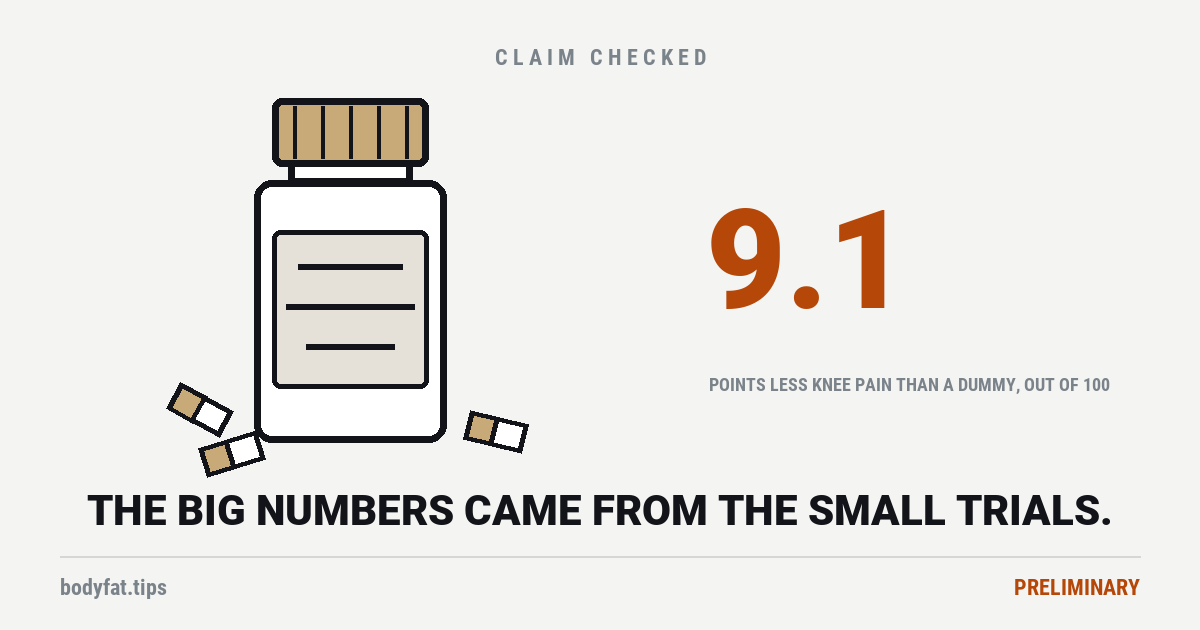
Turmeric extract may take the edge off knee arthritis pain. In a double-blind trial run by university researchers in Tasmania, 12 weeks of a turmeric extract left knee pain 9.1 points lower than a dummy capsule did, on a 100-point scale [3]. That is about the 9-point line a large review of painkiller trials uses for the smallest difference a patient notices, drawn from studies that asked people with osteoarthritis what change they noticed [4]. It is also half the 18-point difference the trial was designed to detect, and the range the true answer probably sits in runs from under half a point to almost 18 [3].
The big numbers come from small trials, mostly paid for by the extract’s maker. Pooled, the trials against a dummy show an effect researchers call large, graded very low certainty [5]. In the newest pooling whose trial-by-trial numbers are public, the biggest trial found the smallest effect [6].
For blood sugar, insulin resistance, fatty liver and PCOS, the evidence is small and split. Most of the trials come from one country, the reviews disagree with each other, and the newest broad review’s summary disagrees with its own results [7].
Is turmeric the same as curcumin?
Not quite. Turmeric is the ground root of Curcuma longa, a plant in the ginger family [8]. Its yellow comes from three related compounds called curcuminoids, of which curcumin is the main one [8]. In a US laboratory’s test of 28 spice products, pure turmeric powder averaged 3.14% curcumin by weight [9]. The capsules in the trials are something else: the extract in the largest knee trial was 75 to 85% curcuminoids [10], and among US supplements the most common label claim is 95% [8]. When this page says “turmeric”, it means what the trials gave, which was almost always a capsule, not a spoonful.
Does turmeric help arthritis?
The trials work the same way. People with sore knees take capsules for a few weeks to a few months; half of them get a placebo, a dummy capsule that looks the same, and everyone rates their pain. Most trials use a 100-point line running from no pain to the worst imaginable, or the WOMAC, a questionnaire about knee pain, stiffness and getting about [6].
Pooled, the answer looks big. An effect size is a difference measured in a common unit so that different pain scales can be compared: 0.8 is what researchers call large; 0.2 is barely there. A 2018 review funded by the US National Institutes of Health combined five dummy-controlled trials with 331 people and found an effect size of 0.81 in curcumin’s favour [5]. A 2021 review of 11 dummy-controlled trials found almost the same, 0.82 [11].
Now the small print, from the same reviews. The 2018 review graded its pain result “Very Low”, the bottom of four certainty grades, because of risk of bias, inconsistency and imprecision [5]. Of its five trials, two were funded by the maker of the product tested, a third got its capsules from the maker without saying who paid, a fourth was an unpublished abstract, and one was not funded by a maker [5]. In the 2021 review, a measure called I-squared came to 86% [11]. I-squared is the share of the spread between the trials’ results that is more than chance would produce. Zero means they differed no more than luck allows. And a 2025 review of the reviews themselves found seven of them, rated them of extremely low quality as a group, and rated 37 of the 48 results they reported as extremely low-quality evidence [12].
What is under the pooled number?
We opened the newest pooling whose trial-by-trial numbers are public, a 2025 network review, one that compares several products at once, which searched the literature to August 2024 [6]. A 2026 review searched seven months later, but its trial-level results are not in the part of it we could read, and its headline effect size, 2.82, is more than three times the size researchers already call large [13].
For curcumin extracts made to be better absorbed, set against a dummy, the 2025 review’s figure is 2.47 points less pain on the WOMAC’s 20-point pain score [6]. We added up its forest plot, the chart listing each trial’s result, ourselves and got the same answer, 2.47. Behind it are four trials and 278 people [6]. The review itself counts that as a difference patients notice: by its own measure the gap between extract and dummy came to about 30% of where patients started, past the 20% line it set for this score, taken from a review of such lines in arthritis research. On the 100-point pain line, the same extracts came to 28.5%, just under the 30% line it set there [6].
The biggest of the four, 117 people in Armenia in this comparison, found the smallest effect: 1.38 points [6]. In its own authors’ analysis, curcumin alone did better than the dummy on tests of physical performance but not clearly on the pain score [14]. Its capsules were donated by their maker, which supported the trial in part, and the list saying who got which capsule was drawn up and kept at the maker’s manufacturing site [14].
The trial with the most weight in that figure, about two-fifths of it by our arithmetic, is a 50-person trial in India [6]. “The research was funded by” the company that “manufactures” the extract, which “had final approval of the manuscript”, and all five authors give that company or a contract research company as their employer [15]. Take it out and the figure barely moves, to 2.40 by our arithmetic, so it is not one trial holding the number up. It is that all four are small, and the two we could read in full both had the maker’s money or capsules [14] [15].
Then the trials that carry the most weight on this page, with who paid. Read them one row at a time.
| Trial | What it found | Money, capsules or staff from the maker? |
|---|---|---|
| Tasmania, 2020; 70 adults, 12 weeks, against a dummy [3] | 9.1 points less pain on a 100-point scale; no change in the swelling inside the knee [3] | Partly funded and supplied by the extract’s maker, which had no role in the design or analysis [3] |
| Thailand, 2014; 367 adults, four weeks, against ibuprofen 1,200 mg a day [10] | Not worse than ibuprofen by more than the trial’s set margin; both groups improved [10] | Partly: one of its three funders was Thailand’s state drug maker, which now sells a turmeric-extract capsule at this trial’s dose for knee arthritis pain; the capsules were made by a hospital pharmacy [10] [16] |
| Sydney, 2026; 83 adults analysed, 12 weeks, a five-ingredient mix with curcumin, against a dummy [17] | No difference: 0.16 points on a 100-point scale [17] | No: a national research fellowship; the manufacturer had no role [17] |
| Armenia, 2018; 201 adults in three groups, 12 weeks, against a dummy [14] | Curcumin alone: better on physical tests; on the pain score, no clear difference in the authors’ own analysis [14] | Yes: capsules donated, study supported in part, allocation kept at the maker’s site [14] |
| Belgium, 2019; 150 adults in three groups, three months, against a dummy [18] | The planned analysis found no difference between the groups. In an analysis the authors added after their plan (post hoc), pain fell 29.5 and 36.5 points against 8 on the dummy; a blood marker that was a main measure did not differ [18] | Yes: the maker funded the running of the trial; one author is its employee [18] |
| Australia, 2021; 101 adults, eight weeks, against a dummy [19] | Less pain on two pain scores [19] | Yes: funded by the maker, which helped design the study and write the paper [19] |
| India, 2018; 50 adults, 60 days, against a dummy [15] | Less pain [15] | Yes: funded by the maker, which had final approval of the paper; all five authors work for it or a contract research company [15] |
| France, 2009 to 2010; 280 planned, never updated, 15 days, against a dummy [20] | Registered as completed; we could not find its results [20] [21] | Sponsored by the extract’s maker [20] |
| Brazil, 2015 to 2016; 288 adults, six weeks, unblinded, against ibuprofen 2,400 mg a day [22] | Registered as completed; we could not find its results [22] [23] | Sponsored by a company that sells the extract [22] [24] |
Of the eight dummy-controlled arthritis trials on this page whose declarations we read, seven had money, capsules or staff from the company that made or supplied the product [3] [14] [18] [19] [15] [25] [26]. The eighth, paid for by an Australian national research fellowship, tested a five-ingredient mix that included 500 mg of curcumin with black pepper extract, and found a difference of 0.16 points on a 100-point scale [17]. The range the true answer probably sits in reached no further than about 7 points either way: short of the 18 points the trial had set in advance as the smallest that would matter, and short of the painkiller review’s 9-point line too [17] [4]. It tested a mixture, so it cannot clear curcumin alone, but it is the only one of the eight with no product to sell, and it found nothing.
And two trials are missing. In 2009 a turmeric-extract maker registered a trial of its extract against a dummy capsule, planned for 280 people, with patients, doctors, investigators and assessors all blinded, and with pain after 15 days as its main measure; the registry says it was completed in May 2010, and its 280 is still the planned figure, never updated [20]. In 2013 a review co-written by one of the maker’s staff said the trial “was completed but the data not yet divulgated” [21]. We could not find its results in the registry, PubMed, Europe PMC, the newest review’s list of trials or an ordinary web search [23]. It was planned to be the largest dummy-controlled trial of a turmeric extract alone in knee arthritis on this page.
The second was against a painkiller. In 2015 a Brazilian drug company registered a trial of its turmeric extract against ibuprofen at 2,400 mg a day, the full dose, in people with knee arthritis: 288 enrolled, six weeks, and everyone knowing which pill they took [22]. The company sells the extract there on prescription, as an add-on treatment for osteoarthritis [24]. The registry says the trial finished in June 2016, and it holds no results [22]. We could not find them in PubMed, Europe PMC, Crossref, an ordinary web search in Portuguese or English, or the 2025 network review’s list of trials [23] [6]. The company’s own leaflet for doctors, approved by Brazil’s regulator in October 2025, still describes two older studies in which the extract was added to usual treatment, and says that using it in place of anti-inflammatory painkillers is “a ser comparado em estudos futuros”: to be compared in future studies [24].
Two more things the pooled numbers hide. First, the double-blind Tasmanian trial tested an extract the 2025 review classes as rich in other turmeric compounds and low in curcuminoids [6]. Second, a Danish trial published in 2024, in a journal that none of the medical databases we searched returned, found less knee and hip pain at six months on “Japanese White Turmeric”, a variety “containing labdane terpenoid and hardly any curcumin” [26]. At three months the two groups’ pain did not differ; by six months 22 people had left the dummy group and 12 the extract group, and the difference was among those still in it, 40 on the extract and 27 on the dummy [26]. If both results are right, curcumin may not be the only thing in turmeric doing the work, which is not what the word “curcumin” on a label suggests.
For scale: this site’s verdict on strength training for older adults found it eased osteoarthritis pain by an effect size of 0.30, small, across six trials of 503 people [27]; the resistance-training verdict sets out those trials. And the American College of Rheumatology’s 2019 guideline for osteoarthritis does not mention turmeric or curcumin at all, while recommending strongly against glucosamine, partly because industry-sponsored trials of it found more benefit than publicly funded ones [28].
Is turmeric as effective as ibuprofen?
Google’s AI answer says curcumin shows “effectiveness comparable to some standard pain medications” [2]. That rests mostly on one trial. In Thailand in 2014, 367 adults with knee arthritis took either a turmeric extract with 1,500 mg of curcuminoids a day or ibuprofen 1,200 mg a day, for four weeks [10]. It was a non-inferiority trial: one designed to show a treatment is not worse than another by more than a set margin, here half a point on a 10-point pain scale [10]. Counting the 331 who finished, the extract met that test, and its authors concluded that it is “as effective as ibuprofen” [10]. About 90% of them were women, and the ibuprofen group reported more stomach pain [10]. It was paid for by Thailand’s national research council, a clinical research network and the state drug maker, and its capsules were made by a hospital pharmacy [10]. That drug maker now sells a turmeric-extract capsule at this trial’s dose, 1,500 mg of curcuminoids a day after meals, as a medicine for knee arthritis pain, and its entry in a Thai government register of locally developed products cites a multi-centre trial against ibuprofen and offers the capsule as an alternative to that class of painkiller [16].
Two things limit what that means. There was no dummy group, so the trial cannot say how much of either group’s improvement came from the pills [10]. And 1,200 mg a day is a modest dose of ibuprofen. A 2021 review of painkiller trials, which admitted only trials averaging at least 100 people a group, gave ibuprofen at 2,400 mg a day an effect size of 0.37 against a dummy; at 1,200 mg, its estimate was 0.31 [4]. The range the true answer probably sits in ran from a large benefit to slightly worse than a dummy, so for that dose “does nothing” is still on the table [4]. The same Thai team’s earlier trial had used 800 mg a day, a dose they themselves later called “subtherapeutic” [10]. A trial against ibuprofen at the full 2,400 mg a day, run by a Brazilian company that sells a turmeric extract, finished in 2016 with no results we could find [22].
An Indian trial of 139 people set a better-absorbed curcumin extract against diclofenac, another anti-inflammatory painkiller, at 50 mg twice a day for 28 days; pain fell about equally, and side effects were reported by 13% on curcumin against 38% on diclofenac [29]. Everyone knew which pill they were taking, the trial was registered after it began, and its capsules came from their maker [29].
So is it as effective? “Not worse by more than half a point, over four weeks, than a modest dose of ibuprofen” is what was shown, and it is a real result. It is not the same as “as good as a painkiller”. None of this is a reason to stop, skip or swap a prescribed painkiller; that is a conversation with whoever prescribed it.
Does turmeric help inflammation, and does it work immediately?
Pooled across 103 trials in many conditions, a 2024 review rated the evidence for its finding on CRP, a blood marker of inflammation, as high, and concluded that curcumin can modify inflammatory markers [30]. In knee arthritis, a 2025 pooling of 21 trials found CRP lower on curcumin across the 13 that measured it, and TNF, another inflammation marker, lower across eight; IL-6, a third, did not differ [31]. Its authors graded the CRP and TNF findings low certainty: the trials set curcumin, alone or in a mix, against a dummy in 11 and against painkillers or a glucosamine supplement in the other ten, and for CRP, 95% of the spread between the trials’ results was more than chance would produce [31]. In the double-blind Tasmanian knee trial, though, 12 weeks of extract did not change CRP or two other inflammation markers compared with the dummy, and its authors concluded the extract is “unlikely to have clinically significant effects” on them [32]. We read the 2024 review only as its summary; the knee trial measured the markers directly.
Immediately? The knee trials measured pain after weeks, not hours. The earliest difference reported in the trials on this page came at seven days, in two trials whose authors worked for the extracts’ makers [15] [25]. None of the trials on this page compared one time of day with another; they gave the capsules once, twice or three times a day [6], and the largest gave them after meals [10]. Taking curcumin with a meal containing fat helps it dissolve and reach the blood, the US Pharmacopeia’s review says [8].
Does black pepper make turmeric work better?
Curcumin is famously hard to absorb. In 24 healthy volunteers given single doses from 500 to 12,000 mg, none was found in the blood at any dose up to 8,000 mg, and low levels showed up in two people at the top two doses [33].
The black-pepper idea comes from a 1998 study. Volunteers given 2 g of curcumin had blood levels “either undetectable or very low”; with 20 mg of piperine, the compound that makes black pepper hot, the amount absorbed rose by 2000% [34]. That sounds like a lot until you remember the starting point. That figure is still the headline: Google’s AI answer for “turmeric benefits” says black pepper “boosts absorption by up to 2,000%” [2]. The US Pharmacopeia’s 2026 safety review concluded that the 5 to 20 mg of piperine typical of commercial products is too little to make a significant difference to the curcumin reaching the blood [8]. And in the knee trials, the extracts made to be better absorbed did not clearly beat the plain ones; the 2025 review called that comparison inconclusive [6].
What about the spice in the kitchen? A teaspoon of ground turmeric weighs about 3 g [35]. At 3.14% curcumin [9], that is about 94 mg of curcumin a teaspoon, by our arithmetic. The Thai and Armenian knee trials gave 1,500 mg and about 1,000 mg of curcuminoids a day [10] [14]: roughly 11 to 16 teaspoons of the spice a day, by our arithmetic, counting the spice’s curcumin alone; its two other curcuminoids would bring that down somewhat. People eating a typical Indian diet get about 60 to 100 mg of curcumin a day, by an estimate the US Pharmacopeia’s review cites [8]. Cooking with turmeric is cooking. It is not the dose that was tested.
Does turmeric help diabetes, insulin resistance or metabolic syndrome?
The most striking trial is from Thailand in 2012. Of 240 adults with prediabetes, blood sugar higher than normal but below the diabetes line, 237 were allocated by chance to 1,500 mg of curcuminoids a day or a dummy for nine months. 19 of those on the dummy, 16.4% of that group, developed type 2 diabetes; none of those on curcumin did [36]. It was paid for by a Thai traditional-medicine fund and the health ministry’s traditional-medicine department, and the capsules were made by the Thai state drug maker, whose research institute is among the authors’ affiliations [36].
Has anyone repeated it? Not with curcumin alone, in what we found [23]. A 2023 Thai trial of 47 people with prediabetes gave 250 mg of curcumin a day with fish oil, with or without vitamin D, against an olive-oil dummy for 24 weeks, and did count new diabetes: 14.3%, 13.3% and 12.5% of its three groups, no difference [37]. Its summary calls a related result, fewer people whose blood sugar worsened, significant; its results section says it was not [37]. Small, short and a mixture, it neither repeats the 2012 result nor overturns it. A 2026 review of 378 diabetes-prevention trials, searched to December 2025, put curcumin at the top for lowering HbA1c, the three-month average of blood sugar, after a year, and in the same paper said “there is currently no data on” its “ability to reduce the progression to diabetes” [38]. That review and the 2012 trial cannot both be the whole story; on our reading, the trial did count exactly that.
For blood sugar itself, the reviews mostly point the same way and disagree on how far. A 2026 pooling of 34 trials in prediabetes and type 2 diabetes found fasting blood sugar 10.15 mg/dL lower and HbA1c 0.32 percentage points lower on curcumin, with “significant heterogeneity” [39]. The newest broad review, of 104 trials, says in its summary that curcumin “significantly reduced fasting blood sugar” in type 2 diabetes; its own results section gives that analysis as not statistically significant, with 88% of the spread between trials more than chance would produce [7]. The summary’s figures are not in its results.
Insulin resistance, when the body’s cells respond less to insulin, is estimated in these trials with HOMA-IR, a score from fasting sugar and insulin. The 2026 pooling found it lower on curcumin [39]; the broad review’s results call it “largely null across populations”, with no clear effect in its diabetes trials [7]. In metabolic syndrome, the cluster of a large waist, high blood pressure, high blood sugar and unhealthy blood fats, that review found a small drop in fasting blood sugar across six trials [7]. And where were the trials run? Of its 104, 65 were from Iran [7].
Is turmeric good for your liver?
Two questions hide in that one: does it help a fatty liver, and can it harm a healthy one?
Fatty liver. Most trials measured liver enzymes, ALT and AST, which leak into the blood when liver cells are damaged, rather than the fat itself. The poolings disagree. One pooling of 14 trials found no clear change in either enzyme [40]; another, of 14 studies, found ALT 8.72 units lower, with 94.1% of the spread between trials more than chance would produce [41]. A third, of 15 trials, found ALT 4.10 units lower [42]. An “umbrella” review advertising “99 randomized controlled trials” was adding up the trials inside 11 reviews [43]; since the poolings above found 14 and 15 trials each, many of the 99 must be the same trials counted more than once, by our arithmetic.
More than a dozen trials have measured the fat itself. We found at least 15 placebo-controlled trials in people with a fatty liver that imaged it, by ultrasound or a scanner; 12 of them were run in Iran, and most lasted two to three months [23]. Most reported less fat on curcumin, and a 2022 pooling of 16 trials found the liver’s ultrasound picture improved more often on curcumin [44]. At least six found no clear difference between the groups [45] [46] [47] [48] [49] [50]. In one, in Iran, everyone got advice on diet and exercise, and after 12 weeks of 1,500 mg of curcumin a day or a dummy, liver fat was lower in both groups and no different between them [49]. Another was Danish: six weeks of a better-absorbed curcumin made no clear difference to liver fat measured by magnetic resonance, in 37 people with obesity, with tablets made and supplied by the extract’s maker, which had no other role [46]. Two of the longer trials found less. In China, 24 weeks of 500 mg a day lowered a scanner’s liver-fat score in 80 people, though they also lost 5.7 lb (2.6 kg) more than those on the dummy, which by our reading makes it hard to say how much of the fall was the curcumin [51]. In Thailand, 12 months of 1,500 mg a day lowered a scanner’s liver-fat score in 227 people with obesity and type 2 diabetes, in a trial from the same research group as the prediabetes trial, funded by Thai public research grants [52]. The site’s fatty-liver verdict covers what does reverse it, and reports that the European guideline says food supplements cannot be recommended for the disease [53].
Liver injury. The US government’s liver-injury database, LiverTox, says turmeric and curcumin have a “long history of safety” but that “some turmeric products have recently been implicated in several dozen instances of clinically apparent acute liver injury” [54]. A US network that collects such cases found ten linked to turmeric, all since 2011; five people were admitted to hospital and one died; symptoms began one to four months in; three of the seven products tested also contained black pepper extract; and seven of the ten carried the same immune-system gene variant, HLA-B*35:01 [55]. In Italy, 28 reports of acute hepatitis linked to turmeric supplements reached the national system in the first six months of 2019 [56], and the Tuscan cases involved high-dose, high-absorption products [57].
How common is it? About 11.4 million American adults had taken turmeric or curcumin in the previous month, by a 2024 analysis of national survey data [58], and the users’ liver tests looked like non-users’ [8]. A count of published cases set against a number of users is not a risk, which is the same point this site’s ashwagandha verdict makes about the same survey. The government’s liver-injury database does offer an estimate, and calls it one: the incidence “is not known but is probably very rare, in the range of 1:10,000 to 1:100,000 persons exposed”, somewhere between 1 in 10,000 and 1 in 100,000 people who take it [54]. It now gives turmeric its top grade, “A”, for a well-documented cause of liver injury, says turmeric appears to have become the commonest cause of herbal liver injury in the United States, and records cases with plain ground turmeric and turmeric teas as well as with the better-absorbed capsules behind most of them [54]. And the US Pharmacopeia’s expert committee now recommends a caution on turmeric supplements: “Liver problems have been reported very rarely”, stop if you get abdominal pain, dark urine or yellowing skin or eyes, and ask a clinician first if you have had liver problems [8]. It reports that Health Canada is adding liver warnings to its own labelling rules after reviewing 12 Canadian cases and more than 60 from abroad [8].
Does turmeric help PCOS?
PCOS, polycystic ovary syndrome, is a hormonal condition with irregular periods, often higher levels of male-type hormones, and insulin resistance. A 2025 pooling of eight trials, five from Iran, one from Turkey and two from China, each of 30 to 104 women, found small falls in fasting blood sugar and insulin resistance on curcumin, and no change in weight [59]. Fewer of them reported the hormones. The pooling combined the two that drive ovulation from three trials, 202 women, and testosterone from two, 130 women; pooled, none changed clearly [59]. The broad 2025 review found no reliable effect on insulin resistance in its PCOS trials [7]. But single trials point the other way in places. In one of the pooled trials, 72 women in Iran randomised to 1,500 mg of curcumin a day or a dummy for 12 weeks, DHEA, a male-type hormone made mostly by the adrenal glands, fell more on curcumin than on the dummy [60]. In another, of 54 women in Iran on 1 g a day or a dummy for 12 weeks, 13 of the 27 on curcumin had regular periods at the end, against 5 of the 27 on the dummy, a secondary measure in that trial; their testosterone, measured only at the end, did not differ [61]. And in a 2024 Iranian trial of 200 women in four groups, published after the pooling’s search, the 50 assigned curcumin alone, 80 mg every eight hours, ended the 12 weeks with lower testosterone than the 50 assigned two dummies, and with no difference in the two hormones that drive ovulation; we read it as its summary and its published charts [62]. So the pooling found changes in blood-sugar markers and not in the pooled hormones. It did not pool periods or ovulation, and the single trials’ results for hormones and periods are few and small, and some favour curcumin.
Is it advisable to take turmeric daily, and how much is too much?
Europe’s food-safety authority sets an acceptable daily intake for curcumin, the amount judged safe to eat every day for a lifetime, of 3 mg per kg of body weight, agreeing with the UN’s food-additive committee [63]. For a 154 lb (70 kg) adult that is 210 mg a day, by our arithmetic. Curcumin from an ordinary diet comes to less than 7% of it [63]. The knee trials’ 1,000 to 1,500 mg a day is about five to seven times the figure, by our arithmetic [10] [14].
What that settles, and what it does not. The intake figure comes from rat studies, divided by 100 for safety, and it governs curcumin used as a yellow food colouring, E 100 [63]. It does not say that more than 210 mg for three months harms you; in the knee trials, the side effects recorded were mostly mild, with stomach complaints among the most common [6] [10]. Nor does it cover the rare liver reactions above, which look like an immune reaction in some people rather than a dose everyone reaches [55] [8].
What should you not take with turmeric?
The interactions on record in the sources we read involve medicines, not vitamins. A woman on a blood thinner of the warfarin type saw her INR, the measure of how slowly blood clots, rise from a usual 2 to 3 up to 6.5 after five days of turmeric tea, and people on warfarin itself have been reported with INRs above 10 after starting turmeric or curcumin supplements [8]. A liver-transplant patient on tacrolimus, an anti-rejection drug, had markedly raised levels of it and kidney injury after ten days of about 15 spoonfuls of turmeric a day, some 2.6 oz (75 g) [8]. On the other side, a two-day test in healthy volunteers found 4 g of curcuminoids with piperine did not change how the body handled three test drugs [8]. Anyone on a blood thinner or a transplant drug should ask their prescriber first.
And iron? In ten young women, half a gram of turmeric with a meal did not reduce how much iron they absorbed from it [64].
Can turmeric cure gum disease?
Not as a pill, and not as a cure. The trials put curcumin gels into the pockets between gum and tooth after a dental cleaning, against cleaning alone. Pooled, the pockets ended 0.46 to 0.67 mm shallower, a modest gain the 2026 review rated low certainty [65]. A cleaning is still the treatment; the gel was an add-on.
What is better, moringa or turmeric?
We found two small Indonesian studies that set them against each other, both for period pain, which this page does not rate. In 2025, 40 schoolgirls with period pain took a single capsule of moringa-leaf or turmeric extract, allocated by chance by the paper’s account; two hours later their pain had fallen 3.7 points on turmeric and 2.6 on moringa, on a 10-point scale [66]. A 2022 study of 32 schoolgirls, not randomised, found the same direction: 1.8 points against 0.9 [67]. Neither had a dummy group, and neither paper gives the dose. They are sold for different things, so “better for what?” still comes first, and this page answers only for turmeric.
If turmeric matches ibuprofen, why does it beat a dummy by twice as much as ibuprofen does?
This section is the desk’s own reasoning, and it is labelled as such. Against a dummy, the curcumin trials pool to an effect size of about 0.8 [5] [11]. Ibuprofen at full dose, against a dummy in big trials, comes to 0.37 [4]. Yet head to head, the extract merely kept up with ibuprofen [10]. Both cannot be the whole truth. Three answers, each rated.
Answer one: the trials against a dummy are the small, sponsored ones. None of the dummy-controlled knee trials on this page with published results averaged 100 people a group, the size the painkiller review required before it would count a trial at all [4]. The one registered at that size, with 280 planned, has no results we could find [20] [23]. Seven of the eight whose declarations we read had money, capsules or staff from the company behind the product. This is measured: it is in the trials’ own sizes and declarations. What it does to the pooled figure is not measured here.
Answer two: the ibuprofen it matched was a modest dose. The Thai trial used 1,200 mg a day [10], a dose the painkiller review could not clearly separate from a dummy [4]. Matching it is a lower bar than matching ibuprofen at full strength. This is measured, in two papers; setting one against the other is our arithmetic. The higher bar has been tested: a Brazilian company that sells a turmeric extract set it against 2,400 mg a day in 288 people, and the result has not appeared [22].
Answer three: the bigger and more independent the trial, the less it found. The double-blind Tasmanian trial, run by university researchers, found 9.1 points on a 100-point scale [3]; the publicly funded Sydney trial of a curcumin mix found 0.16 [17]; and in the 2025 pooling, the biggest trial found the smallest effect [6]. This is a surmise with three trials on its side, one of which tested a mixture, and none of which was designed to test it.
Put the three together and here is what we think is true, stated plainly so you can disagree with it: turmeric extract may take the edge off sore knees, by about as much as a modest dose of ibuprofen, which is less than the pooled numbers say.
What we could not find, and would like to. A trial of a curcumin extract alone against a dummy, with at least 100 people in each group, paid for by someone with no product to sell, lasting six months or more. And the results of two trials: the 280-person trial registered in 2009 [20], and the 288-person trial against full-dose ibuprofen completed in 2016 [22]. If you know of any of these, the corrections line on this site is open.
Who these studies were done on
The knee trials: mostly women, middle-aged and older, mostly in Asia. In the largest, about 90% were women with an average age of 60 [10]; the 2025 review found its 17 trials came mostly from Asia and mostly enrolled women [6]. The 2021 review found less improvement in people with a higher body mass index [11]. The metabolic trials: mostly from Iran [7]. The PCOS trials: women in their twenties and thirties on average [59]. Men were a minority in most of the knee trials, though about two-thirds of the Indian diclofenac trial and half of the Australian trial of 101 were men [6]. None of the trials on this page tested a benefit particular to men.
Three things change the answer for a reader. The product: the trials tested concentrated extracts, two of the positive ones low in curcumin, not the spice [6] [26]. The time: the knee trials on this page lasted four weeks to about four months, apart from the Danish one of six months [6] [26]. And what else you take: a blood thinner or a transplant drug changes the safety question [8].
Where “turmeric for arthritis” came from
The research came first, from Thailand: the 2014 trial in which a turmeric extract was not worse than ibuprofen 1,200 mg a day over four weeks [10]. The framing came with it, in the paper’s own conclusion: “as effective as ibuprofen”, from a four-week trial with no dummy group [10].
Then the spread. The video, in March 2023, offered “Updated science-backed evidence” for osteoarthritis and five metabolic conditions [1]. Google’s AI answer for “turmeric benefits” in October 2026 says curcumin eases arthritis pain, “showing effectiveness comparable to some standard pain medications”, and that black pepper “boosts absorption by up to 2,000%”, the 1998 figure; it cites a university medical centre’s page, a university’s health publication, three hospital health blogs, an orthopaedic practice, a drug-price website and three YouTube videos [2] [34].
The product is the capsule: extracts concentrated far beyond the spice, many sold as “better absorbed” or with black pepper extract, and the branded ones tested, mostly, by trials their makers paid for [8] [5].
None of this is aimed at anyone with a jar of turmeric in the cupboard or a bottle of capsules by the bed. The extract may help a sore knee a little. It is the promise of a painkiller without the side effects, and of a fix for blood sugar and the liver, that the evidence does not carry.
What this is rated, and what the rating covers
Preliminary — for the claim that turmeric, taken as a curcumin extract, eases knee arthritis pain.
It is rated Preliminary because the trials point one way but are small, short and mostly sponsored. Every pooling we read found less pain on curcumin than on a dummy [5] [11] [6], and a large Thai trial found it not worse than a modest dose of ibuprofen [10]. But the pooled results are graded very low certainty [5]; the biggest trial behind the newest public pooling found the smallest effect and, in its own analysis, no clear effect on pain for curcumin alone [6] [14]; the double-blind Tasmanian trial found 9.1 points on a 100-point scale, about the 9-point line a painkiller review uses for a difference patients notice and half the 18 points the trial was designed to detect [3] [4]; the one publicly funded knee trial against a dummy on this page, of a mix containing curcumin, found nothing [17]; and two large trials by companies selling an extract, 280 planned against a dummy and 288 enrolled against full-dose ibuprofen, were completed and have no results we could find [20] [22]. It is the same shape as this site’s verdict on honey for coughs, where the review’s figure was about twice what its largest trial found: here, the pooled effect size of about 0.8 is about twice the 0.41 that the biggest trial in the 2025 pooling reported for curcumin alone on its pain score [5] [14]. What could move it to Supported is a large dummy-controlled trial of curcumin alone, paid for by someone with nothing to sell; the results of the two missing trials could move it too, either way.
Rated alone, in words. That turmeric is as effective as ibuprofen: Preliminary; one large trial, four weeks, no dummy group, against a modest dose, part-paid for by a state drug maker that now sells the extract for this use; a trial against the full dose, by a company that sells an extract, has not reported [10] [4] [16] [22]. That it lowers fasting blood sugar and HbA1c a little in prediabetes or type 2 diabetes: Preliminary; three poolings point the same way, and the review of 103 trials graded its fasting-sugar finding high, but that grade covers trials in many conditions together, not prediabetes or diabetes alone; the falls are small, the trials short and mostly from one country, and the broad review’s own results give its fasting-sugar figure for diabetes as not significant [39] [30] [7]. That it prevents type 2 diabetes: Preliminary; one trial of 240 people, not repeated with curcumin alone, and a small trial of a mixture that found no difference [36] [37]. That it lowers insulin resistance, as estimated by HOMA-IR: Preliminary; one pooling finds a fall, another finds none [39] [7]. That it lowers fasting blood sugar a little in people with metabolic syndrome: Preliminary; a small drop across six trials, an effect size of 0.25, where 0.2 is barely there [7]. That it reduces fat in the liver: Preliminary; enzyme poolings that disagree, and imaging trials that mostly favour it but are small, short and mostly from one country, at least six of them finding no clear difference [40] [41] [44] [46] [48] [49]. That it improves blood-sugar markers in PCOS: Preliminary; small falls across eight small trials [59]. That it treats PCOS itself: Preliminary, at the bottom of that rating; pooled, the hormones that define it did not change clearly in two or three small trials [59], but single small trials point the other way: one found regular periods more often on curcumin, 13 of 27 women against 5 of 27, one found DHEA lower, and a 2024 trial found testosterone lower on curcumin alone [61] [60] [62]. Small trials that do not agree are what this site rates Preliminary.
What is not rated here: turmeric for skin, mood, the brain, the heart or cancer, and for rheumatoid arthritis, which this page did not weigh; gum disease, answered above but not rated; the safety of turmeric, which is a separate question from whether it works; and the frame above, which is this desk’s reasoning from the evidence rather than a result the evidence delivered. It is marked as ours so that you can weigh it as ours.
This is journalism, not medical advice. Knee pain that stops you walking, a diagnosis of diabetes or a fatty liver, and any medicine that thins the blood belong with a clinician. The site’s ashwagandha verdict covers the same liver-injury survey for another supplement, the magnesium verdict weighs another supplement sold for blood sugar among other things, and how we read a study, and what each tier means, is set out here.
- Aged Garlic Extract: Six Small Trials Slowed a Number on a Heart Scan. None Showed an Artery Unclogging.
preliminary - Akkermansia Benefits: The Supplement Trials for Weight and Blood Sugar Are Small and Mixed. The Cancer Link Is a Stool Finding, and More Was Not Better.
preliminary - Do Parasite Cleanses Work? One Seller Told Buyers 90% of Americans Have Parasites. In 129,732 Rounds of Lab Tests Doctors Ordered, 1.7% Found One That Causes Disease.
unsupported