How to Lose Visceral Fat: Exercise Shrank It in Trial After Trial, Often by More Than the Scale Showed. The Green Tea Evidence Comes Mostly From Its Makers.

On 19 October 2025 a physician’s health-video channel posted “Fastest Way to Shrink Visceral Fat (Backed by Science).” By 10 October 2026 it had 11,315,215 views, nearly twice as many as anything else the channel has made. Its description says visceral fat can be lost “quickly, if you know how to target it,” with the best foods and drinks and the right exercise, and it links a matcha green tea product.
A physician-author’s food-and-health channel pushes the food half harder. Its “Eat THIS to Burn Visceral Fat For WEIGHT LOSS and Stop Inflammation!” says green tea, matcha and pu’er tea contain compounds that “target visceral fat without extreme dieting.” The two channels even share their hooks: the first one’s “Fastest Protocol to Erase VISCERAL FAT” and “8 Foods to Eat Every Day to Destroy Visceral Fat” have twins on the second, “Fastest Protocol to Burn VISCERAL FAT” and “4 Foods to Eat Every Day to DESTROY Visceral Fat.” Three of the first channel’s visceral-fat videos had 14,244,636 views between them when we read the counts on 10 October 2026; four of the second channel’s videos selling teas and foods that burn fat had 3,103,688.
People search “how to lose visceral fat” about 14,800 times a month, against 260 for “foods that burn visceral fat” and 170 for “best exercise for visceral fat” (from a paid keyword database, pulled 10 October 2026). And when they do, the AI answer at the top of the results now cites two of the first channel’s videos.
The short answer
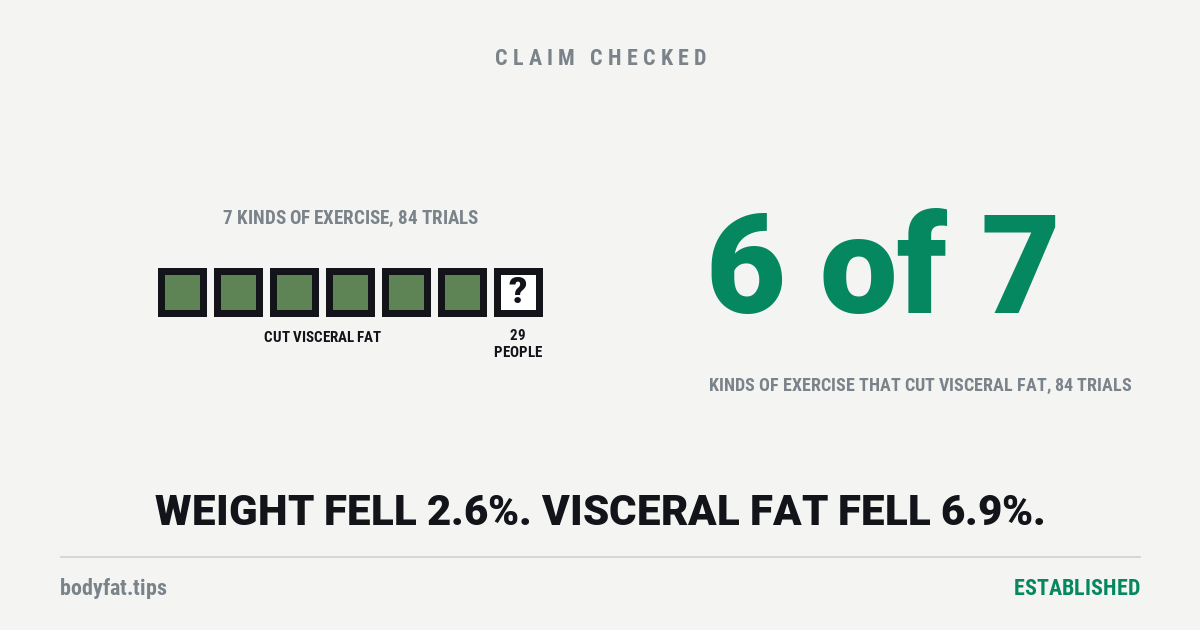
Two claims are riding together, and they come apart. Exercise does shrink visceral fat. Across 84 randomised trials, six of the seven kinds of exercise tested cut it [1], and it often goes by more than the scale shows [3] [4]. Losing weight by eating less shrinks it too [2].
Foods and drinks that target it are another matter. The most-tested drink on this page, green tea, was tested mostly by companies that sell tea or tea extracts. Their trials found several square centimetres off a scan, along with a little weight [8] [9] [10]. Outside Japan and China, the trials we read mostly found no difference [12] [13] [29] [30]. Of the three we read with no company among their authors, two found no change [7] [20], and one, a small eight-week trial in Iranian men who were also training, found visceral fat down by more with green tea extract than without it [28]. The rest of this page shows the working.
What is visceral fat, and what is subcutaneous fat?
Visceral fat is the fat packed around the organs inside the abdomen, around the liver and the gut. Subcutaneous fat is the fat under the skin, the kind you can pinch. Visceral fat is the one more closely tied to diabetes and heart disease [2]. It is also the one you cannot see, and neither a bathroom scale nor a tape measure can separate it from the fat above it.
So the trials on this page measure it with machines. Most use a CT or MRI scan and report the area of visceral fat on one slice through the belly at about navel height, in square centimetres (6.5 of them make a square inch), or its volume. Some estimate it from a DXA scan, the low-dose X-ray used for body composition, and some from a bioimpedance device, which infers fat from how an electrical current travels through the body. Where a number below is an estimate rather than a scan, we say so.
Does exercise reduce visceral fat?
Yes, and this is the best-evidenced part of the whole subject. In 2024 a team in Beijing pooled 84 randomised trials of exercise against no exercise in people mostly carrying extra weight, using a network meta-analysis, a method for ranking several options against each other across many trials at once [1]. Six of the seven kinds of exercise cut visceral fat compared with doing nothing: moderate aerobic exercise, vigorous aerobic, a mix of the two, weight training, aerobic plus weights, and high-intensity intervals [1]. The seventh, intervals plus weights, had 29 people in it and could not tell [1].
How big? The review used effect sizes, a way to put results measured in different units on one scale, where 0.2 is small, 0.5 moderate and 0.8 large. The six kinds ran from 0.55 to 0.76 when each was set directly against doing nothing [1]. Read who was in it before you read it as yours: trial average ages 10 to 70, about seven in ten of them women, some with diabetes or fatty liver, in programmes of at least eight weeks, with visceral fat measured six different ways, from CT and MRI to body-fat devices and an estimating formula [1]. Most carried extra weight, but not all: its largest trial, of 320 women past menopause, took women whose body-mass index (weight relative to height) ran from 22, which counts as normal weight, to 40 [1] [25]. A mix like that is a reason to trust the direction more than any single number.
A 2023 review from Hong Kong took a stricter line and kept only trials that scanned visceral fat by CT or MRI: 40 trials, 2,190 adults carrying extra weight [2]. Exercise cut visceral fat compared with controls, a small effect of 0.28 on that same scale; eating less cut it by a moderate 0.53 [2]. But exercise showed a staircase that dieting did not: the more calories the exercise burned each week, the more visceral fat went, about 0.15 more for every extra 1,000 calories a week [2]. Allowing for the size of the weekly calorie gap, exercise did better than dieting for each calorie [2]. Waists shrank too, by about 1.2 inches (3.15 cm) more than the controls’ with exercise and 1.8 inches (4.67 cm) with dieting [2].
What is the best exercise for visceral fat?
The one you will do the most of, and aerobic work gets there faster than weights. In the 84-trial review, vigorous aerobic exercise ranked most likely to be the best, high-intensity intervals second and weight training last, a ranking of probabilities rather than a verdict [1]. Two network meta-analyses published in 2026 ranked intervals first. In one, of 61 trials, intervals cut visceral fat by 0.84 on the same scale, against 0.41 to 0.54 for the other kinds, though only 327 of its 2,903 exercisers did intervals [26]; in the other, of 60 trials, intervals came only just ahead of aerobic exercise combined with weights [27]. Weight training cut visceral fat in men and in people under 40% body fat [1]. In women its effect was smaller, 0.25 on that scale against 0.89 in men, and the review could not tell it from none; the same went for people above 40% body fat [1]. A separate review did find lifting cut visceral fat by a moderate amount, in four trials whose participants were almost all women; our verdict on whether lifting burns fat reads it, and covers what weights do for the rest of the body.
A US university trial put the two side by side. It randomised 196 sedentary adults with overweight to eight months of aerobic training, weight training or both; 144 finished, and the visceral-fat scans of 110 of them were analysed [5]. In the aerobic group visceral fat fell by about 2.5 square inches (15.9 cm²) from a slice that started at 190, about 8%, while weight fell 4.4 lb (2.0 kg) [5]. In the weight-training group visceral fat did not move; its members gained 1.5 lb (0.7 kg), including 2.4 lb (1.1 kg) of lean mass [5]. The aerobic programme burned 67% more calories, the university’s press office reported [6].
An earlier trial from the same team tested amount. Its 175 sedentary adults were randomised to no exercise for six months or to about eight months at one of three doses [4]. The group that did nothing gained 8.6% more visceral fat in six months [4]. The equivalent of about 11 miles a week of walking or jogging stopped that gain, and about 20 miles a week (32 km) of jogging cut visceral fat by 6.9% [4]. When the later trial came out, its lead author told the press office that what really counts is how much exercise you do [6]. The trials agree with him. For running in particular, see our verdict on whether running burns fat.
Can you lose visceral fat before the scale moves?
Often, yes, by more than the scale suggests. In 2016 a Dutch-led team set exercise against dieting across 117 studies and 4,815 people [3]. In the eight trials that tested both head to head, dieting took off more weight, while exercise took off somewhat more visceral fat, a difference at p = 0.08, just the wrong side of the line researchers use for “probably not chance” [3].
The more telling result is how loosely weight followed visceral fat after exercise. In the diet trials, the weight lost accounted for about three-quarters of the differences in visceral fat lost; in the exercise trials, under half [3]. Draw a line through the exercise trials’ averages and it crosses “no weight lost” at 6.1% less visceral fat; the same line for the diets crosses at 1.1% [3]. That is a line through trial averages, not a measurement of anyone who lost no weight, so read it as a direction.
The single trials point the same way. In the 20-miles-a-week group, weight fell 2.6% and visceral fat 6.9% [4]. In the aerobic group of the later trial, weight fell about 2% and visceral fat about 8% (our arithmetic from the trial’s table) [5].
Why can’t I lose belly fat no matter what I do?
Three answers the evidence supports. The scale is the wrong instrument for this fat, as the section above shows. The belly is also fat under the skin, and no exercise takes fat off one chosen spot: our verdict on spot reduction reads those trials. And the averages hide real differences: in one review, weight training clearly cut visceral fat in men and leaner people, and cut it by less, by an amount the review could not tell from none, in women and in people above 40% body fat [1]; and men lost more visceral fat than women from both exercise and dieting [3].
One more thing worth knowing. Standing still is not neutral: the inactive group in the 175-person trial gained 8.6% more visceral fat in six months [4]. A programme that only holds your visceral fat where it is has already beaten doing nothing.
How to lose visceral fat without exercise
Lose weight. Eating less cut visceral fat by a moderate amount in the scanned trials [2], and in the diet trials the visceral fat lost tracked the weight lost closely; with no weight lost, the line through the diet trials sits at almost nothing, 1.1% [3]. There is no special diet trick in that: intermittent fasting is one way to eat less, and how many calories it takes to lose a pound has its own verdict.
Can cutting sugar reduce belly fat? Our page on cutting sugar reports two trials in which adding sugar-sweetened drinks or fructose added visceral fat, and what cutting it did for weight.
Do foods or drinks burn visceral fat?
Most of the food trials on this page are of green tea, or rather its catechins, the bitter compounds concentrated from it into bottled drinks and capsules. Those trials come mostly from Japan, and mostly from the companies that make the drinks.
The best known put 240 Japanese adults carrying excess visceral fat on a can a day of green tea with 583 mg of catechins, or a weaker can with 96 mg, for 12 weeks [8]. Visceral fat area fell about 9% (10.3 cm²) on the strong tea and about 4% (3.9 cm²) on the weak one, and weight fell 3.7 lb (1.7 kg) against 0.2 lb (0.1 kg) [8]. The authors concluded that catechins reduce body fat “without the need for any lifestyle changes” [8]. All three worked at a Japanese consumer-products company’s health-food research laboratories [8].
A Japanese tea company’s trial in 124 adults found the same kind of result: catechin-rich bottled tea taken with the fattiest meal of the day cut visceral fat about 8% (from 92.2 to 84.8 cm²) while the placebo group’s rose about 3% [9]. Five weeks after people stopped drinking it, the visceral fat was most of the way back, at 90.5 cm² [9]. Four of the five authors worked for the company, which made the drinks [9]. The consumer-products company’s researchers later pooled six of their own trials, 921 people, and put the average at 7.5 cm² of visceral fat area, with the range the true answer probably sits in running from 5.7 to 9.3 [10]; we read that analysis as its abstract.
In China, a trial in 182 adults paid for by a tea brand’s research institute, and run by employees of the multinational that owned it, found 5.6 cm² less fat inside the abdomen with the strongest of its teas [11]. That fat was estimated from a DXA scan and a waist calliper, using a formula built on Western women, not scanned directly [11]. It is in the reference list of the most-watched video.
Look at where the weight went in the trials that worked. In the 240-person trial, people on the strong tea lost 3.5 lb more than people on the weak one [8], and the visceral fat went with it. These trials cannot say whether the tea did anything to visceral fat beyond the weight it helped take off, and that is the claim the videos make.
Outside Japan and China, the two trials we read that scanned visceral fat found no difference. In 107 American adults who were all exercising, a catechin drink trimmed total belly fat but not visceral fat; the visceral difference (p = 0.125) was one the trial could not tell from chance [12]. The same Japanese consumer-products company paid for that trial [12]. In 38 Australian women past menopause who walked three times a week, capsules of the main catechin made no difference to visceral fat on CT, and both groups lost some [13]. And in 2026 a Japanese trial paid for by a government research programme and, in part, by the same company, four of whose employees were among its authors, gave 96 adults with excess visceral fat a drink of catechins with inulin, a plant fibre, added, and found no difference after 12 weeks: up 0.9 cm² against up 4.6 cm², measured by a waist bioimpedance device rather than a scan [14].
We read three more trials from outside Japan and China that reported visceral fat, and they do not all point the same way. In Iran, 45 overweight middle-aged men were split three ways for eight weeks: endurance training with green tea extract capsules, the same training with dummy capsules, or neither. Visceral fat fell in both training groups, and fell more with the extract [28]. Its authors work at universities and declare no conflicts of interest. We read it as its abstract and the journal’s page, which do not say how visceral fat was measured or who paid; a registry record matching its design, which the same team’s companion trial in women cites, names the university as its only funder and lists body fat, measured by a body-fat analyser, but not visceral fat among its outcomes [28]. In Italy, 28 overweight or obese women past menopause took a green tea extract or a placebo for 60 days. Visceral fat, estimated from a DXA scan, fell in the extract group but not by significantly more than with the placebo (p = 0.73, far from the line researchers use for “probably not chance”) [29]. The extract’s maker supplied the tablets and employed three of the authors [29]. And in the Netherlands, 38 overweight or obese adults took the main catechin together with resveratrol, a compound found in grapes (given here as a knotweed extract), for 12 weeks; visceral fat, estimated from a DXA scan, “tended to decrease” against the placebo (p = 0.09), short of that line [30]. A foundation whose contact email is at a plant-based food company paid for it, a supplement maker supplied the capsules, and two of its ten authors worked for a nutrition-ingredients company; the paper declares no conflicts [30].
The Cochrane review of green tea for weight loss, 18 trials, had to split them by country because they disagreed [15]. Outside Japan, six trials found an average difference of 0.09 lb (0.04 kg); the range the true average probably sits in runs from a loss of 1.1 lb to a gain of 0.9 lb (−0.5 to 0.4 kg), so “no effect at all” is well inside it [15]. In Japan, eight trials found losses of 0.4 to 7.7 lb (0.2 to 3.5 kg) and were too different to pool [15]. The reviewers’ notes record authors from that same consumer-products company on six of those eight [15].
Two more trials found visceral fat down: 118 Chinese adults on a bottled catechin tea [16], and 36 Japanese adults on a pu-erh tea extract before meals [17]. We read the Chinese trial as its abstract, which does not say who paid, but four of its nine authors worked for the same Japanese consumer-products company as the 240-person trial above [16]. The pu-erh trial was paid for by a supplement company’s research division, and three of its eight authors worked in that company’s research department; its acknowledgment says so, read in the Internet Archive’s copy of the journal page [17]. Three trials we read had no company among their authors: the Iranian trial above [28], and two that found no change. In 48 overweight young Australian men, green tea capsules alone did nothing to belly fat measured by DXA, while interval sprinting cut it by 6%, and adding the tea to the sprinting did not help [7]. In 22 lean young Japanese women, a catechin drink raised a measure of brown fat (more on that below) while visceral fat on MRI did not notably change [20].
Coffee and vinegar, the other two drinks in these videos, have their own verdicts: coffee for weight loss and apple cider vinegar, whose load-bearing visceral-fat trial was run by a vinegar company. So do fat burners, some of which contain green tea extract.
Can a diet shrink visceral fat by more than the weight it takes off?
Possibly, and the best evidence for it comes from whole diets, not single foods. In an 18-month trial of 294 workers at one Israeli workplace, 88% of them men, two Mediterranean diets took off similar amounts of weight, 2.7% and 3.9% [22]. But the “green” version, with three to four cups of green tea a day, a daily shake of duckweed, walnuts and less red meat, cut visceral fat by 14.1% on MRI against 6.0% [22]. Allowing for weight lost, its lead over the other Mediterranean diet held (p = 0.042), and its lead over a standard healthy diet narrowed to p = 0.07 [22]. The authors say they cannot tell which part of the diet did it [22]. The walnuts, tea and duckweed were donated by their makers, a walnut growers’ board helped pay for the trial, and the lead investigator advises the duckweed company [22]. The first channel lists this trial under its “Fastest Protocol” video.
A German trial of 300 people aged 50 to 80 found a smaller version of the same thing. A year on a diet rich in unsaturated fat, mostly rapeseed oil, with plant protein and fibre took off about 3.5% more visceral fat than usual care (0.16 L more, from about 4.6 L at the start; the percentage is our arithmetic), while body-mass index did not differ significantly [23]. Its authors call the result exploratory [23].
That German trial is in the reference list of the first channel’s “8 Foods to Eat Every Day to Destroy Visceral Fat,” whose foods are walnuts, dark chocolate, fatty fish, broccoli sprouts, blueberries, chia seeds, extra virgin olive oil and Greek yogurt. We read all thirteen of that video’s references by their abstracts. Two are trials that report a measure of visceral fat: the German diet trial, and a ten-week trial of cocoa powder in endurance athletes. The rest measure blood hormones, insulin, inflammation genes, waist size or total body fat, or are surveys, reviews and a study of mouse muscle.
Besides the green tea trial above [11], the most-watched video’s food-and-drink references hold one other trial that reports visceral fat: 28 Japanese men given carotenoid-rich vegetable drinks for eight weeks, in four groups that all got a drink [24]. Visceral fat, measured by a bioimpedance analyser, fell in every group, including the one with the least carotenoid, and the authors write that carotenoids alone may not have contributed [24]. On exercise, that same video’s references include the three reviews this page leans on [1] [2] [3], along with a 2018 review of interval training, a 2022 review of exercise in young people and a 1997 training study in people with type 2 diabetes.
Does matcha burn visceral fat?
Matcha is green tea leaf ground to a powder and drunk whole [18], so it carries catechins, and the catechin trials above are what matcha borrows. The studies of matcha itself are small. In a Jordanian study that did not randomise, 34 adults on a low-calorie diet lost about 23 lb either way: 23.4 lb (10.6 kg) with a daily cup of matcha and 22.7 lb (10.3 kg) without [18]. In 30 young Japanese women, a single 3 g dose made no overall difference to a thermal-camera measure of brown fat in the cold, with a difference only in the third whose brown fat responded least [21].
We found no randomised trial of matcha itself that scanned visceral fat (PubMed searched in two wordings, ClinicalTrials.gov, the newest review of matcha’s effects in people, and an ordinary web search, 10 October 2026).
That web search’s first page held two things worth knowing. A matcha seller’s online “research database” posts the abstract of the 118-person Chinese trial [16], which tested a bottled catechin tea, not matcha, on a site offering 20% off. And a British regional newspaper’s “One hot 9p drink each day can lower ‘hidden’ visceral body fat” (1 December 2024), an article carrying affiliate links, quotes a personal trainer: switch to matcha, because a study found its key nutrient, catechin, helped reduce visceral fat. The study was of a drink. The advice is about a powder. And the article says it earns a commission on sales from its links.
Does brown fat burn visceral fat?
Brown fat is fat, found mostly around the collarbones in adults, that burns energy to make heat [21]. Cold is the strongest switch [19]; our verdict on cold plunges covers how little that adds up to. Foods are the newer pitch. The second channel says tea catechins and the sulforaphane in broccoli “convert harmful fat into beneficial brown fat.”
A 2019 systematic review of the human studies found three on tea catechins and concluded that the designs were too weak to confirm that any food activates human brown fat [19]. About a third of the studies came from one research group, and the reviewers found no independent group had confirmed that group’s results, apart from one study of a chilli compound [19]. A 2020 review that pooled what human data it could came to the same place: human brown fat activity “was not significantly affected by nutrition/diet,” on evidence its authors call limited [31]. One of the 2019 review’s catechin studies measured both halves of the pitch at once: in 22 lean young women, 12 weeks of a catechin drink raised brown fat density by 18.8%, and visceral fat on MRI did not notably change [20]. That is small, and in women with little visceral fat to lose, but it is the test the claim needs, and it did not come out the claim’s way.
Who these findings apply to
| Evidence | Who was in it | How visceral fat was measured | What it found |
|---|---|---|---|
| Exercise, 84 trials [1] | Trial average ages 10 to 70, about 7 in 10 women, mostly carrying extra weight (the largest trial also took women of normal weight); some with diabetes or fatty liver | Six ways, from CT and MRI scans to body-fat devices and an estimating formula | 6 of 7 kinds of exercise cut it |
| Exercise and dieting, 40 trials [2] | Adults carrying extra weight | CT or MRI scans only | Both cut it; dieting more on average, exercise more for each calorie of deficit |
| Exercise against dieting, 117 studies [3] | Adults carrying extra weight; men lost more than women | Scans | Weight followed visceral fat closely after dieting, loosely after exercise |
| Exercise at or near a normal weight, 13 studies [32] | 354 adults in studies whose average BMI was 27 or under | CT, MRI or DXA | Exercise cut it; the studies varied far more than chance would produce |
| Green tea catechin drinks, company trials [8] [9] [10] [11] | Japanese and Chinese adults carrying extra visceral fat | CT in the trials we read in full, except one estimate from a DXA scan and a calliper | Visceral fat down a few square centimetres in 12 weeks, along with a little weight |
| Catechin trials that found no difference [7] [12] [13] [14] [29] [30] | 107 US adults and 38 Australian women past menopause, all exercising; 96 Japanese adults; 48 Australian men; 28 Italian women past menopause; 38 Dutch adults | CT; a waist bioimpedance device; DXA; an estimate from DXA (the Italian women and the Dutch adults) | No difference in visceral fat (in the men, belly fat; in the Dutch adults, a lean towards less that could be chance) |
| Green tea extract with training, no company among the authors [28] | 45 overweight middle-aged Iranian men | Not stated in the parts we could read | More visceral fat lost with the extract than with training alone, in 8 weeks |
| Green Mediterranean diet [22] | 294 adults at one Israeli workplace, 88% men | MRI | 14.1% less visceral fat against 6.0%, at similar weight loss |
| Matcha [18] [21] | 34 Jordanian adults on a diet, not randomised; 30 young Japanese women, one dose | Not measured | No extra weight lost; no overall difference in brown fat |
Two gaps matter most if you are deciding what to do. The exercise evidence is broad, mostly women, and spans trial average ages from 10 to 70 [1]; the green tea evidence that found anything is almost all Japanese and Chinese adults in 12-week trials [8] [9] [11], the exception being one small eight-week trial in Iranian men who were also training [28]. And the women’s result for weight training was weaker than the men’s [1]. This is journalism, not medical advice; if visceral fat matters to you because of diabetes, liver or heart risk, a clinician can tell you what your own numbers mean.
What if you are not carrying extra weight at all? One 2026 review asked exactly that. It pooled 13 studies of 354 adults whose studies’ average body-mass index (weight relative to height) was 27 or under, normal weight or just over it, with visceral fat measured by CT, MRI or DXA, and found that exercise cut visceral fat against no exercise [32]. Aerobic training was the most consistent. Two cautions come with it. The spread between its studies’ results was far more than chance alone would produce (by the review’s measure of heterogeneity, 86% of that spread was more than chance), so the direction is clearer than the size; and when it looked only at studies with no comparison group, before against after, the change did not reach significance [32]. We read it as its abstract. Whether that much hidden fat at a normal weight is a health risk in the first place is the question our verdict on skinny fat answers. This paragraph was added on 10 October 2026.
If exercise works, why is everyone selling you a drink?
This section is the desk’s own reasoning, and it is labelled as such. The evidence above leaves an obvious question: if the reliable route to less visceral fat is moving more and eating less, why do the videos, the newspaper and the search results lead with teas? Three answers, with the evidence for each.
Answer one: exercise hides its own result. Visceral fat cannot be seen or pinched, and the one number most people check follows it loosely after exercise: weight change accounted for under half of the differences between exercise trials [3], and the 20-miles-a-week group lost 2.6% of its weight and 6.9% of its visceral fat [4]. To a bathroom scale, someone who is winning looks like someone who is not. This is measured.
Answer two: the drink has a sponsor and a study; the walk has neither. Of the thirteen catechin trials and poolings on this page whose funding or full author list we could read, ten were paid for, run, supplied or co-written by a company that sells tea or tea extracts [8] [9] [10] [11] [12] [13] [14] [16] [29] [30]. The other three had no company among their authors: two found no change [7] [20], and one, alongside exercise, found visceral fat down [28]. The exercise research here that states its funding was paid for by public bodies and universities [2] [5], or by no one [1], and no one can sell you the walk. The funding is measured, printed on the papers; that it explains which claims travel is a surmise, and we mark it as ours.
Answer three: a drink can carry a link. The most-watched video links a matcha product. Three of the second channel’s visceral-fat videos link an at-home body-composition device with a discount code. The newspaper’s matcha article carries affiliate links. It is an observation, not a trial, and we mark it as one.
Put the three together and here is what we think is true, stated plainly so you can disagree with it: believe the effect that survives a change of country and of sponsor. For visceral fat, so far, exercise does; the tea has done it once in the trials we read, in one small eight-week trial alongside exercise.
What we could not find, and would like to: a randomised trial of matcha itself, the powder the videos link to, against a placebo, with visceral fat scanned. We would also like to see the catechin result tried again by someone with nothing to sell, in adults carrying excess visceral fat, scanned by CT or MRI, for a year rather than twelve weeks. If you know of either, the corrections line on this site is open.
Where “target your visceral fat” came from
The exercise half of the claim has a clean lineage, and it starts with a good trial. In August 2011 the US university trial above reported that aerobic training cut visceral fat on CT and weight training did not [5]. The university’s press office headlined it “Aerobic Exercise Bests Resistance Training at Burning Belly Fat” [6]: a scan of fat around the organs became belly fat, and a result its lead author put down to the amount of exercise was sold as a contest between kinds.
Twelve years later a hospital-software company’s consumer health site repeated it, crediting the university’s research and the 2.5 square inches lost on CT. In October 2026 that page is one of the sources the search engine’s AI answer cites for “how to lose visceral fat,” beside two of the physician’s videos. The answer tells readers they can reduce visceral fat even before seeing big changes on the scale. That part is right.
The product is where it bends. Next to the first channel’s three visceral-fat videos sits a “Smart Body Scale” in a block of affiliate links. Three of the second channel’s visceral-fat videos link an at-home body-composition device with a discount code, one of them at up to 50% off under the line “Measure your body composition (not just the scale).” The trials measured visceral fat with CT and MRI scanners. Our verdict on body fat scales found a single reading from a home device can be many points off. Our pages on body recomposition and cortisol and belly fat cover the neighbouring claims.
None of this is aimed at anyone who has bought a tin of matcha or a smart scale. Tea is a fine drink, and wanting to see your progress is reasonable. It is the promise that a cup targets the fat around your organs, made in videos that link the cup, that the evidence does not carry.
What this is rated, and what the rating covers
Established — for the claim that exercise shrinks visceral fat in people carrying extra weight.
It is rated Established because every review we read finds it, across trials from Asia, Europe, the Americas and Australia [1], in an analysis restricted to CT and MRI scans [2], and against dieting head to head [3], with more visceral fat lost the more calories the exercise burned [2], and a US trial pointing the same way across its doses, though the gaps between them fell just short of the line for “probably not chance” [4].
The other parts, rated alone: that losing weight by eating less shrinks visceral fat too would be Established on the same reviews [2] [3]. That exercise shrinks it by more than the scale shows: Supported, because the pattern is consistent [3] [4] [5] but rests on a line through trial averages and a few trials, not on people who lost no weight. That particular foods or drinks shrink visceral fat beyond the weight they help lose: Preliminary, on company-run catechin trials in which the weight fell too [8] [9], mostly null results outside Japan and China [12] [13] [29] [30], one small trial there with no company among its authors that found less alongside exercise [28], and two whole-diet trials that cannot name the ingredient [22] [23]. That foods switch on brown fat which then burns visceral fat: Unsupported, of the tested kind, because the one trial we read that measured both found brown fat up and visceral fat not down [20], and two reviews of the field could not confirm the first step [19] [31]. That matcha in particular does it: it borrows the catechin evidence, so it can be no better than Preliminary.
What is not rated here: the cancer claims that ride along in some of these videos, which are a separate question, rated in our verdict on skinny fat; and the frame in the section above, which is this desk’s reasoning from the evidence rather than a result the evidence delivered. It is marked as ours so that you can weigh it as ours. This is journalism, not medical advice. How we read a study, and what each tier means, is set out here.
- Sit-to-Stand Test: In Older Adults, the Slowest Risers Died at Nearly Twice the Rate. Whether Raising Your Score Buys Years Is Unproven.
established - Does Calisthenics Build Muscle? The Light-Load Leg Grew 6.8%, the Heavy-Load Leg 7.2%. Muscle Can’t Tell What It’s Lifting, Only How Close to Failure You Got.
supported - Does Dancing Help You Lose Weight? A Zumba Class Burned 369 Calories, Not 1,000. Eight Pooled Trials Couldn’t Find the Fat Loss.
preliminary