Body Recomposition: In a 114-Trial Review, Lifting Alone Took Off 2.2 lb of Fat and Added 1.8 lb of Lean Mass, No Diet. It’s Not a Protocol. It’s the Default.

Somewhere on your phone is a before-and-after with the words body recomposition under it, and a plan for sale under that. The pitch is that losing fat and gaining muscle at the same time is an advanced trick — a protocol, a calculator, a rule with three numbers in it.
Here is the number the pitch leaves out. In a review of 114 randomised trials, the people who lifted weights and changed nothing about their diet lost fat and gained muscle at the same time, compared with people who did nothing [1]. Not the ones on the protocol. The plain lifting group. The default.
So the real question is not can you. It is: if it happens by default, why does everybody say it is hard? We think there are three answers, and one of them is the reason most attempts at it quietly fail.
Can you lose fat and gain muscle at the same time?
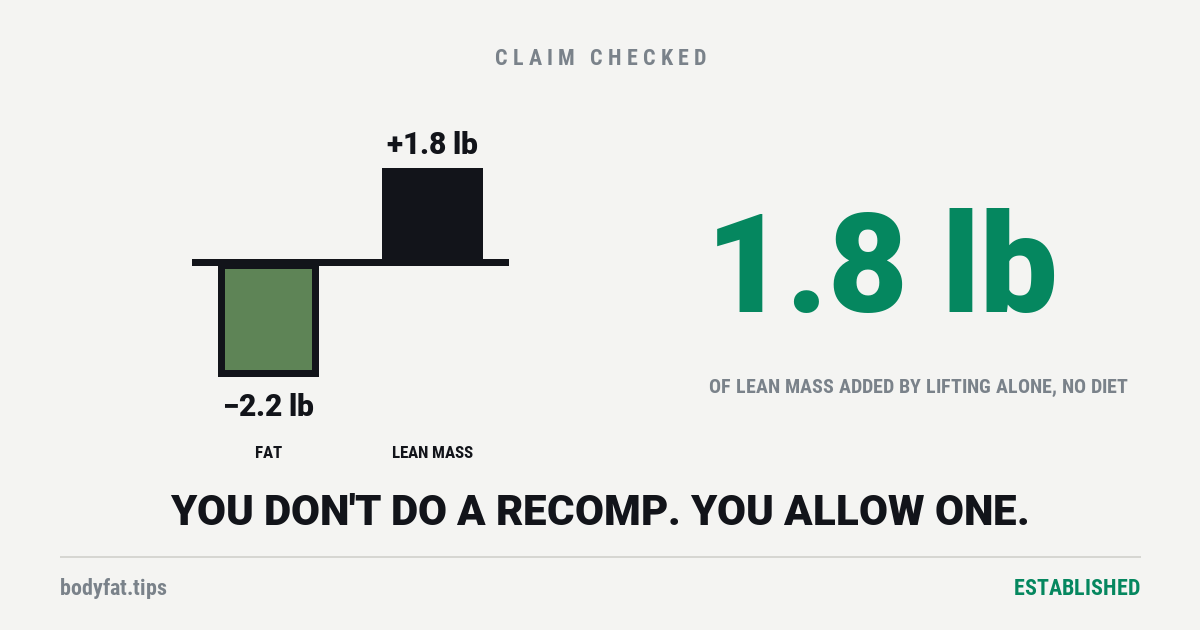
Yes, and it is one of the better-measured things in exercise science. A 2022 review pooled 114 randomised trials — 4,184 people with overweight or obesity, from children to older adults (878 of them were under 18) — and sorted them by what each trial actually asked people to do [1]. Lifting alone, with no diet change, against no exercise at all: 2.2 lb (1.0 kg) of fat gone and 1.8 lb (0.8 kg) of lean mass added, both well past the line researchers use for “probably not chance” [1]. The plausible range for the lean gain ran from 1.3 to 2.2 lb (0.6 to 1.0 kg). It never touches zero.
Lean mass is everything in you that is not fat — muscle, mostly, plus bone and water — and it is what the scans measure, so it is the word this page will use.
| What people did | Fat | Lean mass |
|---|---|---|
| Lifting alone, no diet change | −2.2 lb (1.0 kg) | +1.8 lb (0.8 kg) |
| Lifting plus cardio | −3.1 lb (1.4 kg) | not the headline result |
| Lifting plus a calorie-restricted diet | −11.2 lb (5.1 kg) | about −0.4 lb (0.2 kg), statistically unchanged |
Two numbers moving in opposite directions from one thing you did. That is the entire definition of recomposition, and it is what the average trial participant got for showing up to lift. The fat loss held across age groups and both sexes [1]. The lean gain reached significance in trials of women and of mixed groups; in the 17 trials of men only it was 1.1 lb (0.5 kg) with a range that just touched zero — a smaller pool, not evidence that it fails in men [1].
The fat half replicates in a completely separate pool of people. Another 2022 review took 58 studies of healthy adults — not overweight, just ordinary — and found lifting alone cut body fat by 1.46 points and took off about 1.2 lb (0.55 kg), with the fat packed around the organs down too [2]. That result has its own verdict on this site. This page is about the two halves together.
And none of it is new. In 1988 a University of Michigan lab split 40 obese women into four groups for eight weeks [6]. The ones who lifted and did not diet gained 2.4 lb (1.07 kg) of lean mass while their weight moved by one pound. The ones who dieted and did not lift lost 9.9 lb (4.47 kg) — and 2.0 lb (0.91 kg) of it was lean. The group that did both lost 8.6 lb (3.89 kg) and gained lean [6]. The word “recomp” would not exist for years. The finding was already sitting in the American Journal of Clinical Nutrition.
If it happens by default, why does everyone say it’s hard?
This section is the desk’s own reasoning, and it is labelled as such. The trials say the default result of lifting is fat down and lean up. The internet says recomposition is an advanced goal that needs a protocol. Both cannot be right about the same people, so here are three ways to reconcile them, with the evidence we could find for each.
Answer one: the scale hides it. Look at the 114-trial numbers again: 2.2 lb of fat off, 1.8 lb of lean on. Net change on a bathroom scale: roughly half a pound. The clearest case is a trial in trained lifters, where the high-protein group’s bodyweight moved by 0.2 lb (0.1 kg) in eight weeks — while underneath, 3.7 lb (1.7 kg) of fat left and 3.3 lb (1.5 kg) of lean arrived [5]. The scale said nothing happened. Seven pounds changed places. This is not a hunch; it is what the measurements show, and it means the most common recomposition outcome is a person who concludes it did not work. The muscle-versus-fat page covers what to measure instead.
Answer two: the word was coined by the people it is hardest for. “Recomp” came out of bodybuilding, where the normal rhythm is a bulk — eat a lot, lift, gain muscle and some fat — then a cut, eating less to lose the fat and some muscle with it. Recomposition was the name for the third option, for people who wanted neither. Those are trained, already-lean people, and they are precisely the population the trials barely cover. The deficit analysis below gathered 59 studies and found one pair explicitly in resistance-trained lifters; its authors write that “not enough data exist on experienced lifters training in an energy deficit” [3]. A 2020 review in the strength coaches’ journal carried the doubt in its title: can trained individuals build muscle and lose fat at the same time? [7] The one trial we found that tried it says maybe: 48 lifters averaging two to five years of training by group, eight weeks, 3.4 g of protein per kg of bodyweight (1.5 g per lb), and both groups gained 3.3 lb (1.5 kg) of lean while the high-protein group lost 3.7 lb (1.7 kg) of fat — eating more calories than before [5]. Diet was self-reported through a phone app, body composition came from a Bod Pod, and the company that donated the protein powder is named in the paper. So this answer is a surmise with one trial on its side: the beginner and the person carrying extra weight get recomposition by default, and the term was invented by, and is now sold to, the people for whom it is a genuine open question.
Answer three: the deficit you chose to speed it up is what switches it off. This one has the strongest evidence, and it is the one we think matters most. A 2022 meta-analysis gathered every randomised trial of lifting in a calorie deficit it could find and set them against lifting without one [3]. Lean-mass gains were impaired by an effect size of 0.57 — on the scale where 0.2 is small, 0.5 moderate and 0.8 large, a moderate hit — while strength gains came out the same either way, 0.84 against 0.81 [3]. Then the useful part. Instead of trusting what people said they ate, the authors worked out each group’s deficit from the fat that actually left, and ran it against the lean-mass result. In energy balance, lifting added a small, reliable amount of lean. At a deficit of about 500 calories a day — the number printed on every diet plan — the lean-mass gain reached zero [3]. The authors’ own comparison: a 500-calorie deficit costs your muscle gain about what thirty years of ageing does [3].
The 114-trial review says the same thing from the other side. Lifting plus a calorie-restricted diet took off 11.2 lb (5.1 kg) of fat and held lean at about −0.4 lb (0.2 kg), statistically unchanged; add cardio to that and the figures were 11.7 lb (5.3 kg) and −0.7 lb (0.3 kg) [1]. Preserved. Not gained.
So a protocol that promises fat loss and muscle gain, and prescribes a deficit big enough to make the fat loss fast, is prescribing the thing that cancels its own second half. Strength still climbs — which is exactly why it feels like it is working.
Is there a way through? One trial says protein, and it is the most extreme version of the experiment anyone has run [4]. Forty young men, four weeks, a 40% calorie deficit, lifting plus interval training six days a week, food provided — and the group eating 2.4 g of protein per kg (1.1 g per lb) gained 2.6 lb (1.2 kg) of lean and lost 10.6 lb (4.8 kg) of fat, while the group on half the protein gained 0.2 lb (0.1 kg) and lost 7.7 lb (3.5 kg) [4]. Measured with a four-compartment model, the most accurate method there is. The catch is the population: young men, four weeks, six days a week, meals handed to them. It shows the door exists. It does not show that a 45-year-old with a job can walk through it.
Put the three together and here is what we think is true, stated plainly so you can disagree with it: you do not do a recomp. You allow one. Lifting with enough protein produces it by default. The only decision that actually matters is the size of the deficit, and the deficit big enough to be sold as fast is about the size that switches the muscle half off. Nobody sells “a smaller deficit.” Everybody sells a protocol.
What we could not find, and would like to: a trial that took lean, trained people and ran them at a 250-calorie deficit against a 750-calorie one for six months, with a proper body-composition scan at each end. That is the study the recomp industry’s claim actually needs, and as far as we can find nobody has run it. If you know of one, the corrections line on this site is open.
How many calories should I eat a day for body recomposition?
The trials give a band, not a number. Lean gain reached zero at about a 500-calorie daily deficit and stayed positive below it [3]; the deficit groups in that analysis averaged 567 calories a day short, which fits — on average they lost a little lean [3]. So: under 500 a day if you want both halves; at maintenance if lean is the priority.
Google’s AI Overview, when we checked on 14 September 2026, told readers 200 to 400 calories below maintenance, or maintenance. That sits inside the band the analysis draws. It does not say where it got it, and the pages it cited were a gym chain and a prescription weight-loss programme. Right number, no receipt.
A “body recomposition calculator” cannot beat the band, because the trials measured averages, not anybody’s individual response — and the spread around that average is enormous.
What should I eat to lose fat and gain muscle?
Protein is the only part of the diet the trials on this page actually varied, and it moved the result every time. Double the protein in a hard deficit and the lean gain went from 0.2 lb to 2.6 lb [4]. Raise it for trained lifters and the fat loss went from 0.7 lb (0.3 kg) to 3.7 lb (1.7 kg) [5]. This site’s protein verdict found the famous 1.6 g-per-kg ceiling was never statistically significant, and that people in a calorie deficit kept an extra 0.79 lb of lean mass when they ate more than the recommended amount. Recomposition is the case that exception was written for.
Beyond protein and the size of the deficit, the trials tested nothing — not meal timing, not carbs, not the food list on the plan you were sold. That is not evidence those things do nothing. It is evidence nobody has checked.
How long does body recomposition take?
The trials behind this page ran from four weeks to nearly two years in the big review, averaging about fifteen, and three to twenty-eight weeks in the deficit analysis, most of them three to four months [3] [4] [5] [6], and the pooled figures — 2.2 lb of fat, 1.8 lb of lean — are roughly what a trial of that length produced [1]. The deficit analysis tested whether longer trials produced more lean and found no relationship [3], an odd result that probably says more about how differently the trials were run than about your next six months. For the rate at which muscle arrives, 585 people did the same 12-week programme and the answers ran from a 59% gain to a 2% loss.
What is the 3-3-3 rule for fat loss? And the 30-30-30 one?
People ask both, so here they are. The 30-30-30 rule says eat 30 grams of protein within 30 minutes of waking, then do 30 minutes of easy exercise. Two of its three numbers trace to a 2010 diet book, The 4-Hour Body (30 grams of protein within 30 minutes of waking); the 30 minutes of exercise was added when the rule went viral on TikTok in 2023. Its two parts are ordinary advice; as a package, as far as we can find, nobody has tested it in a trial. The 3-3-3 rule is worse off: there are at least two rules by that name in circulation — three strength days plus three cardio days, or three meals three hours apart — they describe different things, and neither has been tested either.
A rule with three numbers in it is a memory aid, and memory aids are fine. Just notice that the one variable the trials say decides recomposition — the size of the deficit — appears in none of them.
Signs you are gaining muscle and losing fat
Not the scale, for the reason in Answer one. The trials measured this with DXA scans, Bod Pods and four-compartment models [3] [4] [5], and you have none of those. What you have: a tape measure at the waist, the weight on the bar, and the same photo in the same light a month apart. If the scale is flat and the waist is coming down, that is recomposition and you have evidence of it. If the scale is flat and nothing else is moving, then nothing is moving. The muscle-weighs-more page has the fuller version, and the one on body-fat scales explains why the bathroom gadget will not settle it.
Does body recomposition work for women? For men? Over 50?
The 114-trial review found the fat loss held across age groups and both sexes; the lean gain reached significance in trials of women and mixed groups and fell just short in the 17 men-only trials [1]. The 1988 trial was 40 women [6]. The four-week deficit trial was 40 men [4]; the trained-lifter trial was 11 women and 37 men [5]. The lifting-in-a-deficit analysis found sex made no significant difference, and older people gained somewhat less lean per block of training, though that fell just short of significance [3] — ageing and the deficit push the same way, which is why its authors compared them. One caution from the same analysis: heavier participants gained a little less lean from lifting [3]. So the default holds for everyone the trials looked at. It is smaller with age and, in one analysis, with weight.
Where “recomp” came from
The observation is old and the word is not. In 1988 the Michigan trial above showed weight training alone adding lean mass to obese women while diet alone stripped it [6] — the finding, decades before the name.
The name came from bodybuilding. Competitive lifters alternate a bulk and a cut, and at some point the third option got a forum nickname: recomp. We could not trace who first used it, and would rather say so than invent a lineage. What we can place is the moment the question reached print: a 2020 review in the Strength and Conditioning Journal titled “Body Recomposition: Can Trained Individuals Build Muscle and Lose Fat at the Same Time?” [7] — asked about the one population the trials do not answer it for.
Then it left the gym. “Maingaining” — gaining muscle while maintaining your weight, a fitness-YouTube coinage — now draws about 880 searches a month on its own. The 30-30-30 rule went from a diet book to TikTok. “Body recomposition near me” is a related search, which tells you someone is selling it as a place you go.
And where it lives now: ask Google, and its AI Overview cites a gym chain, a prescription weight-loss programme, Healthline, Reddit and YouTube; quotes a protein target and a calorie band with no source for either; and ends by offering to write your daily plan itself. The calorie band happens to sit inside what the deficit analysis found. Nothing on the screen would tell you that.
None of this is aimed at anyone who bought a recomp plan. The plan probably told you to lift and eat protein, which is correct, and to run a deficit that quietly cancelled the half you paid for. That is on the plan.
What this is rated, and what the rating covers
Established — for the claim that lifting weights loses fat and builds lean mass at the same time, in adults who are not already lean and trained.
It is rated Established because two independent meta-analyses of randomised trials — 114 trials in adults with overweight and obesity [1], 58 studies in healthy adults [2] — find fat falling with lifting alone; the larger one finds lean rising in the same comparison, with a plausible range that never touches zero; the pattern holds across age and sex [1]; and a randomised trial found it 38 years ago [6]. The deficit finding comes from a meta-regression across trials rather than a trial that varied the deficit directly [3], so it shapes the frame but is not what the tier rests on.
What is not rated here: recomposition in lean, trained lifters, which rests on one eight-week trial with self-reported diet [5] and would earn no better than Preliminary on its own; any named protocol, rule or calculator, none of which has been tested; and the frame in the section above, which is this desk’s reasoning from the evidence rather than a result the evidence delivered. It is marked as ours so that you can weigh it as ours. How we read a study, and what each tier means, is set out here.
Three descriptions of the evidence were corrected on 15 September 2026 after an independent editorial review. The 114-trial review was described as 4,184 adults; 878 of its participants were children and adolescents, and the page now says so (the adult subgroups carry the rating). The evidence panel’s follow-up field gave the deficit analysis’s range and said no trial ran a year; the 114-trial review’s interventions ran from 4 to 96 weeks, and the field now reports both reviews correctly. And “held across age groups and both sexes” was true of the fat loss but not established for lean mass in the 17 men-only trials, which pointed the same way without reaching significance; the sentence now says that.
Also changed: the headline now says “in a 114-trial review” and “lean mass” rather than “in 114 trials” and “muscle”, because the lifting-alone comparison is a subset of the review and lean mass is what the scans measured; the diet-plus-lifting row now uses the lifting-only figures rather than the lifting-plus-cardio row; the 30-30-30 rule’s origin is split correctly between a 2010 book and a 2023 TikTok addition; and the AI Overview observation is dated. The rating is unchanged.
- Are Body Fat Scales Accurate? Right on Average. For One Person, Up to 14.5 Points Off — and a Glass of Water Moves It a Point.
unsupported - What Is a Good Body Fat Percentage? The Chart Everyone Quotes Was Built From BMI, Called Provisional, and Never Replaced
preliminary - Does Metabolism Slow With Age? Yes — at 60, Not 30
established