Does Muscle Weigh More Than Fat? Yes — But Not Enough to Explain Your Scale

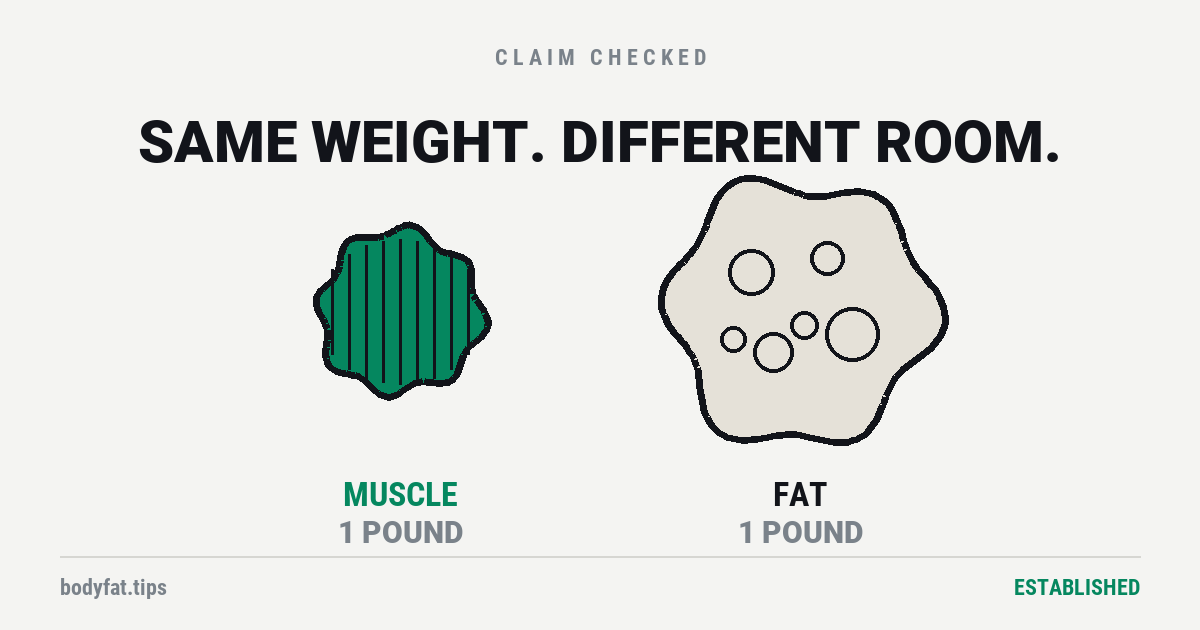
Yes — by volume. Take the same amount of muscle and fat by bulk and the muscle is heavier, and that is not really in dispute. Muscle is mostly water and protein. Fat is mostly triglyceride, and triglyceride is lighter than water. The chemistry settles it before anyone measures anything.
A pound of muscle and a pound of fat, obviously, weigh the same pound. That version of the sentence is just sloppy.
So why does the sloppiness matter? Because of what the phrase is used for.
Nobody says this in a vacuum
You do not hear “muscle weighs more than fat” in a physiology lecture. You hear it eight weeks into a programme, from someone explaining why the scale has not moved.
That is a different claim entirely, and it is the one worth checking. Not is muscle denser — it is. But is that why your weight is stuck?
So how much muscle are we actually talking about?
Thirty-one recreationally active adults, twelve weeks of training three times a week, two different loading schemes. Lean body mass went up 2.4 lb (1.11 kg) in one group and 2.8 lb (1.25 kg) in the other. The control group lost 0.75 lb [3].
Call it two and a half pounds in three months. Under a quarter-pound a week, in people training properly and being measured for it.
Now put that against a scale that has not moved in a month. You would need to have gained about a pound of muscle and lost almost exactly a pound of fat in the same window. Not impossible. But that is a coincidence, not a mechanism — and it is being offered to you as a mechanism.
The bit the excuse gets backwards
Here is what actually happened in that trial, and it is the opposite of the story.
Alongside the lean mass they gained, those groups lost 7.0 lb (3.19 kg) and 3.6 lb (1.64 kg) of fat [3]. Do the subtraction. Body weight went down — by something like four and a half pounds in one group.
Learn More:


Recomposition, when it happens, does not usually freeze the scale. It moves the scale less than the fat loss alone would predict. Those are not the same thing, and only one of them is a reason to stop weighing yourself.
Read the limits with us: thirty-one people, and body composition measured by bioelectrical impedance, which is a good deal noisier than a DXA scan. This is one trial, not a law. It is enough to say the arithmetic does not obviously support the excuse; it is not enough to say it never happens.
Where the famous numbers come from
We went to check the density constants everyone quotes. This part surprised us.
The value used for human skeletal muscle across the literature is 1.0597 g/cm³. In 2005 two researchers went back to check it and noted, in passing, where it came from: unfixed rabbit and canine tissue [1].
Rabbits and dogs. That is the number behind the most-repeated fact in fitness.
When they measured human muscle themselves they got 1.112 g/cm³ in one fixation protocol and 1.055 g/cm³ in another — both on formaldehyde-fixed tissue, not fresh [1]. Their own warning was practical: use the wrong constant and you introduce 5 to 10% error into downstream calculations.
The fat side is thinner still. The standard human figure traces to a 1953 paper by Fidanza, Keys and Anderson [2]. PubMed carries no abstract for it, and we could not obtain the full text. So we are not going to print its number and imply we checked it. We are telling you the constant exists, that it is seventy-three years old, and that we read the citation rather than the paper.
You will see “muscle is 18% denser than fat” stated all over the internet, usually to one decimal place. That percentage is two constants divided by each other — one from rabbits, one we could not read. We are not going to compute it for you.
None of which makes it false
Worth being clear, because this site gets accused of finding a problem with everything.
Muscle really is denser than fat. Shaky constants do not overturn that — they just mean the precision is invented. Two people at the same weight can carry visibly different bodies, and that is real and it is why a tape measure and a mirror tell you things a scale cannot.
The claim is true. It is the deployment that is doing work it has not earned.
What to actually do
Keep weighing yourself, but stop reading single weights. Body weight swings two pounds or more on water alone — we went through that on why the first week of low-carb looks so dramatic. A weekly average tells you something; Tuesday does not.
Take a waist measurement. If the scale is flat and your waist is coming down, that is recomposition and you have actual evidence of it. If the scale is flat and nothing else is moving either, then the honest reading is that nothing is moving — and that is a useful thing to know eight weeks in, rather than eight months in.
The phrase is not a lie. It is just the most comfortable true sentence in fitness, and comfort is exactly why it gets reached for when the numbers disappoint.