Does Lack of Sleep Cause Weight Gain? Yes — But Not How You Think

Yes. But the version sold on the supplement shelf gets the mechanism wrong, and the real finding is more useful than the myth.
Short sleep does not secretly switch your metabolism off. It makes you hungry, and it changes what your diet takes off you.
Start with the second one, because it is the strangest result in this whole area.
Same diet. Same weight lost. Different body.
Researchers at the University of Chicago took ten overweight adults and put them through the same fourteen-day calorie-restricted diet twice.
Once with 8.5 hours a night in bed. Once with 5.5 [1].
This is a crossover design, and it is worth understanding why that’s clever: every person did both versions, months apart. Nobody is being compared with a stranger who has different genes and a different life. Each participant is their own control group. It is one of the cleanest ways to run a comparison, and it is why ten people can produce a result worth reading.
Here is what came off, on the well-slept version versus the short-sleep version [1]:
Fat lost: 3.1 lb (1.4 kg), versus 1.3 lb (0.6 kg).
Fat-free mass lost: 3.3 lb (1.5 kg), versus 5.3 lb (2.4 kg).
Add the paper’s own two numbers together and the totals come out at 6.4 lb and 6.6 lb (2.9 and 3.0 kg). Effectively identical.
Both versions of the diet “worked”. The scale would have congratulated you either way.
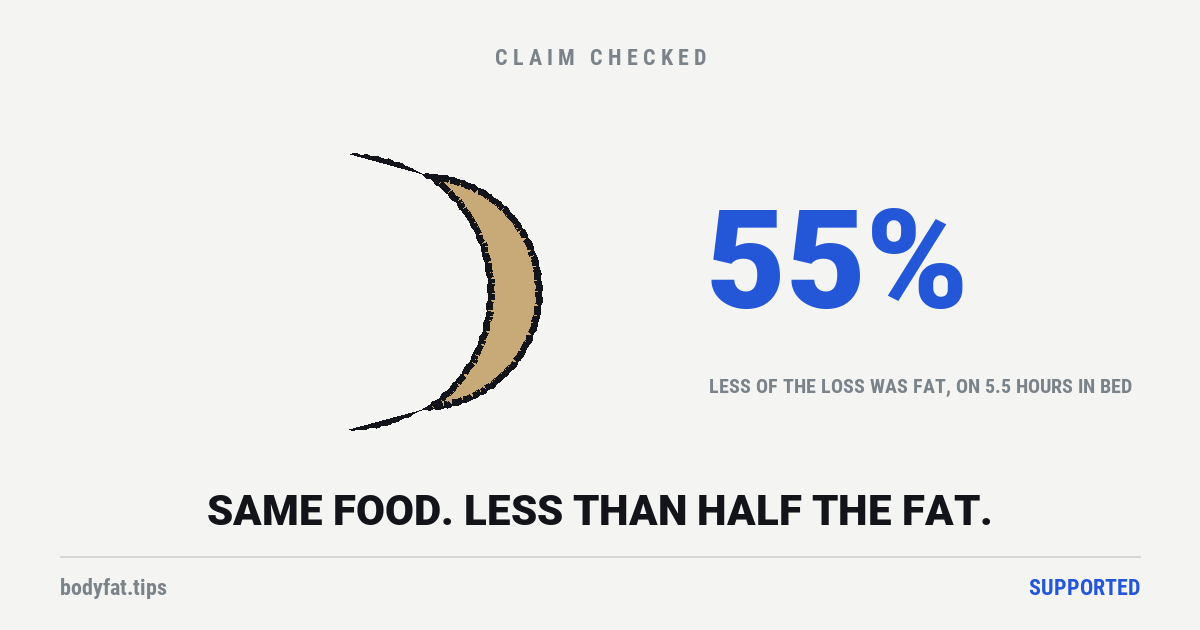
But five and a half hours in bed cut the proportion of that loss that was fat by 55%, and increased the fat-free mass lost by 60% [1].
Fat-free mass is everything that isn’t fat. The study got it by taking scale weight and subtracting the fat a DXA scan found (a low-dose X-ray that reads fat, lean tissue and bone), so muscle was never measured on its own. The researchers point out that lean tissue is mostly water, and they call their own suggested explanation — the body turning protein into glucose to fuel longer waking hours — untested [1].
Same food. A little hungrier. Less than half the fat. That is the trade you are making when you diet on short sleep, and no bathroom scale in the world will tell you it is happening.
How solid is that, really?
Ten people. Fourteen days.
We are not going to dress that up: it is a small study, and the paper lists exactly that under its own limitations [1]. A finding this striking from a sample this size is a strong hint, not a settled fact, and that is why this verdict sits at Supported rather than Established.
Two things do make it more credible than the headcount suggests. The crossover design, as above. And the funder — the National Institutes of Health [1], which is to say nobody with a mattress or a supplement to sell.
The authors themselves had other ties at the time, which their disclosure forms list and mark as separate from this study. The ones that touch sleep or weight: one author listed a grant, received or pending, from Lipid Nutrition/Loders Croklaan to test CLA, a fatty acid, for weight loss in children, a submitted patent on CLA for weight control in children, and consulting for a GlaxoSmithKline panel on diet and weight control. Another listed a research grant from Sepracor, whose sleeping pill Lunesta the FDA approved in 2004 [3] [4].
Has anyone tested the finding since? A separate team has. At the University of South Carolina, 36 adults with overweight or obesity, about four in five of them women, dieted for eight weeks; one group slept about an hour less on five nights a week and caught up on the other two. Both groups lost similar amounts of weight, fat and lean mass. What differed was the share: less of the loss came from fat in the group sleeping less [5]. Same direction as the Chicago study on the share, not on the amounts, and another small sample.
So does sleeping more actually make you eat less?
This is where the 2022 trial comes in, and it is the one that tests that directly.
In 2022 a randomised trial took 80 adults who habitually slept under six and a half hours, and simply helped half of them sleep longer. No diet. No exercise programme. No lab. They went home and lived their lives [2].
The sleep group gained about 1.2 extra hours a night.
Compared with the group who kept their usual sleep, they ate about 270 calories a day less [2]. Without being asked to.
That 270 is the gap between the two groups, not one group’s cut. The sleepers’ own intake fell by about 155 calories a day while the comparison group’s rose by about 115. The researchers list that rise among their limitations, and point out that comparing the groups, not each group with its own starting point, is the recommended way to read a trial [2].
Now, the detail that makes this trial worth more than a dozen like it: they did not ask anyone what they ate. Food diaries are famously, hopelessly wrong — people under-report, forget, and lie, mostly to themselves. Instead the researchers used doubly labelled water: you drink water with traceable isotopes in it, and how fast they leave your body reveals how much energy you burned. Combine that with a body-composition scan and you can calculate what somebody must have eaten, without ever taking their word for it [2].
Total energy expenditure did not significantly change [2]. So the burn stayed flat, intake fell, and weight came down.
Which kills the supplement version of this story: sleeping more did not raise the calories people burned. It does not follow that sleep works only through appetite. This trial measured how much people ate, and its authors say working out why is a job for future studies [2].
The 2010 study, where the food was fixed, looked at the body’s side. On short sleep, people rated themselves a little hungrier. By the end, their resting metabolic rate — the calories you burn lying still — was about 147 calories a day lower than after the long-sleep fortnight (anywhere from roughly 40 to 250, once you allow for chance), more than the tissue they had lost would explain. Their breath showed them burning relatively less fat, too [1]. That is ten people, nine for the metabolic-rate reading. And when the researchers tried to confirm a drop in total daily burn directly, the measurement was too noisy to say either way [1].
And 270 calories a day is not a small number
Sustained, that is roughly the gap people spend years trying to close with willpower.
The trial ran two weeks. The researchers did run the long sum: a published weight-change model turns 270 fewer calories a day, kept up for three years, into about 26 lb (12 kg). That starts from the gap between the groups, and in the same paragraph they wrote that the study cannot say how long anyone keeps the habit [2]. We are not going to lean on it. But it does reframe the question. If you are fighting your appetite every afternoon and sleeping six hours, you may not have a discipline problem. You may have a sleep problem wearing a discipline problem’s clothes.
What this does not license
There is an entire shelf built on the sentence “your body burns fat while you sleep” — the PM fat burners, the night-time metabolism formulas, the bedtime powders.
Nothing above supports any of that. In the 2022 trial the change ran through how much people ate; in the 2010 study the food was fixed and the only thing changed was the hours in bed. There is no overnight furnace to stoke, and a capsule taken at 10pm does not extend your sleep by 1.2 hours — the thing that actually did that in the trial was a counselling session about bedtimes [2].
Which is free, and nobody can sell it to you by the bottle, which is roughly why you have heard about the capsules and not the counselling.
What to actually do
If you are dieting, treat sleep as part of the diet rather than a separate virtue. In the 2010 study and the eight-week trial, both in middle-aged adults carrying extra weight, short sleep shifted how much of the loss came from fat while the scale reported the same success either way. Whether that means losing real muscle has not been measured.
If you are overweight but not obese and habitually sleep under six and a half hours, the 2022 trial suggests making more time for sleep is worth doing alongside what you eat, not instead of it: it compared sleep counselling with none, and never tested a diet [2]. What extended sleep was one-to-one advice on sleep habits, with a follow-up a week later, and cutting back on electronic devices appeared to be a key part of it [2].
That trial took adults aged 21 to 40 and left out anyone with insomnia, sleep apnea or another sleep disorder, night or rotating shift workers, and anyone already on a weight-loss diet [2]. If you have a sleep disorder or work nights, this evidence does not reach you, and a clinician is the right next stop.
And if the scale is your only instrument, you are blind to the exact thing short sleep is doing to you. Waist tape. Photographs. How your lifts feel. Anything that separates fat from everything else.
This page misreported what its own two studies found, and was corrected on 16 September 2026 after an independent editorial review. It said sleep “is not doing anything to your metabolism” and that both studies ran through how much you eat. In the 2010 study everyone ate the same weighed food, and short sleep still left people a little hungrier, with a lower resting metabolic rate and relatively less fat burned; the page now says so, with that study’s size and its own caveats. It called fat-free mass “muscle, mostly”; the study worked it out as scale weight minus scanned fat, never measured muscle, and notes that lean tissue is mostly water. It gave the 2022 trial’s 270 calories a day as the sleep group’s own cut; that is the gap between the groups, and the sleep group’s own intake fell by about 155. And it said the researchers had not projected a pound count; they projected about 26 lb (12 kg) over three years if the habit lasted.
Also changed: the search description and the evidence figure now say 5.5 hours in bed, since measured sleep averaged 5 hours 14 minutes; “same suffering, half the fat” now says people were a little hungrier and lost less than half the fat; the 2022 trial is no longer said to close the argument on causation; the evidence panel no longer calls the two studies independent, since they share two authors and a university, and the page now adds a separate eight-week trial that agrees on the share of weight lost as fat but not on the amounts; the advice now says who the 2022 trial left out and that it never tested a diet; an unsourced price and an unsourced slogan are gone, and the provenance chain now names the university’s press release and three products’ own claims; the study figures carry kilograms; and the funding paragraph adds the authors’ disclosed outside ties. The rating is unchanged.