How to Raise HDL: Exercise Lifts It About 2 mg/dL. Two Pills Approved Partly to Raise It Lost Approval After Heart Trials Found No Clear Benefit.

“This helps boost ‘good’ HDL cholesterol and improve overall heart health.” That is the promise under a 50-second video called “How To Lower Your Cholesterol”, posted on 27 October 2023 by a physicians’ explainer channel run by two orthopaedic surgeons. It had 1,968,915 views when we read its numbers on 10 October 2026 [1]. The “this” is exercise: “at least 30 minutes of moderate-intensity exercise, like brisk walking or cycling, most days of the week” [1].
We read the description, not the video, so what is said on camera is not what this page checks. It checks the sentence, and the question behind it: in the United States, “how to raise hdl” is searched about 8,100 times a month and “does exercise raise hdl” about 260 times a month (from a paid keyword database, pulled 10 October 2026) [2].
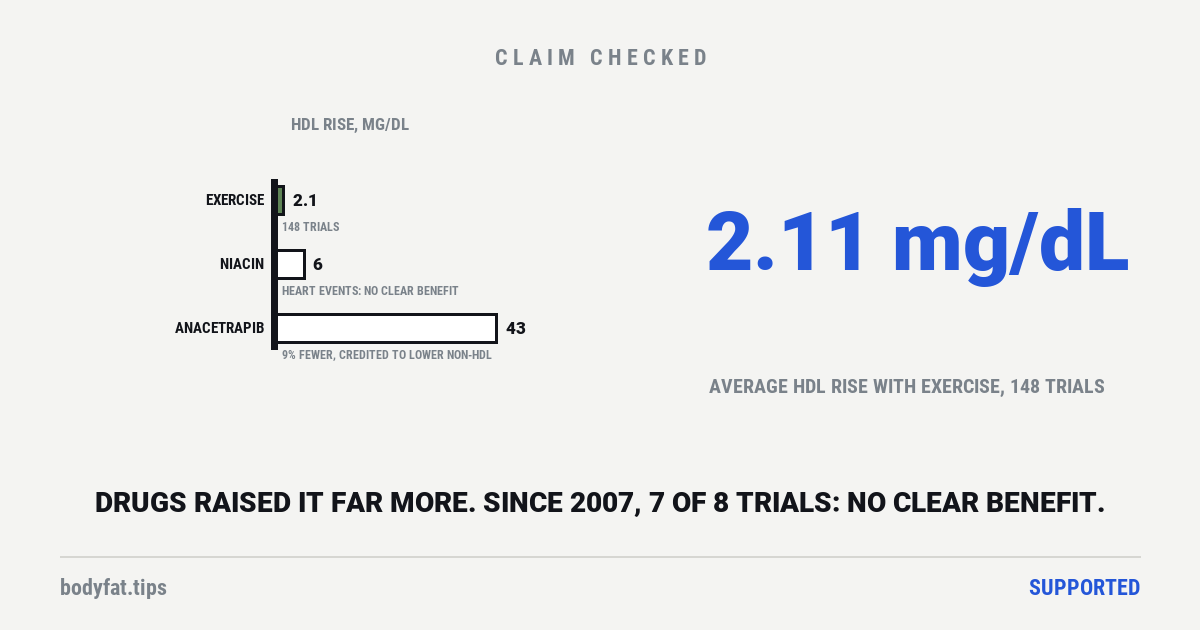
Exercise does raise HDL, by about 2 mg/dL on average. A 2025 pooling of 148 randomised trials put the rise at 2.11 mg/dL [3], and a 2007 pooling of aerobic training at 2.53 [4]. Aerobic exercise has the clearest record; weight training on its own has a mixed one. Losing weight, quitting smoking and eating fat in place of carbohydrate raise HDL too, and so does alcohol, which is not a reason to drink.
The second half of that sentence is where the HDL story broke. Since 2007, eight large heart trials have tested drugs aimed at HDL: seven raised it, most far more than any workout did, and one infused its main protein. Seven of the eight found no clear benefit, one of those seven found harm, and the eighth found a small benefit that a 2026 review credits to the drug lowering LDL and the other cholesterol-carrying particles, not to the HDL rise [5] [6] [7] [8] [9] [10] [11] [12] [13]. Low HDL is a warning sign worth taking seriously. Raising the number is not the same as fixing what it warns about.
What is HDL and why is it important?
HDL is not a kind of cholesterol. It is a lipoprotein: a tiny particle of fat and protein that carries cholesterol through the blood, the way LDL does [14]. The cholesterol inside both is the same molecule. The number on your blood test, HDL cholesterol, is how much cholesterol the HDL particles are carrying.
In the United States it is reported in milligrams per decilitre (mg/dL). Much of the world uses millimoles per litre (mmol/L); divide mg/dL by about 38.6 to convert [15]. The US cholesterol guideline counts HDL below 40 mg/dL in men and below 50 mg/dL in women as low: one of five signs, along with waist size, triglycerides, blood pressure and blood sugar, any three of which make the metabolic syndrome [15]. The older federal guidelines went further: an HDL of 60 mg/dL or more counted as a “negative” risk factor, which took one risk factor off a patient’s total [16].
Why the attention? Because in large studies of the general population, people with higher HDL have fewer heart attacks. Pool 302,430 people from 68 studies, and coronary heart disease came at 6.4 cases per 1,000 people a year in the lowest third for HDL against 2.4 in the highest third; every 15 mg/dL more HDL went with a 22% lower risk, after allowing for other risk factors [17]. That is an association, measured in people who were not randomly assigned their HDL. Whether pushing the number up would buy the same protection is a different question, and it has been tested.
Does exercise raise HDL?
Yes, a little. The largest pooling we read, published in 2025, gathered 148 randomised trials of exercise training with 8,673 people [3]. HDL rose by 2.11 mg/dL (0.05 mmol/L) on average, with a confidence interval of 1.43 to 2.79 — the range the true average probably sits in, and it does not reach zero [3]. That is about 3.5% of where people started [3].
An earlier pooling, of 25 trial reports in 2007, landed in the same place: 2.53 mg/dL (0.065 mmol/L) [4]. Two analyses 18 years apart, the second far larger, agree on the size of it.
Not every pooling agrees. A 2025 pooling of seven studies in 341 people who had been sedentary, some of the studies not randomised, found no clear rise: a standardised effect of 0.06, with a range from 0.16 lower to 0.27 higher, on a scale where 0.2 is small, 0.5 moderate and 0.8 large [18]. Another 2025 pooling, of aerobic exercise in people with overweight or obesity, found a small rise of 0.33 on the same scale; it was clear in people with overweight and not in those with obesity [19]. The big pooling’s answer, about 2 mg/dL, is the one with the most trials behind it, and the smaller ones are a reminder of how much the result varies from one setting to the next.
How big is 2 mg/dL? Against the guideline’s line of 40 mg/dL for men, it is a nudge, not a rescue. In the 302,430-person pooling, the ordinary spread of HDL between one person and the next was about 15 mg/dL [17], so exercise moved it about a seventh of that spread, by our arithmetic.
And the average hides a lot of variety. The 2025 authors also worked out a prediction interval, the range they would expect the result of the next similar trial to fall in: from 4.66 mg/dL lower to 8.88 mg/dL higher [3]. By their reading of that range, about a third of trials would show no HDL benefit [3]. The trials were small (on average 23 people exercising and 15 not), most often twelve weeks long, and of the 216 comparisons pooled for HDL, the authors judged 122 at high risk of bias and only five at low risk [3]. Before printing that total we looked for the biggest trial in it: the authors say only four had more than 100 people in both groups, and taking out any single trial did not change whether the result held [3].
| What changed | HDL change | What else moved |
|---|---|---|
| Exercise training, 148 randomised trials, 2025 [3] | About 2.1 mg/dL higher (0.05 mmol/L) [3] | LDL about 7 mg/dL lower, triglycerides about 8 mg/dL lower [3] |
| Losing weight with diet and exercise, 73 trials, at 12 months [20] | About 0.46 mg/dL higher for every 2.2 lb (1 kg) lost; it dips while the weight is coming off [20] [21] | LDL and triglycerides lower [20] |
| Quitting smoking, 27 studies [22] | About 3.9 mg/dL higher (0.100 mmol/L) [22] | LDL, total cholesterol and triglycerides not clearly changed [22] |
| Low-carb against low-fat diets, 38 trials, at 6 to 12 months [23] | About 1.9 mg/dL higher on low-carb (0.05 mmol/L); beyond a year, not clear in its two trials; a little higher in a 2024 pooling of six trials of a year or two in type 2 diabetes [23] [24] | LDL about 2.7 mg/dL higher on low-carb (0.07 mmol/L) [23] |
| Alcohol, feeding studies in a review of 63 [25] | About 3.6 mg/dL higher (0.094 mmol/L), more with more drink [25] | Not a reason to drink: see the alcohol section below |
Best exercise to increase HDL
Aerobic training has the firmest evidence. In the 2025 pooling, it raised HDL in the well-run trials and the rest alike; weight training, and aerobic and weight training combined, raised it only in the trials that fell below the authors’ own bar for good quality, and the authors call weight training’s effect on HDL “borderline” [3]. On the paper’s bar chart, which prints no figure for each kind, all three sit at about 2 mg/dL, by our reading of the chart [3]. What mattered most there was how long each session lasted. In the 2025 pooling, sessions longer than 30 minutes raised HDL clearly and shorter ones did not clearly [3]; the video’s 30 minutes sits right on that line. In the 2007 one, each extra 10 minutes per session went with about 1.4 mg/dL more, while how often and how hard people trained showed no clear link [4].
The 2007 pooling also estimated a floor: about 120 minutes a week, or about 900 calories burned in exercise a week, before HDL rose measurably [4]. Thirty minutes on most days is 120 to 210 minutes a week, at or above that floor, so the video’s dose is in the right place. A US trial of 111 inactive, overweight adults found the same pattern from the other side: more exercise did more for blood fats than harder exercise did [26].
Weight training on its own is where the poolings disagree. A 2009 pooling of 29 randomised trials, 1,329 people, found no clear HDL rise: 0.7 mg/dL, with a range from 1.2 lower to 2.6 higher [27]. A 2019 pooling of strength-training trials found a small rise, 0.36 on the scale above [28], and a 2026 pooling of 12 randomised trials in 454 adults with overweight or obesity found no clear change [29]. The newest is a 2026 network pooling, which compares several kinds of exercise at once: 56 randomised trials in 3,788 people with the metabolic syndrome. It ranked interval training first, weight training second, aerobic and weight training combined third and steady aerobic exercise fourth, of five kinds [30].
Those ranks come from a ranking score: the chance, from 0 to 100%, that a kind of exercise is among the best. Interval training scored 86%, weight training 65% and combined training 64% [30]. Ranking scores are fragile. By our reading, two kinds a point apart are as good as tied, and weight training’s place rests on far fewer people than interval training’s, 274 against 1,359 by the labels on the paper’s network chart [30]. Against no exercise, only interval training’s rise was clear in the pooling’s main estimates, about 0.08 mmol/L (roughly 3 mg/dL, our conversion); the ranges for weight training, combined training and steady aerobic exercise reached or crossed zero [30].
The paper is not consistent about weight training. Its results report a clear rise, about 0.09 mmol/L (roughly 3.5 mg/dL, our conversion), in the trials that compared it directly with no exercise; one passage of its discussion says it did not show a significant rise in either analysis; and its dose model found only a small rise, about 0.03 to 0.04 mmol/L (roughly 1 to 1.5 mg/dL, our conversion), at heavy loads, with what its authors call unfavourable responses at moderate ones [30]. Women past menopause have a conflict of their own, set out further down.
One line to be wary of if you read the 2025 paper yourself. Its summary says each extra minute of session time produced “an additional 2.11 mg/dL HDL increase” [3]. Taken at its word, a 30-minute session would add 63 mg/dL, more than the 40 mg/dL the guideline uses as its low line for men, and 2.11 is also the paper’s overall average. We read it as a slip and do not use it; that judgement is ours. Our pages on zone 2 cardio, walking and lifting weights cover what those kinds of exercise do for fat.
What do I eat to raise HDL?
The food that raises HDL most reliably is fat, eaten in place of carbohydrate. In a World Health Organization review of 84 tightly controlled feeding studies, swapping 1% of daily calories from carbohydrate to saturated fat raised HDL by 0.011 mmol/L (about 0.43 mg/dL, our conversion) [31]. Swap ten percentage points and that is about 4 mg/dL, by our arithmetic. But LDL rose more, about 1.4 mg/dL for each percentage point (our conversion), and the ratio of total cholesterol to HDL did not clearly change [31]. Our saturated fat verdict goes through what those swaps do to heart disease itself.
Diet trials agree. Pool 38 trials of low-carb against low-fat diets and HDL came out 0.12 mmol/L higher on low-carb in the first three months, about 4.6 mg/dL by our conversion; by six to twelve months the lead was 0.05 mmol/L, about 1.9 mg/dL; and beyond a year, in the only two of its trials that lasted that long, it was not clear [23]. LDL ran 0.07 mmol/L higher on low-carb at six to twelve months, about 2.7 mg/dL [23]. A 2024 pooling of six trials that ran a year or more, 12 to 24 months, three of them a year long, 524 people, all with type 2 diabetes, found HDL still a little higher on low-carb, a standardised effect of 0.22, small on the scale above [24]. So at a year or more the evidence is thin and mixed: the 2020 pooling’s two trials that ran beyond a year found no clear lead, and the 2024 pooling, in people with diabetes only, found a small one. Our page on cutting carbs covers the weight side, and the insulin-resistance verdict reports the same HDL lead in its long trials.
Here is the part that surprises people. The usual advice, as a US government health page puts it, is “to raise your HDL level, you need to eat good fats instead of bad fats. This means limiting saturated fats” [14]. On HDL alone, the feeding studies point the other way: swapping saturated fat for olive-oil-type fat lowered HDL very slightly, and swapping it for vegetable-oil-type fat lowered it a little more [31]. The swap is good advice for LDL, which falls much further [31]. It is not a way to raise HDL.
Single foods move it by small amounts. Eggs raised HDL by about 2 mg/dL in one pooling of studies and not clearly in another, as our egg verdict reports, alongside a bigger rise in LDL. Our olive oil verdict covers the polyphenol-rich oils and HDL, and our vegetable oil verdict the small HDL differences between cooking fats. And one sweetener pushed the other way: in several trials, HDL fell while people took allulose and came back when they stopped, as our allulose page reports. The foods that lower LDL have their own verdict.
Does losing weight raise HDL?
Yes, once the weight stops coming off. A 1992 pooling of 70 studies found something worth knowing before a diet: while people were actively losing weight, HDL went down, by about 0.27 mg/dL for every 2.2 lb (1 kg) lost; once their weight had settled at the new, lower level, it went up, by about 0.35 mg/dL for every 2.2 lb (0.009 mmol/L per kg; the mg/dL figures are our conversion) [21]. On this evidence, a falling HDL in the middle of a diet is not a sign the diet is failing.
A 2020 pooling of 73 randomised trials and 32,496 people measured it a year in: for every 2.2 lb (1 kg) lost through diet and exercise, HDL was 0.46 mg/dL higher [20]. Lose 22 lb (10 kg) and that is about 4.6 mg/dL, by our arithmetic. Weight-loss drugs and surgery did much the same per pound lost [20].
Does quitting smoking raise HDL?
Yes. A 2003 pooling of 27 studies that followed smokers who quit found HDL rose by 0.100 mmol/L, about 3.9 mg/dL by our conversion, while LDL, total cholesterol and triglycerides did not clearly change [22].
A US trial of 1,504 smokers, given quit-smoking medicines or a dummy pill, followed 923 of them for a year [32]. The 334 who quit saw HDL rise by 2.4 mg/dL, against 0.1 mg/dL in those who kept smoking, even though the quitters gained more weight: 10.1 lb (4.6 kg) against 1.5 lb (0.7 kg) [32]. The effect was stronger in women [32]. One fence: the trial randomly assigned the medicines, not the quitting, so the quitters and the smokers were compared as they chose.
Does alcohol raise HDL?
Yes, and more drink raises it more. A 2011 review of 63 studies in which people were given alcohol and then none pooled the HDL results: 0.094 mmol/L higher on alcohol, about 3.6 mg/dL by our conversion [25]. One to two drinks a day raised it by about 2.8 mg/dL; two to four, about 4.0; five or more, about 5.5, though that last figure rests on two studies [25]. The same US government page that gives the fats advice says moderate alcohol “may lower your HDL level” [14]; the feeding studies found the opposite.
So why isn’t a nightly drink the advice? Because the HDL rise does not seem to be how alcohol touches the heart. A genetic study of 261,991 people used a gene variant that goes with drinking less: its carriers drank 17.2% less, had fewer coronary heart attacks, and had HDL not clearly different from non-carriers’ [33]. The 2025–2030 US dietary guidelines say plainly: “Consume less alcohol for better overall health” [34]. What alcohol does to cancer risk is on its own page, and what it does to weight on another.
Supplements to increase HDL
One pill raises HDL by more than a workout does: niacin, a B vitamin, taken at drug doses, a median of 2 g a day in its trials [35]. It is also the one tested best for what it does to the heart. A Cochrane review of 23 randomised trials and 39,195 people found niacin did not clearly reduce deaths, heart attacks or strokes, and people on it were about twice as likely to stop because of side effects [35]. Seventeen of those 23 trials were paid for wholly or partly by the drug’s maker [35].
The fibre sold for cholesterol works on LDL: our psyllium verdict is about LDL, and the pooling behind our oatmeal verdict found no significant effect on HDL. In people with type 2 diabetes, magnesium nudged HDL up slightly in one pooling of nine trials, as that page reports.
What is the main cause of low HDL?
The US guideline panel that set the 40 mg/dL line listed the causes, and the list is worth reading slowly: high triglycerides, overweight and obesity, physical inactivity and type 2 diabetes, which it ties together through insulin resistance; then smoking, very high carbohydrate intakes (more than 60% of calories), and certain drugs, among them beta-blockers, anabolic steroids and progestins [16]. Genes matter too: some people inherit variants that set their HDL higher or lower all their lives [36].
Notice what the list is. Most of the causes on it, extra weight, inactivity, diabetes and smoking, are heart risks in their own right. That will matter in a moment.
Does raising HDL protect your heart?
This is where the name came from. In 1977 the Framingham Study, the long-running heart study in a Massachusetts town, reported on 2,815 men and women aged 49 to 82: over about four years, 79 of 1,025 men and 63 of 1,445 women developed coronary heart disease, and the lipid that predicted it best was HDL, in the protective direction [37]. The paper’s title called HDL “a protective factor” [37]. By 1989, four US studies had put a number on it: every 1 mg/dL more HDL went with 2% less coronary risk in men and 3% less in women [38].
If that were cause and effect, raising HDL with a pill should work. In 2001 the federal guideline said so, cautiously: “Although clinical trial results suggest that raising HDL will reduce risk, the evidence is insufficient to specify a goal of therapy” [16]. Then the trials came in.
| Trial, drug, people | What happened to HDL | Heart events |
|---|---|---|
| AIM-HIGH, 2011: niacin, 3,414 people with heart disease on a statin [5] | Median 35 to 42 mg/dL (0.91 to 1.08 mmol/L) [5] | 16.4% against 16.2% on placebo; stopped early for lack of benefit [5] |
| HPS2-THRIVE, 2014: niacin with a flushing blocker, 25,673 people with vascular disease [6] | 6 mg/dL higher than placebo (0.16 mmol/L); LDL 10 mg/dL lower [6] | 13.2% against 13.7%, a difference within chance; more serious side effects [6] |
| ILLUMINATE, 2007: torcetrapib, 15,067 people at high risk [7] | Up 72%; LDL down 25%; systolic blood pressure up 5.4 mm Hg, with shifts in blood salts and a salt-regulating hormone. Its authors write that the harm was “of unknown mechanism”, and: “Although there was evidence of an off-target effect of torcetrapib, we cannot rule out adverse effects related to CETP inhibition”. An off-target effect is one beyond the drug’s intended action; CETP inhibition is that intended action [7] | More heart events and more deaths; stopped early [7] |
| dal-OUTCOMES, 2012: dalcetrapib, 15,871 people after a heart attack or unstable angina [8] | Up 31 to 40% (placebo 4 to 11%); LDL barely moved [8] | 8.0% against 8.3%; stopped as futile [8] |
| dal-GenE, 2022: dalcetrapib, 6,147 people after a heart attack or unstable angina, all with a gene type thought to help the drug [9] | 11 mg/dL higher at six months, against 1.4 on placebo; LDL and blood pressure moved the same in both groups [9] | 9.5% against 10.6%, a difference within chance; heart attacks alone, one part of that measure, were fewer [9] |
| ACCELERATE, 2017: evacetrapib, 12,092 people at high risk [10] | Up 133%; LDL down 31% [10] | 12.9% against 12.8%; stopped early for lack of benefit [10] |
| REVEAL, 2017: anacetrapib, 30,449 people on a strong statin dose [11] | 43 mg/dL higher (1.12 mmol/L); non-HDL cholesterol 17 mg/dL lower [11] | Coronary events 10.8% against 11.8%, about 9% fewer; credited by a 2026 review to the fall in non-HDL cholesterol [11] [13] |
| AEGIS-II, 2024: four weekly infusions of HDL’s main protein, apolipoprotein A1, 18,219 people just after a heart attack [12] | Given to boost the job HDL is credited with, carrying cholesterol out of artery walls; the summary gives no HDL figure [12] | 4.8% against 5.2% at 90 days, a difference within chance; much the same at a year [12] |
Put a number on the gap. In the largest niacin trial, HDL was 6 mg/dL higher on the drug, and LDL 10 mg/dL lower [6]. By the 1989 figures, the HDL alone should have meant something like 11 to 17% fewer coronary events, by our arithmetic, if those figures described cause and effect, and the lower LDL should have added a little more. The trial found 4% fewer major vascular events, with a range from 10% fewer to 3% more [6]. It also found more serious problems with diabetes control, more infections and more bleeding on niacin [6].
The favourable results deserve the same attention. Before statins, niacin was linked to fewer non-fatal heart attacks in its trials, with odds about 31% lower in a 2014 pooling; on top of a statin, the same pooling found no clear difference [39]. Niacin also lowers LDL and triglycerides [6], so those early trials cannot say which change did the work. And REVEAL did cut coronary events, by about 9% [11]; a 2026 review of the field says its long-term follow-up suggests the benefit is “best explained by lowering of non-HDL/ApoB-related lipoproteins rather than by HDL-C increases” [13]. Non-HDL cholesterol is all the cholesterol carried in particles other than HDL, LDL included.
Fibrates show the same pattern in the 2014 pooling: before statins, the odds of a non-fatal heart attack about 22% lower; in trials where some or all took a statin, not clearly lower [39]. VA-HIT, in 1999, chose 2,531 men with heart disease for an HDL of 40 mg/dL or less and gave them a fibrate or a dummy pill for a median of 5.1 years. HDL ended 6% higher than on placebo and triglycerides 31% lower, with LDL not clearly different, and 17.3% had a non-fatal heart attack or died of coronary heart disease, against 21.7% on placebo: 22% fewer. Its authors wrote that the rate of coronary events “is reduced by raising HDL cholesterol levels and lowering levels of triglycerides”, which is two changes, not one [40].
Not every fibrate trial found a benefit; two that did not are ACCORD and PROMINENT. In ACCORD, 5,518 people with type 2 diabetes, all on a statin, HDL ended at 41.2 mg/dL on the fibrate against 40.5 on placebo, median triglycerides at 122 against 144, and heart events ran at 2.2% a year against 2.4%, a difference within chance; the FDA notice below cites it [41]. PROMINENT gave a newer fibrate-type drug, pemafibrate, to 10,497 people with type 2 diabetes chosen for an HDL of 40 mg/dL or less and high triglycerides, on cholesterol treatment or unable to take a statin: triglycerides fell about 26% against placebo, and 572 people had a heart event on the drug against 560 on placebo, a difference within chance [42].
Genetics asked the same question without a drug. A 2012 study used a gene variant that raises HDL by about 5.4 mg/dL (0.14 mmol/L; the mg/dL figure is our conversion) and leaves other blood fats alone [36]. Its carriers should have had about 13% fewer heart attacks, if HDL protects. Their risk was not clearly lower: the odds came out at 0.99, where 1 means no difference [36]. Run on gene variants that raise LDL, the same method did find more heart attacks, as LDL’s reputation predicts [36]. This kind of study is called Mendelian randomisation: the genes are dealt at conception, so they work like a trial nature ran.
In April 2016 the US Food and Drug Administration withdrew its approval of two niacin-and-statin combination pills, one of them approved, in part, “to increase HDL-C”, concluding that “the totality of the scientific evidence no longer supports the conclusion that a drug-induced reduction in triglyceride levels and/or increase in HDL-cholesterol levels in statin-treated patients results in a reduction in the risk of cardiovascular events” [43]. The US cholesterol guideline now says the trials “do not support” adding niacin or fibrates to a statin [15]. And the 2026 review sums up where the field has landed: raising HDL cholesterol “per se is not an evidence-based strategy” for preventing heart disease [13].
One door is still open. A newer drug of the same class, obicetrapib, raises HDL by about 68 mg/dL and lowers LDL by about 34 mg/dL [44]. In a pooled look at two of its year-long cholesterol trials, both sponsored by its maker and with half the authors on the maker’s staff, the main heart measure among 2,884 people was not clearly lower (3.9% against 5.0%), while a narrower coronary measure was, only just [44]. Its 9,541-person heart trial had posted no results when we checked the registry on 10 October 2026 [45], and we found no published report of them [46]. The field now treats it chiefly as a drug that lowers LDL and the particles like it [13]. If it works, the open question will be the same one: was it the HDL?
Our plaque verdict covers what lowering LDL does to the arteries themselves, and the statin verdict one of the trade-offs of the drug that most of these trials were built on top of.
Can HDL be too high?
Possibly. Two Copenhagen studies of 116,508 adults found the lowest death rates at an HDL of about 73 mg/dL in men and 93 mg/dL in women (1.9 and 2.4 mmol/L), with higher death rates at the very top [47]. Men with HDL of 116 mg/dL (3.0 mmol/L) or more died at about twice the rate of men at the best level, and women at 135 mg/dL (3.5 mmol/L) or more at about 1.7 times, after allowing for drinking, smoking and other factors [47]. Such high levels were rare, the groups small, and the people all white Danes; the authors said the findings needed confirming [47]. Others have looked since, and they do not all agree. A 2020 pooling of 37 cohorts and 3.5 million people found a J-shape, death rates rising at both ends, more steeply at the low end: the lowest death rate came at an HDL of about 54 to 58 mg/dL [48]. In 631,762 Ontario adults without heart disease, HDL above 70 mg/dL in men and 90 in women went with more deaths from causes other than heart disease and stroke [49]. The 2026 review adds cohorts in China and the United States, and a study of people who already had heart disease, in British and American biobanks, that found more deaths at the top as well [13]. But a 2024 pooling of eight studies, about a million people without heart disease, found no clear difference in deaths from any cause at an HDL of 80 mg/dL or more, fewer heart attacks and other coronary events, and more cardiovascular deaths only above about 94 mg/dL in men and 116 in women [50]. All of these are associations, not tests, and they disagree on where the line is. The 2026 review puts the line where very high HDL stops being reliably protective at around 80 to 90 mg/dL, depending on sex and population [13].
If pills that raised HDL did not protect hearts, does the HDL you gain from exercise mean anything?
This section is the desk’s own reasoning, and it is labelled as such. Exercise raises HDL. Exercise is linked to fewer heart attacks, and in people who already have heart disease, randomised trials of exercise programmes cut them [51]. Raising HDL with pills did not clearly prevent them. Those three can all be true. Here are three ways to fit them together, each rated.
Answer one: the HDL rise travels with other changes. In the 148 trials, exercise also lowered LDL by about 7 mg/dL and triglycerides by about 8 [3]. In 27,055 women followed for about 11 years, the lower heart risk that went with more activity was explained more by inflammation markers (32.6%) and blood pressure (27.1%) than by total, LDL and HDL cholesterol together (19.1%) [52]. The shares are measured, in a cohort, not a trial. That HDL itself does little of the work is a surmise, with the drug trials and the genetics on its side. Two randomised results lean the same way, though neither isolates HDL. In a 2004 pooling of 48 trials of exercise-based rehabilitation in people with heart disease, the odds of dying were about 20% lower with the exercise, while HDL, and the rate of non-fatal heart attacks, did not change significantly [53]. And in Look AHEAD, 5,145 adults with type 2 diabetes randomly assigned to diet and activity aimed at weight loss improved their HDL more than the comparison group, at first, and had heart events at a rate not clearly different, 1.83 against 1.92 per 100 people a year, over a median of 9.6 years [54].
Answer two: the case the other way. In a study inside a cohort of 18,225 US men, three more hours a week of vigorous activity went with 22% fewer heart attacks, and HDL alone accounted for about 38% of that, with a range from 3% to 74% [55]. Its own authors warn that markers like this “may not be in the causal pathway” [55]. And HDL raised by exercise may not behave like HDL raised by a drug; the 2026 review calls the HDL cholesterol number “an imperfect surrogate for HDL function” [13]. This is an association with a wide range, and a hypothesis the field is still testing.
Answer three: low HDL is a smoke alarm. Go back to the guideline’s list of causes: extra weight, inactivity, diabetes, smoking, high triglycerides [16]. Most are heart risks in their own right, and most of the ways to raise HDL on this page change one of them. A smoke alarm is the best predictor of a fire in the building; unplugging it does not lower the risk, and taping a louder one to the ceiling does not put anything out. This is an observation from the guideline’s own list, not a trial.
Put the three together and here is what we think is true, stated plainly so you can disagree with it: HDL is a reading, not a lever; the things that raise it are worth doing for everything else they change, and the number going up is a sign you did them, not proof that it worked.
What we could not find, and would like to: a randomised exercise trial large and long enough to count heart attacks, that reported whether they fell in step with the HDL rise once LDL, blood pressure and weight were accounted for. The nearest randomised evidence, set out in Answer one, points both ways. In a 2026 Cochrane review of 107 trials of rehabilitation programmes in people with heart disease, the trials that followed people for six to twelve months found heart attacks cut by about 28%, on evidence the review rates high-certainty, and deaths probably cut a little, by about 14%, with a range that reaches no difference at all [51]. In the 48 trials pooled in 2004, deaths fell while HDL, and the rate of non-fatal heart attacks, did not change significantly [53]. Look AHEAD raised HDL and did not clearly cut heart events [54]. None of them analysed heart events against each person’s HDL change. The two cohort analyses above did, in people who were not randomly assigned, and a 2014 Cochrane review of exercise in people at high heart risk found four trials, of six months at most, that counted no heart events [56] [46]. If you know of the trial, the corrections line on this site is open.
Who these studies were done on
The exercise trials were small and short: on average 23 people exercising, twelve weeks the most common length [3]. The 2007 pooling found bigger HDL rises, by about 2.1 mg/dL, in people with a body-mass index under 28 whose total cholesterol started at 220 mg/dL or more, against heavier people with lower cholesterol [4]. For weight training in women past menopause, two poolings point opposite ways: one of 19 trials found no clear HDL change across all of them, by our reading of its chart, with a fall of about 3 mg/dL that its authors saw only in women with obesity; another found 12 weeks of weight training raised HDL by about 4 mg/dL in women with obesity past menopause, from three trials whose results differed from each other by more than chance would produce, evidence it grades low in certainty [57] [58]. In people with heart disease, the rehabilitation trials pooled in 2004 did not move HDL significantly, while deaths fell [53]. The quitting effect was stronger in women [32]. The feeding studies were two-thirds men [31]. The drug trials were in people who already had heart disease or were at high risk, most of them on statins; AIM-HIGH was 85% men [5]. The very-high-HDL findings come from cohorts in Europe, North America and Asia, most of them of people without heart disease [47] [48] [50]. If your HDL is low because you smoke, sit most of the day or carry extra weight, those are the causes these trials changed.
Where “good cholesterol” came from
The research was real. In 1977 a heart study in a Massachusetts town found that people with more HDL developed less heart disease, and put “a protective factor” in its title [37]. The framing came next. The 2001 federal cholesterol guidelines let an HDL of 60 mg/dL or more cancel one risk factor, and said the trials “suggest that raising HDL will reduce risk” [16]. A protective particle became a protective number, and a number you could raise.
Then it spread, and it is still spreading. A US government health page, updated in August 2026, tells readers “a high HDL level can lower your risk for coronary artery disease and stroke” [14]. Ask Google how to raise HDL and its AI answer opens “You can increase your HDL (good) cholesterol naturally”, citing that page among others [2]. The video that brought this page into being promises a boost to “good” HDL and to heart health in one sentence [1]. The same channel’s longer food episode describes foods “shown to improve blood cholesterol levels by lowering LDL and raising HDL” [1].
And it was sold. Two niacin-and-statin pills were approved in the US in 2001 and 2008 with HDL-raising among their labelled uses; in 2016 the regulator withdrew its approval, on trials like those in the table above [43].
None of this is aimed at anyone trying to raise their HDL. Walking more, quitting smoking and losing weight are worth doing, and HDL rising is one honest sign that you did. It is the promise attached to the number that the trials did not keep.
What this is rated, and what the rating covers
Supported — for the claim that regular aerobic exercise raises HDL cholesterol.
It is rated Supported because two poolings, 18 years apart and the second of 148 randomised trials, agree on a rise of about 2 to 2.5 mg/dL, and in the larger one aerobic training raised HDL in the well-run trials and the rest alike [3] [4]. The rating is for aerobic exercise, steady or in intervals, both of which raised HDL in the 2025 pooling; combined training’s rise there held only in the less carefully run trials, and weight training alone is rated below [3]. The newest pooling, of people with the metabolic syndrome, adds a limit rather than support: interval training raised HDL clearly there, but steady aerobic exercise ranked fourth of five kinds and its rise was not clear against no exercise [30]. It is not Established because most of the comparisons carry a high risk of bias, the trials are small and short, the range for the next trial includes no rise at all, and a small 2025 pooling of seven studies found no clear rise [3] [18].
Each of the other claims on this page, rated alone, in words. That low HDL marks a higher risk of heart disease: Established, on cohorts of hundreds of thousands of people [17].
That losing weight raises HDL, once the weight has stopped coming off: Supported, with the dip while losing reported [21] [20].
That quitting smoking raises HDL: Supported, though in the studies we read the quitting itself was not randomly assigned [22] [32].
That eating fat in place of carbohydrate raises HDL: Supported. The low-carb lead is largest in the first months and shrinks, LDL rises with it, and at a year or more the evidence is thin and mixed: two trials that ran beyond a year, in one pooling, found no clear lead, and a pooling of six trials of a year or two, half of them a year long, found a small one, in people with type 2 diabetes only [31] [23] [24].
That alcohol raises HDL: Supported. It is not a reason to drink [25] [33].
That weight training on its own raises HDL: Preliminary. The poolings conflict: a 2009 pooling of 29 trials and a 2026 pooling of 12 found no clear rise, a 2019 pooling found a small one, the 2025 pooling found it only in its less carefully run trials, the newest, in people with the metabolic syndrome, ranked it second of five kinds of exercise but is not consistent about whether its rise was clear, and in women past menopause two poolings point opposite ways, the one that found a rise resting on three trials [27] [29] [28] [3] [30] [57] [58].
That raising HDL by itself lowers heart risk: Unsupported, of the tested kind. What was tested: the cleanest tests first. A drug that raised HDL while leaving LDL and blood pressure close to where they were, dalcetrapib, was tried in two trials: 15,871 people after a heart attack or unstable angina (chest pain at rest from a narrowed heart artery), and 6,147 more chosen for a gene type thought to help the drug. A gene variant that raises HDL and leaves the other blood fats alone was studied in 20,913 heart attacks and 95,407 controls, with a score of 14 such variants alongside. And infusions of HDL’s main protein were given to 18,219 people just after a heart attack. None clearly cut its main measure of heart events; in the second dalcetrapib trial, heart attacks alone, one part of that measure, were fewer [8] [9] [36] [12]. The other drug trials test it less cleanly, because the drugs did more than raise HDL: niacin also lowered LDL and triglycerides and brought more serious side effects, torcetrapib also raised blood pressure, and evacetrapib and anacetrapib also lowered LDL or the other cholesterol-carrying particles [5] [6] [7] [10] [11] [39]. Fibrates, in the two fibrate trials on this page that report both figures, lowered triglycerides far more than they raised HDL [40] [41]. What was not tested, in any trial we found: whether HDL raised by exercise or diet protects through the HDL; that is the question in the section above [46].
That very high HDL goes with more deaths: Preliminary, as an association. Cohorts in Denmark, Canada, China and the United States, and a 2020 pooling of 37, found more deaths at the very top; a 2024 pooling of eight studies found no clear difference in deaths from any cause at 80 mg/dL or more, and more cardiovascular deaths only far higher. They are associations, not tests, and they disagree on where the line is [47] [48] [49] [13] [50].
What is not rated here: tests of HDL particle size or function, which people search for alongside this question [2] and which the trials on this page did not use; foods that lower LDL, which have their own page in preparation; and the frame above, which is this desk’s reasoning from the evidence rather than a result the evidence delivered. It is marked as ours so that you can weigh it as ours.
This is journalism, not medical advice. If you take a statin or any other cholesterol medicine, decisions about it belong with the clinician who prescribes it; do not stop or add one because of an HDL number. How we read a study, and what each tier means, is set out here.
- White Coat Hypertension: In Four Studies, High Blood Pressure or Pills for It Followed Roughly Twice as Often. The Death Risk Is Unsettled.
supported - How to Measure Blood Pressure at Home: A Cuff Two Sizes Too Small Added 19.5 Points. Skipping the Five-Minute Rest Added Less.
supported - Are Squats Bad for Your Knees? The Warning’s Best-Known Source Is a 1961 Study of 128 Weightlifters. Squatters’ Knees Have Mostly Tested Fine Since. Hours of Squatting at Work Have Not.
unsupported