Does Cutting Carbs Burn Fat? The First Week Is Water

Cut your carbs and the scale drops fast. Four, five, six pounds in a week, sometimes more. That happens, it is well documented, and anyone telling you it doesn’t is arguing with a bathroom scale.
The question is what came off.
The first week is water, and it has been measured
Researchers put six people through three separate ten-day diets each, measuring what the lost weight was actually made of.
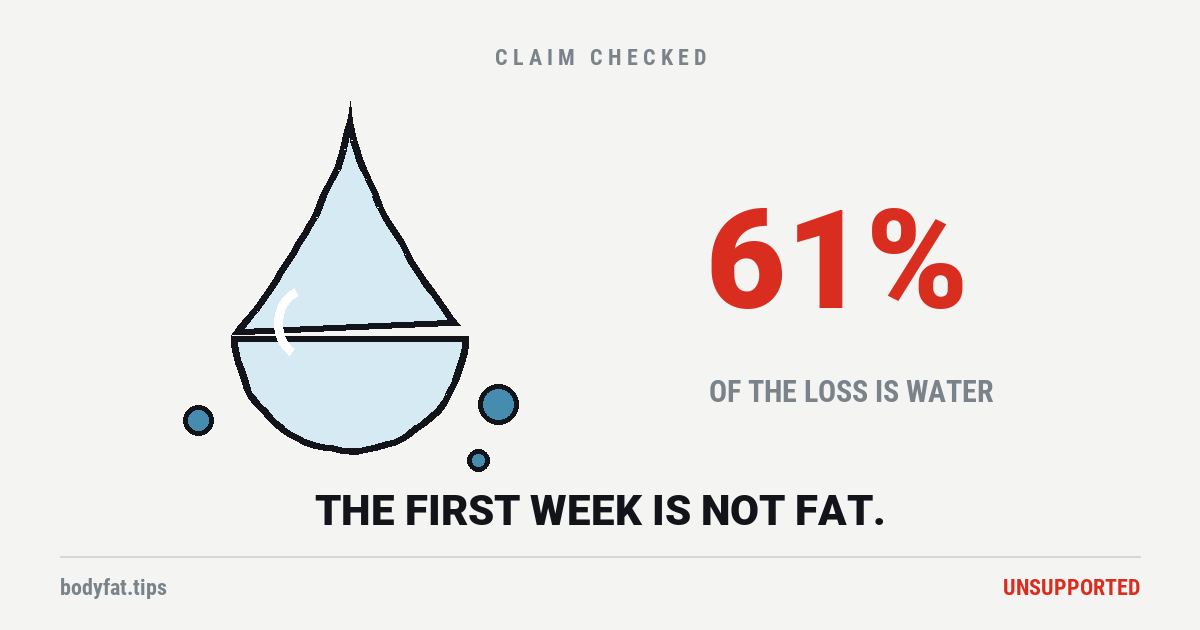
On the ketogenic diet they lost more weight — and it was 61 percent water, 35 percent fat. On an equal-calorie mixed diet they lost less total weight, but that loss was 37 percent water and 59.5 percent fat [1].
Same calories. More movement on the scale with low carb. More actual fat with the mixed diet.
A metabolic-ward study forty years later put a number on the swing: switching people to a ketogenic diet produced 1.6 kg of extra weight loss over about two weeks, of which 0.2 kg was fat [2].
The mechanism is unglamorous. Your body stores carbohydrate as glycogen, and glycogen is stored wet — each gram holds several grams of water alongside it. Empty the tank and the water goes with it. Refill it and the water comes back, which is why the weight returns the moment you eat a bowl of pasta, and why that feels like failure when it is really plumbing.
So does it burn more fat?
This is the actual claim, and it has been tested in the strictest way available: lock people in a metabolic ward where every calorie in and out is measured.
In one such study, cutting carbohydrate did exactly what the theory requires — insulin secretion fell by 22 percent. Fat loss on that diet: 53 grams a day. On the equal-calorie low-fat diet, where insulin didn’t budge: 89 grams a day [3].
Lower insulin. Less fat lost. The opposite of the prediction.
Pool 32 controlled feeding studies covering 563 people and the pattern holds: the advantage sits fractionally with the lower-fat side, by an amount the authors themselves call physiologically meaningless [4]. Their conclusion was that for practical purposes, a calorie is a calorie.
The test the believers paid for
Here is the part of this story almost nobody tells, and it is to several people’s credit.
The carbohydrate-insulin model — the idea that carbs drive fat storage through insulin rather than through calories — has serious academic advocates [9]. In 2012 two of its most prominent champions launched a research non-profit for the express purpose of funding rigorous tests of it.
That money helped pay for the 2016 ketogenic-diet ward study — the one that measured the 3.5 lb (1.6 kg) water swing, not the 22-percent insulin study, which the NIH funded on its own. Its acknowledgements state that the organisation convened the research team, helped formulate the hypothesis and provided part of the funding [2].
The result came back negative. Insulin secretion dropped sharply on keto, and fat loss slowed.
A separate year-long trial of 609 people tested the model’s own fallback prediction — that people who secrete more insulin should do better on low carb. The interaction came out at p = 0.47. Nothing [5].
They funded the studies, helped design them, chose the strictest possible venue, and published the results when the results went against them. That is how it is supposed to work, and it deserves saying plainly.
Where low carb genuinely wins
None of the above makes low carb useless, and we are not going to pretend it does.
Blood sugar and type 2 diabetes. Across 23 trials, diabetes remission at six months reached 57 percent on low-carb diets against 31 percent on controls, with real improvements in weight, triglycerides and insulin sensitivity [7]. Read the caveats — the advantage faded by twelve months and shrank when remission had to be achieved without medication — but at six months this is a genuinely strong result and it is the best reason to consider the diet.
Appetite. Ketogenic diets appear to blunt the rise in hunger that normally accompanies dieting [8]. That is not a metabolic trick; it is an adherence mechanism — and adherence is what actually produces weight loss.
And in the real world it does edge ahead. Across the 37 trials in people without diabetes — about 3,300 people, inside a 61-trial review — low carb came out about 2.4 lb (1.07 kg) better at three to 8.5 months [6]. Real, replicated, and small — and consistent with people simply eating a bit less when a whole food group is off the table.
The argument is still live
We would be overstating our case if we called this closed.
One trial of 164 people, part-funded by the same non-profit that paid for the 2016 ward study, found the low-carb group burning roughly 200 extra calories a day during weight maintenance [10]. Critics showed the analysis plan had been changed after data collection, and that using the originally registered comparison the difference vanished [11]. The original authors replied that the critics’ own exclusions removed up to half the participants on a variable linked to the outcome [14].
A 2024 reanalysis argued that two-week ward studies are too short for the body to adapt to a ketogenic diet, and that ordering effects were being missed; that drew a detailed statistical rebuttal in the same journal [12]. There is also genetic evidence suggesting the causal arrow runs from insulin to weight rather than the reverse [13].
What does not exist — and probably cannot be built — is a multi-year study where every calorie is controlled. Anyone claiming certainty in either direction is reading past a real hole in the literature.
The bottom line
Cutting carbs will drop your weight quickly, and most of that first drop is water leaving with your glycogen. At matched calories it does not remove more fat, and the strictest tests point mildly the other way.
It may still be the right diet for you — if it keeps you full, if you will stick to it, or if you are managing blood sugar. Those are excellent reasons. “Carbs make you fat” is not one of them, and it never was: the observation dates to 1863, and the insulin explanation was bolted on decades after the fact by people who weren’t there.
Three source links and two facts in the funding story were corrected on 15 September 2026 after an independent editorial review. The link on source [2] pointed at a 2018 preprint by other authors rather than at the 2016 ward study; the link on [7] pointed at a one-page summary rather than the meta-analysis; and the link on [12] pointed at a corrigendum rather than at either paper it lists. All three now carry the right DOIs, [6] has gained its DOI, and the trial authors’ reply in the closing section is now cited as [14].
The non-profit that paid to test the carbohydrate-insulin model was launched in September 2012, not 2011. And “the metabolic-ward study above” read as the 2015 insulin study, which the NIH funded on its own; the non-profit’s money went to the 2016 ketogenic-diet study, and its funding statement says so. The page now names that study, and says that the 164-person maintenance trial in the last section was part-funded by the same non-profit — so the reader gets the whole story: it paid for the results that went against it and for the one that went its way. The one-kilogram figure from the Cochrane review is now attributed to the 37 trials in people without diabetes it came from, rather than to the whole 61-trial review, and led in pounds. The rating is unchanged.
- Is Intermittent Fasting Better Than Just Eating Less?
preliminary - Does Food Combining Work? One Real Trial in Ninety Years Says No
unsupported - The No-Sugar Diet: Cutting Sugar Lost 1.8 lb in the Trials Pooled for the WHO. Swapping It for the Same Calories Changed Nothing. The Sugar Was Never the Point.
supported