Do Eggs Raise Cholesterol? Yes, 5 to 8 mg/dL. The Fight Is Over Whether It Matters.

Yes. By about 5 to 8 milligrams per decilitre of LDL, depending on which pooled analysis of the trials you read.
That is the whole answer to the question in the headline, and it is strange how rarely you get it. The two popular positions — “eggs were unfairly demonised and don’t affect your cholesterol” and “eggs are clogging your arteries” — are both arguing past a small, measured rise that the pooled analyses of the trials keep finding.
The first is wrong. The second is about a number this size. What follows is what the number is, and the much better question of whether it does anything to you.
Do eggs raise cholesterol?
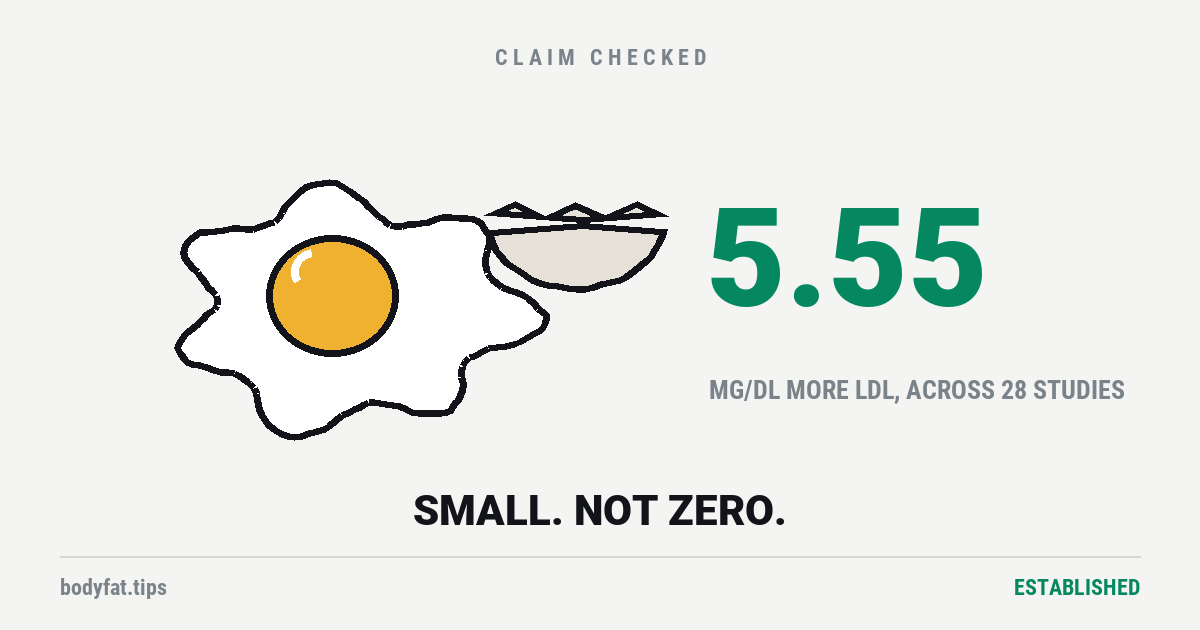
A 2018 meta-analysis pooled 28 studies from randomised trials that fed people eggs and measured what happened to their blood [1].
| LDL cholesterol | +5.55 mg/dL | 3.14 to 7.69 |
| Total cholesterol | +5.60 mg/dL | 3.11 to 8.09 |
| HDL cholesterol | +2.13 mg/dL | 1.10 to 3.16 |
| Triglycerides | — | no effect found |
Every one of those intervals sits above zero, which means the direction is not seriously in dispute. Eggs raise LDL. In this analysis they also raised HDL, by about 2 mg/dL, and triglycerides did not move [1]; the second analysis below found no clear rise in HDL [2].
Later analyses put the LDL rise a little higher: 8.1 mg/dL in that second one [2], and 7.4 mg/dL across 53 trials in a 2020 analysis, the one a 2025 review of the reviews took as its estimate [6].
For scale: an LDL under 100 mg/dL is the usual target and 130 to 159 counts as borderline high, as the second analysis notes [2], so 5 to 8 is a nudge rather than a shove. But “a nudge” is not the same as “nothing”, and any article telling you eggs do not affect your cholesterol is rounding down to zero something that measurably is not.
But doesn’t the HDL rise cancel it out?
This is the reassurance you will have heard, and it is where the lipid evidence genuinely splits — which almost nobody tells you.
The argument rests on a ratio. If LDL and HDL rise together in proportion, the balance between them is unchanged and arguably nothing meaningful has happened. So: does the ratio move?
The first meta-analysis, of 28 studies, says no. It found no effect on the LDL-to-HDL ratio or the total-to-HDL ratio [1].
A second meta-analysis, restricted to randomised trials in healthy people, says yes. It found the LDL-to-HDL ratio rose in the higher-egg groups — a mean difference of 0.14, p = 0.001 [2]. It also found LDL rising more than the first analysis did, by 8.14 mg/dL.
Its authors suggest the rise may be larger in trials running longer than two months. Their own numbers do not show it: 8.1 mg/dL in the shorter trials and 8.5 in the longer, and their test for a difference between the two gave p = 0.92, nowhere near the line researchers use for “probably not chance” [2]. The first analysis found no link with trial length at all [1]. And the trials in the second analysis lasted three to twelve weeks [2], so these results describe weeks of eating eggs, not years.
So the honest position is that the “it’s a wash” argument depends on a ratio that two syntheses of overlapping trials disagree about. We are not going to pick the flattering one for you.
Are egg yolks bad for you?
The yolk is where the cholesterol is — and also where almost everything else is. Choline, lutein, vitamin D and most of the B vitamins live there, and a little over two-fifths of the protein: about 2.7 of a large egg’s 6.3 grams [9]. An egg white is essentially protein and water.
So the yolk is the part with the measured effect on LDL, and the part with the nutrition. If you separate them you get less of both. Whether that trade is worth making is exactly what the rest of this page is about, and for most people the answer is that it is not worth the bother.
Now the finding that reframes everything
Here is the most useful result in the whole subject, and it is buried in a 2019 pooled analysis of six American cohorts — 29,615 people, followed for a median of 17.5 years, with 5,400 cardiovascular events between them [3].
It found what you would expect. Each extra half an egg a day, the same as three or four eggs a week, was associated with more cardiovascular disease (a hazard ratio of 1.06, meaning a 6% higher rate) and more death from any cause (1.08, an 8% higher rate) [3].
Those figures already allowed for age, sex, race, education, calories, smoking, exercise, alcohol and hormone therapy. Then the authors added total dietary cholesterol — cholesterol from all foods, not just eggs.
The egg association vanished. Cardiovascular disease: hazard ratio 0.99, with a range from 0.93 to 1.05. All-cause mortality: 1.03 [3]. Both intervals comfortably include “no effect at all”.
Read what that means, because it is easy to read backwards. It does not clear the egg. The authors’ own reading is that the egg’s link with heart disease “was fully accounted for by the cholesterol content in eggs” [3]. Once the model knew how much cholesterol people ate, their eggs added nothing on top, because the eggs’ cholesterol was already in the count. Eggs supply about a quarter of the cholesterol in American diets, the paper notes, and the authors concluded that “cholesterol from egg yolk may be harmful in the context of the current US diet” [3].
Two cautions keep that in proportion. It is an association in people who chose their own diets, not an experiment. And the same paper shows how hard cholesterol is to pull apart from the foods that carry it: allow for eggs, unprocessed red meat and processed meat together, and the link between dietary cholesterol and cardiovascular disease was no longer statistically clear — its range of plausible answers took in no effect at all. The authors say that leaves it “unclear if cholesterol from these foods is more harmful than other cholesterol-containing foods” [3].
What the same study said about absolute risk
That 2019 paper does something we wish more did, and something our red meat verdict argues every reader should demand: it reports the absolute difference alongside the ratio.
Per extra 300 mg of dietary cholesterol a day — roughly doubling what the average American eats, which the paper puts at 293 mg a day — the absolute difference in cardiovascular disease over the whole follow-up was 3.24%, and in death from any cause 4.43% [3].
Per extra half egg a day, the absolute differences were 1.11% and 1.93% [3] — and those are the figures before the model accounted for the cholesterol the eggs carried.
Small, real, and estimated over follow-up that ran as long as 31 years (the median was 17½). That is a much more useful thing to know than a hazard ratio on its own.
How many eggs a day is too many?
One large pooled analysis, from 2022, took 33 cohort studies — studies that follow people for years and count who falls ill — covering 2.2 million people and 232,408 deaths [4].
Comparing the highest egg eaters with the lowest, it found no association with death from any cause (1.02), cardiovascular disease (1.04), coronary heart disease (0.98), stroke (0.81) or respiratory disease (0.96) [4].
That is reassuring as far as it goes, and it goes less far than it looks. The heart-death result covered 11 of the cohorts and 1.4 million people, and the authors call it not robust: leave out one Chinese cohort, the China Kadoorie Biobank, and the highest egg eaters had a 9% higher risk of dying of cardiovascular disease; in the three US studies it was 20% higher [4].
Other pooled analyses split the same way. One from 2022, pooling 3.6 million people, found each extra egg a day went with 4% more cardiovascular disease overall, 8% more in American cohorts and none in Asian ones [7]. One from 2020, pooling 1.7 million, found no link with cardiovascular disease, American cohorts included, and a lower risk in Asian ones [8]. All of these are associations in people who chose their own diets.
And the same 2022 analysis found something else: highest versus lowest egg intake was associated with 20% higher cancer mortality — relative risk 1.20, range 1.04 to 1.39, from thirteen studies [4]. In the dose-response, each extra egg per week came with 2% more all-cause mortality and 4% more cancer mortality — and 4% less stroke mortality.
The certainty of all of that was rated low to moderate, and the authors landed on a specific recommendation: eggs “be consumed in low to moderate amounts (≤1 egg/d) as part of a healthy diet” [4].
An egg a day is also where the American Heart Association landed. Its 2019 advisory says that, “given the relatively high content of cholesterol in egg yolks, it remains advisable to limit intake to current levels”, and that “healthy individuals can include up to a whole egg or equivalent daily”; for older people with normal cholesterol, “consumption of up to 2 eggs per day is acceptable within the context of a heart-healthy dietary pattern” [5].
And the US Dietary Guidelines? The December 2015 edition dropped the earlier limit of 300 mg of cholesterol a day, adding that “this change does not suggest that dietary cholesterol is no longer important to consider when building healthy eating patterns” and that “individuals should eat as little dietary cholesterol as possible while consuming a healthy eating pattern” [10]. The December 2020 edition cited the National Academies’ advice that cholesterol intake be “as low as possible without compromising the nutritional adequacy of the diet” [11]. The edition published in January 2026 does not mention dietary cholesterol at all; it says to “consume a variety of protein foods from animal sources, including eggs, poultry, seafood, and red meat” [12].
Is it OK to eat eggs every day?
On the evidence above: for most people, yes, at around one a day.
What does one a day do to the number? In the second analysis, trials adding one egg a day raised LDL by about 8 mg/dL, much the same as trials of two eggs, or of three or more [2], and the first analysis found no link with how many eggs people ate [1]. In these trials the rise did not climb egg by egg.
Three situations where it is worth more thought. If your LDL is already high or you have been told to manage cholesterol, the 5–8 mg/dL that eggs add is a real contribution to a number somebody is trying to get down, and that conversation belongs with your clinician rather than a website. And the first meta-analysis noted that some of the variation between studies came down to “participant response to dietary cholesterol” [1] — people genuinely differ in how much their blood cholesterol moves when they eat more of it, and you cannot know which sort you are without testing.
And if your blood fats are abnormal and you also have diabetes, or have been told you are at risk of heart failure, the American Heart Association advises caution: patients with abnormal blood lipids, “particularly those with diabetes mellitus or at risk for heart failure, should be cautious in consuming foods rich in cholesterol” [5]. Among people with type 2 diabetes, two of the three studies it reviewed linked eggs with coronary heart disease; in three studies, more than an egg a day went with a 20% to 30% higher risk of heart failure in men, though not in women [5].
Are eggs good for weight loss?
Nothing on this page is about weight, and we are not going to pretend otherwise to answer a popular question.
What can be said is narrow and true: eggs are protein-dense and protein is the macronutrient with the best evidence for keeping people full, which we covered separately in does protein keep you full. An egg breakfast displacing a cereal breakfast is a reasonable move on those grounds. That is a claim about protein, not about eggs.
What we are rating
Established: eggs raise LDL cholesterol by a small, measurable amount, about 5 to 8 mg/dL in the pooled trials. The three pooled analyses cited here agree on the direction, and every interval sits above zero [1][2][6]. The rating rests on that direction, not on the size, and it has known limits. The analyses draw on many of the same trials, so they are not independent tests. The trials are short [2]. And a 2025 review of the reviews calls the evidence for the rise “very weak”, because the 53 trials behind its figure disagreed a lot about how big the rise is and the analysis that pooled them was judged very low in quality [6]. Even a history of the egg industry’s own research programme, written by its former director, describes that research as documenting a “minimal effect”, not no effect [13]. Anyone telling you eggs do not affect your cholesterol is wrong.
Genuinely disputed: whether the LDL-to-HDL ratio moves. One meta-analysis says no, the other says yes [1][2].
Disputed: whether eggs raise the risk of heart disease. In six US cohorts, the egg’s link with heart disease was fully accounted for, and its link with death largely, by the cholesterol it carries [3]. The large pooled analyses split: some find small positive associations in American cohorts, others find none [4][7][8]. All of it is association, not experiment.
Open: the cancer mortality signal in the 2022 pooled analysis, at low to moderate certainty [4].
What to actually do
About one a day is where the evidence lands. It is the most the 2022 pooled analysis recommends [4], and what the American Heart Association says healthy people can include [5]. Not three a week, which was the 1968 rule [13], and not unlimited, which is the new overcorrection.
Eat the yolk. Separating it costs you most of the nutrition to avoid a few milligrams per decilitre.
Count the yolk as cholesterol, because it is. In the US cohorts the risk followed total dietary cholesterol, and eggs supply about a quarter of the cholesterol Americans eat [3]. A large egg carries about 186 mg, all of it in the yolk [9]: nearly two-thirds of the 293 mg the average American eats in a day [3].
If your LDL is high, get it measured before and after. People differ in how much their cholesterol responds to eating cholesterol [1], and you are not an average of 28 studies. That is a conversation for a clinician who can test you.
And distrust both slogans. “Eggs don’t raise cholesterol” is false. “Eggs cause heart disease” is not established either: the six-cohort US study ties the egg’s risk to the cholesterol in its yolk, as an association, and the large pooled analyses disagree about whether any link shows up at all. The true answer is smaller and duller than either, which is presumably why neither side sells it.
This is journalism, not medical advice.
An independent editorial review on 18 September 2026 found that this page had read its central heart-disease study backwards. We said that once total dietary cholesterol was accounted for, the egg’s link with heart disease vanished because the egg had only been standing in for cholesterol from other foods, and that “eggs cause heart disease” was not supported once you account for everything else on the plate. The 2019 study’s authors read the same result the other way: the egg’s association with heart disease “was fully accounted for by the cholesterol content in eggs”, and they concluded that cholesterol from egg yolk “may be harmful in the context of the current US diet”. It is an association, and the large pooled analyses disagree about whether any link shows up, so this page now calls the heart-disease question disputed rather than not supported, and the search description says so. We also said no industry funding was declared in the papers used. Of the trials in our second meta-analysis whose funding statements we could read, seven of eight were paid for in whole or in part by the American Egg Board, its Egg Nutrition Center or the British Egg Industry Council. The funding row now names them, and says which statements we could not read.
Also corrected. The 2022 mortality analysis is not the largest; its heart-death result covered 1.4 million people, not 2.2 million, its authors call it not robust, and in its three US studies the risk was 20% higher. The American Heart Association did give a number, in 2019: up to a whole egg a day for healthy people, with caution for people with abnormal blood fats, particularly those with diabetes or at risk of heart failure. The second lipid analysis found no real difference between shorter and longer trials, and no clear rise in HDL. The lipid analyses share many of their trials, the first pooled 28 studies rather than 28 separate trials, and a 2025 review of the reviews calls the evidence for the LDL rise very weak; the page now gives the rise as 5 to 8 mg/dL and states those limits, and the headline gives the range. An extra 300 mg of cholesterol a day roughly doubles average US intake rather than adding half as much again; the absolute risks were estimated over follow-up of up to 31 years, not 17; and the yolk holds about 43% of an egg’s protein, not half. We had called the 2015 Dietary Guidelines change a reversal; the page now quotes the 2015, 2020 and January 2026 editions instead. We removed a comparison with two other verdicts that does not describe them, a claim that the cancer signal had not been reported elsewhere, and an unsourced range for LDL, and the provenance chain now names a dated study and the 1968 advice. The rating of the headline claim is unchanged: Established.