How to Measure Blood Pressure at Home: A Cuff Two Sizes Too Small Added 19.5 Points. Skipping the Five-Minute Rest Added Less.

“Most blood pressure readings at your doctor’s office are NOT accurate, and it’s actually very easy to make a mistake when measuring your own blood pressure.” That is from the description of “10 MISTAKES Measuring Your BLOOD PRESSURE (Doctor Explains)”, posted on 27 January 2026 by a physician’s health-video channel. It had 1,184,425 views when we read its numbers on 10 October 2026 [1]. Its chapters run through the list: a full bladder, one arm or two, how you sit, where your arm rests, how long you rest, caffeine, alcohol, cuff size, how many readings, and wrist cuffs [1].
Plenty of people are asking. In the United States, “are wrist blood pressure monitors accurate” is searched about 5,400 times a month, “blood pressure cuff size” about 4,400 times, “how to measure blood pressure at home” about 1,900 times, “how to take blood pressure correctly” about 1,600 times and “wrist vs arm blood pressure” about 480 times a month (from a paid keyword database, pulled 10 October 2026) [2].
Two words first, because everything below is measured in them. Blood pressure comes as two numbers: the top one, systolic, is the pressure while your heart pushes, and the bottom one, diastolic, is the pressure between beats. Both are in mmHg, millimetres of mercury, the unit on every blood-pressure monitor. A mistake that “adds 5” makes a true 125 read 130.
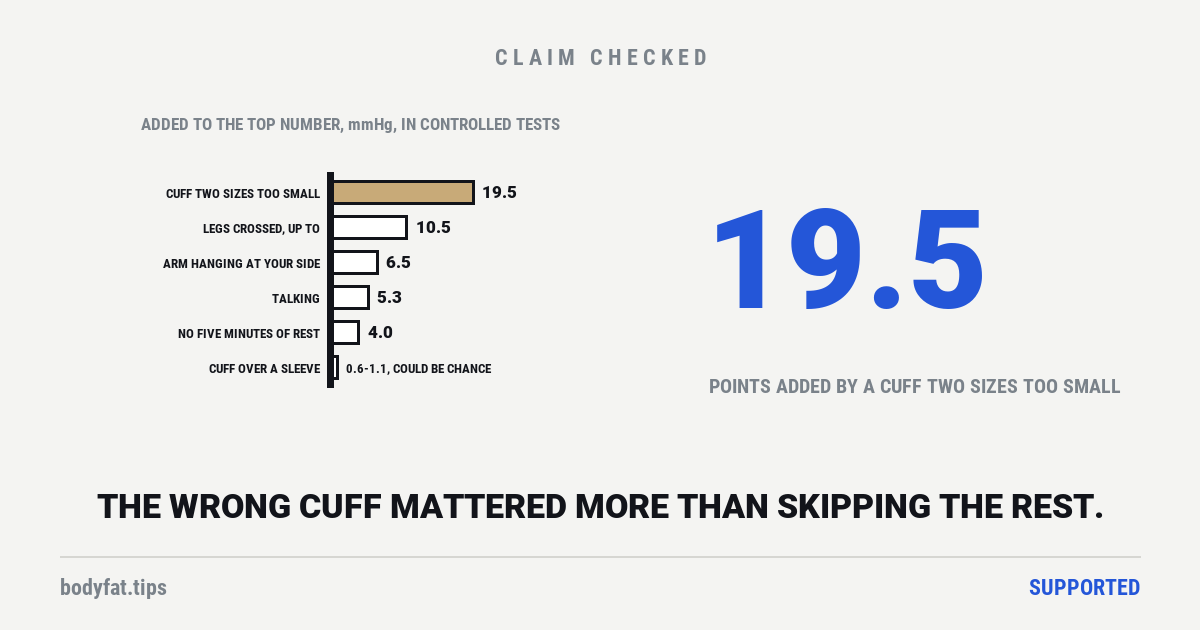
Most of the mistakes on that list are real, and the biggest are bigger than you’d guess. In a 2023 trial that measured the same people with cuffs of different sizes, a regular cuff on arms that needed an extra-large one read the top number 19.5 mmHg high [3]. An arm left hanging at the side added 6.5 [4].
Not every item on the list held up. A cuff over a sleeve, said to add 5 to 50 points, made no clear difference when 12 studies were pooled [5]. The five-minute rest, the best-known rule, held up, but small: skipping it raised the reading by 1.3 to 5 points in three of the four randomised trials we found, and not at all in the fourth, where everyone had already sat for ten minutes in a waiting area [6] [7] [8] [9].
Wrist monitors miss more often at home, and most sold online are on no list of validated monitors. And “most office readings are not accurate” fits one 1999 Canadian study, where a routine and a careful reading put more than half of patients in different categories, by our arithmetic; a 2005 Canadian study found 42%, and one US health system found no average gap at all [10] [11] [12].
Which mistakes change a blood pressure reading?
The best tests here are randomised crossover trials: the same people are measured every way the trial compares, in an order decided by chance, so a difference between the readings is the mistake, not the person. Where we could not find one, the table says what kind of study there was.
| The mistake | The test | Top number (bottom number), mmHg | Who was measured |
|---|---|---|---|
| Cuff two sizes too small | Same people, both ways, random order, 2023 [3] | +19.5 (+7.4) | 40 adults whose arms needed an extra-large cuff |
| Cuff one size too small | Same trial [3] | +4.8 (+1.8) | 65 adults whose arms needed a large cuff |
| Cuff one size too big | Same trial [3] | −3.6 (−1.3): reads low | 35 adults whose arms needed a small cuff |
| Arm hanging at your side | Same people, every position, random order, 2024 [4] | +6.5 (+4.4) | 133 adults |
| Hand resting in your lap | Same trial [4] | +3.9 (+4.0) | 133 adults |
| Perched on an exam table: feet dangling, back and arm unsupported | Random order, 2023; paid for by the maker of the chair and table [13] | +7.0 (+4.5) | 97 adults at a family-medicine office, measured both ways |
| Legs crossed at the knee | Same people, random order (1999); same people (2007) [14] [15] | +6.7 to +10.5 with high blood pressure; +2.3 to +2.7 without | 103 and 111 adults |
| Talking | Same people, random order, 2012 [16] | +5.3 (+6.2) | 111 healthy adults |
| Caffeine, 200 to 300 mg | Five trials pooled, 2011 [17] | +8.1 (+5.7), lasting at least 3 hours | People with high blood pressure |
| Full bladder | Before and after emptying it, 2011 [18] | +4.2 (+2.8) | 172 women aged 40 to 60 |
| No five minutes of rest | Four randomised trials we found [6] [7] [8] [9] | +4.0 (+1.0); +1.3, and +3.5 when the unrested reading came first; +3.0 (+1.4, could be chance), or 5.1 against each group’s 24-hour daytime average; no rise after a 10-minute wait | 100 cardiac-rehabilitation patients; 100 Greek patients with high blood pressure; 618 people sent for 24-hour monitoring; 113 community adults |
| Cuff over a sleeve | 12 studies pooled, 2020 [5] | +0.6 (thin sleeve) to +1.1 (thick), could be chance; the plausible range stopped at +1.3 and +2.4 | Office readings |
Behind the table sits a 2017 systematic review, a search for every study that had measured a source of error, which found 328 of them covering 29 possible mistakes in clinic readings [19]. It did not pool them into single numbers; it reported the range of results that were clearly more than chance. For crossed legs, every one of the seven studies it found had the top number going up; for talking, all six; for caffeine, every significant result it found was a rise [19].
How big is “enough to matter”? Compare the trials on this site’s other blood-pressure pages. Beetroot juice took about 3.5 points off the top number, hibiscus tea about 6, and the diet and exercise changes in our lifestyle verdict roughly 3 to 8. Those trials are averages across groups of people in trials. At home, a single reading with one of these mistakes can be off by as much, enough to hide a change like that or invent one. That comparison is ours.
Does cuff size matter?
More than anything else on the list. Searched about 4,400 times a month in the US (from a paid keyword database, pulled 10 October 2026), this is the question with the clearest answer [2].
In the 2023 trial, 195 adults in Baltimore had their mid-upper arm measured and were then measured four times: with the right cuff, one too small, one too big, and the right one again, in random order [3]. The cuffs followed the sizes sold in the US: small for arms of 7.9 to 9.8 in (20 to 25 cm) around, regular 9.9 to 12.6 in (25.1 to 32 cm), large 12.6 to 15.7 in (32.1 to 40 cm) and extra large 15.8 to 21.7 in (40.1 to 55 cm) [3].
The regular cuff, the size most US home monitors come with according to the trial’s authors, read 4.8 points high on arms that needed a large one and 19.5 mmHg high on arms that needed an extra large, with the bottom number 7.4 high [3]. On thin arms that needed a small cuff, the regular one read 3.6 low. In the extra-large group the average went from 125/79 with the right cuff to 144/87 with the regular one: from a reading the 2017 US guideline’s categories call elevated to one they call stage 2 high blood pressure, by the trial’s own account [3]. The authors add that the effect varied from person to person, so no simple correction would fix it for everyone [3].
Picking the cuff is harder than it sounds. A 2023 check of 42 home monitors on the US list of validated devices found none of the makers’ cuffs lined up with the heart association’s size bands, and the same word meant different things: “large” covered 8.7 to 16.5 in (22 to 42 cm) around the arm on one monitor and 12.6 to 15.0 in (32 to 38 cm) on another; we read it as its summary [20]. So measure around the middle of your upper arm and compare it with the range printed on the cuff, not the size on the box.
Where should your arm be?
Resting on a table, with the middle of the cuff at the level of your heart. The 2024 arm trial measured 133 adults three ways in random order: arm on a desk, hand in the lap, and arm hanging at the side [4]. The lap added 3.9 to the top number and 4.0 to the bottom; hanging at the side added 6.5 and 4.4, and about 9 on the top number in people whose blood pressure was already 130 or more [4]. The trial could not separate the height of the arm from whether it was supported; the authors say so [4].
A 2023 trial put the whole posture to the test at a family-medicine office in Ohio: 97 of its 150 adults were measured once perched on a fixed exam table, feet dangling, back and arm unsupported, and once in a chair with feet flat and back and arm supported, in random order; the other 53 sat in the chair both times, to measure the effect of going second [13]. On the table the readings were 7.0 higher on top and 4.5 on the bottom [13]. Weigh that beside who paid: the company that makes the chair, the table and the monitor funded the trial, and the first author was paid by it to design the study [13]. The 2017 US guideline had already said measurements taken sitting or lying on an exam table do not meet its standard [21].
Does crossing your legs raise blood pressure?
Yes, at the knee. The question is searched about 140 times a month in the US (from a paid keyword database, pulled 10 October 2026) [2]. In a 1999 Canadian trial, 103 people were measured with feet flat and with legs crossed two ways, in random order, by an assessor who could not see their legs [14]. In those with high blood pressure, crossing added 8.1 and 10.5 to the top number; in healthy volunteers, about 2.5, with little change in the bottom number; we read it as its summary [14].
A 2007 Dutch study of 111 people found the same pattern, a rise of 6.7 to 7.9 in people treated for high blood pressure or diabetes and 2.7 in the rest, and one more thing: crossing at the ankles made no clear difference in any group [15].
Does talking raise blood pressure?
Yes. It is searched about 90 times a month in the US (from a paid keyword database, pulled 10 October 2026) [2]. In a 2012 British study, 111 healthy adults were measured resting, breathing deeply, talking and moving, in random order: talking added 5.3 to the top number and 6.2 to the bottom; we read it as its summary [16]. All six talking studies in the 2017 review found a rise [19].
Does a full bladder raise blood pressure?
Probably, though the two studies we read are small and measured in a fixed order. In 2011, 172 Korean women aged 40 to 60, holding urine for at least three hours with a full bladder confirmed by ultrasound, were measured before and straight after emptying it: 124.2/78.3 before, 120.0/75.4 after, a fall of 4.2 on top [18]. The full bladder always came first, and the authors note they could not get a reading with an empty bladder to start from [18]. In a 1989 study of 16 volunteers who drank until the urge was strong, the top number rose from 125 to 140; we read it as its summary [22].
Do you need to rest for five minutes first?
This is the best-known rule on the list, and it moved the reading about as much as a hand in the lap, and less than a wrong cuff. The rule is in the 2017 US guideline and the heart association’s statement [21] [23], but the 2017 review found two studies behind it: one compared five minutes of rest with ten, the other no rest with sixteen minutes, and both found readings higher after the shorter rest [19]. Neither shuffled the order: the shorter rest always came first [9].
In 2021 a Baltimore trial shuffled it. 113 adults were measured after no rest, two minutes and five minutes, in random order, and then after five minutes again [9]. The averages: 127.6 after five minutes, 126.7 with no rest at all [9]. No rest was no higher. Two things to know before you skip it. Before every set the volunteers had walked for two minutes and then sat for ten in a waiting area, so “no rest” meant no extra rest after that [9]. And in people whose top number was 140 or more, the readings after different rests differed by more than the trial’s own margin for calling them equal [9].
A 2018 trial measured 100 cardiac-rehabilitation patients both ways, in random order, and found a rise: 124.2/67.9 with no rest, 120.2/66.9 after five minutes [6]. A 2020 Greek trial did the same with 100 patients with high blood pressure: 127.0 on top with no rest and 125.7 after five minutes, a gap right on the line researchers use for “probably not chance” [7]. The gap was 3.5 when the unrested reading came first, and there was no clear gap when it came second [7]. A 2021 Toronto trial gave 618 people sent for 24-hour monitoring one or the other, by chance, and compared each reading with that person’s daytime average from the 24-hour monitor, a cuff worn all day that reads automatically [8]. With no rest, the office readings matched the daytime average almost exactly; after five minutes they ran 5.2 points below it [8]. The unrested readings were also the higher ones, 141.2 on top against 138.2, and by the trial’s main measure, which sets each group against its own 24-hour average, skipping the rest added 5.1 [8]. A company paid for that trial, and one of its staff is an author; the company runs cardiology and diagnostic centres, and another author works for a maker of 24-hour monitors [8]. At home, a 2026 study of 45 new mothers who wore a sensor that recorded whether they were sitting found only a third of their readings followed five minutes of rest, and the rested ones were lower by 1.2 points on top, which its authors judged not clinically relevant [24].
How does caffeine affect blood pressure?
It raises it, for hours. A 2011 review pooled five trials in people with high blood pressure: 200 to 300 mg of caffeine raised the top number by 8.1 and the bottom by 5.7 within the first hour, and the rise lasted at least three hours [17]. In three studies of two weeks of coffee, blood pressure did not rise against going without; we read the review as its summary [17]. The 2017 review’s caffeine studies found rises lasting as long as three hours [19].
Here is the catch, and the reading is ours. The 2017 US guideline says to avoid caffeine, exercise and smoking for at least 30 minutes before a reading [21]. The trials, in people with high blood pressure, found the caffeine rise still there at three hours [17]. So a morning reading taken 30 minutes after coffee is a reading with coffee in it. What caffeine does for exercise and for weight has its own verdicts on this site: before a workout and for weight loss. Smoking pushed readings up too, by 2.81 to 25 on top in the studies the 2017 review found, measured up to an hour after [19].
What about alcohol?
It pushes the reading both ways, depending on when you measure. A 2020 Cochrane review, from the network that pools medical trials to a fixed standard, gathered 32 trials of 767 people, mostly healthy men with an average age of 33: a medium dose, 14 to 28 g of alcohol, lowered the top number by 5.6 within six hours; a high dose, more than 30 g, lowered it at first and raised it by 3.7 thirteen hours or more later; we read it as its summary [25]. By our reading, an evening drink can flatter that evening’s reading, and a heavy evening can push up the next morning’s.
One arm or both?
Both, once. The 2017 US guideline says to measure both arms at the first visit and use the arm that reads higher after that; for home monitoring it says to check the difference and use the higher arm if it is significant [21]. How common is a big gap? A 2016 review of 16 studies that measured both arms at the same moment found a gap of 10 or more on the top number in 11.2% of people with high blood pressure and 3.6% of adults in general [26]. Measuring one arm after the other made gaps look about three times as common as they were; we read it as its summary [26].
How many readings do you need?
More than one, and over more than one day. The 2025 US guideline, the current one, says a single reading is not enough for clinical decisions [27]. For home monitoring, the heart association’s 2019 statement asks for two readings at least a minute apart in the morning and two in the evening, ideally for seven days, three at the least, averaged [23]. In the rest trial, the first reading of each set ran 0.4 to 1.8 points above the average of three [9].
And check the monitor itself once. In a Canadian clinic, from 2011 to 2014, 210 patients’ own home monitors were compared with a nurse’s careful readings at the same visit: 30% were 5 or more points off on the top number and 8% more than 10 [28]. That comparison is one your clinic can run with you.
What is the best time of day to measure blood pressure?
The guidelines give the same answer in two versions: in the morning before you take any blood-pressure medicine, and in the evening, before supper in the 2017 guideline [21] and before bed in the heart association’s statement [23]. These are protocols. Our reading of them is that their point is the same times every day, averaged, not that one hour gives a truer number.
Are wrist blood pressure monitors accurate?
Some pass the accuracy tests. At home, in ordinary hands, they miss more often. It is the most searched question on this page, about 5,400 times a month in the US (from a paid keyword database, pulled 10 October 2026) [2].
The heart association’s 2019 statement says wrist monitors able to pass the accuracy tests have only existed for a decade or so, and that even accurate ones have two problems: the sensor has to sit over the artery, and the wrist has to be at the level of the heart, or the reading comes out too high or too low [23]. It reports “strong reservations” about them in routine practice unless the upper arm cannot be used [23].
How far off are wrist blood pressure monitors?
Often by 10 points or more. In a 2016 Italian study, 721 adults from one town were trained and then measured themselves at home with a validated upper-arm monitor and a validated wrist monitor without a position sensor, validated meaning tested against a reference by an accepted protocol [29]. The gap between wrist and arm at home differed from the gap measured in the clinic by 5 points or more in 621 people, 86%, and by 10 or more in 455 [29]. The errors were bigger in people who scored lower on memory and practical-skill tests, and on the top number in people with longer forearms: the authors think people forgot where to hold the wrist [29].
In a 2008 Greek trial, 79 people with high blood pressure used a validated wrist monitor with a sensor that checks the wrist’s height and a validated arm monitor at home, in random order: 34% had readings 10 or more points apart on top, and readings from a 24-hour monitor correlated more closely with the arm readings than with the wrist ones; we read it as its summary [30].
Do wrist blood pressure monitors read higher?
Sometimes higher, sometimes lower; it depends on where the wrist is. In the Italian study, at home, the wrist read higher than the arm, 5.6% on the top number, after reading 2.5% lower in the clinic [29]. In the Greek trial, with a position sensor, the wrist read 5.2 lower than the arm [30]. In a 2010 French study, 100 people told to hold the hand on the opposite shoulder averaged 136 on top at the wrist against 144 on the arm; the next 100, told to hold it on the opposite elbow, averaged 142 against 144; we read it as its summary [31]. Below the heart, too high; above it, too low [23].
Do doctors recommend wrist blood pressure monitors?
The heart association does not, except when an upper-arm cuff cannot be used: its statement says patients should be advised to use upper-arm monitors that have passed validation [23]. The 2017 and 2025 US guidelines ask for a validated monitor with a cuff that fits, on the upper arm in the 2017 checklist; neither mentions wrist monitors in its text, though the 2025 guideline’s own checklist is an image we could not read as text [21] [27]. The 2025 guideline points readers to a US list of validated devices [27], set up by the American Medical Association, with each device reviewed by an independent committee; the list has a wrist category [32].
Validated wrist models exist, but most sold online are not on any such list. In a 2022 count of 3,411 monitors worldwide, 103 wrist models had evidence of validation: 11.1% of wrist models, against 23.1% of upper-arm models [33]. On the best-seller lists of one large online retailer in ten countries in 2020 and 2021, a median 79% of upper-arm monitors and 84% of wrist monitors were not validated; in the US, 84% of upper-arm models and every wrist model on the lists [34]. The unvalidated ones were cheaper and had about the same star ratings [34].
Are most office readings wrong?
Office readings often break the rules, and on average they run high: by 4 to 11 points on top in five comparisons with a careful reading that we read, though not in a sixth, a Californian system; a 2019 pooling against unattended automated readings found 14.5. Whether “most” are wrong depends on the clinic: in a 1999 Canadian study a routine and a careful reading put more than half of patients in different categories, by our arithmetic, and in a 2005 one 42%; we read both as their summaries [10] [11].
Breaking the rules is well documented. The 2017 US guideline says errors in office measurement “are common” [21]. A working group convened by a US government health institute wrote in 2019 that clinic methods “nearly always deviate” from the guidelines, while noting that recent data are sparse [35]. In a 2016 New York survey of 103 patients, 64 said their doctor took their readings; of those, 77% said the doctor did not wait at all before the first and 56% that only one reading was taken; we read its summary and its results [36]. At a 2015 meeting, 1 of 159 medical students did all 11 steps of a correct measurement [37].
How far off that leaves the number has been measured by comparing routine office readings with careful ones in the same people. In Sweden, across 9,567 middle-aged adults, routine readings ran 4.0 points higher on top and 1.7 on the bottom, and the abstract says 16% more were classed as having high blood pressure; we read it as its summary [38]. Among 3,074 people in a large US trial, readings in their own doctors’ records ran 4.6 to 7.3 points higher than the trial’s; we read it as its summary [39]. But in a California health system that had worked to standardise its measurements, 309 older adults’ routine and careful readings averaged the same [12].
The two that reported person-by-person agreement found something else: a single routine reading could sit a long way from the careful one. In California the limits of agreement, the band inside which 19 of 20 people’s differences fall, ran from 30 points below to 29 above [12]; in the US trial, from about 30 below to 45 above [39]. Part of that is blood pressure really changing, since the readings were taken at different visits. That is the honest version of the claim: a routine office reading is a rough number, and a single one should not decide anything, which is also what the guideline says [27].
Three smaller studies counted something closer to the video’s “most”: how often a routine reading puts a patient in a different category from a careful one. In a 1999 Canadian study, physicians’ usual readings ran 6.2 points higher on top than standardised ones; 42% of patients were classed as having high blood pressure by the usual reading and as normal by the standardised one, and 15% the other way round, which makes 57% classed differently, by our arithmetic [10]. In a 2005 Canadian study of 107 patients sent by their family doctors for 24-hour monitoring, usual clinic readings ran 10.8 points higher than a research nurse’s, and the two disagreed on whether the patient had high blood pressure in 42% [11]. At a US hypertension clinic in 2018, routine readings of 202 patients ran 10.3 points higher than a standardised automated protocol, and 26.9% of the patients the routine reading put above the treatment goal were at goal by the careful one; we read these three as their summaries [40]. And a 2019 pooling of nine study groups whose average automated reading was 130 or more, found routine office readings 14.5 points higher on top than automated readings taken with the patient alone in a quiet room, the kind of reading that, pooled across 19 studies, matched the daytime 24-hour average; careful research readings ran 7.0 higher than the automated ones too. We read it as its summary [41].
“Most” arrived as a number, and we could not trace it. In January 2017 a county health department told clinic patients there was “a 50% chance their blood pressure measurement is inaccurate”, citing “a 2016 study from the Journal of Clinical Hypertension” that it did not name [42]. The 2016 paper in that journal closest to its description that we found is the New York survey above, which asked about waiting and the number of readings and did not measure accuracy [36] [43]. We could not confirm which study the release meant.
If the mistakes are real, why did skipping the five-minute rest, the best-known rule, add less than a wrong cuff or a hanging arm?
This section is the desk’s own reasoning, and it is labelled as such. The cuff, the arm and the legs moved the reading in every controlled test we read [3] [4] [14]. Skipping the rest raised it by 1.3 to 5 points in three of the four randomised trials we found, and not at all in the fourth [6] [7] [8] [9]. Three answers of our own, each rated.
Answer one: the mistakes that move it most are built into the set-up. An arm below the heart adds the weight of the column of blood above the cuff, the arm trial’s authors explain, and the heart association gives the same reason for wrist monitors that read too high or too low [4] [23]. A cuff that does not fit, an arm that hangs, legs that cross: those act on every reading, every time. This is measured: the cuff and arm trials found it, and the wrist errors grew with forearm length [3] [4] [29].
Answer two: a rested reading is not automatically the truer one. In the Baltimore trial, “no rest” followed ten minutes in a waiting area [9], so it was not what most people mean by no rest. In the Toronto trial, readings without rest matched people’s daytime 24-hour average, and rested ones ran below it [8]. The first half is our reading of a trial’s design; the second is measured, in one trial a company paid for. In the Greek trial, neither reading differed clearly from the 24-hour average, which is measured too [7].
Answer three: some mistakes wear off, and some come back at every reading. The authors of the 2017 review make this argument: a passing cause, like caffeine or a full bladder, can only be removed by measuring again once it has passed; a cause built into how you sit, like crossed legs or an unsupported arm, repeated readings cannot remove [19]. So the passing kind is dealt with by timing, measuring before the coffee rather than after, and the built-in kind only by fixing the set-up. This is their reasoning, which we adopt; no study we read tested it head to head.
Put the three together and here is what we think is true, stated plainly so you can disagree with it: get the set-up right once, a cuff that fits, the arm on a table at heart height, feet flat, back supported, and averaging takes care of most of what is left; get the set-up wrong and averaging gives you the same wrong number, more precisely. The same is true of a body-fat scale.
What we could not find, and would like to: a trial in which people measuring themselves at home, with their own monitors, followed the full checklist for a week and their usual habits for another, in random order, with a 24-hour monitor as referee [43]. The trials on this page that measured what the set-up mistakes do were run by trained staff [3] [4] [9]; a 2021 trial showed that an hour of training makes people follow the checklist, but did not measure what that did to their numbers; we read it as its summary [44]. If you know of the trial we describe, the corrections line on this site is open.
Who these studies were done on
The three Baltimore trials, of cuff size, arm position and rest, recruited community adults, most of them Black and most of them women, measured by trained staff with a clinic-grade automatic monitor in a quiet room [3] [4] [9]. The table-and-chair trial was at one Ohio office [13]. The crossed-legs studies were in Canada and the Netherlands; the talking study was of healthy British adults [14] [15] [16]. The bladder study was of Korean women aged 40 to 60 [18]. The caffeine trials were of people with high blood pressure, and the alcohol trials mostly of healthy young men [17] [25]. The wrist studies were of Italian townspeople and Greek and French patients with high blood pressure [29] [30] [31].
Two things change the answer for a reader. Most of these readings were taken by trained staff, not by people measuring themselves; the wrist studies and the study of new mothers are the exceptions [29] [30] [24]. And in the studies that checked, crossed legs and an arm at the side added more in people whose blood pressure was already high [14] [4].
Where “ten mistakes” came from
The research is real and mostly agrees. The round numbers came from two documents published before the 2017 review. A 2005 heart-association statement on measurement said crossing the legs “may raise systolic pressure by 2 to 8 mm Hg”, and an unsupported back the bottom number by 6 [45]. A 2009 article in a health system’s medical journal gave a table with one figure or range for each mistake: talking or listening 10, a full bladder 15, a cuff too small 10, a cuff over clothing “5–50”; its text covers clothing under the cuff and a tight sleeve pushed up above it [46]. The 2017 review later gathered 328 studies of 29 sources of error and gave each a range, not a single number [19].
The framing put one figure on each mistake. An infographic, “7 Simple Tips To Get an Accurate Blood Pressure Reading”, made by a US doctors’ association with a university and dated December 2016, and republished by a federal heart-disease prevention campaign, gives one figure for each: talking adds 10 mmHg, a full bladder 10, an unsupported arm 10, crossed legs 2 to 8, a cuff over clothing 5 to 50 [47]. It labels them an estimate and cites the two documents above [47]. Most sit inside the ranges the 2017 review later reported [19]. The last does not: a 2020 pooling of the 12 studies that compared a sleeve with a bare arm found a cuff over a sleeve made no difference that could be told apart from chance; the range the true average probably sits in stopped at 1.3 points for the thinnest sleeves and 2.4 for the thickest, below the infographic’s lowest figure of 5; we read it as its summary [5]. Its authors still say a thick sleeve may add a little in the office, and most of the studies were at high risk of bias [5]. Two later studies, of 300 and 138 people, found no clear average difference either, the second once the order of measurement was randomised; we read both as their summaries [48] [49]. A third, of 100 people, found no clear difference on average, except a slightly lower top number on the bare left arm, and found that a sleeved and a bare reading taken at the same moment differed by a median 7 to 8 points on top, up in some people and down in others; by our reading, part of that scatter would appear between any two readings [50]. One later study pointed the other way: in 26 mostly young adults, average age about 30, measured in a fixed order with each sleeve reading set against bare-arm readings taken just before and after it, and with a research recording device rather than a monitor on sale, readings ran 11.7 higher over a thick sleeve and 4.3 over a thin one [51]. A rolled-up sleeve is a different case: pooled, its range ran from 1.0 below to 6.5 above, which does not rule out 5 [5]. By our reading, the “50% chance” release above made the same move with a share [42].
Then the spread. The video put the list in front of more than a million views, with the line about office readings at the top of its description, just under an affiliate link [1]. Ask Google in October 2026 whether wrist monitors are accurate and its AI answer says “Studies show wrist cuffs frequently give falsely high readings”, citing for that line a clinic’s page and the 2016 Italian home study; a wrist-monitor maker’s own site is among its other sources [2]. That study’s authors did conclude that wrist self-measurement at home “leads to frequent detection of falsely elevated blood pressure values” [29]. The line leaves out the other direction: with a position sensor, and with the hand held on the opposite shoulder, the wrist read lower [30] [31].
And the product: the video’s description opens with an affiliate link to a blood-pressure monitor on a large online retailer [1]. We did not follow the link and do not know which model it is. On that retailer’s US best-seller lists in 2020 and 2021, a median 84% of upper-arm monitors and every wrist monitor were on no list of validated devices [34].
None of this is aimed at anyone who has taken a reading with their legs crossed and their coffee still warm. Nearly everyone has, and nobody hands you the checklist with the monitor. It is the round numbers, the unnamed 50% and the unvalidated monitors that the evidence does not carry.
What this is rated, and what the rating covers
Supported — for the claim that common mistakes when measuring blood pressure change the reading by enough to matter.
It is rated Supported because the direction holds in every controlled test we read of the biggest items on the list: in randomised crossover trials of cuff size and arm position [3] [4], in randomised tests of crossed legs and talking [14] [16], in pooled caffeine trials [17], and in every controlled study the 2017 review found for crossed legs and talking, where every significant caffeine result it found was a rise too, though doses of 100 and 200 mg did not reliably show one [19]. “Enough to matter” means several points or more: as big as what the treatments on this site’s other blood-pressure pages achieve, and in the cuff trial enough to move a group’s average across a diagnostic line [3]. It is not Established because each of the trials behind it is one site and 100 to 200 people, measured in single sessions by trained staff, not by people at home; and because some items vary in size from trial to trial: skipping the rest raised readings by 1.3 to 5 points in three randomised trials and did not raise them in a fourth [6] [7] [8] [9].
Rated alone, in words. That wrist monitors, as people use them at home, are less reliable than upper-arm monitors: Supported; two home studies found many people’s wrist and arm readings 10 or more points apart, a 24-hour monitor’s readings correlated more closely with the arm, and wrist models are less often validated [29] [30] [33].
That most office readings are not accurate: Preliminary; routine readings break the rules often and ran higher than careful ones on average, by 4 to 11 points on top in five comparisons with a careful reading that we read, though not in one Californian system, and by 14.5 against unattended automated readings in a 2019 pooling, with poor agreement person by person; but the share of patients they put in a different category from a careful reading was 42% in a 2005 Canadian study and, by our arithmetic, 57% in a 1999 one, so “most” fits one study we read, not the others [38] [39] [12] [10] [11] [40].
That skipping the five-minute rest raises your reading by a few points: Supported; three of the four randomised trials we found saw a rise, of 1.3 to 5 points on top, one of them right on the line for “probably not chance”, and the fourth saw none in people who had already sat for ten minutes in a waiting area; the two older studies behind the rule found rises too, without randomising the order [6] [7] [8] [9] [19]. Whether the rested reading is the more accurate one is a separate question, not rated here: of the two trials that checked against a 24-hour monitor, the unrested reading was the closer in one, a trial a company paid for, and both sat close in the other [8] [7].
That a full bladder raises it: Preliminary; the direction is consistent, but the studies are small and measured in a fixed order [18] [22].
That a cuff over clothing adds 5 to 50 mmHg: Unsupported, of the tested kind, for a sleeve under the cuff; pooled, 12 studies put the plausible average at no more than 1.3 points for thin sleeves and 2.4 for thick ones, and later studies of 300, 138 and 100 people found little or no average difference, against one small study, with a research recording device, that found 11.7 over a thick sleeve, which leaves a thick sleeve the least settled case [5] [48] [49] [50] [51]. For a tight rolled-up sleeve, the pooled range reached 6.5, so 5 is not ruled out [5].
What is not rated here: white-coat high blood pressure, a reading raised by the clinic itself, which is a different subject, and our verdict on white coat hypertension takes it up; whether any monitor brand is better than another; and the frame above, which is this desk’s reasoning from the evidence rather than a result the evidence delivered. It is marked as ours so that you can weigh it as ours. Magnesium and the other blood-pressure verdicts rate what lowers the number; this page rates what distorts it.
This is journalism, not medical advice. A diagnosis of high blood pressure, and any medicine for it, belong with a clinician, and so does a reading that worries you, urgently if it comes with symptoms. How we read a study, and what each tier means, is set out here.
- Are Squats Bad for Your Knees? The Warning’s Best-Known Source Is a 1961 Study of 128 Weightlifters. Squatters’ Knees Have Mostly Tested Fine Since. Hours of Squatting at Work Have Not.
unsupported - How to Lose Visceral Fat: Exercise Shrank It in Trial After Trial, Often by More Than the Scale Showed. The Green Tea Evidence Comes Mostly From Its Makers.
established - Sit-to-Stand Test: In Older Adults, the Slowest Risers Died at Nearly Twice the Rate. Whether Raising Your Score Buys Years Is Unproven.
established