Psyllium Husk Is Not Nature’s Ozempic. What It Actually Does Is Better Proven and Far Duller.

Psyllium husk gets about 246,000 Google searches a month in the US, by the data we pulled from a paid keyword database on 20 August 2026. A good number of the people behind them have been told it is nature’s Ozempic.
It is not. Nothing is.
But here is the twist that makes this worth your time: psyllium is one of the few things on the supplement shelf that genuinely works. It just works at something duller than weight loss.
So this page rates two separate claims, and they land in completely different places. The cholesterol claim is Established — that is what the badge at the top refers to. The Ozempic claim is not in the same postcode.
What is actually established
Psyllium is a soluble fibre that forms a gel when it meets water. That gel does something measurable to your cholesterol, and it has been measured a lot.
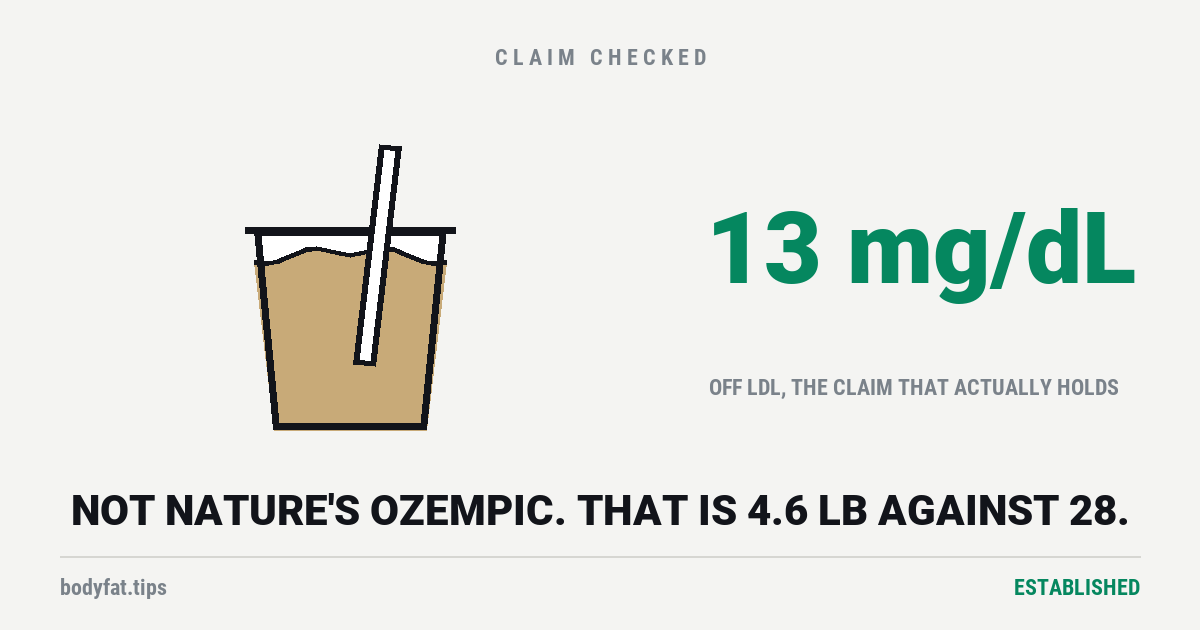
The best summary pooled 28 randomised controlled trials covering 1,924 people, lasting from three weeks to a year. Most were in people with high cholesterol, four of those trials in children, and many added psyllium to a cholesterol-lowering diet; the trials in other groups found about the same effect. Psyllium lowered LDL cholesterol — the one people call bad cholesterol — by about 13 mg/dL (0.33 mmol/L). It also moved two other markers that cardiologists increasingly prefer: non-HDL cholesterol by about 15 mg/dL, and apolipoprotein B, a count of the actual particles carrying cholesterol around your blood. [1]
The reviewers graded their own confidence, which is the part most articles skip. Moderate certainty for the LDL and non-HDL results, marked down because the trials did not all agree on the size of the effect. And high certainty for apolipoprotein B — the top of the scale, which is rare in nutrition research.
| Claim | Trials | Effect | Who ran it |
| Lowers LDL cholesterol | 28 | −13 mg/dL | university group |
| Improves blood sugar | 35 | real if yours is high, nothing if normal | the powder’s maker (3 of 5 authors) |
| “Nature’s Ozempic” | 6 | 4.6 lb | the powder’s maker |
There is also a regulator involved, which almost never happens in this aisle. United States food law contains an authorised health claim linking soluble fibre from psyllium to reduced risk of heart disease, and it sets a threshold: 7 grams or more per day of soluble fibre from psyllium seed husk. [6] The trials above used a median of about 10 grams of psyllium husk a day, roughly the amount that supplies those 7 grams of soluble fibre. [1]
Established does not mean large
Thirteen milligrams per decilitre. Hold that number for a second, because the tier on this page could easily mislead you.
Established means settled, not big. It means 28 trials, and four separate teams pooling this literature across nearly thirty years — in 1997, 2009, 2018 and 2024 — all landing on the same side, at between about 11 and 13.5 mg/dL (0.28 to 0.35 mmol/L). [8] [9] [10] It means a regulator willing to put it in the rules. What it has not shown is fewer heart attacks: no trial of psyllium on its own has reported heart attacks, strokes or deaths, so the heart benefit is inferred from the cholesterol, which is the reasoning the regulation itself sets out. [6] It does not mean psyllium is a statin. A statin typically moves LDL by tens of percent. This is a nudge you would struggle to feel and would need a blood test to see.
A reliable nudge is still worth having. It is just a different product from the one being sold to you.
The blood sugar effect, and its enormous asterisk
Thirty-five trials across three decades looked at psyllium and blood sugar. In people being treated for type 2 diabetes, the results are genuinely striking: fasting blood glucose down 37 mg/dL, and HbA1c — a rolling average of your blood sugar over about three months — down 0.97 percentage points. [2] Those two figures rest on small numbers: four multi-week trials for glucose and three for HbA1c, and the HbA1c result sat just the right side of the line researchers use for “probably not chance” (P = 0.048). An independent 2020 review of eight studies in people with diabetes found the same direction, glucose down 31.7 mg/dL and HbA1c down 0.91 points, though almost all the variation between its trials was more than chance would produce. [12]
Now the asterisk, and it is the whole ballgame. The authors found the benefit was proportional to how much blood sugar control you had already lost. In people whose blood sugar was normal, there was no significant glucose lowering at all.
Read that again if you are a healthy person holding a tub. The blood sugar benefit is real and it is not for you.
The regulator is blunter about prevention. When the powder’s maker asked FDA in 2012 for a label claim that psyllium reduces the risk of type 2 diabetes, FDA found that 47 of the 53 intervention studies it reviewed could support no conclusion, and in 2014 it allowed the claim only with the words “the FDA has concluded that there is very little scientific evidence for this claim.” [16]
So what about the Ozempic thing?
Here is where the evidence gets thin, and the contrast with everything above is stark.
The meta-analysis the weight-loss claim leans on found six studies. Total participants: 354, all adults with overweight or obesity, two of the six trials in people with type 2 diabetes. Average duration just under five months. The result: 4.6 pounds (2.1 kg), a BMI drop of 0.8, and about an inch off the waist. [3] Two trials count for 70% of that average: a six-month Italian trial (43%) in 93 people with metabolic syndrome, a cluster of raised blood pressure, blood sugar and blood fats around a large waist, and a three-month Iranian trial (27%) of psyllium cookies in 51 people with diabetes and constipation.
It is not the only pooling, and the independent poolings of psyllium trials found less. An independent 2020 review of 22 trials found no significant change: 0.6 lb (0.28 kg). [11] Another, of eight studies in people with diabetes, found no significant change in weight either. [12] A 2020 review of the thick, gel-forming fibres, taken without a diet, found the psyllium trials among them took off about 2 lb (0.89 kg). [13] The maker’s paper answers that seven of the 22-trial review’s studies were cholesterol trials designed to hold weight steady, and that some ran only two or three weeks. [3] That is a fair point, and it cuts both ways: its own six were picked by employees of the company that sells the powder.
Two bigger numbers circulate, and neither is what it looks like. A 2023 comparison of supplements across 111 trials credits psyllium with 8.2 lb (3.70 kg), but its psyllium figure is a single eight-week trial of 36 people with diabetes. [14] And a 2025 pooling reported a weight gain of 7.9 lb (3.57 kg), a result its own authors call unexpected, from a set of trials that includes a flaxseed gel and a different plant of the same genus. [15]
And appetite, the other half of the pitch? The maker funded two three-day crossover trials in which psyllium taken before meals cut hunger between meals and raised fullness. [5] That is a real measurement. It is three days of hunger ratings, not months of weight.
Semaglutide’s landmark trial ran 1,961 adults with obesity, or overweight with a related health problem, all without diabetes, for 68 weeks. The people on the drug lost 15.3 kg against 2.6 kg on placebo — a difference of 28 pounds. [4]
So the honest comparison is 4.6 against 28, and 4.6 is the most generous of those poolings once the one-trial figure is set aside. And we have compared the two fairly, which slightly favours psyllium: its 4.6 pounds is already a difference against a control group, so we used semaglutide’s difference too rather than its bigger headline number. The time spans differ too: under five months on average for the psyllium trials, nearly sixteen for semaglutide’s.
Six times the effect. Different category of thing.
And one more detail about who did the counting
The weight-loss meta-analysis carries a competing-interests statement. Here it is, word for word, with its two names replaced by what they are:
“The authors are employees of [the powder’s maker], the manufacturer of [its psyllium powder], a psyllium-containing product.” [3]
All three of them, listed at the company’s Ohio address. The blood sugar meta-analysis shares two of the same authors. Three of its five authors worked for the company and the other two had research funding from it, and 10 of its 35 studies came from the company’s own trial files, 7 of them never published. [2]
This does not make the findings wrong. Industry scientists do real work, and the papers are peer reviewed. But set beside the independent poolings, 4.6 pounds is the flattering end of the range, not the modest one. And notice the shape of it. The claim with the most independent evidence is the cholesterol one. The claim going viral is the one whose best number comes from six small studies counted by the manufacturer.
The cholesterol meta-analysis, for contrast, came out of a university research group, and company money does not explain its answer. By the review’s own table, 10 of its 28 trials had company funding and 11 did not say; the 7 paid for by research agencies alone found the same effect, by our arithmetic from its chart. [1] One of the other poolings was not independent: the 1997 one was led from a cereal maker’s science centre, and its four unpublished trials were that company’s own. [8] A 2025 pooling of 41 trials found a smaller drop, 8.55 mg/dL, but some of its comparisons set psyllium against other cholesterol-lowering treatments, niacin and plant sterols among them, rather than a placebo. [23]
We have been here before, with a different powder
In 2023 the internet had another nature’s Ozempic: berberine. We checked it, and the answer was 1.9 pounds.
By that October a US magazine was reporting the same name on psyllium, where the maker’s own number is 4.6. [24] Notice that the phrase does not belong to any particular substance. It is a slot, and more than one powder can sit in it at once, because the comparison sells regardless of which one is in the tub.
The tell is always the same: a real, modest, well-documented effect gets borrowed as evidence for a much larger one that was never measured.
The warnings on the tub
The most important safety point comes from the regulations rather than from us. Psyllium that has not absorbed enough water forms a gel in the wrong place. If a psyllium food carries the heart-disease claim, food law requires a notice about it, and the regulation gives this as its example:
“NOTICE: This food should be eaten with at least a full glass of liquid. Eating this product without enough liquid may cause choking. Do not eat this product if you have difficulty in swallowing.” [7]
Psyllium sold as a laxative must carry a drug-label choking warning, and it goes further: “If you experience chest pain, vomiting, or difficulty in swallowing or breathing after taking this product, seek immediate medical attention.” [17] The label on the maker’s own powder adds two more: an allergy alert for people sensitive to inhaled or swallowed psyllium, and “Take this product 2 or more hours before or after other drugs. Laxatives may affect how other drugs work.” [18] The allergy is not theoretical: a death from an allergic reaction to a psyllium product has been reported. [19]
If you have any difficulty swallowing, those sentences are written for you specifically. If you take medicine, for blood sugar or anything else, ask a pharmacist how to time it around the fibre. A pharmacist is a better source than a video.
One finding from the longer trials belongs here too. In a three-year European trial, 665 people who had had bowel polyps removed took 3.5 g a day of ispaghula (psyllium) husk, about a third of the cholesterol trials’ dose, or calcium, or a placebo; polyps came back in 29% of the fibre group against 20% on placebo. [20] A Cochrane review counts that trial and warns that, with so many dropouts, its results cannot be considered robust, [21] and a study that followed postmenopausal American women for 15 years on average found no link between fibre supplements, mostly psyllium, and bowel cancer. [22] One trial against one long study: unsettled, and worth knowing before taking a tub for years.
The verdict
Established — for cholesterol. Twenty-eight trials, high certainty on apolipoprotein B, and a regulator that put it in writing. About 13 mg/dL off LDL. Real, replicated, and modest.
Genuinely useful for blood sugar, if yours is already high. And measurably nothing if it is not.
Not nature’s Ozempic. Six studies counted by the company that sells the powder found 4.6 pounds; independent poolings found about 2 pounds or no significant change. The drug moved 28.
Which leaves psyllium in an unusual position for this site: a supplement that works, sold on the one thing it does least well. The boring claim on the side of the box was the true one all along.
Related: whether fiber helps you lose weight and what oatmeal actually does — the same family of gel-forming fibre, checked separately.
If you want to know what earns each rating, we wrote down how we read a study, and everything we have checked is in one place.
The page’s account of the weight evidence, its safety section and its funding row were corrected on 1 October 2026 after an independent editorial review. The page presented a six-trial pooling written by employees of a psyllium powder’s maker as the weight evidence. Independent poolings found no significant change in 22 trials and in 8 studies of people with diabetes, and about 2 lb in the psyllium trials of a viscous-fibre review; the page now reports them, and says why two other figures do not count: a network analysis’s 8.2 lb is one trial of 36 people, and a reported weight gain comes from a pooling that included flaxseed and another plant. The safety section called choking the one important safety point and said food law required the quoted notice on the tub. The notice is required on psyllium foods that carry the heart claim, and the quoted words are the regulation’s example; psyllium sold as a laxative carries a drug-label choking warning, and the maker’s own label adds an allergy alert and a two-hour gap from other medicines. The evidence panel said there were no long-term psyllium outcome data: a three-year trial found bowel polyps returning more often on the fibre, and a 15-year study of supplement users found no link with bowel cancer, and the panel now says so.
Also corrected: the 1997 cholesterol pooling was described as independent, and it was led from a cereal maker’s science centre; the blood sugar paper’s authors are now described exactly (three employees, two researchers the company funded, 10 of 35 studies from its own files); the provenance chain said the federal claim covered heart disease and nothing else, and FDA also allows a qualified type 2 diabetes claim that must say there is very little scientific evidence for it (2014). The satiety trials the panel listed are now reported; the dating of the nature’s Ozempic label, the search count (searches, not people) and the panel’s follow-up range are fixed; a line saying nobody makes videos about psyllium and cholesterol was false and is gone; and companies are named by role. The rating, Established for lowering LDL cholesterol, is unchanged.
Corrected again on 1 October 2026. The funding row said the satiety trials were funded by the powder’s maker, which is what the publisher’s record says. The same paper’s PubMed and Europe PMC records also list a US government grant, to a nutrition and obesity research centre at one author’s university, and the row now says so, along with the two authors who worked for the maker. Nothing else changes.
Corrected on 7 October 2026. The page and its provenance chain gave a search figure, about 246,000 searches a month for psyllium husk, without saying where it came from or when. It comes from a count of US searches in a paid keyword database, pulled on 20 August 2026, and both now say so. The rating is unchanged.