Is Olive Oil Good For You? Yes — But Not Compared To The Oils You’ve Been Told To Fear

Short answer: yes, probably, and we are rating it Supported.
But the famous study everyone cites for it was withdrawn from the New England Journal of Medicine and published again, with numbers that barely moved — and a 28-year study of 92,000 Americans contains one sentence that quietly deflates the marketing. Neither fact tends to make it into the articles.
The trial you have heard of, and what happened to it
PREDIMED is the reason olive oil has a reputation backed by more than vibes. It was a proper randomised trial: 7,447 Spaniards aged 55 to 80, all at high cardiovascular risk but none with heart disease yet, followed for a median of 4.8 years [1].
In 2013 it reported that a Mediterranean diet with extra-virgin olive oil cut major cardiovascular events. It became the citation.
Then in 2018 the authors withdrew it.
Their own account of why, and it is worth reading in their words: they found “protocol deviations, including enrollment of household members without randomization, assignment to a study group without randomization of some participants at 1 of 11 study sites, and apparent inconsistent use of randomization tables at another site” [1].
Randomisation is the entire machinery of a trial. It is what makes the groups comparable, and it is the reason a randomised study can claim cause where a survey cannot. If some people were assigned by household — a whole family into one arm — then the groups were not assembled the way the analysis assumed.
So they retracted the paper and published a new one, with, in their words, “revised effect estimates based on analyses that do not rely exclusively on the assumption that all the participants were randomly assigned” [1].
And now the half that the sceptics leave out
If we stopped there you would conclude the olive oil evidence collapsed. It did not.
The re-analysis still found a benefit. Compared with the control diet, the hazard ratio was 0.69 for the olive oil group (95% confidence interval 0.53 to 0.91) [1] — roughly a third fewer events, with the whole plausible range sitting below 1.
More convincing still: they reran it after throwing out 1,588 participants whose assignment was known or suspected to have gone wrong. “Results were similar” [1].
That is close to the best a damaged trial can do. The randomisation failures do not appear to be what produced the finding.
Two other limits remain, and the paper states both. The trial was stopped early, at a planned interim check, and it recorded fewer events than expected, which left it with, in the authors’ words, “reduced statistical power to separately assess components of the primary end point” — fewer events than it needed to judge heart attacks, strokes and cardiovascular deaths one by one [1]. Taken one at a time anyway, only strokes were clearly fewer on olive oil. Heart attacks, cardiovascular deaths and deaths from any cause could not be told apart from chance (hazard ratios 0.82, 0.62 and 0.90, each with a range of plausible answers that includes no effect) [1].
What this episode should change is not whether you believe the result. It is how you treat anyone who cites the 2013 paper without mentioning any of this. And people still cite it: OpenAlex, an open index of research papers and their citations, counts 122 citations of the retracted 2013 paper in 2025 alone, seven years after it was withdrawn (checked 18 September 2026).
Look at what the three groups actually got
Here is the part that matters more than the retraction, and it was never hidden. It is in the abstract. It just does not suit a headline about olive oil.
| Mediterranean diet + free olive oil |
Quarterly sessions. Oil delivered. | 3.8% had an event |
| Mediterranean diet + free nuts |
Quarterly sessions. Nuts delivered. | 3.4% had an event |
| Control | Advice to eat less fat. A yearly leaflet until October 2006, then quarterly sessions. “Small nonfood gifts”, no food. | 4.4% had an event |
Two things jump out.
The nuts did just as well. Events were 3.8% on olive oil and 3.4% on nuts [1], with adjusted hazard ratios of 0.69 and 0.72 — overlapping so heavily that the trial cannot tell them apart. PREDIMED is not evidence that olive oil is special. It is evidence that a Mediterranean diet with a generous fat source beats being told to eat less fat.
And only two of the three groups got food. The intervention arms had extra-virgin olive oil or nuts delivered to them, free: about a quart (1 liter) of oil a week per household, or about an ounce (30 g) of mixed nuts a day per person. The control group got advice to reduce dietary fat and “small nonfood gifts” [1].
Free groceries are not nothing. But what about the counselling? Dietitians met both Mediterranean groups at the start and every three months after. The control group had dietary training at the start too, then, for the trial’s first three years, only a leaflet once a year; in October 2006 the protocol was changed to offer it sessions just as often [1]. The authors then checked whether the extra contact explained the result. It does not look that way. Among people recruited after the change, when the control group had the same sessions from the start, the two Mediterranean diets together roughly halved the rate of major cardiovascular events (hazard ratio 0.49); among those recruited before it, the cut was about a quarter (0.77). The trial could not reliably tell those two results apart, but the benefit did not vanish once the counselling was equal [1].
So the lasting difference was the food. It is not a flaw the authors hid — it is the practical reality of running a diet trial — but it means the comparison was never purely about what was on the plate.
The sentence nobody quotes
Away from the trial, the observational evidence on olive oil is genuinely large and genuinely consistent.
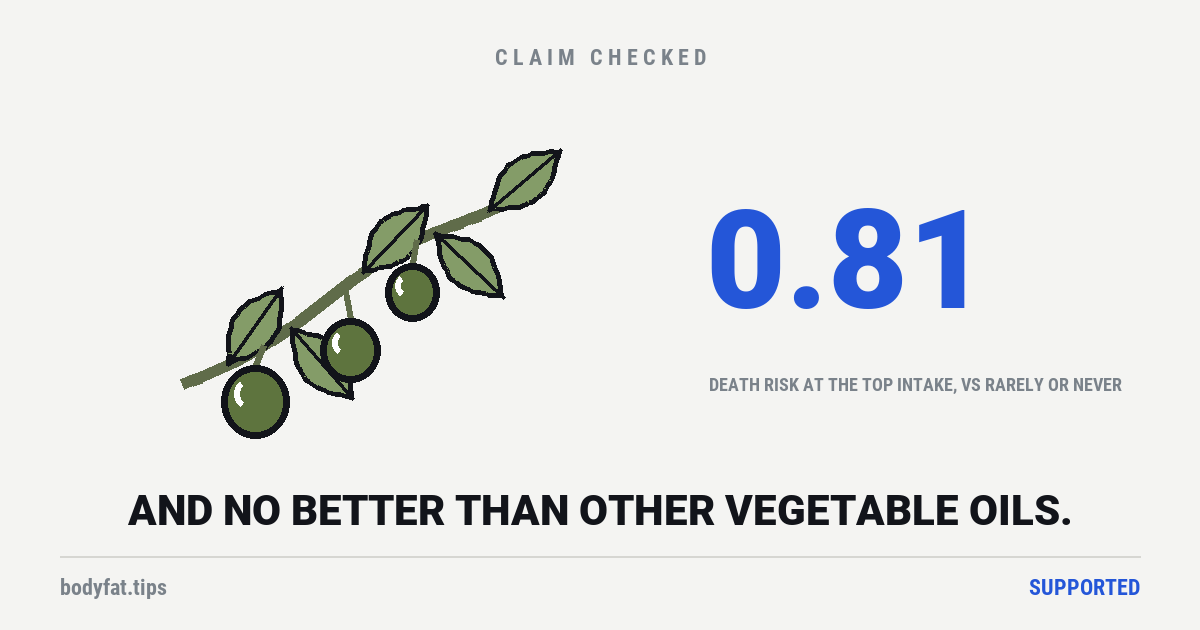
One US analysis followed 60,582 women and 31,801 men — nurses and other health professionals, more than 95% of them white — for 28 years, recording 36,856 deaths [2]. People eating the most olive oil — more than half a tablespoon a day — had a 19% lower rate of death from any cause than those who never or rarely ate it (hazard ratio 0.81, 95% CI 0.78 to 0.84). Lower cardiovascular death, lower cancer death, and the largest gap of all in neurodegenerative death, at 0.71.
A meta-analysis pooling 24 cohorts and hundreds of thousands of people — among them these US cohorts, and three reports from PREDIMED itself — found the same direction: per extra 2 tablespoons or so a day (25 g), 16% less cardiovascular disease, 22% less type 2 diabetes, 11% lower all-cause mortality [3]. Cancer, notably, showed nothing clear — a relative risk of 0.94 with a range crossing 1, for getting cancer or dying of it, counted together [3].
Now the sentence. In that 92,000-person analysis, the researchers also asked what happens when you swap other fats for olive oil. Swapping about three-quarters of a tablespoon (10 g) a day of margarine, butter, mayonnaise or dairy fat for the same amount of olive oil was associated with a 13 to 19% lower risk of death from any cause [2].
And then: “No significant associations were observed when olive oil was compared with other vegetable oils combined.” [2]
Read that carefully, because it is the practical answer to the question you probably came here with. Olive oil looks good against butter. Against corn, safflower, soybean and canola oil taken together, this dataset found no difference it could tell from chance.
Which is the third time we have landed here
Three of our verdicts on cooking oil, from three separate literatures, keep arriving at the same place.
On seed oils, the inflammation mechanism failed when tested, and the trials that swapped saturated fat for vegetable oil never produced a mortality benefit.
On canola, the molecule everyone fears was bred out fifty years ago — and in thirteen head-to-head trials canola lowered LDL cholesterol more than olive oil did.
And here, a 28-year study of 92,000 Americans cannot separate olive oil from other vegetable oils on mortality.
Three literatures, three methods, one conclusion: among unsaturated cooking oils, which one you buy matters far less than the marketing on either side implies. Where the numbers do move, in the cohorts, is when olive oil takes the place of butter, margarine or mayonnaise — an association among people who chose their own diets, not a swap anyone was assigned to [2]. After that, you are choosing on taste and price, and that is a perfectly good way to choose.
What we are rating, and why not Established
Supported: olive oil is good for you in the sense that matters — higher intake tracks lower cardiovascular disease, lower diabetes and lower all-cause mortality across very large populations, and the trial in people without heart disease, damaged and repaired, still found fewer heart attacks, strokes and cardiovascular deaths, counted together [1].
And it is no longer the only trial. In 2022 a second Spanish trial, CORDIOPREV, reported on 1,002 people in Córdoba who already had heart disease, randomised to a Mediterranean diet with free extra-virgin olive oil or a low-fat diet with free food packs and followed for seven years. The Mediterranean group had about a quarter fewer major cardiovascular events — heart attacks, procedures to reopen arteries, strokes, blocked leg arteries and cardiovascular deaths, counted together — with hazard ratios of 0.72 to 0.75 across the authors’ models [4]. The difference was clear in the 827 men; in the 175 women, none was found. Like PREDIMED, it tested a whole diet, not the oil on its own. Its main funder, a foundation that works for Spain’s olive-oil sector, also supplied the oil; the trial’s design paper says the foundation had no part in designing or running the study [4].
Not Established, for three reasons we will state rather than bury. The first trial was retracted, and its control arm got no free food and, for its first three years, less counselling. It tested a dietary pattern, with nuts doing equally well. And the cohort data rests on food frequency questionnaires — people recalling what they ate, every four years [2] — in populations where buying olive oil in 1990s America travelled with a good deal else.
Not shown either way: cancer. The meta-analysis pooled studies of getting cancer and of dying of it, and its estimate is small and uncertain: a relative risk of 0.94, with a range of plausible answers from 14% lower to 3% higher, so “no effect at all” is still on the table [3]. The US study on its own recorded fewer cancer deaths among the heaviest users (hazard ratio 0.83) [2], and those deaths are among the results the meta-analysis pooled. That is not enough to rate in either direction. The same meta-analysis notes that only its diabetes result was statistically homogeneous — meaning the studies behind the other outcomes disagreed with each other more than you would like.
Which olive oil, and what the labels may say
Does the grade matter? That is a separate question from the one above, and the short answer is that nobody has tested it head to head. Both trials used extra-virgin oil [1][4], which keeps the plant compounds called polyphenols that ordinary refined oil is poor in [1]. The US study could not tell grades apart [2]. Two Spanish studies that could found the lower risk with virgin or extra-virgin oil, and little or none with common, refined olive oil. In 12,161 adults chosen to represent Spain’s population and followed for about 11 years, the top third of virgin-oil users had a death rate about a third lower than the bottom third, who used almost none (hazard ratio 0.66); the top third of common-oil users did no better than the bottom third (0.96) [5]. Among the PREDIMED volunteers, the heaviest extra-virgin users, averaging about 3½ tablespoons (49 g) a day, had a quarter fewer cardiovascular events (0.75), while common olive oil’s link was weaker and fell just short of the line researchers use for “probably not chance” [6].
Both are observational: nobody in either study was assigned one grade or the other. And both share authors with the PREDIMED trial. The hints favour extra-virgin. Nothing has settled it.
What the labels are allowed to say is less than the headlines. In 2004 the FDA let olive oil carry a heart claim only in qualified form, with its doubts written in: “Limited and not conclusive scientific evidence suggests that eating about 2 tablespoons (23 grams) of olive oil daily may reduce the risk of coronary heart disease due to the monounsaturated fat in olive oil,” and only if the oil is to “replace a similar amount of saturated fat.” The North American Olive Oil Association, which petitioned for a claim, had proposed a firmer one built on a single tablespoon [7]. The FDA has since allowed claims of the same kind for canola (2006), corn (2007) and soybean oil (2017) [7], and in 2018 one for oils that are at least 70% oleic acid, a monounsaturated fat, rated “supportive but not conclusive” at about 1½ tablespoons (20 grams) a day; the petition listed olive oil beside high-oleic sunflower, safflower, canola and algal oils [8].
In the EU, the 2012 list of permitted health claims has one entry for olive oil, and it is narrow: its polyphenols “contribute to the protection of blood lipids from oxidative stress” — that is, they help keep fats in the blood from being damaged by oxidation, a laboratory marker rather than a heart attack. Only oil with at least 5 mg of hydroxytyrosol and its relatives, the polyphenols in question, per 1½ tablespoons (20 g) may say it, and the label must add that the benefit comes with that much a day [9]. In 2025 EFSA, the EU’s food-safety agency, assessed two further polyphenol claims and found cause and effect not established for either: that they lower LDL cholesterol (the kind linked to clogged arteries) and blood pressure, and so the risk of heart disease; and that they help keep HDL cholesterol (the kind usually counted as protective) normal [10][11]. The heart-disease application came from QvExtra!, an association of extra-virgin producers. A year later it launched a “SIQEV heart” mark for bottles that meet the conditions for the EU’s permitted claims, announcing that it certifies “for the first time the cardiovascular and antioxidant benefits” of extra-virgin oil (our translation) [12].
None of that says extra-virgin oil is a waste of money. It says the heart claims made for its polyphenols have not got past the EU’s own scientific assessors, and that the case for paying more for it rests on observational studies, not a trial.
What to actually do
Use olive oil. It is a good oil. Nothing on this page is an argument against it, and if you enjoy it, that is reason enough.
Do not pay for the story that olive oil beats every other oil. The gap that the evidence actually shows is between olive oil and butter, margarine and mayonnaise — not between olive oil and the other vegetable oils on the shelf beside it [2]. Whether extra-virgin earns its price over common olive oil is the open question above.
About a tablespoon a day is where the top group sat. More than half a tablespoon (7 g) was the way in. Its members averaged about two-thirds of a tablespoon (9 g) when the study began and about a tablespoon (14 g) in the analysis behind the 19% figure, and only one person in twenty was in that group at the start [2]. Across the range these Americans ate, more olive oil went with a slightly lower death rate at every step, about 4% lower per extra teaspoon or so (5 g) a day [2], so nothing marks one amount as a sweet spot. A tablespoon is still a modest amount, not a regime.
And treat “a randomised trial proved it” as a claim to check, not a conversation-ender. The trial olive oil’s reputation leans on was withdrawn and rebuilt. That is science working — the correction is a feature — but only if somebody tells you it happened.
One thing we have left out deliberately: the claim that a compound in olive oil works like ibuprofen. That rests on enzyme experiments in glassware with no human outcome evidence behind it, which is exactly the mistake we took apart on our sucralose page. If that changes, we will write it up.
This is journalism, not medical advice. Cardiovascular risk is a conversation for a clinician who knows your numbers.
This page was corrected on 16 September 2026. The link on source [1] went to correspondence the New England Journal of Medicine published in October 2018 under the same title, not to the June 2018 republication of the trial that the source line cites. It now goes to the republication. We found it by checking every DOI link on this site against the title, volume and pages of the document it actually belongs to. Nothing the page reports from the trial has changed, and neither has the rating.
An independent editorial review on 18 September 2026 found three errors on this page that a reader would act on. We said only the olive-oil and nut groups in the PREDIMED trial got regular counselling. The trial paper says the control group had a leaflet once a year for the first three years and, from October 2006, sessions as often as the other groups, and that the Mediterranean diets did at least as well against it after that change, so extra attention does not appear to explain the result; the lasting difference was the free food. We said the trial was government-funded; the same paragraph of the paper says its olive oil was donated by two Spanish olive-oil organisations and its nuts by the California Walnut Commission and two nut companies. The funding row and the source entries now list every tie by role, for every study on the page. And we said half a tablespoon a day was where the lowest-risk group sat; that was the way into the group, whose members averaged about a tablespoon.
Also corrected: the cancer line (the meta-analysis pooled getting cancer and dying of it, and its estimate is uncertain rather than a flat nothing, while the US cohorts recorded fewer cancer deaths); the swap figures, now 13 to 19% lower death from any cause for about three-quarters of a tablespoon (10 g) a day; the oils olive oil was compared with; four places that called a study the largest when a bigger one is among those our own source [3] pools; “the one randomised trial”, when a second, CORDIOPREV, tested a Mediterranean diet with free olive oil in people who already had heart disease; the trial’s limits, which now include its early stop and that only strokes were clearly fewer taken one at a time; “six years on”, which was eight; and three unsupported lines, two we could not source and a superlative that citation counts contradict. We added what the evidence says about extra-virgin versus common olive oil, what US and EU regulators allow on labels, and EFSA’s 2025 opinions on olive-oil polyphenols, and the last step of the provenance chain now names a dated label rather than a category. The rating is unchanged: Supported.