Is Oatmeal Good For Weight Loss? Maybe a Little. It Does Lower Cholesterol.

Maybe a little. What oats do have is one of the few breakfast claims with a regulator’s signature on it, and it is not about weight.
But the useful finding on this page is not about weight at all. It is that the word “oats” on a box tells you almost nothing: of the oat forms tested for blood sugar, the instant kind scored worst.
Start with the thing oats are genuinely good at
Almost no food has this. Oats have a health claim that food standards agencies actually examined and approved, attached to a specific measurable dose.
The active ingredient is beta-glucan, a soluble fibre. Soluble means it dissolves in water; beta-glucan also goes thick — it is what makes porridge gluey — and for cholesterol that viscosity is thought to be the point [1]. It slows things down in the gut and interferes with the reabsorption of bile acids, which your body then has to replace using cholesterol.
A meta-analysis of 28 randomised trials put a number on it. At 3 grams of oat beta-glucan a day or more, LDL cholesterol fell by 9.7 mg/dL (0.25 mmol/L) and total cholesterol by 11.6 mg/dL (0.30 mmol/L) [1].
Two details that make it more useful than the headline.
More may not do more. Across trials using anywhere from 3 to 12.4 grams a day, the analysis found no sign that bigger doses lowered cholesterol further [1]. Its authors call that “curious and somewhat unexpected”, because the two earlier analyses that tested for a dose effect found one, and they say theirs may not have been able to detect it [1]. So 3 grams is where the evidence starts, not a proven ceiling.
It works hardest on the people who need it. The reduction was significantly larger in people who started with higher LDL, and larger again in people with diabetes, though only three of the 28 trials recruited them [1]. If your cholesterol is already fine, expect less.
And what it does not do: no significant effect on HDL cholesterol or triglycerides [1].
Where the number on your packet came from
That “3 grams” is not a marketing round number. It has a paper trail, and the trail runs through two studies and a petition.
The first study, in 1991, was a dose-controlled trial in JAMA: people with high cholesterol, on a low-fat diet, ate different amounts of beta-glucan from oatmeal and oat bran. In the FDA’s summary of it, total cholesterol fell 7 to 10 percent from where it started in the groups eating 3 g a day or more; in the groups eating 1 to 2.4 g, it did not change significantly [5].
The second was a 1992 meta-analysis, also in JAMA. Ten trials met its criteria. Oats lowered total cholesterol by 5.9 mg/dL — modest. But the authors noted that larger reductions came in people who started above 229 mg/dL, and “particularly when a dose of 3 g or more of soluble fiber was employed” [2].
Then the petition. In March 1995 the Quaker Oats Company asked the FDA to allow a heart-disease claim for oats, and proposed 3 g of beta-glucan a day as the standard — the amount in about 2 ounces (60 g) of dry oatmeal or 1.4 ounces (40 g) of oat bran, as the FDA put it. The FDA agreed that 3 g or more was associated with significant falls in cholesterol, citing the 1991 trial, the meta-analysis and other studies [5], and authorised the claim in January 1997 at 0.75 g per serving: the 3 g spread across four servings a day [6]. In 2010 EFSA, the EU’s food-safety agency, concluded that oat beta-glucan lowers cholesterol and set the same 3 g a day as the amount a food must provide to carry the claim, on an application from CreaNutrition AG, a company that sells oat beta-glucan [1][7].
So the number is real, and the record of where it came from is public. It just did not come from one sentence: a dose trial found it, a meta-analysis agreed, and an oat company asked for it to go on the box.
Now the part that should change what you buy
Here is the finding we did not expect, and it is the reason this page exists rather than being another list of oat benefits.
Researchers pooled 72 separate measurements of how different oat products affect blood sugar [3]. Glycaemic index, for anyone who has not met it, just scores how sharply a food raises blood glucose against a reference — lower is a gentler rise. It compares portions holding the same amount of digestible carbohydrate, not the same bowl or the same calories, and it measures blood sugar, not weight. And 93% of these tests were run in healthy people [3].
| Large-flake oats | 53 | 11 tests |
| Steel-cut oats | 55 | 2 tests |
| Muesli and granola | 56 | 28 tests |
| Quick-cook oats | 71 | 7 tests |
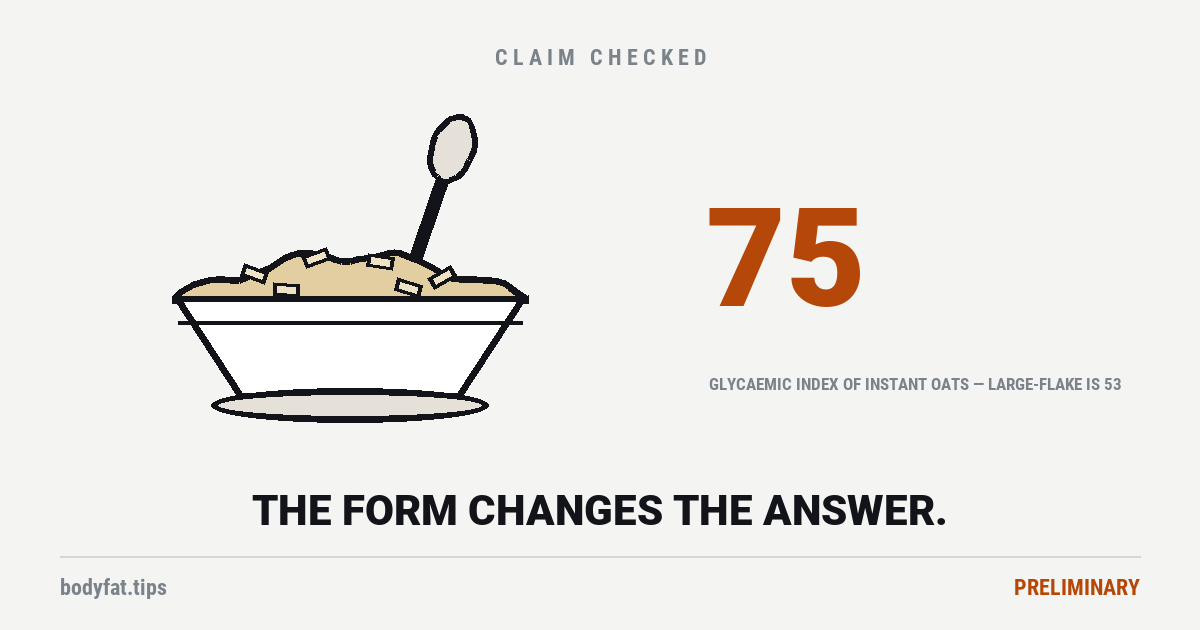
| Instant oatmeal | 75 | 9 tests |
Instant oatmeal scored 75. Muesli and granola scored 56.
Instant oats produced a sharper blood sugar response than muesli, the uncooked mix of oat flakes, dried fruit and nuts that made up nearly all of that group; the three granolas tested, which are usually toasted, scored 44, 63 and 70 [3]. Quick-cook oats are barely better than instant, at 71.
Why? Nothing mysterious. Instant oats are cut finer and pre-cooked, so the starch is already broken open and your digestion has less work left to do. The review puts it plainly: “smaller particle size and increased starch gelatinisation appear to increase the glycaemic response” [3]. The oat is the same grain. The processing is the variable.
One honest note on that table, because it cuts against advice we would otherwise be giving you: steel-cut oats rest on exactly two measurements [3]. They score well, and everybody recommends them, and the evidence underneath that recommendation is two tests. Large-flake oats have eleven and score slightly better anyway.
Regulators have looked at oats and blood sugar too, and they tie the effect to a dose of beta-glucan per helping of carbohydrate. In 2011 EFSA concluded that beta-glucans from oats and barley reduce the rise in blood sugar after a meal, at about 4 g per 30 g of digestible carbohydrate in the bread and pasta it assessed [8]. In August 2025 it assessed a request from PepsiCo International to lower that to 2 g, and found that a consistent effect at the lower dose “has not been demonstrated” [9]. And in January 2026, on an application from ScanOats, it concluded that oat beta-glucans reduce the peak in blood sugar after a meal, for meals with at least 30 g of digestible carbohydrate and at least 3 g of oat beta-glucan for each 30 g [10]. None of the 72 tests in the chart reported how much beta-glucan its oats contained [3], so the chart cannot tell you which bowls would clear those bars. And none of it is about weight.
So does any of this make you lose weight?
Maybe a little, if you have weight to lose. The evidence for even that is thin, and much of it did not test a bowl of oatmeal.
An umbrella review — a review of earlier reviews, funded by PepsiCo, which owns Quaker Oats — gathered what randomised oat trials have found [4]. On weight, its summary reports a reduction in “body weight and adiposity in overweight individuals”, adiposity meaning body fat. Its full text, weight section included, is behind the publisher’s paywall, so we read the pooled analyses it cites instead.
The same review is notably careful about the bigger claims. On living longer: “limited epidemiological data indicated a possible beneficial effect”, and on cardiovascular events specifically, the effect was “not adequately discerned” [4]. That is a review with every reason to be enthusiastic declining to be.
How big is “a reduction”? A 2019 analysis pooled 20 trials of cereal beta-glucan — the soluble fibre in oats and barley. On average, people who got it lost about 1.7 lb (0.77 kg) more than people who did not, and the range the true average probably sits in runs from 3.3 lb (1.49 kg) down to about 0.1 lb (0.04 kg), which is next to nothing [11]. A 2022 analysis of oats, oat extracts and oat plant compounds found about 2.1 lb (0.94 kg), with a range down to about 0.1 lb (0.05 kg). That figure came from five trials and 250 people, typically followed for about four weeks, and none of the five was rated at low risk of bias, the reviewers’ grade for how well a trial guarded against tilting its own result. In the same paper’s two other weight comparisons — oats added to a restricted diet against the same diet alone (7 trials, 739 people), and oats against other foods such as rice, eggs or wheat (8 trials, 344 people) — weight did not differ significantly [12]. These are averages across groups, not a range for any one person.
And much of what was tested was not a bowl of oatmeal. The trials gave beta-glucan in hot cereal, porridge and bread, but also in extracts and concentrates, and from barley as well as oats [12][13]. A 2023 review of beta-glucan and weight, also funded by PepsiCo and cited by the umbrella review, gave the most weight to six trials in overweight adults, lasting 6 to 12 weeks; three of them tested barley [13]. Of the three oat trials, one found more weight lost on a hot oat cereal than on a placebo cereal over 12 weeks. In another, men given bread made with oat fibre for eight weeks lost more than men given whole-wheat bread, though both groups lost weight, and by the trial’s own description the oat group’s diet was also higher in monounsaturated fat, so the bread was not the only difference [18]. The largest, 132 adults with high LDL cholesterol eating oat-bran porridge or a corn-starch and rice-flour porridge every morning for 90 days, found that both groups lost weight and that the difference between them was not significant; the trial’s own authors credit the nutrition counselling everyone received [13][14].
The newest pooled analysis points the other way. Published in January 2026, it gathered 49 studies and 3,854 people, all with a body mass index — weight relative to height — of 25 or more: the overweight population this page’s rating is about. Cereal beta-glucan lowered their cholesterol. But its summary lists body weight among the outcomes where “No effects were observed”, and adds that “BMI results were conflicting owing to publication bias” — the tendency for studies that find something to reach print more often than studies that find nothing [15]. That summary is all we could read; the full paper sits behind the publisher’s paywall and a security check.
Regulators have not been persuaded either. In 2009 EFSA assessed claims that oat and barley fibre “Helps with weight control”. None of the 77 references it was sent addressed beta-glucan and body weight, and it concluded that “a cause and effect relationship has not been established” [16]. In 2011 it assessed the claim that beta-glucans from oats and barley make people feel full enough to eat less. The two studies it was given each tested a single meal, and again a cause and effect relationship “has not been established” [8]. Both are verdicts on the evidence submitted at the time, not new tests, and every pooled analysis above came later.
Then why would oats help at all, if they do? What follows is our reasoning, not a finding, and it is labelled as such. The obvious story is that a thick, slow breakfast fills you up and you eat less later. The trials that measured eating do not show it. In the 2019 analysis, beta-glucan made no significant difference to how much people ate, and in the trials giving 4 g a day or more, people ate more [11]. In the trials the 2023 review weighted most, five found no significant difference in how much the two groups ate [13]. And EFSA found a lasting effect on fullness not established [8]. Our fibre page lists “this will fill you up so you eat less” as the claim that travelled rather than the finding, and our protein page found fullness holding up over hours but not shown over months. So the fullness explanation is a hunch the evidence does not support, and if oats do take a little weight off, nobody has shown how.
Who paid for the oat research
We report funding on every page, and this one has a thread running through four decades that is worth seeing laid out.
The 1992 JAMA meta-analysis states in its methods that trials were identified by “a computerized literature (MEDLINE) search and the Quaker Oats Co” [2]. The 2014 meta-analysis searched, alongside the public databases, “in-house study reports at CreaNutrition AG” — a company that sells oat beta-glucan [1]. The 2015 processing review and the 2025 umbrella review are both co-authored from PepsiCo, which owns Quaker Oats; the earlier one gives the affiliation as the “Quaker Oats Center of Excellence” [3][4].
The money went further than the bylines. The 2025 umbrella review, this page’s original source for a weight effect, states that “This work was funded by PepsiCo, Inc.” [4]. The 2023 weight review it cites was funded by PepsiCo too, and two of its three authors work there [13]. The 2014 meta-analysis was “Supported by DSM Nutritional Products”, which also paid the university of its first author, who ran the statistics, for her part in it [1]; DSM supplies a commercial oat-bran ingredient rich in beta-glucan [17]. The 2015 processing review had no specific grant, but its first author has received research funds from PepsiCo and DSM, among others [3]. The 1992 paper’s own funding statement is in its full text, behind the journal’s paywall, and we have not read it.
Does that sink it? No, and here is the reasoning rather than just the reassurance.
The cholesterol finding has been examined by food regulators on both sides of the Atlantic, replicated across 28 randomised trials, and pointed the same direction for three decades. The FDA’s review began with a Quaker Oats petition and EFSA’s 2010 opinion with an application from CreaNutrition, but each regulator weighed the trials itself [5][7]. That is not what a manufactured result looks like.
And notice what the industry-linked processing review found: instant oatmeal, the quickest to make, produced the highest blood sugar response of the oat forms it pooled. That is a ranking within oats, not a finding against them — the same review calls steel-cut and large-flake porridge, muesli and granola “good options” for people concerned about blood sugar [3] — so it tells you little either way about the funding.
What the disclosure should do is make you read the expansive claims harder than the cholesterol one. The further a claim travels from the thing regulators actually approved, the more it is worth asking who benefits from the journey.
What we are rating
Preliminary: that oatmeal helps people who are overweight lose weight. Real trials exist, and the pooled averages are small, about 2 lb [11][12]. But they tested beta-glucan from oats and barley in many forms rather than oatmeal as such, one of the two positive pooled results rests on five short trials, and the newest pooled analysis, in overweight adults, found no effect on body weight [15]. Alongside it sits a separate and firmer finding, on cholesterol.
Established in its own right, though it is not what you asked: the cholesterol effect at 3 g/day of beta-glucan. If this page were about cholesterol it would carry a higher tier.
Not supported: that oats are a weight-loss food in the sense the marketing implies, or that the effect is anything but modest, or that it applies to people who are not overweight.
Explicitly hedged by the umbrella review: living longer, and preventing cardiovascular events [4].
What to actually do
Buy large-flake or rolled oats, not instant. This is the single actionable thing on the page, and it is about blood sugar, not weight. It is the same grain, it costs less per serving, and it scored 53 against instant’s 75 [3].
You do not need to hunt for steel-cut. They are fine. The evidence that they beat large-flake is two measurements against eleven, and large-flake scored marginally better [3]. Buy them if you like the texture, not because a chart told you to.
Three grams of beta-glucan a day is the amount the cholesterol evidence supports. In the trials pooled, more than that did not measurably add to the effect, though the authors say their analysis may not have been able to see it [1]. By the FDA’s reckoning, 3 g is about 2 ounces (60 g) of dry oatmeal or 1.4 ounces (40 g) of oat bran a day [5].
Watch what has been done to the grain. The instant oats in these tests were mostly plain, so it was the processing, not a flavouring, that pushed the score up [3]. The oats are not the problem; what has been done to them is.
And be suspicious of anything oat-based sold as a weight-loss programme. The regulated claim is about cholesterol. Everything beyond that has travelled, and the further a claim travels from the evidence the more it costs — a pattern we took apart on detox teas.
This is journalism, not medical advice. If you are managing cholesterol or diabetes, that belongs with a clinician who knows your numbers.
An independent editorial review on 18 September 2026 found that this page rated oats on weight more firmly than its evidence allows, and did not say who paid for that evidence. We rested the weight claim on one line from a 2025 umbrella review, and never said that review was funded by PepsiCo, which owns Quaker Oats, or that the 2014 cholesterol analysis we presented as an independent check was funded by DSM Nutritional Products, which supplies an oat-bran beta-glucan ingredient. Our funding row said everything was reported; it was not. Read directly, the weight evidence is trials of beta-glucan from oats and barley in cereals, breads and extracts, not of oatmeal as such. The two pooled analyses that found an effect found about 2 lb, one of them from five short trials, and a 2026 analysis of 49 studies in overweight and obese adults found no effect on body weight. The page now gives those numbers, what the EU’s food-safety agency concluded on weight and fullness, and a funding row that names every tie we could read.
Also corrected. The 3 g figure did not come from “a single line” of the 1992 meta-analysis: the FDA’s own record shows the Quaker Oats Company proposed it in a 1995 petition, and the FDA based it on a 1991 dose trial as well as that analysis. “Granola scores 56”, in our headline and search description, was the average of 24 muesli and 3 granola tests; the granolas scored 44, 63 and 70. The review did not find flavoured instant packets worst for blood sugar — its instant oats were mostly plain — and nothing we cited ranked them for added sugar. The 2014 analysis found no dose effect above 3 g, but its authors call that “curious and somewhat unexpected”, so we no longer say more is not better. The “thick, slow, filling” explanation for a weight effect is now labelled as our reasoning, beside the trials that found people did not eat less. The claim our provenance chain traces is now stated in our words rather than in quotation marks, because we found no one to quote. The rating has changed with the finding, from Supported to Preliminary: real trials exist, and they are not yet good enough to say that oatmeal helps you lose weight.