Does Alcohol Cause Cancer? Yes, and More Drinking Means More Risk

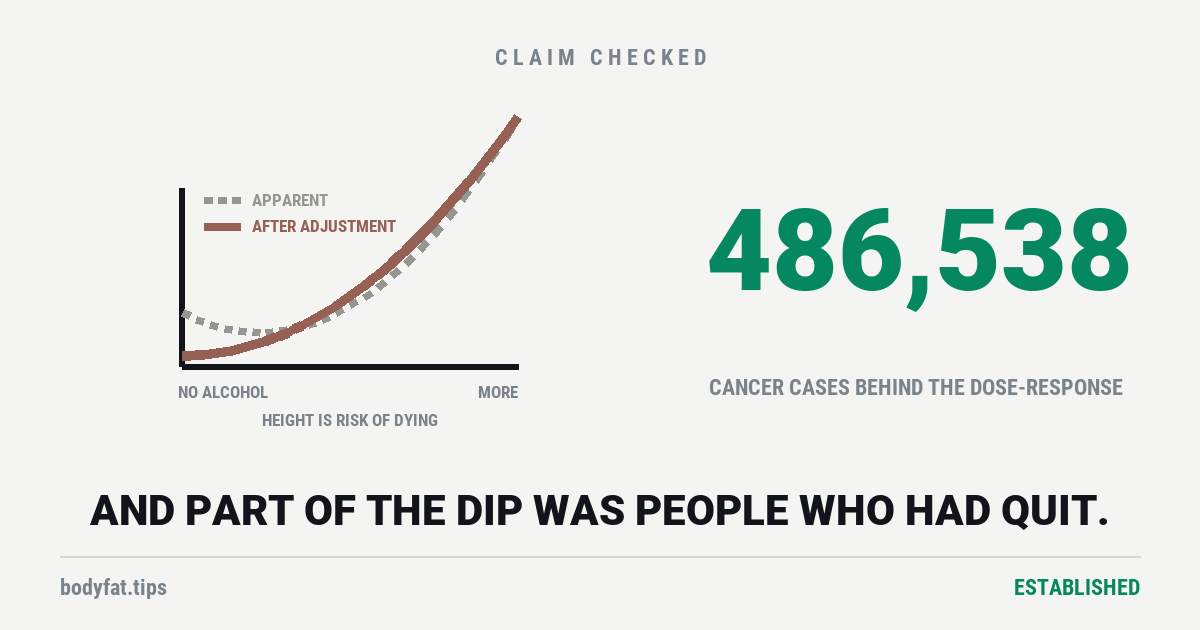
Yes. The evidence is large, old and consistent, and the dose-response is the part that settles it. Across 572 studies and 486,538 cancer cases, more alcohol meant more cancer of the mouth, throat, oesophagus, colon, larynx and breast. [1] For the mouth and throat, the oesophagus and the breast, the rise showed up even in light drinkers, at up to about one US drink a day (12.5 grams of alcohol), though for the mouth, throat and oesophagus the light-drinking rise was clear only in studies of Asian populations; for the colon and larynx, it appeared only at moderate and heavy drinking. [1]
The interesting question is not whether. It is why so many people believe a glass a day is actively good for them, and the answer is one of the clearest examples we have covered of a research problem escaping into the world while researchers were still arguing about it.
What it raises, and by how much
| Cancer | Risk multiplier | Dose-response |
| Mouth and throat | 5.13 | clear |
| Oesophagus (squamous) | 4.95 | clear |
| Larynx | 2.65 | clear |
| Gallbladder | 2.64 | — |
| Liver | 2.07 | — |
| Breast (female) | 1.61 | clear |
| Colon and rectum | 1.44 | clear |
| Stomach | 1.21 | — |
| Pancreas | 1.19 | — |
| Lung | 1.15 | — |
| Lymphoma | lower, not higher | — |
Three findings in that analysis point the other way, and we are printing them anyway. Drinkers had lower rates of Hodgkin and non-Hodgkin lymphoma, and light and moderate drinkers lower rates of kidney and thyroid cancer. [1] Why? For lymphoma, the authors call the mechanism largely unknown and offer a partial explanation that comes up again below: early symptoms can make people quit or cut down before they are diagnosed, which files people who are already ill as light drinkers or non-drinkers. A European cohort of 120,852 people that they cite did not show the inverse link, and they conclude it could be biased and needs more study. On thyroid cancer they say there are too few studies to conclude anything; on the kidney, their discussion leans toward a real protective effect and their conclusion toward no association. [1] Leaving these out would be the selective quoting this page exists to correct.
Now the glass of red wine
For decades the data showed something odd: people who drank moderately died less often than people who did not drink at all. Plot risk against intake and you got a J — a dip at the bottom, then a climb.
That dip is where “a glass a day is good for your heart” came from. It was real in the data. At least part of it was an artifact of who got counted as a non-drinker.
Here is the mistake. If you group everyone who is not currently drinking together, your “non-drinkers” include people who used to drink and stopped — and a lot of people stop because they have become ill. So the abstaining group quietly fills up with sick people, and moderate drinkers look healthy by comparison.
A 2023 analysis of 107 studies, 4,838,825 people and 425,564 deaths went back and adjusted for that miscounting, and for the habit of filing occasional drinkers as non-drinkers too. It also adjusted for thirteen other differences between the studies: how old the people in each were when it began, its mix of men and women, its country, how long it ran, when it was published, how people drank, whether it excluded or allowed for people who were already ill, and whether it allowed for smoking, social status, race, diet, exercise and body weight. [2]
The protection shrank, and stopped being statistically significant. Before any adjustment, low-volume drinkers (up to 25 grams of alcohol a day; more on grams below) had a 15% lower death rate than non-drinkers, a relative risk of 0.85, where 1.00 would mean no difference. With every adjustment in, low-volume drinking came out at 0.93, with a range of plausible answers from 0.85 to 1.01 that still includes no difference at all. Occasional drinking came out at 0.96, also not significant. [2]
And above that the risk climbed: significantly higher mortality for women drinking 25 grams a day or more, and for men at 45 grams or more. [2]
A note on what a gram is, because this is where the reporting usually gets sloppy. These studies measure grams of pure alcohol, not “drinks”, because a drink is not a fixed quantity — it differs by country and by pour. The paper’s own translation is that 25 grams is about two Canadian standard drinks. [2] In the US, where a standard drink is defined as 14 grams, 25 grams is about 1.8 drinks and 45 grams about 3.2. [4] We give the definition with the conversion, because the conversion is exactly the step where these numbers usually go wrong.
So was it the quitters? Partly. The 2023 paper also shows what each adjustment did, by taking them out one at a time. Take out the correction for quitters alone and low-volume drinking goes back to 0.90, a statistically significant 10% lower risk. But take out any one of nine of the other thirteen (smoking, social status and the age of the people in the study among them) and the same thing happens. [2] No single correction did the work: the non-significant result needs nearly all of them at once.
And a 2025 review kept the quitters out and still found the dip. The US National Academies of Sciences, Engineering, and Medicine, reviewing the evidence at Congress’s request for the federal dietary guidelines, did that by design: it used only studies that compared drinkers with people who had never drunk. Its eight studies, published from 2019 to 2023, still found a 16% lower death rate in moderate drinkers (a relative risk of 0.84), mostly at the low end of moderate. It rated that association moderate certainty, and flagged confounding: other differences between drinkers and never-drinkers that the studies may not have fully accounted for. [4] So part of the dip was the sick people. How much is still argued over.
Then which reading is right? More adjusting will not decide it: the 2023 authors themselves write that the link between drinking and death in studies like these is “highly dependent on the modeling strategy used”. [2] A randomised trial could, and one is running in Spain. It is assigning more than 10,000 regular drinkers aged 50 to 75 to advice either to quit or to drink moderately, with meals, and following them for four years for deaths, heart disease, cancer and other illness, to test whether moderate drinking is no worse than quitting. Its organisers say four years may be too short to show an effect on cancer. [5] In the meantime, there is a natural experiment.
Then somebody found a natural experiment
Adjusting for a bias is an argument. What can settle it is a design where the bias cannot operate at all.
Some people carry gene variants that make alcohol physically unpleasant — the flush reaction — so they drink far less, for life. Which variant you carry was decided at conception, before anything about your health, your income or your habits. Comparing people by that genotype is much closer to a randomised trial than any survey can be.
A study of 512,724 adults in China, followed twelve years with 56,550 deaths, did precisely this. In men, those variants predicted sixty-fold differences in how much they actually drank — from under a third of a US drink a week to about 18 (4 grams to 255). [3] Only about 2% of the women drank most weeks, so the genetic test is a test in men; the women, who carried the same variants, served as a check that the genes were not harming people by some route other than drinking. [3]
The same study produced both answers, in men. Its conventional analysis found the familiar pattern: non-drinkers and ex-drinkers had higher death rates than moderate drinkers. Its genetic analysis found that genotype-predicted alcohol intake was “uniformly and positively associated” with dying — of anything (1.07), of alcohol-related cancers (1.12), of liver disease (1.31), of cardiovascular disease (1.15), mostly stroke. Each multiplier is per extra seven US drinks a week, about one a day (100 grams of alcohol a week, the paper’s unit). [3] For cancer deaths as a whole, the genetic estimate showed no rise (1.01); the rise was in the cancers already linked to alcohol. [3]
The authors’ conclusion, in their own words: “There was no genetic evidence of protection from moderate drinking for all-cause and cause-specific mortality, including CVD.” [3]
And one result in that study did not reach significance, which we are reporting because it is the kind of detail that gets dropped: for ischaemic heart disease specifically, the genetic estimate was 1.06 per extra seven drinks a week, with a range running from 0.99 to 1.14 — so “no effect” is still inside it. That is how we read an interval. The heart-disease case is the weakest part of the picture; the cancer and stroke case is not.
Worth knowing who paid, for all three. The cancer analysis: an Italian cancer-research association and foundation, and an Italian research foundation for two of its authors, who declared no conflicts of interest. [1] The mortality analysis: partly a Canadian national substance-use centre, on a federal health department grant to develop the country’s guidance on alcohol and health; one of its authors declared fees, outside the study, from a public-service union for expert-witness testimony and from Finland’s state alcohol retailer. [2] The genetic study: medical-research charities and government funders in Britain and China, a Hong Kong charitable foundation, and a pharmaceutical company that helped pay for the genotyping; its funders had no role in the analysis. [3] We keep a running count of who funds what we cite.
What this does and does not tell you
It does not tell you your odds. Everything above is a multiplier on a baseline risk, and those baselines differ enormously between cancers and between people. None of the three studies above publishes the underlying rates, so we are not putting a number on your personal risk — and you should be suspicious of any page that does without showing its working.
One source has shown its working, for averages rather than for you. The US Surgeon General’s 2025 advisory on alcohol and cancer took risk estimates from an Australian study of 226,162 people and applied them to the cancer rates of people drinking less than one drink a week, using very light drinkers rather than non-drinkers as the comparison, to keep the sick quitters out. Its figures, for any of seven alcohol-related cancers over a lifetime up to age 80: about 16.5 in 100 women who drink less than one drink a week, 19 at one drink a day and about 22 at two; for men, 10, about 11 and about 13 in 100. [6]
It does tell you the direction is not in doubt. For the cancers linked to alcohol, the pooled studies and the genetic study point the same way; the mortality analysis answers the glass-a-day question, not the cancer one. As for a floor, a World Health Organization statement published in January 2023 says the evidence “does not indicate the existence of a particular threshold” at which alcohol’s cancer-causing effects begin, so “no safe amount of alcohol consumption for cancers and health can be established”. [7] And the dose-response means less is genuinely less.
What we are not going to do is lecture you. Plenty of things worth doing carry a risk, and people are allowed to weigh that themselves once somebody has told them the truth about it. The target here is the marketing that sold wine as good for your health on the back of that dip, at least part of which was a statistical artifact — not anybody who believed it.
One thing that is not a lifestyle question. If drinking is something you have tried to cut down and could not, that is a clinical matter with real treatments behind it, and it belongs with a doctor rather than an article.
Elsewhere on the harder questions: saturated fat, red meat, the Blue Zones and what actually lowers blood pressure. Sleep is the other one people underrate.
This page was corrected on 9 October 2026 after an independent editorial review. It said the “glass a day” benefit came from counting people who had quit drinking as non-drinkers, and vanished once a 2023 analysis adjusted for exactly that. That analysis corrected for the quitters and for thirteen other differences between studies, and its own figure shows that taking out the quitter correction alone, or any one of nine of the others, brings back a statistically significant lower death rate. A 2025 National Academies review that compared drinkers only with people who had never drunk still found a lower death rate in moderate drinkers, an association it rated moderate certainty. The title now states only the cancer finding this page rates. The opening, search summary, J-curve section, evidence panel and provenance chain now say that the quitters explain part of the dip and that how much is still argued over, and the section names the randomised trial under way that could decide it.
Also corrected: the genetic results are now described as results in men, with their unit, per 100 grams of alcohol a week (about seven US drinks); the opening no longer says the risk rose without a threshold at all six sites, because in the cited analysis light drinking raised cancer of the mouth, throat, oesophagus and breast but not of the colon or larynx, and for the mouth, throat and oesophagus only in studies of Asian populations; the lymphoma paragraph now gives the authors’ own partial explanation and adds the kidney and thyroid results the page had left out; the funding row, which said two of the three studies stated no funding, now gives each paper’s own statement; “there is no floor” is now attributed to a 2023 World Health Organization statement; the follow-up row gives the mortality analysis’s range, up to 41 years; grams are converted to US standard drinks; the lifetime risks in the US Surgeon General’s 2025 advisory are added, with where they come from; the provenance chain names the 1980 and 1988 studies and the 1999 wine labels, and no longer carries a search-demand figure in place of a product; and a link that promised wine on a page that does not discuss it was reworded. The rating is unchanged: it rates the cancer claim, and the corrections leave that claim standing.
- Is Saturated Fat Bad for You? Cutting It Probably Reduced Cardiovascular Events. Deaths Barely Moved.
supported - Tart Cherry Juice: The 84-Minute Sleep Result Came From Eight People. The Better Evidence Is for Something Else.
unsupported - Honey for Cough: Maybe a Little Help for a Night. Never Under One Year.
preliminary