Does Alcohol Make You Gain Weight? Fat-Burning Drops By A Third. Thirty-One Studies Still Could Not Agree.

Yes. Obviously. Alcohol has calories. Next question.
Except that is not what the research says, and the gap between “obviously” and “actually” is wider here than on almost anything else we have checked.
Here is the shape of it, up front. The mechanism is real, it has been measured breath by breath, and it is nastier than you think. And thirty-one studies of drinkers — surveys, long-running cohorts and short trials — could not agree that drinkers gain more weight than non-drinkers.
Both of those things are true at the same time. Working out why they are both true is the most useful thing on this page, and it changes what the question should have been.
What happens in the hours after a drink
In 1992, researchers in Lausanne put eight men in a sealed room for two separate 48-hour stretches and measured everything they breathed [1].
That is not a figure of speech. Indirect calorimetry works by measuring the oxygen you take in and the carbon dioxide you put out. The ratio between the two tells you what your body is actually burning right now — fat, carbohydrate or protein — hour by hour. It is the closest thing metabolic research has to reading the meter directly.
Each session started with a normal control day. Then on the second day, in one session, alcohol was added on top of the men’s usual intake, at a quarter of their daily energy needs — about 96 grams a day, which is close to seven American standard drinks. In the other session the same amount of alcohol was swapped in, with an equal number of calories of fat and carbohydrate taken out to make room [1].
That second arm is the clever part, and it is why the study still gets cited more than thirty years on. If alcohol mattered only because of its calories, then trading it one-for-one against food should change nothing at all. Same calories in, same fuel burned.
It changed a great deal.
| What was measured | Alcohol ADDED | Alcohol SWAPPED IN |
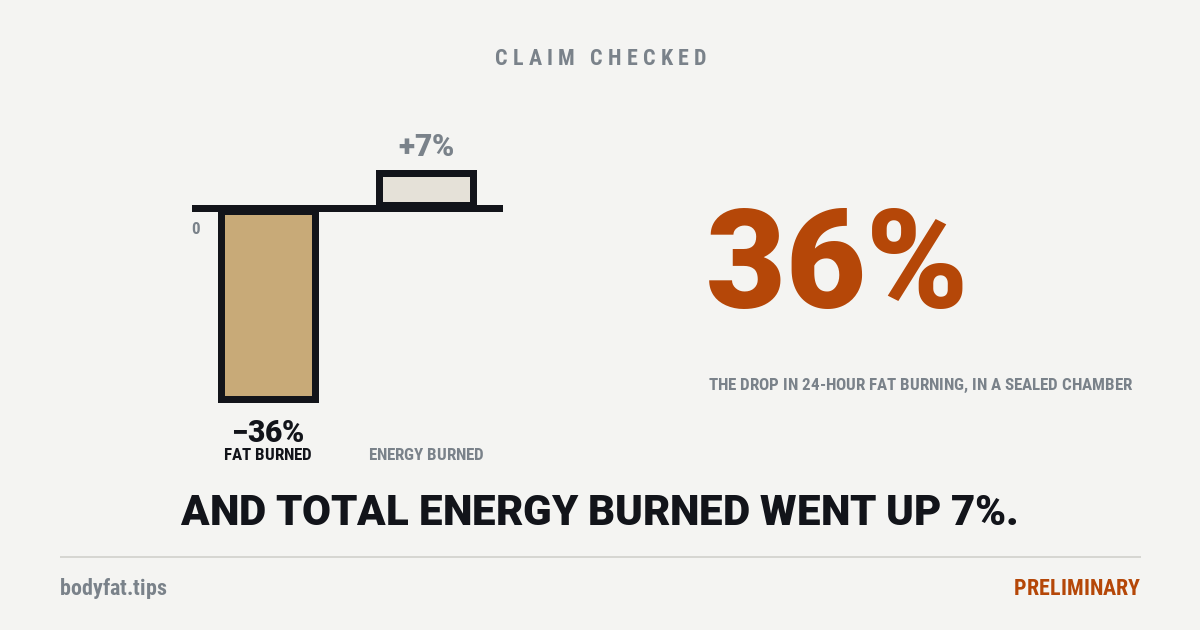
| 24-hour fat burning | −36% | −31% |
| Fat left unburned | 49 g/day | 44 g/day |
| Carbohydrate burning | no change | no change |
| Protein burning | no change | no change |
| Total energy burned | +7% | +4% |
Fat burning fell by about a third, both ways — whether the alcohol was piled on top of the diet or traded straight against it [1]. Carbohydrate and protein burning did not budge. And the effect showed up only during the daytime window when the men were actually drinking and clearing it.
Now read the bottom row again, because it runs backwards to what nearly everybody believes.
Alcohol did not slow their metabolism down. It sped it up. Seven percent more energy burned over a full 24 hours [1]. If you have been told that drinking wrecks your metabolism, the sealed room says the opposite happened.
And that is exactly the problem.
Why speeding up is the bad news
Your body cannot store alcohol. There is no ethanol equivalent of a fat cell or a glycogen store — nowhere to put it, nothing to do with it later. It is also mildly toxic, which your liver treats as a scheduling problem: clear this first, deal with everything else afterwards.
So alcohol goes to the front of the queue. Your metabolism speeds up because it is working — busily, measurably — on the ethanol. And for as long as that is happening, the fat you would otherwise have been burning waits its turn.
A third of it, for the hours the drinking lasts. That is the mechanism, and it is about as well measured as anything in nutrition.
It is not one lab’s result, either. A team in Cambridge ran the measurement again in its own sealed calorimetry room, in 1994 and in 1996, and a Danish team measured breathing after an alcohol-rich meal in 2003, with women among the volunteers in the last two. All three saw fat burning drop after alcohol [6] [7] [8].
The swap is where they part company. The 1994 study followed its volunteers for twenty hours after alcohol arrived with a meal: when the alcohol had replaced food, fat burning rose again later and fat balance evened out; only when it came on top of the meal did the extra fat stay stored [6]. The 1992 study, measuring the whole 24 hours, still found fat burning down by almost a third in its swap arm [1]. Both agree on the case that matters most: alcohol drunk on top of a normal diet leaves fat stored. The Lausanne team said so themselves. The extra energy their volunteers burned, they wrote, explains how drinking in place of food can lead to weight loss; the obesity risk is alcohol taken on top of what the body needs [1].
And then you order the fries
The chamber handled the metabolism. What it could not handle is the part where you look at a menu.
In 2004, twelve men came into a Liverpool lab on three separate days [2]. Same breakfast every time. Then, thirty minutes before lunch, a 330 ml lager: one day with no alcohol in it at all, one day with 8 grams of alcohol in it (a bit over half an American standard drink), one day with 32 grams (a bit over two). Then lunch, eat as much as you like. Then dinner four hours later, same deal.
Three things happened, and it is the third one that matters.
They ate more at lunch after the bigger drink than after the small one — about 205 calories more, and that is on top of the calories in the drink itself. They ate different things; the high-fat, salty items went first. And they rated themselves hungrier across the whole day [2].
Then dinner came, and the paper reports intake as similar on all three days [2].
Against the half-drink day, there was no correction. No smaller dinner, no quiet rebalancing later on. Counting the drinks themselves, the bigger dose came out about 337 calories ahead over the day, and by our arithmetic about half of that was the stronger drink’s own extra alcohol [2]. Against the day with the alcohol-free lager, the study’s own chart marks no significant difference [2].
And notice what the small dose did. Half a drink changed nothing — not appetite, not intake, not food choice [2]. The effect needed a threshold to cross before it appeared at all. Hold on to that, because it comes back.
Still, one twelve-man study is a shaky base for a number. A better one comes from pooling. A 2019 review pooled twelve controlled studies that gave adults an alcoholic drink or a non-alcoholic one and then measured what they ate. After the alcohol, people ate about 82 calories (343 kJ) more food and took in about 256 calories (1,072 kJ) more in all, the drink included. The studies were in younger adults, 18 to 37. The reviewers’ summary: adults “do not compensate appropriately for alcohol energy by eating less” [9].
So here is the arithmetic — and here is why we do not trust it
Let us do the sum you are already doing in your head, so that you can watch us take it apart rather than running it yourself later and believing it.
Take that pooled figure: about 256 calories more on a drinking occasion, drink included. Say Friday and Saturday most weeks — call it a hundred occasions a year. That is roughly 25,600 calories. Divide by the 3,500 calories everyone says sit in a pound of fat, and out comes about seven pounds a year.
Tidy. We do not believe it, and we have already published the reason.
The 3,500-calorie rule is a piece of 1958 arithmetic whose own author warned that your body does not just stand there and take it; the way everyone uses it, that warning got dropped. Your energy expenditure falls as you get lighter, and the real curve bends: in the model this site leans on, a steady change in what you eat does about half its work in the first year — which is the whole subject of a separate verdict here.
So what does 256 calories on a hundred nights actually do to a person? Something. Less than seven pounds. Probably a good deal less. And what it does depends almost entirely on whether the rest of the week quietly adjusts — which is precisely the thing a one-day lab study cannot see, and precisely the thing the population studies were built to catch.
Which brings us to the population studies, where the whole story falls over.
Thirty-one studies. No agreement.
In 2011 a group at the University of Navarra went looking for every study that had asked whether drinking makes people gain weight — surveys, long-running cohorts followed for years, and short experimental trials. Thirty-one publications survived their screen for relevance and quality [3].
Their conclusion, in their own words: the results “do not conclusively confirm a positive association between alcohol consumption and weight gain” [3].
The large cross-sectional studies were contradictory. The well-powered prospective cohorts, following people for years, were contradictory. The short experimental trials showed no clear trend [3].
Where a signal did turn up, it was in the studies looking at heavier drinking. And in a detail that irritates everybody: light-to-moderate intake, wine especially, tended to point the other way, while spirits were positively associated with gaining [3].
A 2022 pooling of 127 observational studies found no clear link between drinking and becoming overweight in the studies that followed people over time, and a modest one in the snapshot surveys; heavy drinking, more than 28 grams of alcohol a day (two American standard drinks), went with about a third higher odds of being overweight or obese, a finding the authors place in the surveys rather than the long-term studies [10]. A 2024 narrative review, one that summarises the studies rather than pooling them again, landed in substantially the same place — frequent drinking could contribute to a rise in fat mass over time, and the field still needs better studies to settle it [4].
Thirteen years, three reviews. Same verdict: unresolved.
So why can they not agree? Here is our read.
This next part is the desk’s own reasoning. One large survey, which we come to below, found the pattern it predicts, but a survey shows who weighs what, not why. Weigh it accordingly.
The mechanism operates per occasion. Fat burning drops for the hours the alcohol is in you. Appetite lifts above a threshold dose, within that meal.
The reviews on this page sort drinkers by volume — drinks per week, grams per day, a number on a questionnaire — not by occasion [3] [10].
Picture two people who both report fourteen drinks a week. One has two with dinner every night. The other has seven on Friday and seven on Saturday. They are the same row in the dataset. They are a completely different set of metabolic events: one of them crossed the appetite threshold twice and the other never crossed it at all.
Now average a few thousand of those people together, and ask why the answer keeps coming out mush.
Some studies do split the two, and one is worth knowing. A 2005 analysis of US national health surveys took 45,896 drinkers who had never smoked and separated how much they drank on a drinking day from how often they drank. The two pulled in opposite directions: more drinks per occasion went with a higher body mass index (weight scaled for height), more drinking days with a lower one. The people who drank the smallest amounts most often were the leanest; those who drank the most, least often, were the heaviest [11]. It is a snapshot in which people reported their own height and weight, so it shows who weighed what, not what caused it.
The 2011 review reaches for this itself, in its closing recommendations — studies should “take the effect of consumption patterns into account” [3]. We would put it harder than that. Volume may simply be close to the wrong variable, and a literature built on it may be averaging away the very thing it is trying to find.
If that is right, then the honest answer to “does drinking make you gain weight” is not yes and it is not no. It is: how do you drink?
Is the beer belly real?
It is a specific enough claim to test, and in 2013 somebody tested it: 35 observational studies and 12 experimental ones, pulled together to ask whether beer in particular parks fat on the abdomen [5].
The answer is a shrug with one hard edge in it.
In men, most of the observational data pointed either towards a positive association with waist size or towards no association at all. In women the results were simply inconsistent. For overall body weight it nearly reversed — mostly inverse or null in women, positive or null in men [5].
Then the edge. Across a subset of those studies, drinking more than 500 ml of beer a day was positively associated with abdominal obesity. Below that line, the review’s own word for the evidence is “inadequate” [5].
The experiments are the strangest part, because they disagree with each other inside the same paper. Six trials that gave men alcoholic beer versus low-alcohol beer for three weeks to four months found weight gain of 1.6 lb (0.73 kg), with a p-value below 0.0001 — strong, by the usual standards. Four trials comparing alcoholic beer against no alcohol at all found nothing. The reviewers noted that the experimental data were generally low quality [5]. One more thing to know before leaning on this review: it was paid for by a research institute that the Dutch brewers’ trade association funds, and two of its seven authors held posts at that institute [5] [12].
That is the entire field in miniature. Point at it one way and it is there. Point at it another way and it is gone.
“Will two beers a night make me fat?”
Google lists it among the questions people also ask about whether alcohol makes you gain weight, so it gets a real answer rather than a lecture.
Two American beers is 24 fluid ounces — about 710 ml. That is above the 500 ml line where the beer review found an association with abdominal fat [5]. Not dramatically above. But on the wrong side of it. It is also two American standard drinks, 28 grams of alcohol, the top of the band the 2022 pooling called moderate; anything more it counted as heavy, the level that went with higher odds of being overweight [10].
Two beers is also somewhere around 300 calories arriving most nights, with the evidence saying your next meal will not make room for them. Whether that turns into weight depends on whether the rest of your intake quietly adjusts over months, and the randomised trials we found that tested nightly drinking were short, or used wine, or both. Fourteen men who added two glasses of red wine to dinner every night for six weeks showed no difference in weight, body fat or calories eaten against six weeks without [13]. A two-year trial that gave 224 non-drinking adults with type 2 diabetes a glass of wine or of water with dinner found no material difference in body fat measures between the groups [14]. A four-week trial that randomised 69 healthy adults to daily red wine or to water went the other way: its authors report weight increases in the wine group, relative to the others, closely matching the energy the alcohol supplied, though the abstract, which is all we have read, gives no figure [17]. And in a three-month diet trial, getting a tenth of the day’s calories from white wine instead of grape juice did not slow weight loss: 10.4 lb (4.73 kg) lost on wine, 8.3 lb (3.75 kg) on juice, with no significant difference [18]. The beer review’s six weight-gain trials ran three weeks to four months and, as above, disagreed with the other four [5].
What we will not do is tell you two beers a night is fine because the studies disagree. The studies disagree about populations. You are not a population.
Will you lose weight if you stop?
Google lists it first among the questions people also ask about this (we checked in August 2026). The answer turns out to be hiding in the blood-pressure research.
There is a large literature on giving up alcohol and the liver, on giving up and blood pressure, on giving up and cancer risk. The bathroom scale turns up inside the blood-pressure trials. A research group in Perth, Australia, ran a series of them that switched regular male drinkers to low-alcohol beer to see what happened to their blood pressure, and weighed them along the way. In one, 86 overweight men averaging 440 ml of pure alcohol a week (about three and a half American standard drinks a day, by our arithmetic) were randomly assigned for 18 weeks. Cutting the alcohol, on its own account, took off 4.6 lb (2.1 kg) [15]. The beer review’s six pooled trials of the same kind, all in men and lasting three weeks to four months, are the 1.6 lb (0.73 kg) above, seen from the other side [5].
Everyone will tell you confidently that you will lose weight. Mostly they are doing arithmetic on the calories, and calling it a finding. The finding is the one above, and it is smaller and narrower than the arithmetic.
The arithmetic is not nothing, mind you. Stop two beers a night and you have removed roughly 300 calories a day that your body was not compensating for [2] [9], and released your fat burning from a one-third penalty for several hours every evening [1]. Both point the same direction.
But a measured 4.6 lb over 18 weeks, in men who were drinking fairly heavily, is not the pounds a year the arithmetic promises. The mechanism points one way, and the trials that weighed people point the same way, gently.
What we would actually do
Cut the big nights before the small ones. In the lab, half a drink before a meal changed nothing at all; a bit over two changed appetite and food choice, and raised the day’s total against the half-drink day [2]. The effect had a threshold. If that carries over — and it is one day in twelve men, so hold it loosely — the four-drink evening is doing far more of the work than the single glass, and trimming your heaviest occasions buys you more than shaving a little off every one. It is also what every drinking guideline already tells you, for reasons that have nothing to do with your waistline.
If you are a woman, adjust for one thing. The appetite study, the 1992 chamber study and the trials on this page that cut drinking were all in men. In the population data women look different: a 2022 pooling of 48 data sets found drinking went with a very slightly higher body mass index in men and a somewhat lower one in women [16], and the beer review found the same split for body weight [5]. That is a pattern in population studies, not evidence that drinking keeps women lean.
Count the drink as food, because your body will not. That is the single most transferable finding here. Dinner did not shrink to make room [2]. If you are tracking intake and you leave the drinks out, you are not tracking intake.
Watch what you eat while drinking, not just what you drink. The high-fat, salty items were the ones that went first [2]. The bar snacks may genuinely be doing more damage than the beer, and nobody ever counts them.
Do not run the seven-pounds-a-year sum. We ran it above so you would not have to. It rests on a rule from 1958 that does not survive contact with an actual body.
And if you want the one number here that is genuinely settled: alcohol carries 7.1 calories per gram, sitting between carbohydrate at 4 and fat at 9 [3]. An American standard drink holds 14 grams of it, so about 100 calories before anything is mixed in. That figure is not in dispute and never has been. Everything downstream of it is.
What this page is rated, and why
Preliminary. Not because the evidence is thin — there is plenty of it — but because it conflicts, and it conflicts at every level of design at once.
The mechanism has been measured in four small studies, over hours to two days. The appetite effect comes from short lab studies in younger adults. The trials that weighed people mostly ran for weeks or months, and mostly in men, and the beer experiments contradict each other inside a single review. The population data is thirty-one studies that will not line up, a 2022 pooling in which the long-term studies found no clear link, and a 2024 review still calling for better ones [4].
A page that told you “yes, alcohol makes you fat” would be overclaiming. A page that told you “no, the studies say it does not” would be worse, because the mechanism is right there in the sealed room and it is not subtle.
What is actually true is that we can watch alcohol stop your fat burning, we can watch it make you eat more, and the trials that have weighed people find changes of a pound or a few, or none: a few pounds off heavy-drinking men who cut down, nothing measurable when a glass or two of wine was added for six weeks or, in one trial, two years, though a four-week wine trial reported a gain about the size of the wine’s calories. That is a real state of knowledge, and pretending otherwise in either direction is how this subject got to be answered by rehab marketing pages in the first place.
This is journalism about research, not medical advice. If drinking is a problem for you, that is a conversation for a clinician, and it is a more important one than your body weight. How we read a study · Does alcohol cause cancer? · The other thing that moves your scale without moving your fat · What a good body fat percentage actually is
Corrected on 9 October 2026, after our verdict on the 3,500-calorie rule was corrected the same day. This page said the 1958 arithmetic behind the rule assumes your body just stands there and takes it. The 1958 paper itself warned that the calories you burn fall as your weight falls; it is the way the rule gets used that drops the warning. We also credited that verdict with showing that appetite argues back, which it does not cover, and described the curve as flattening hard, where its model has it bending over about a year. The paragraph now says so. Nothing else on this page changed, and the rating is unchanged.
Corrected again on 9 October 2026, after an independent editorial review of the whole page. We wrote that we could not find trials that cut people’s drinking and then weighed them. They exist, inside the blood-pressure research: in one, 86 overweight men in Perth who switched to low-alcohol beer for 18 weeks lost 4.6 lb (2.1 kg) more than men who kept drinking, and the beer review this page already cited pools six trials of that kind. The section on stopping now reports them, with their limits, and the closing paragraph no longer says the pounds have not been measured. We also wrote that nobody had run the trial of nightly drinking that would show whether the rest of your intake adjusts; short wine trials and a two-year one had, and found little or no change. And the evidence panel said we could not check how the beer review was funded. The publisher’s own article page says it was funded by a research institute that the Dutch brewers’ trade association pays for, and two of its authors held posts there; the panel and the beer section now say so.
Also corrected: the appetite study’s 205- and 337-calorie figures compared the bigger drink with the half-drink day, not the alcohol-free one, and the 337 included the drink; the page now says so, adds a 2019 pooling of twelve studies, and runs its arithmetic on that, which turns the ten-pounds-a-year sum into seven. The desk’s reasoning about drinking occasions no longer says it has no citation, because a 2005 survey of 45,896 drinkers found the pattern it predicts. The fat-burning result now has its three later replications, and the chart caption no longer presents the swap arm as proof of harm beyond the calories: it shows fat burning dropping with no extra calories, not extra weight; one replication found the swap evening out later in the day, and the 1992 authors themselves read it as compatible with weight loss. The thirty-one studies are no longer called population studies, since they include short trials; a 2022 pooling of 127 studies is added; two lines that called reader questions the most asked now say where Google lists them; the advice now says the experiments behind it were mostly in men; the evidence panel covers the added studies; and the page’s search markup now names the claim it rates. The rating is unchanged.
Corrected on 10 October 2026. A search this page was owed found two wine trials it had not reported. We summed up the wine trials as finding nothing measurable and named only the two that found nothing. A third, which gave 69 healthy adults daily red wine or water for four weeks, reported the wine drinkers’ weight rising by about the energy in the alcohol, though its abstract gives no figure. A fourth, in which dieters took a tenth of their calories as white wine instead of grape juice, found no difference in three months of weight loss. Both are now in the text, the summary and the evidence panel. The rating is unchanged.
- Does Alcohol Cause Cancer? Yes, and More Drinking Means More Risk
established - Is Saturated Fat Bad for You? Cutting It Probably Reduced Cardiovascular Events. Deaths Barely Moved.
supported - Tart Cherry Juice: The 84-Minute Sleep Result Came From Eight People. The Better Evidence Is for Something Else.
unsupported