How to Reverse Insulin Resistance: A 5% Weight Loss Improved It by About a Quarter. In Pooled Type 2 Diabetes Trials, Low-Carb’s Lead on Blood Sugar Had Halved by 12 Months.

“Get rid of Insulin Resistance Once And For All.” That is the title of a five-minute video posted on 4 February 2022 by a physician’s low-carb and fasting video channel. It had 3,302,867 views when we read its numbers on 10 October 2026 [1]. Two and a half years later the same channel posted “Reverse Insulin Resistance Once and For All”, now at 1,498,664 views [1]. The channel describes its work as helping “reverse medical problems through healthy Keto living”, and 43 of the 1,004 video titles we read name insulin resistance [1].
The descriptions under the two videos give one line each: “What you need to know to LOWER your insulin levels and lose fat”, and “If you’re insulin resistant, you have different rules to live by” [1]. The rest is links. We read the descriptions, not the videos, so what is said on camera is not what this page checks. It checks the promise in the titles, and the question people type into a search box: in the United States, “how to reverse insulin resistance” is searched about 12,100 times a month and “insulin resistance diet” about 33,100 times a month (from a paid keyword database, pulled 10 October 2026) [2].
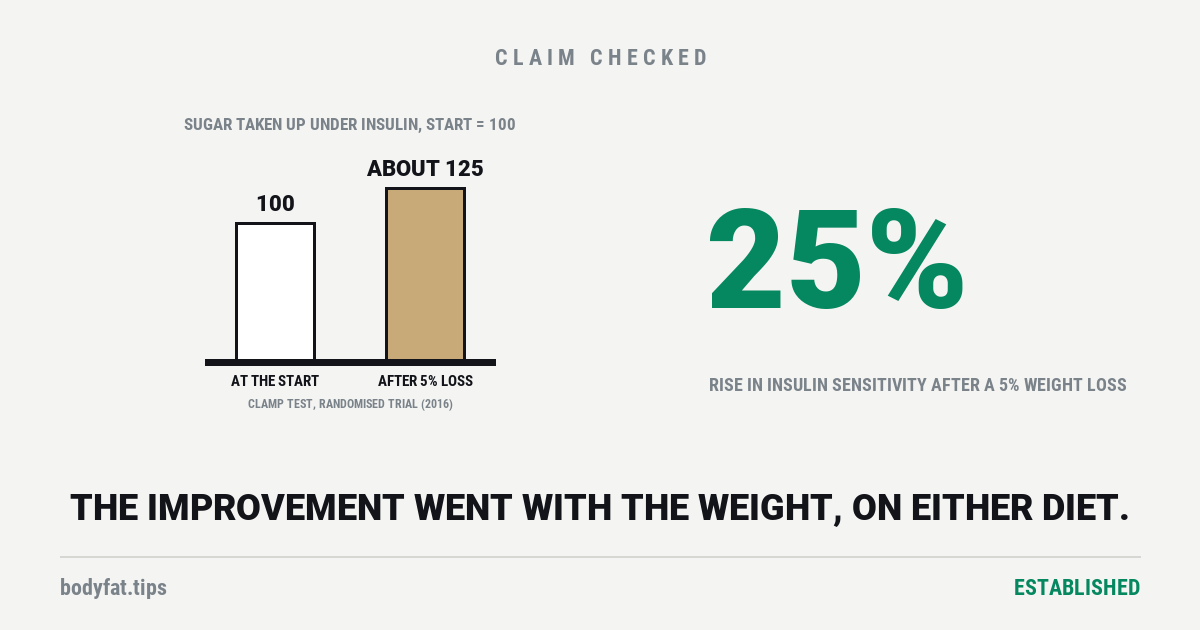
Losing weight lowers insulin resistance, and the diet that produced the loss made no clear difference in the two trials that held the loss equal. In a randomised trial using the most exacting test there is, losing 5% of body weight raised the amount of sugar the body took up under insulin by about 25% [3]. Two small trials took people to the same weight loss on a low-carb or a low-fat diet. Neither found a clear difference between the diets in the muscle’s response to insulin, and in one of them only the low-carb group’s improvement was clear on its own [4] [5]. No clear difference is not the same as proof that the two are equal.
Exercise lowers it too, in pooled trials of thousands of people. Whether it does so with no weight lost at all is less settled than the advice suggests.
“Once and for all” is the part the trials on this page do not show. In type 2 diabetes, low-carb diets pulled ahead of other diets on blood sugar over about six months; by twelve months that lead, pooled across 8 trials rather than the 17 at six months, had roughly halved, though triglycerides, a fat carried in the blood, stayed lower on low-carb, and on the standard insulin-resistance score the gap was not clear at either point [6]. Two trials on this page followed people after a low-carb diet, or a year of low-carb counselling, had ended, and in both, fasting insulin had not stayed down [7] [8]. When weight came back, so did diabetes, in the UK trial built to put type 2 diabetes into remission [9].
What is insulin resistance, and how is it measured?
Insulin is the hormone that moves sugar out of the blood and into the cells that burn or store it. Insulin resistance is the body needing more insulin than normal to do that job. The American Diabetes Association’s 2026 standards describe it as “decreased biological responses to insulin”, and note that most people with type 2 diabetes carry excess weight, “which alone causes some degree of insulin resistance” [10].
Researchers measure it three ways, and none of them is a test most people are ever given.
The clamp. Insulin is dripped into a vein at a fixed rate while sugar is dripped in beside it, adjusted every few minutes to hold blood sugar steady. The more sugar it takes to keep the level steady, the more sensitive the body is to insulin. It is the reference method [11], and it is a research procedure that takes hours [12].
HOMA-IR. A score worked out from one fasting blood sample: fasting blood sugar multiplied by fasting insulin, divided by a fixed number. Higher means more resistant [5]. It is the measure most of the diet poolings below report [6] [13].
Fasting insulin. The insulin level alone, from the same sample. More insulin needed to hold the same blood sugar suggests more resistance.
None of these is used to diagnose diabetes or prediabetes. The diabetes association’s standards diagnose prediabetes and diabetes with blood sugar and with HbA1c, the blood test that works as a roughly three-month average of blood sugar; among the reasons to test, they list conditions that go with insulin resistance, such as severe obesity, dark velvety skin patches called acanthosis nigricans, and a fatty liver [10]. In 2010 a workgroup convened by the same association wrote that measures of insulin sensitivity were done “only for research purposes”, and that there were no criteria by which a person could be classified as insulin sensitive or resistant [14]. “Signs of insulin resistance” is searched about 49,500 times a month (from a paid keyword database, pulled 10 October 2026) [2]; spotting it by eye is a different claim, and this page does not rate it.
Does losing weight reverse insulin resistance?
Losing weight improves it. Whether that counts as reversing it depends on which measure you read, and on whether the weight stays off.
In a 2016 trial at Washington University in St Louis, 40 adults with obesity but no diabetes were randomly assigned to keep their weight steady or to lose 5%, and nine of those who lost 5% went on to lose about 11% and then 16% [3]. Measured by the clamp, losing 5% raised the sugar taken up under insulin by about 25%, with gains in the liver and fat tissue too; in the nine who went on to 11 to 16%, the uptake had roughly doubled [3]. The groups were small and mostly women: 19 people finished the 5% loss, 16 of them women, and 14 the steady-weight group [3].
Which diet produced the loss made no clear difference to the muscle in the two trials on this page that tested it. In a Belfast trial, 24 adults were given every meal, weighed out, for eight weeks, on either a low-fat or a low-carb plan with the same 500-calorie daily shortfall; both groups lost similar weight. The clamp measure rose by about 20% on low-carb, a clear change, and by about 7% on low-fat, a change within what chance produces; the difference between the diets was within chance too [4]. The percentages are our arithmetic from the paper’s table, in which the low-fat group started higher [4]. That trial was part-funded by a UK sugar-industry body [4]. In a St Louis trial of 22 adults, low-carb pulled ahead in the liver within 48 hours, but once both groups had lost 7% of their weight, the muscle’s response to insulin had risen by about half, by a similar amount on either diet [5].
The liver moves first. In a Newcastle study, 11 adults with type 2 diabetes went on a 600-calorie-a-day diet of formula drinks and vegetables. Within one week their fasting blood sugar fell from about 166 to 106 mg/dL (9.2 to 5.9 mmol/L), and the liver’s response to insulin rose to the level of the comparison group without diabetes [12]. The muscle was slower. Measured as raw sugar uptake on the clamp, its response did not clearly change in eight weeks. Measured as clearance, which the authors used to allow for the different blood sugar levels on each test day, it showed no clear change at one week or at four, and by week eight it had reached the comparison group’s level, after the participants had lost 15% of their weight [12]. Our fatty liver verdict covers how fast liver fat falls.
There are exceptions. In a Canadian trial of 54 women, those who lost about 6.5% of their weight by dieting alone did not improve their insulin sensitivity measurably more than a control group; only the women who lost it by exercising did [15]. We read that trial as its summary.
The largest test on this page is the US Diabetes Prevention Program. It assigned 3,234 adults with raised blood sugar who did not yet have diabetes to a programme aiming at 7% weight loss and 150 minutes of activity a week, to the diabetes drug metformin, or to a dummy pill [16]. The programme group lost an average of 12.3 lb (5.6 kg) and developed diabetes 58% less often over about three years [16]. Its insulin sensitivity, estimated from fasting blood, improved the most at one year; metformin’s came second, and the dummy-pill group’s did not clearly change [17].
So weight loss improves insulin resistance. The diabetes association’s standards say how far: in type 2 diabetes, insulin resistance “may improve with weight reduction, physical activity, and/or pharmacologic treatment of hyperglycemia but is seldom restored to normal” [10].
Does exercise help insulin resistance, even without weight loss?
The same channel posted “Why Exercise Doesn’t Work for Insulin Resistance” on 3 February 2023, now at 30,995 views, under the line “Why do I tell my insulin resistant patients to NOT exercise?” [1]. Here is what the trials found.
A network meta-analysis — a method for ranking several options against each other across many trials at once — published on 5 October 2026 pooled 86 randomised trials and 4,358 adults with overweight or obesity. Aerobic exercise, weight training, the two combined and high-intensity intervals all lowered fasting insulin and HOMA-IR compared with usual care, at a certainty its authors graded low to moderate [18]. We read it as its summary.
A 2021 pooling for the European obesity association found HOMA-IR lower after exercise training across 37 exercise groups, by an effect size of 0.34, on the scale where 0.2 is small, 0.5 moderate and 0.8 large; in people with type 2 diabetes the effect size was 0.50 [19]. Fourteen small trials of 411 adults with type 2 diabetes, using the more exacting tests, found exercise improved insulin sensitivity by an effect size of about 0.6, and the gain was still there in the few trials that measured it more than three days after the last session [11].
Without weight loss, the trials disagree. The European pooling said plainly that it could not separate exercise’s effect from weight loss [19]. In a Canadian trial of 52 men, sugar uptake on the clamp rose in the men who lost weight by dieting or by exercise, significantly more than in controls and in men who exercised while eating enough to keep their weight [20]; in the women’s trial, those who exercised without losing weight did not improve measurably over controls either [15]. On the other side, in an Ohio trial, 18 adults with type 2 diabetes ate to hold their weight steady and were randomly assigned to a week of daily treadmill walking or to none; on the clamp, the walkers’ insulin sensitivity rose at a high insulin dose, not at a low one [21]. And 18 inactive adults who walked for six months, in three walking programmes, improved theirs without changing weight or waist, in a study with no group that did not walk [22]. We read the two Canadian trials as their summaries.
What exercise adds to a diet at the same weight loss is where small studies disagree. In a 2023 Washington University study, adults with obesity and prediabetes lost 10% of their weight either by dieting or by dieting and training; at the same weight loss, the improvement in insulin sensitivity was twice as large with exercise [23]. There were eight people in each group, and they were not randomly assigned, as the authors point out [23].
We read three randomised trials that set out to bring the groups to the same weight loss and measured insulin sensitivity without the clamp: from frequent blood samples after a dose of sugar, given as a drink or into a vein, or from HOMA-IR. They point both ways. In a St Louis trial, 69 overweight adults aged 45 to 65 were randomly assigned to diet, exercise or both, each meant to take off 6 to 8% of their weight; among the 52 who finished and lost weight, insulin sensitivity rose about twice as much with diet and exercise as with either alone [24]. Counted across everyone randomised, the gap between the groups fell just the wrong side of the line researchers use for “probably not chance” [24]. In a Louisiana trial, 12 overweight adults who dieted and 12 who dieted and exercised each lost 10% of their weight over six months; insulin sensitivity rose 40% with diet alone and 37% with diet and exercise, and the authors found the gains no different, though only the exercise group’s rise was clear on its own [25]. A 2010 report on the same trial gives that group’s rise as 66% and reads the trial as favouring exercise [26]. And in a Brazilian trial, 48 adults with obesity were randomly assigned to diet alone or diet and exercise until each had lost 5% of their weight; among the 35 who finished, HOMA-IR fell by similar amounts in both groups, and the authors concluded that exercise did not add to the effect of the weight loss [27]. We read that one as its summary.
Two reviews that pool trials like these point different ways. A 2026 review of 97 randomised trials that added exercise to a low-calorie diet found HOMA-IR improved more than on the diet alone, at a certainty its authors graded moderate to low; its summary does not say whether the people who exercised also lost more weight [28]. A 2023 review of 11 trials in people with type 2 diabetes found no clear difference in HOMA-IR, or in weight, between diet alone and diet with exercise [29]. We read both as their summaries.
So: exercise lowers insulin resistance in pooled trials, and may add to what weight loss does; at the same weight loss, the small trials and the two poolings disagree. That it works with no weight lost at all is a reasonable expectation with small, conflicting trials behind it. What training does to body fat is covered in our verdicts on lifting weights and visceral fat, and walking after meals has its own page.
Does a keto diet reverse insulin resistance better than other diets?
A 2021 review in the BMJ, pooling 23 randomised trials of low-carb diets in type 2 diabetes and 1,357 people, found real short-term advantages [6]. At six months, 57% of people on low-carb diets had an HbA1c below 6.5%, the diabetes line, against 31% on the comparison diets, most of them low-fat [6]. Counting only people who had also come off diabetes medicine, the advantage shrank to a difference within what chance produces [6]. HbA1c fell about half a point more on low-carb, at high certainty [6]. Our verdict on cutting carbs covers what those diets do to body fat.
Open the review’s chart of trials and the biggest one tells a quieter story. In an Australian trial, 36 of 46 people on low-carb and 30 of 47 on the comparison diet ended under the line, a gap within what chance produces; the large gaps in that chart come from trials of 12 to 33 people, by our reading of it [6] [30]. In that trial both groups ate the same calories and lost about 26 lb (12 kg); the low-carb group cut more diabetes medicine, and its HbA1c fell further only among people who started highest, by the summary [30].
On insulin resistance itself, the review’s table is less flattering than its summary. HOMA-IR was 0.14 lower on low-carb at six months, in six trials and 241 people, with a range running from 0.51 lower to 0.23 higher; at twelve months it was 0.13 lower, in two trials, with a range from 0.39 lower to 0.13 higher [6]. That range is where the true answer probably sits, and when it includes zero, “no difference at all” is still on the table. The authors graded the certainty of both very low [6]. Their summary still calls the result a large, clinically important improvement, because they set the smallest change that matters at 0.05 points [6].
A 2025 pooling of 38 trials in type 2 diabetes reported that every 10% cut in the share of calories from carbohydrate lowered HOMA-IR by 1.53 points, with a range running from 3.09 lower to 0.03 higher, at a certainty graded very low; in trials longer than six months the figure was 0.38, its range also reaching past zero [13]. Its conclusion says cutting carbohydrate “significantly improves” insulin resistance [13]. The range in its own table includes no difference.
When trials hold the weight loss equal, the clamp has not shown a clear advantage for low-carb in the muscle. Belfast and St Louis found no clear difference between the diets there [4] [5]. A 2024 Texas trial went further and held weight steady: 29 adults with type 2 diabetes ate a standard diet, a ketogenic diet, or a ketogenic diet with a ketone drink for ten days without losing weight, and insulin sensitivity in muscle, liver and fat did not measurably change in any of the three groups [31].
The evidence on the other side is real, and small. A 2024 Danish crossover trial, in which the same 11 people tried both diets in turn, found muscle insulin sensitivity higher after three weeks of keto than after a standard diet, though the keto weeks also took off 4.9 lb (2.2 kg); and in fat tissue the result went the other way: after keto, insulin did less to hold back the release of fat, the authors’ measure of how that tissue responds to insulin [32]. An Alabama trial of 34 adults aged 60 to 75 found insulin sensitivity rose more on a very-low-carb diet over eight weeks in which that group also lost far more fat, 9.7% of it against 2.0% [33]; it was part-funded by an egg-industry nutrition centre, and one author advises a keto telehealth company and a low-carb food company [33]. In St Louis, the liver’s response improved faster and further on low-carb [5]. Pooled across 11 trials in healthy adults on matched calories, fasting insulin came out slightly lower on lower-carb diets, by an effect size of 0.19, just under what researchers call small; those groups also lost a little more fat [34].
The closest head-to-head on this page is a 2022 Stanford trial. Forty adults with prediabetes or type 2 diabetes ate a ketogenic diet for 12 weeks and a Mediterranean diet without added sugar or refined grains for 12 weeks, in random order [7]. HbA1c fell on both, 9% on keto and 7% on the Mediterranean plan, a difference within chance; weight fell 8% and 7%; fasting insulin did not clearly differ between the diets; LDL cholesterol rose 10% on keto and fell 5% on the Mediterranean plan [7]. The diabetes association cites the trial in its 2026 standards [35]. What a meat-heavy version of low-carb does to LDL is in our carnivore diet verdict.
Not every pooling leans toward fewer carbs. A 2025 review of ten trials that changed fibre and carbohydrate together found that diets higher in both lowered HbA1c and fasting insulin a little more than diets lower in both; the lower-carb diets in those trials were moderate, 34 to 47% of calories, not keto [36].
So: on the evidence here, a keto diet improves insulin resistance when it takes weight off. Whether it does more than another diet at the same weight loss, or exactly as much, is an open question with small, short and conflicting trials on each side.
A warning before you try it. If you take insulin, or diabetes tablets of the kinds called sulfonylureas and meglitinides, cutting carbohydrate can push your blood sugar dangerously low. The diabetes association names low blood sugar as the major risk of those three medicines [37], and says insulin and other diabetes medicines may need adjusting on a very-low-carb diet [35]; the 2021 review warns that the lower HbA1c low-carb brings can mean low-blood-sugar episodes if doses are not adjusted [6]. And if you take one of the diabetes drugs called SGLT2 inhibitors, a different class of tablet from those above, the association says very-low-carb eating should be avoided, because of the risk of ketoacidosis, a dangerous build-up of acid in the blood [35]. Change what you eat only with the clinician who manages those medicines.
What happens at 12 months, and after people stop?
This is the claim’s own test. “Once and for all” is a promise about time.
| Study | What was compared | What happened later |
|---|---|---|
| Pooling of 23 randomised trials, type 2 diabetes, 2021 [6] | Low-carb diets against comparison diets, mostly low-fat | At 12 months: weight 0.6 lb (0.29 kg) heavier on low-carb, a gap within chance; the HbA1c lead halved (8 trials, against 17 at six months), with a range reaching zero; triglycerides still lower on low-carb; insulin-resistance score, no clear difference [6] |
| Australia, 115 adults with type 2 diabetes, 1 and 2 years [38] [39] | Low-carb against high-carb at the same calories, both with supervised exercise | Same weight loss and no clear difference in HbA1c at one year or two; at both, the low-carb group needed less diabetes medicine, had steadier blood sugar through the day and lower triglycerides, and its HDL cholesterol, the kind often called good, held up better, by the summaries [38] [39] |
| Pooling of six randomised trials lasting 1 to 2 years, 524 people, 2024 [40] | Low-carb against comparison diets | No clear difference in HbA1c or weight; HDL cholesterol higher and triglycerides lower on low-carb [40] |
| Stanford, 33 adults, 12 weeks after the trial diets ended, 2022 [7] | Ketogenic and Mediterranean diets in turn, then free choice | Weight still 7% down; fasting insulin back near where it started; most people ate closer to the Mediterranean plan [7] |
| Philadelphia, 132 adults with severe obesity, 3 years, 2006 [8] | A year of counselling to eat under 30 g of carbohydrate a day, against cutting calories and fat; then two years without it. At three years the low-carb group was getting 39% of its calories from carbohydrate, against 51% at the start | Fasting insulin higher than at the start on both diets, in the 53 with blood from every visit; weight about 9 lb (4 kg) lower, within chance [8] |
| UK, 298 adults with type 2 diabetes, 1, 2 and 5 years [41] [9] [42] | A formula diet, then food again, then support to keep weight off (not keto), against usual care | In remission, of the programme group: 46% at one year and 36% at two; of those in remission at two years, 26% still were at five [41] [9] [42] |
| US Diabetes Prevention Program, 3,234 adults, about 22 years [43] [44] | A weight-loss and activity programme, metformin, or a dummy pill | Diabetes 24% less often with the programme; by 15 years, 55% of the programme group had diabetes against 62% on the dummy pill [43] [44] |
| A keto telehealth company’s own study, 262 adults, 5 years, not randomised [45] | Ketogenic diet with remote coaching | 122 stayed five years; 24 were in remission, 20% of those who stayed and 9% of those who started, the second figure by our arithmetic [45] |
In the 2021 pooling, most of the six-month advantages had shrunk by twelve months: weight no longer differed, the HbA1c lead had roughly halved (the twelve-month figure pools 8 trials and the six-month one 17, so the two are not the same set), and remission without medicine came out at 13 per 100 on low-carb against 16 per 100 on the comparison diets, a gap within chance; triglycerides were still lower on low-carb [6]. The Australian trial ran to two years: both groups lost about the same weight, 15.0 lb (6.8 kg) against 14.6 lb (6.6 kg), and their HbA1c falls did not clearly differ [39]; they had not at a year either, nor at 24 weeks apart from people who started highest [30] [38]. What held on low-carb at two years was less diabetes medicine, steadier blood sugar through the day, lower triglycerides and HDL cholesterol that did not fall, by the summary [39]. In this trial there was no HbA1c lead to fade. A 2024 pooling of six trials that ran a year or more found no clear difference in HbA1c or weight, and HDL cholesterol higher and triglycerides lower on low-carb [40].
Some results favour low-carb over a year. In a San Francisco trial of 34 adults, HbA1c fell from 6.6% to 6.1% over 12 months on a very-low-carb diet and from 6.9% to 6.7% on a moderate-carb, calorie-reduced one, a clear difference in the change, and the low-carb group had lost more weight; HOMA2-IR, a newer version of the same score, barely moved in either group, and the two did not clearly differ [46]. In a 52-week Thai trial of 76 adults with metabolic syndrome, insulin resistance was lower on an Asian-style ketogenic diet than on a balanced low-calorie diet at week six, by the summary, which reports other gains later in the year [47]. Among the 609 people of a year-long Stanford diet trial, the few who ate close to keto and the few who ate close to ultra-low-fat lost similar weight and improved insulin resistance similarly, and kept both at a year [48].
What happens when people stop? In the Stanford keto trial, 12 weeks after both trial diets ended, weight was still 7% below where it started, but fasting insulin was back near its starting level: 2% lower on average, a difference far smaller than its own margin of error, by our reading of the reported spread [7]. By then most people were eating closer to the Mediterranean plan than to keto [7]. Everyone in that trial had eaten both diets in turn, so its follow-up cannot separate keto from the Mediterranean plan [7]. A longer, rougher test comes from a Philadelphia veterans’ hospital. There, 132 adults with severe obesity, most of them men, were counselled for a year either to eat under 30 g of carbohydrate a day or to cut calories and fat [8]. That was the instruction, not a measure of what people ate. The trial’s one-year report lists “suboptimal dietary adherence” among its limits [49], and at three years the low-carb group was getting 39% of its calories from carbohydrate, against 51% when it started: about 190 g a day, nearly four times the top of the 20 to 50 g the diabetes association gives for the ketogenic pattern in the Stanford trial, by our arithmetic from the trial’s table [8] [35]. Two years after the counselling ended, the 53 people with blood samples from every visit had higher fasting insulin than when they started, on low-carb as on the other diet, while their weight, by the paper’s table, was about 9 lb (4 kg) lower, a change within chance [8]. Only 53 of the 132 had blood samples from all three visits, and fasting insulin is a cruder measure than the clamp [8].
The trial built to reverse type 2 diabetes was not a keto trial. In the UK’s DiRECT, people replaced meals with formula drinks of about 850 calories a day for three to five months, then went back to food with support [41]. At one year 46% of the programme group were in remission, against 4% on usual care, and across both groups remission tracked the weight: none of 76 people who gained weight reached it, and 86% of the 36 who lost 33 lb (15 kg) or more did [41]. At two years 36% of the programme group were in remission, and those who relapsed in the second year had regained more weight than those who did not [9]. Of the people in remission at two years, 26% still were at five [42].
The longest keto study we read ran five years, and it was run by a keto telehealth company: of 262 people who started, 122 stayed, and 24 of them were in remission, which is 9% of those who started, by our arithmetic [45]. It had no randomised comparison group, and four of its nine authors list the company as their employer [45].
What are some good foods to eat if I have insulin resistance?
The weight does most of the work in the trials on this page, so the honest answer is the eating pattern you can keep. The diabetes association’s 2026 standards say there is no one-size-fits-all eating pattern for people with diabetes, and recommend building meals around non-starchy vegetables, whole fruits, legumes, lean proteins, whole grains, nuts and seeds, and low-fat dairy or non-dairy alternatives, with less red meat, sugary drinks, sweets, refined grains and processed food [35]. In the Stanford trial, the two diets shared three rules, vegetables in and added sugar and refined grains out, and HbA1c fell on both [7]. Fibre has the strongest case among the other variables [36].
Whole fruit, which the same channel has called evil in a video title [1], has its own verdict: in trials it has not measurably raised blood sugar or weight. The additive maltodextrin has one too.
Is metformin effective in treating insulin resistance?
It helps, and less than weight loss did in the trial that compared them. In the Diabetes Prevention Program, metformin cut new diabetes by 31% against the programme’s 58% [16], and its effect on insulin sensitivity came between the programme’s and the dummy pill’s [17]. When the pills were stopped for one to two weeks, about a quarter of metformin’s effect turned out to be the drug acting while it was taken; diabetes was still 25% less frequent after the pause [50]. Over about 22 years, metformin went with 17% less diabetes and the programme with 24% less [44].
The diabetes association says metformin “should be considered” to prevent type 2 diabetes in adults at high risk, especially those aged 25 to 59 with a BMI of 35 or more and higher blood sugar, and in women who had diabetes in pregnancy [51]. It also notes that no drug is approved by the US Food and Drug Administration specifically to prevent type 2 diabetes, and that drug effects wane after stopping [51]. It is a prescription medicine, and whether it suits anyone is a conversation with a clinician.
Two other drug classes come up. Pioglitazone, a drug that makes the body more sensitive to insulin, cut strokes and heart attacks in 3,876 people without diabetes who had insulin resistance and a recent stroke or mini-stroke, 9.0% against 11.8%, at the cost of more weight gain, swelling and fractures [52]; the association’s standards say the same trade-off has to be weighed [51]. GLP-1 drugs such as semaglutide take off a lot of weight, and a year after stopping semaglutide, people had regained about two-thirds of the weight they had lost, and most of the improvements in heart and metabolic measures had moved back toward where they started [53]. Our tirzepatide and semaglutide verdict covers both drugs and what happens when they stop, and statins and blood sugar have their own page. We rate none of these drugs here.
What are normal insulin levels?
There is no single range everyone uses. The 2010 workgroup found that approved insulin tests from different makers “produce a range of values for the same samples” [14]. Researchers have since proposed ranges population by population. A Brazilian laboratory database, in a study by authors at the diagnostics company that runs it, suggests 2.52 to 13.14 µU/mL for fasting insulin and 0.39 to 2.86 for HOMA-IR [54]. A German cohort put the top of the normal HOMA-IR range at 2.35 and found three insulin tests disagreeing, so that each needs its own range [55]. A Spanish study of 2,459 adults put the HOMA-IR line anywhere from 1.85 to 3.46, depending on the method and on sex [56]. The pioglitazone trial above used 3.0 [52].
So, by our reading, a lab report that prints a normal range for insulin is printing that lab’s own. The tests doctors use to diagnose are blood sugar and HbA1c [10].
How long does it take to reverse insulin resistance?
About 880 searches a month ask exactly that (from a paid keyword database, pulled 10 October 2026) [2], and the channel’s video “HOW LONG does it take to reverse insulin resistance?” has 1,171,807 views [1]. The measurements give a staged answer.
The liver: days. On a calorie-cut diet, the liver’s response to insulin improved within 48 hours in one trial [5] and reached the level of people without diabetes within a week in another [12].
Muscle, from exercise: days to weeks. Seven days of daily walking improved it, at a high insulin dose, in people with type 2 diabetes who held their weight [21], and in pooled trials the gain from training was still measurable more than three days after the last session [11].
Muscle, from weight loss: weeks to months. The muscle improved after a 5% loss [3] and after a 7% loss reached in about 11 weeks [5]; in the 600-calorie study it showed no clear change at one week or four and reached the comparison group’s level by eight, on the authors’ corrected measure [12].
Keeping it: for as long as the weight and the habits hold. Remission in DiRECT lapsed as weight returned [9], and in the Diabetes Prevention Program the benefit came mostly from the early years of the programme, with the gap narrowing afterwards [43] [44].
Can you reverse insulin resistance naturally in 30 days?
Some measures, yes; the whole thing, not on the evidence here. In the Newcastle study, fasting blood sugar and the liver’s response to insulin were in the range of the comparison group within the first week of a 600-calorie diet, while the muscle’s response showed no clear change at four weeks and reached that level only by eight, on the authors’ corrected measure [12]. That was a supervised formula diet, and under the study’s rules the participants came off their diabetes tablets before it began [12]. Do not stop or change yours on your own: on insulin or a sulfonylurea, eating that little can push blood sugar dangerously low, and the diabetes association names low blood sugar as the major risk of those medicines [37]. And since, as above, no agreed line marks insulin resistance as gone [14] [56], a 30-day promise has no finish line to be measured against.
Do supplements reverse insulin resistance?
“Insulin resistance supplements” and “supplements to reverse insulin resistance” are among the related searches [2]. We have rated several, each on its own page. Berberine, sold as nature’s version of the weight-loss drugs, came to 1.9 lb more weight lost in pooled trials. Apple cider vinegar has a real but modest effect on blood sugar after meals, and the review behind that page found no significant effect on fasting insulin or insulin resistance. Magnesium lowered fasting blood sugar in people with type 2 diabetes but did not significantly change HbA1c. Turmeric‘s case for insulin resistance is rated Preliminary, with poolings that disagree. Psyllium lowers blood sugar in proportion to how high it starts. None of them matches what the weight-loss trials above measured.
If weight loss improves it on low-carb and low-fat diets, why doesn’t the improvement last on its own?
This section is the desk’s own reasoning, and it is labelled as such. The trials agree that insulin resistance improves when weight comes off, on either of the diets tested [3] [4] [5]. Yet low-carb’s lead on blood sugar shrank in the long trials, remissions lapsed, and in the two trials that followed people after their diets ended, fasting insulin did not stay down [6] [42] [7] [8]. Three answers, each rated.
Answer one: the measure follows the weight. Insulin sensitivity improved step by step with more weight lost [3], and remission in DiRECT rose and fell with weight: none of the people who gained weight reached it, and those who relapsed had regained more [41] [9]. The remission half is measured. That insulin resistance itself returns with the weight is a surmise, because those trials did not measure it again after the regain. One small result does not fit neatly: in the Stanford follow-up, fasting insulin was back near its start while weight was still 7% down [7].
Answer two: the edge lasts as long as the diet does. In the 2021 pooling, very-low-carb diets did worse on weight at six months than milder low-carb diets, unless people stuck to them closely [6]; in the Stanford trial, people drifted back toward the Mediterranean plan once the trial let them choose [7]; and the year-long trials found no clear difference in HbA1c or weight [40]. This is a surmise with the subgroup and follow-up data on its side.
Answer three: “reversed” has no finish line. There is no agreed cut-off for insulin resistance [14] [56], the diabetes association says that in type 2 diabetes it is “seldom restored to normal” [10], and the keto telehealth company’s two-year study counted people still taking metformin as “reversed” [57]. “Reversed” has no defined end point, so that half of the promise cannot fail a test; “for all” can, by what happens after the diet stops, and the rating below rests on that. This is an observation about definitions, not a trial.
Put the three together and here is what we think is true, stated plainly so you can disagree with it: insulin resistance is not a switch you flip once; it is a reading that follows weight and movement, and it stays improved for as long as they do.
What we could not find, and would like to. We found no randomised trial that held a ketogenic diet and another diet at the same weight loss for a year or more, measured insulin resistance with the clamp, and followed people after the diet ended [58]. The clamp trials we found ran from ten days to about ten months, the longest in nine people who went on losing weight with no comparison group [3], and the diet trials of a year or two measured HbA1c, weight and, in a few, the fasting-blood insulin score [58] [40] [46]. The nearest thing coming is a Scandinavian, British and German trial, planned for 600 people, that puts a formula diet against a ketogenic one, with remission at 15 months as its main measure and estimated insulin resistance among the others; its main data collection finished in September 2026, and no results are posted [59]. A Washington University trial registered in 2019 puts this page’s open question to the clamp: people with obesity are randomly assigned to a ketogenic, a low-fat or a Mediterranean diet, with every meal provided, for four to eight weeks at steady weight, then tested once a year for five years while eating as they choose. About 300 people are planned, lean volunteers measured for comparison among them; its main data collection is estimated to finish in October 2029, and no results are posted [60]. If you know of a trial we missed, the corrections line on this site is open.
Who these studies were done on
The Diabetes Prevention Program enrolled American adults with raised blood sugar, 68% of them women and 45% from minority groups, with an average BMI of 34 [16]. The clamp trial of weight loss was in adults with obesity but no diabetes [3]; the 600-calorie study, 11 adults with type 2 diabetes, nine of them men [12]; the Stanford keto trial, 33 adults aged 41 to 77, mostly college-educated [7]; DiRECT, British adults aged 20 to 65 who had had diabetes for under six years and were not on insulin [41]. The pooled exercise trials were 68% women [18]. None of the diet trials on this page was in children or in pregnancy.
The diabetes association does not recommend very-low-carb eating in pregnancy or breastfeeding, for children, for people with kidney disease or for people with or at risk of disordered eating, and says it should be avoided by people taking the diabetes drugs called SGLT2 inhibitors, because of the risk of ketoacidosis, a dangerous build-up of acid in the blood [35]. Fasting, the channel’s other tool, has its own verdict, and how much protein to eat while losing weight has one too.
Where “reverse insulin resistance once and for all” came from
The word came from a liver study. In 2011 a Newcastle University team titled a paper “Reversal of type 2 diabetes”: 11 people, eight weeks of 600 calories a day, the liver back to normal within a week, the muscle by eight weeks on one of the authors’ two measures [12]. Its hypothesis was that both the pancreas’s failing insulin output and insulin resistance could be reversed by eating less [12].
The framing came with a business model. In 2019 a keto telehealth company published a two-year study of its own programme, without random assignment: it reported diabetes “reversal” in 53.5% of participants and “remission” in 17.6%, and its “reversal” counted people still taking metformin [57]. The company sponsored the study, and seven of its authors were its employees with stock options [57]. One of the company’s founders co-wrote the 12-month trial above [46].
Then the spread. “Get rid of Insulin Resistance Once And For All” in 2022 and “Reverse Insulin Resistance Once and For All” in 2024, together past 4.8 million views; the same channel has also posted “Why didn’t keto reverse my insulin resistance?” and “Why it’s almost impossible to reverse Insulin Resistance” [1]. Search the phrase in October 2026 and the AI answer above the results opens “Insulin resistance can be reversed primarily through targeted lifestyle modifications”, citing a medical school, a cancer centre, two hospital systems, the CDC, a health website’s blog and two videos [2].
The product sits under the videos. The descriptions link the channel’s keto courses and books, ketone powders and capsules, and an at-home A1C test kit [1]. The test kit is the product closest to the claim, and it measures blood sugar, not insulin resistance: in the San Francisco trial, HbA1c fell further on very-low-carb while the insulin-resistance score did not clearly differ between the diets [46].
None of this is aimed at anyone trying keto to bring their blood sugar down. That is a reasonable thing to try, with a clinician if you take diabetes medicine, and in the trials it improved insulin resistance as the weight came off. It is “once and for all” that the evidence does not carry.
What this is rated, and what the rating covers
Established — for the claim that losing weight lowers insulin resistance.
It is rated Established because the measurements agree across designs. In a randomised trial using the clamp, insulin sensitivity rose with weight lost, and kept rising with more [3]; in trials that brought people to the same loss on a low-carb or a low-fat diet, the muscle’s response improved, with no clear difference between the diets [4] [5]; in the Diabetes Prevention Program’s 3,234 people, the weight-loss and activity programme improved insulin sensitivity the most [17]; and the diabetes association’s standards say the same [10]. The exceptions are on this page: in one trial, women who lost weight by dieting alone did not clearly improve over controls [15], and in the Louisiana trial the 40% rise in the 12 who lost 10% by dieting alone was not clear on its own [25]. And in the 600-calorie study the muscle was slow: its improvement showed by eight weeks on the authors’ corrected measure, not on the raw one [12]. The rating is for improvement; it is not a promise of normal, which the same standards say is seldom reached in type 2 diabetes [10]. It does not say which diet does it better; that is rated below.
Rated alone, in words. That regular exercise lowers insulin resistance: Supported; pooled trials agree, at certainty graded low to moderate [18] [19] [11]. That exercise does so with no weight lost at all: Preliminary; small trials found it and small trials did not [21] [22] [20] [15]. That adding exercise to a diet lowers insulin resistance more than the diet alone at the same weight loss: Preliminary; small trials found it and small trials did not, and of two poolings, the larger found a benefit without its summary saying whether the weight loss matched [23] [24] [25] [27] [28] [29]. That a low-carb diet lowers HbA1c more than other diets over about six months in type 2 diabetes: Supported, at high certainty for six months; by twelve, in 8 trials rather than 17, the gap halves and its range reaches zero [6].
Which diet does more at the same weight loss is one open question, and both of its answers are rated here. That a keto diet lowers insulin resistance more than other diets at the same weight loss: Preliminary; a few small, short trials found an edge in muscle or liver, and others found none [32] [5] [4] [31]. That the diet makes no difference, so that low-carb and low-fat lower it alike: Preliminary too; two trials of 24 and 22 people over 8 to 11 weeks found no clear difference between the diets, which is not a finding that they are equal, and in one of them only the low-carb group’s improvement was clear on its own [4] [5]. That a keto diet reverses insulin resistance once and for all: Unsupported, of the tested kind, and tested roughly. “For all” is tested by what happens after the diet stops. In the two follow-ups on this page, fasting insulin was back near or above its start once the diet or the counselling ended: 12 weeks after a keto trial ended it was back near its start while weight and HbA1c were still down [7], and two years after a year of very-low-carb counselling ended it was higher than at the start [8]. Neither used the clamp. One cannot separate keto from the Mediterranean plan, because everyone ate both in turn; in the other, the trial’s own one-year report called adherence suboptimal, and by three years the low-carb group was eating far more carbohydrate than keto allows [49] [8]. The nearest result the other way is on this page too: in a year-long Stanford diet trial, the few who ate close to keto at three months had drifted back toward their old eating by twelve, still inside the trial, and kept their improvement along with their lost weight, as the few on ultra-low-fat did [48]. The improvement went with the weight, on either diet. The trials of one to two years tested something else, the edge over other diets while people stayed on them: low-carb’s lead on HbA1c and weight shrank or disappeared, while it still came out ahead on triglycerides in the 2021 and 2024 poolings, and on diabetes medicine in the Australian trial [6] [40] [39].
What is not rated here: spotting insulin resistance by sight; metformin, pioglitazone and the GLP-1 drugs, which are linked to their evidence rather than rated; the supplements, which have their own pages; and the frame above, which is this desk’s reasoning from the evidence rather than a result the evidence delivered. It is marked as ours so that you can weigh it as ours.
This is journalism, not medical advice. If you take medicine for diabetes, take any change in what you eat to the clinician who manages your treatment first. Cutting carbohydrate while taking insulin or a sulfonylurea can push blood sugar too low, which is why the diabetes association says those doses may need adjusting, and why the Stanford trial stopped sulfonylureas before its keto phase [37] [35] [7]. How we read a study, and what each tier means, is set out here.
- Is Breakfast the Most Important Meal of the Day? Not for Your Weight. People Assigned to Eat It Lost No More Than People Assigned to Skip It.
supported - Can Plaque in Arteries Be Reversed? Diets Slowed It in Small Trials. Drugs That Push LDL Very Low Shrank It About One Percentage Point of Artery Volume.
preliminary - Can Fatty Liver Be Reversed? The Fat, Yes, Within Weeks. In a Year-Long Study, the Scarring Moved Both Ways.
established