Does Walking Help You Lose Weight? Yes — 10,000 Steps Came From a Campaign

Yes. About 4.7 lb of it, across 22 randomised trials of brisk walking in adults with obesity [1].
That is a real number and a modest one, and if you came here hoping for something dramatic, the honest answer is that walking is not dramatic. It is just one of the very few things almost everybody will actually keep doing.
But there is a second number in that analysis that is better than the first one. None of the ten first-page web results we read for “does walking help you lose weight” on 7 October 2026 gives it, though four make the point behind it: walking helps you keep muscle while you lose fat.
The trials lost more fat than weight
Here are the pooled results from those trials, converted into the units you actually think in. Each line was pooled on its own, from the trials that measured that particular thing, and the number of participants behind them differs line by line — so read them as three separate estimates, not as one group’s ledger [1][5]:
Body weight: down 4.7 lb (2.13 kg).
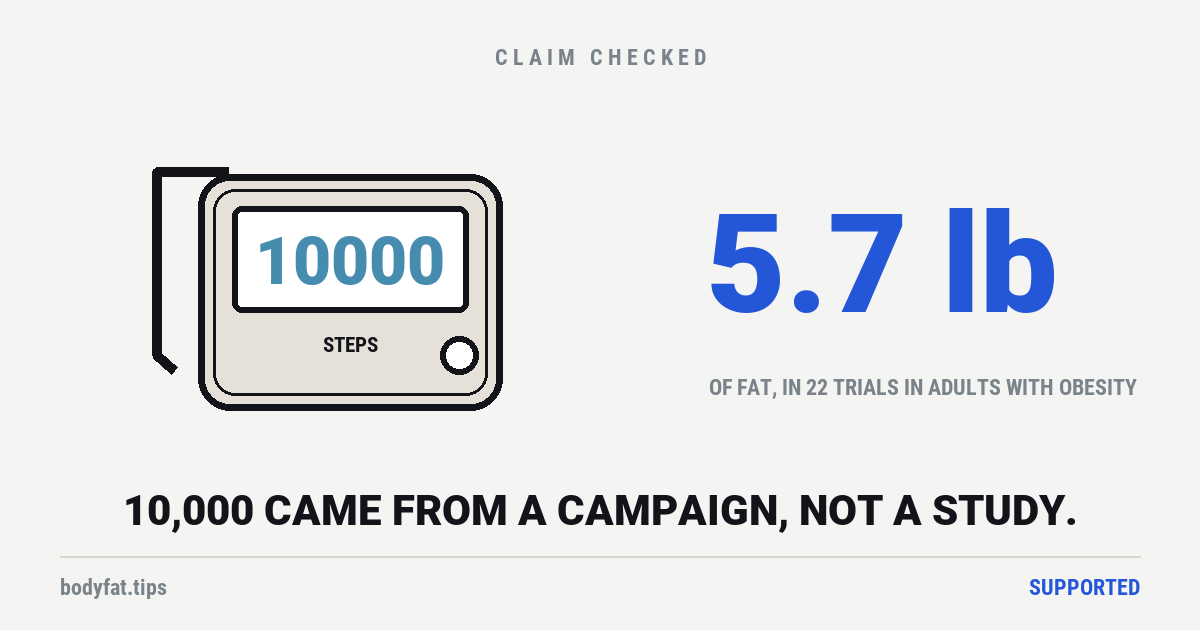
Fat mass: down 5.7 lb (2.59 kg).
Fat-free mass: UP 0.6 lb (0.29 kg).
Waist: down 1.1 inches (2.83 cm). Body fat: down 1.38 percentage points.
Read the first two lines again. More fat came off than weight.
That is not a typo and it is not a rounding error. Fat-free mass — which is everything you are made of that isn’t fat: muscle, bone, organs, water — went up while fat came off. Walking, of all things, may have been quietly building something. And may is the honest word: that 0.6 lb is printed in the abstract with no margin of error beside it, and the full paper sits behind a paywall that eight different routes could not get past, so whether the gain counted as more than chance is something we cannot tell you [1].
So the scale did what a scale does. It reported one number for two things moving in opposite directions. Do not try to subtract the lines into a tidy sum — they come from different sets of participants and they do not close that way [5]. What they say together is the part that matters: fat came off while fat-free mass edged up, which is the exact situation a bathroom scale reports worst.
How fast, honestly?
Slowly. The second meta-analysis is the one to sober you up.
Nine studies, 307 people, pedometer programmes with no dietary intervention — nobody was put on a diet, though the authors are careful to say they could not rule out people cutting back on their own [2] — running anywhere from four weeks to a full year. Median length sixteen weeks. Pooled result: down 2.8 lb (1.27 kg), with the range of plausible answers running from about 1.5 lb to 4 lb [2].
Which works out to roughly a tenth of a pound a week.
The researchers also found that longer programmes lost more than shorter ones [2], all the way out to a year — which is at least not the picture of an early plateau. Whether it keeps going after that, the authors say plainly that nobody knows: we know “very little about the long-term sustainability of weight loss from pedometer-based walking programs” [2]. Nine studies of four weeks to a year cannot tell you what year three looks like.
Note the gap between the two analyses, though — 4.7 lb in the brisk walking trials, 2.8 lb in the pedometer ones. Before you read that as pace beats counting, look at what each number is. The brisk-walking figure is a comparison against people who did not walk at all [5]. The pedometer figure is a before-and-after in the walkers themselves, with no control group to subtract [2]. A controlled difference coming out bigger than an uncontrolled one is what you would expect whatever the pace, and nobody has run the two approaches against each other.
Does it work the same for everyone? No.
The 22-trial analysis went looking for exactly this and found one real split [1].
For men and women with obesity under 50, brisk walking produced clinically meaningful drops in weight, BMI, waist and fat mass.
For women over 50, the weight change was more modest — and here is the good part, because the reason the paper gives is that gains in fat-free mass offset the loss on the scale [1]. The measurement problem again, landing hardest on the group most likely to be told they are failing.
For men over 50, the researchers said plainly that more research is needed [1]. So do we.
And the 10,000 steps? That came from a campaign, not a study.
Here is the part we had backwards. In 1963, doctors and journalists in Japan were pushing a line — walk ten thousand steps a day — and wanted it to become a national movement. The figure was not picked because it sounded round: at a stride of about 28 inches (70 cm) it comes to roughly 4.3 miles (7 km), and the point was that people ought to be walking at least that far. To give the movement something to count with, the founder of a Tokyo instrument company — Yamasa Tokei Keiki, started in 1942 making aircraft instrument parts, of all things — was asked to build a pedometer [4].
Two years of development later, in 1965 — the year after the Tokyo Olympics — it went on sale as Japan’s first consumer pedometer. And the company is blunt about what it was actually called: the name at the time was the Manpo-meter, it says, and not the Manpo-kei. It was a mechanical dial, one sweep of the needle came to exactly ten thousand steps, and they named it after the campaign [4].
The Manpo-kei trademark came later: registered in 1984, registration number 1728037, nineteen years after the device shipped [4]. Which means the lineage runs the opposite way from the way it is usually told, including by us until today. The number did not fall out of a product name. The product was named after the number, and the number came out of a walking campaign. Either way, the most famous figure in personal fitness — printed on watches, built into phones, used to run corporate wellness competitions — was never the output of a study.
What does the evidence say the number should be? One large cohort followed 16,741 women, average age 72, and found the benefit climbing until roughly 7,500 steps a day, after which the curve flattened out. Even 4,400 steps beat 2,700 by a wide margin [3].
One caveat, and it matters: that study measured death, not weight. It is a mortality curve, not a fat-loss curve, and treating it as one would be precisely the sleight of hand we spend most of our time here unpicking. What it tells you is that the number came first and the measuring came later. That paper opens by saying the goal is “commonly believed by the public to be necessary for health” but has “limited scientific basis” [3]. And where the curve actually flattens depends on how old you are: pool fifteen cohorts and 47,471 adults and it levels off at 6,000 to 8,000 steps a day for the over-60s, but not until 8,000 to 10,000 for people under 60 [6].
What to actually do
Walk, and expect about half a pound a month rather than a transformation. That is the pedometer programmes’ own measured rate — a tenth of a pound a week, which the authors put at about a pound every ten weeks and five pounds over a year [2]. The brisk-walking trials averaged more, 4.7 lb, but they ran anywhere from ten weeks to twelve months [5] and neither analysis publishes a monthly rate, so we are not going to invent one for you.
Walk briskly if you can. The bigger figure is the brisk-walking one — but it was measured against people who were not walking, so we cannot tell you the pace is what did it [1][2].
Measure your waist, not just your weight. The trials moved waistlines by over an inch, and given that fat-free mass was going up at the same time, the tape is telling you more than the scale is.
And stop treating 10,000 as a finding. It is a trademark registered in 1984, on a 1965 device named after a slogan [4]. Where the health curve actually flattens depends on your age — 6,000 to 8,000 steps a day for the over-60s, 8,000 to 10,000 under 60 [6] — and that is a mortality curve, not a weight one.
A different question, answered separately. This page is about whether walking makes you lighter. If what you actually want to know is how many steps to take and what they buy you — the mortality, dementia and depression numbers — that is our verdict on how many steps a day. It is a health question, not a weight question, and the answer lands around 7,000.
An independent editorial review on 18 September 2026 found that the history in this page’s headline ran the wrong way round. We had the 10,000 arriving as a product name: a Tokyo instrument company releasing Japan’s first pedometer in 1965 and trademarking it “Manpo-kei”. The company’s own history says otherwise, and it was the source we had cited. Doctors and journalists were already promoting a walk-10,000-steps-a-day movement in 1963; the founder was asked to build something to count it with; the 1965 device was called the Manpo-meter and, in the company’s own words, was not the Manpo-kei; and the “Manpo-kei” trademark was not registered until 1984. The number came first and the product was named after it. The headline, the provenance chain and the closing advice have been rewritten, and source [4] now carries the two company pages so you can check it without taking our word for it.
Five other readings were corrected in the same pass. “The largest study to put a figure on it” was not the largest — 16,741 women against a 15-cohort pool of 47,471 adults and a UK Biobank analysis of 78,500 — and that pool puts the flattening of the curve at 6,000 to 8,000 steps a day for the over-60s but 8,000 to 10,000 under 60, so “10,000 was never the threshold for anything” is now scoped to what was actually measured. “Prescribing a pace beats counting steps” set a controlled result against an uncontrolled one and is gone; nobody has run the two head to head. “There is no plateau in this data” was the reverse of the pedometer authors’ own position, which is that the long-term sustainability of the loss is barely studied. The three body-composition figures come from different numbers of participants, so they were never one group’s ledger subtracting down to the number on the scale. And “expect a pound a month” was about double the rate the page derives; the pedometer programmes measured roughly half a pound a month. The headline answer and the evidence panel are now fenced to the population the trials used, adults with obesity aged 18 to 65, and the panel no longer describes the two analyses as independent, because the brisk-walking review’s list of included studies is behind a paywall we could not get past. The rating is unchanged.
Corrected on 30 September 2026. The evidence panel’s funding row said a co-author of the step-count study “sits on” the scientific advisory board of the company whose step counters the study used. That is what the co-author declared in the paper in 2019; we have not checked whether it is still so, and the row now says it was declared then. Nothing else on the page changed.
Corrected on 9 October 2026. We said the 2021 overview of exercise reviews carried no funding statement and no conflict declaration. It thanks the European Association for the Study of Obesity, a scientific society, for support in conducting the work, and its conflict-of-interest section reads “No conflict of interest statement.” The source entry and the evidence panel now say so, and the panel refers to one author with a pronoun no source gave us only as “they”. The rating is unchanged.