Can Plaque in Arteries Be Reversed? Diets Slowed It in Small Trials. Drugs That Push LDL Very Low Shrank It About One Percentage Point of Artery Volume.

“Use these foods to structure the best evidence-based meal to reverse and stabilize arterial plaque and atherosclerosis.” That is the first line of the description under “#1 Best Meal to UNCLOG Your Arteries (Backed by Science)”, posted on 24 November 2025 by a physician’s health-video channel. It had 6,472,781 views when we read its numbers on 10 October 2026, the channel’s second most-watched video [1]. Its chapters name the meal’s parts: lycopene, plant sterols, foods rich in catechins, extra-virgin olive oil and seafood, then “Best exercise to reverse plaque” and “Best supplement” [1].
The first study in its reference list is a Spanish trial called CORDIOPREV. Its title says a Mediterranean diet “reduces atherosclerosis progression” [2]. Progression is the word for getting worse. Reverse is the word for getting better. The gap between them is what this page is about.
Plenty of people are asking. In the United States, “how to reduce plaque in arteries” and “how to unclog arteries” are each searched about 2,900 times a month, “can plaque in arteries be reversed” about 880 times, “can you reverse plaque in arteries” about 720, “foods that unclog arteries” about 590 and “reverse atherosclerosis” about 390 times a month (from a paid keyword database, pulled 10 October 2026) [3]. In Google’s results for the first of those, the video is the sixth ordinary result, and Google’s AI answer cites it [3].
So we read the trials. Here is the short version; the rest of the page is the working.
A diet slowed the clogging in some trials. On average, it did not clear it. In a 1998 trial of an intensive diet-and-lifestyle programme, the narrowest point of the heart’s arteries neither opened nor closed by a measurable amount over five years, on average, while the comparison group’s narrowed [4]. In a 1992 trial, the arteries’ average width held steady on a diet and narrowed on usual care [5]. No trial we found gave people a single meal and measured their plaque; rated on its own, the meal claim is Unsupported, of the untested kind.
The video’s first reference found a slightly thinner neck artery. After seven years on a Mediterranean diet, the wall of the main neck arteries was 0.031 mm thinner than at the start, about 4% by our arithmetic; on a low-fat diet, the paper says, it did not change [2]. The trial calls that reduced progression.
The shrinking that has been measured came mostly from drugs, and it was small. Trials that drove LDL cholesterol to about 60 mg/dL or lower, and measured plaque from inside the heart’s arteries, found the share of the artery taken up by plaque fell by about one percentage point over one to two years [6] [7] [8]. The drugs’ makers paid for those trials.
What would “unclogging” an artery mean?
Plaque is the fatty, scar-like build-up inside an artery’s wall, and atherosclerosis is the disease of its building up. The coronary arteries feed the heart muscle; the carotid arteries run up the neck to the brain. Unclogging would mean one of two things: less plaque, or a wider channel for the blood. The trials below measured four different things, and it matters which.
Neck-artery wall thickness. An ultrasound of the neck measures the intima-media thickness, the thickness of the inner two layers of the carotid artery’s wall, in fractions of a millimetre. It is a marker of the disease and of the risk of a heart attack or stroke, not a measurement of one plaque [2].
Narrowing on an angiogram. In angiography, dye is run into the heart’s arteries and X-rayed. Researchers read off the percent diameter stenosis, how much narrower the tightest point is than a nearby healthier stretch, and the width of the narrowest point itself, in millimetres [4].
Plaque volume from inside the artery. In intravascular ultrasound, a probe on a thin tube is pulled back through a heart artery and maps the plaque in its wall. The drug trials report percent atheroma volume: the share of the artery’s volume, inside its outer wall, that is plaque [8]. Before treatment, plaque took up about 37% of it, on average, in the 2,737 people of a 2026 pooling of four such trials [9].
Plaque on a CT scan. CT angiography is a scan with dye that measures plaque from outside the body and sorts it by how dense it looks; the softest, least dense kind is called non-calcified plaque [10].
What did the video’s first reference find?
CORDIOPREV gave 1,002 people in southern Spain who already had heart disease one of two diets: a Mediterranean diet rich in extra-virgin olive oil, or a low-fat diet rich in complex carbohydrates, with no calorie target and no exercise programme [2]. Of them, 939 had a neck-artery ultrasound at the start, 809 at five years and 731 at seven [2].
On the Mediterranean diet, the neck arteries’ wall was 0.027 mm thinner at five years and 0.031 mm thinner at seven than at the start, from an average of 0.74 mm; on the low-fat diet it did not change [2]. In people with a plaque in those arteries, the tallest one was about 0.1 mm lower after seven years on the Mediterranean diet and about 0.1 mm higher on the low-fat diet, a gap between the groups the trial counts as significant; the number of plaques did not differ [2].
Two things the summary leaves out. The paper tests the gap between the groups, not whether the Mediterranean group’s plaques shrank from where they started; by our arithmetic from the figures it prints, that fall, 0.10 mm give or take 0.07, could be chance [2]. And the artery measurements were a secondary outcome, one of the extra things a trial measures beside its main question, which here was heart attacks and strokes. The authors write that, as in any substudy, the results “should be treated with caution” [2].
These were people already being treated: 86% were taking a statin, and 82% were men, with an average age of 60 [2]. The trial was funded by a foundation that works for Spain’s olive-oil sector, with Spanish and European public grants [2]. The site’s olive-oil verdict covers the same trial’s main result, on heart attacks and strokes.
A 2025 analysis of the same trial, mostly about white blood cells, put the Mediterranean diet’s difference in wall thickness at 0.028 mm against the low-fat diet. It counted a patient as showing “regression” if the wall was thinner after seven years, or simply no thicker [11]. In these papers, regression means any shrinking at all, however small, and in this one, no growth. That is not what most people hear in “reverse”.
Can you reverse plaque buildup in arteries? The trial everyone cites
The word “reversal” entered this argument with the Lifestyle Heart Trial, run in San Francisco and published in its five-year form in 1998 under the title “Intensive lifestyle changes for reversal of coronary heart disease” [4].
It was not a diet alone. The programme was a vegetarian diet with about 10% of calories from fat, aerobic exercise, stress-management training, help to stop smoking and group support [4]. Patients were assigned to a group by chance first and invited second, and about half in each group agreed to take part: 28 of 53 and 20 of 40 [4]. Thirty-five came back for an angiogram at five years, 20 in the programme and 15 in the comparison group, and all 20 in the programme were men [4].
The result the trial is known for: the average narrowing of the arteries studied fell by 3.1 percentage points in the programme group, from about 39%, and rose by 11.8 points in the comparison group [4]. The range the true answer probably sits in, for the programme group’s change, ran from 0.2 to 5.9 points down [4].
Now the measurement a viewer would picture. The width of the narrowest point changed by 0.001 mm in the programme group over five years, and fell by 0.34 mm in the comparison group [4]. The paper says so plainly: the minimum diameter “remained stable” in the programme group and “markedly narrowed” in the comparison group [4]. On average it neither opened nor closed by a measurable amount: the trial’s range for the change runs from 0.11 mm narrower to 0.11 mm wider [4].
So where did the 3.1 points come from? Narrowing is worked out against a healthier stretch of artery nearby, and in the programme group that reference stretch got 0.13 mm narrower, a change the trial could not clearly tell from chance within the group [4]. By our arithmetic from the trial’s group averages, a reference stretch 0.13 mm narrower beside an unchanged narrowest point would by itself produce a fall of about 3 points, close to the 3.1 the trial reported. That is a calculation on averages, not the trial’s method, and it cannot settle where the fall came from. The trial worked out the narrowing lesion by lesion and then averaged it, and the same sum on its starting averages gives 38.1% where the trial printed 38.9%. And the trial’s ranges for both changes are wider than the fall itself: the narrowest point’s range alone spans about 4 points of narrowing either way. So the averages fit a fall that came from the reference stretch; they do not show it. The authors read the reference change differently again: a slightly narrower healthy stretch, they suggest, may smooth the flow of blood into the tight spot [4].
The comparison group got worse, and that is the trial’s strongest result. Their narrowing rose by 11.8 points even though 9 of the 15 started cholesterol-lowering drugs during the study [4]. Over five years there were 25 cardiac events among the 28 people in the programme and 45 among the 20 in the comparison group, a count that includes hospital stays and artery procedures; deaths were 2 against 1 [4]. The programme group also lost about 24 lb (10.9 kg) in the first year and was still 12.8 lb (5.8 kg) down at five years [4]. Its money came from a US National Institutes of Health grant, the state of California and about two dozen foundations and companies; five of the authors worked at the lead author’s own research institute [4].
When the same programme was tested again, in 2007, 93 heart patients at a US hospital system were assigned by chance to it, under the name “Program for Reversing Heart Disease”, or to ordinary cardiac rehabilitation for a year. Neither group’s neck-artery wall got significantly thinner; the authors concluded that the programme improved risk factors but did not appear to change the disease in the neck arteries [12]. We read that trial as its summary.
What did the other diet trials find?
| Trial | Who, for how long, and what they were given | What was measured | What happened |
|---|---|---|---|
| United States, 1998 [4] | 35 heart patients with five-year scans; a 10%-fat vegetarian diet with exercise, stress management and group support, against usual care | Narrowing of the heart’s arteries on an angiogram | Narrowing down 3.1 points against up 11.8; the narrowest point’s width unchanged, against 0.34 mm narrower [4] |
| London, 1992 [5] | 90 men, 39 months; a cholesterol-lowering diet, or the diet plus a cholesterol drug, against usual care | Angiogram | Average width +0.003 mm on the diet, +0.103 mm with the drug added, −0.201 mm on usual care [5] |
| Germany, 1992 and 1997 [13] [14] | 113 men; exercise and a low-fat diet, against usual care | Angiogram | After a year, narrowing eased in 32% of patients against 17% and worsened in 23% against 48%; slower worsening at six years [13] [14] |
| Spain, 2014 [15] | 164 people at high risk, 2.4 years; a Mediterranean diet with nuts or with olive oil, against advice to cut fat | Neck-artery ultrasound | With nuts, the inner neck-artery wall 0.084 mm thinner against 0.052 mm thicker; with olive oil, no change [15] |
| Israel, 2010 [16] | 140 adults, 88% men, two years; low-fat, Mediterranean or low-carbohydrate, with no non-diet group | Neck-artery wall volume, 3D ultrasound | About 5% lower on all three diets; the authors say it may be muscle in the wall, not plaque [16] |
| Spain, 2021, the video’s first reference [2] | 939 heart patients, seven years; Mediterranean against low-fat | Neck-artery ultrasound | Wall 0.031 mm thinner against unchanged; tallest plaque about 0.1 mm lower against about 0.1 mm higher [2] |
| United States, 2007 [12] | 93 heart patients, one year; the 1998 trial’s lifestyle programme, against cardiac rehabilitation | Neck-artery ultrasound | No significant fall in wall thickness in either group [12] |
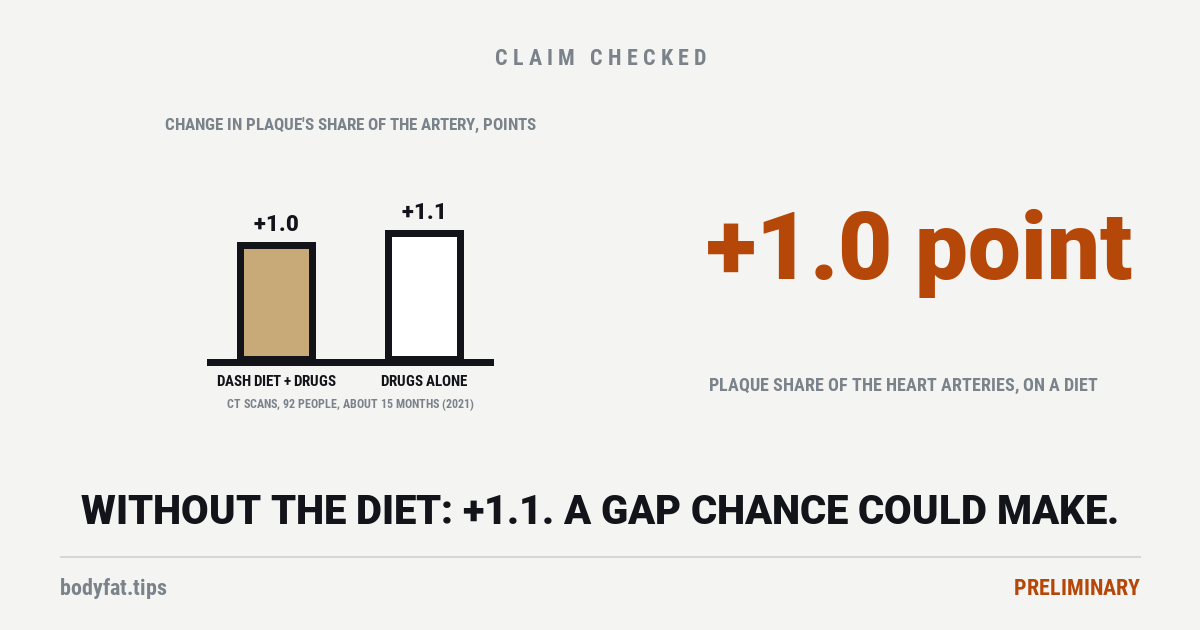
| Poland, 2021 [10] | 92 people, about 15 months; a DASH diet with a dietitian plus drugs, against drugs alone | Heart-artery plaque on CT angiography | Plaque’s share of the arteries up 1.0 point against 1.1, a gap that could be chance; soft plaque down more on the diet [10] |
| Spain, 2025 [17] | 100 people after a heart attack or a threatened one, one year, 48 scanned; a Mediterranean diet against usual care | Plaque imaged from inside the heart’s arteries | No significant difference in plaque area, plaque volume or the cap over the plaque [17] |
| Germany, 2010 [18] | 23 people with type 2 diabetes and heart disease, six months; four weeks in hospital of daily cycling and a 1,500-calorie diet, then exercise at home, against usual care | Plaque imaged from inside a heart artery | Plaque’s share of the artery did not change significantly in either group, and the groups did not differ [18] |
The clearest test of a diet on its own, on angiograms, is a 1992 London trial of 90 men. Over 39 months, the average width of the arteries studied held steady on a cholesterol-lowering diet, up 0.003 mm, and narrowed by 0.201 mm on usual care; only the group given a cholesterol-lowering drug as well gained width on average, 0.103 mm [5]. Fewer men on the diet got worse, 15% against 46%, and more showed wider arteries, 38% against 4% [5]. We read it as its summary.
A German trial of 113 men combined exercise with a low-fat diet. After a year, narrowing had eased in 32% of the programme group against 17% of the others, and worsened in 23% against 48% [13]. Six years on, the same men’s disease had progressed more slowly on the programme, and the authors credited the exercise: fitness was the only measure that explained the changes [14]. We read both as summaries.
A substudy of a Spanish trial called PREDIMED, in the video’s reference list, split its result. In 164 people at high risk, followed for 2.4 years, a Mediterranean diet with about an ounce (30 g) of mixed nuts a day left the inner neck-artery wall 0.084 mm thinner, against 0.052 mm thicker on advice to cut fat; with extra-virgin olive oil in place of the nuts, the abstract says, “There were no changes” [15]. We read it as its summary. PREDIMED’s main report was withdrawn and reissued in 2018 over how some people were assigned to their groups, as the site’s olive-oil verdict explains.
An Israeli trial gave 140 adults at one workplace, 88% of them men, a low-fat, Mediterranean or low-carbohydrate diet for two years. The volume of their neck-artery walls fell by about 5% on all three diets, with no group left off a diet to compare against [16]. The authors flagged the catch themselves: the change “may represent blood pressure-induced changes in the medial smooth muscle thickness rather than changes in atherosclerotic plaque” [16]. The paper’s title still promised a “Dietary intervention to reverse carotid atherosclerosis” [16].
Three trials we found measured plaque volume in the heart’s arteries themselves, against a group left off the programme. In Poland, 92 people, 41% of them women, with plaque that was not yet blocking an artery were given a DASH diet, an eating plan built to lower blood pressure, with a dietitian’s help, on top of their drugs, or the drugs alone, for about 15 months. Plaque’s share of the arteries rose by 1.0 point on the diet and by 1.1 points without it, a difference the trial could not tell from chance; the soft, non-calcified plaque fell in both groups, and more on the diet [10]. We read it as its summary.
In Spain, MEDIMACS gave 100 people just treated for a heart attack or a threatened one, what doctors call an acute coronary syndrome, an intensive Mediterranean diet or usual care for a year, and imaged their plaque from inside the heart’s arteries [17]. Only 48 were imaged at the end. Its published chart shows no significant difference between the groups in the thickness of the cap over the plaque, its main measure, or in plaque area or volume; for volume the p-value was 0.06, just the wrong side of the line researchers use for “probably not chance” [17]. We read its chart; the letter’s text is behind a paywall.
The third was smaller. In a 2010 German trial, 23 people with type 2 diabetes and heart disease were assigned by chance to four weeks in hospital of daily cycling and a 1,500-calorie diet, then five months of exercise at home, or to usual care [18]. Plaque was measured from inside a heart artery that was not yet narrowed by a quarter or more. Its share of the artery did not change significantly in either group over six months, and the groups did not differ; on the programme it went from 51.7% to 57.8%, a rise the trial could not tell from chance [18]. What improved was how the arteries, and the blood flowing through them, responded to a test drug, a measure of the health of their lining [18]. The calorie-cut diet ran for the four weeks in hospital; after that, the paper says, patients chose their own [18]. Its table also gives the width of the tested stretch of artery on a saline drip, the starting point for the drug test rather than a result the trial set out to measure: on average it went from 2.8 to 2.4 mm on the programme and from 3.0 to 2.7 mm without it, and the paper reports no significant difference between the groups in any of these absolute measurements [18]. Its authors wrote that six months of such a programme could not be expected to make a detectable change in plaque this lightly narrowed [18]. We read it in full.
Four more lifestyle trials we found measured only the calcium in the heart’s arteries, the hardened part of plaque that a CT scan picks up without dye. None found significantly less calcium with the programme than without it: in 96 heart patients over three years [19], in 50 people with HIV over a year [20], in 508 women past menopause over four years [21], and, measured once after about 14 years, in 2,029 people whose blood sugar was raised but short of diabetes [22]. We read the first as its summary.
Pooled, the picture is small and leans one way. A 2015 review of trials of intensive lifestyle programmes found less narrowing on angiograms, and thinner neck-artery walls, than in the comparison groups [23]. It expressed the size as a standardised difference, a way of comparing results measured in different units, where 0.2 is barely there and 0.8 is large: 0.34 for narrowing, and 0.13 for the neck-artery wall once the authors allowed for publication bias, the tendency of small studies with disappointing results to go unpublished [23].
Its chart shows two things worth knowing. Its summary counts 14 trials, and by our reading of the chart and the papers’ titles, two of its seven heart-artery entries are later reports of trials already in the list: the 1990 and 1998 reports of the Lifestyle Heart Trial, and the German trial’s 1992 and 1997 reports [23] [4] [13] [14]. And two of its seven neck-artery trials were exercise programmes in children with obesity [23]. We read the review as its summary and its charts.
What does shrink plaque, as measured?
The answer that has been measured most is the drugs that lower LDL cholesterol, the cholesterol carried in the particles that build plaque. A statin is the standard tablet; a PCSK9 inhibitor is an injected drug that pushes LDL lower still.
In the ASTEROID trial, published in 2006, 507 heart patients took the top dose of a statin, rosuvastatin 40 mg a day, for two years, and 349 had the plaque in a heart artery measured from inside at the start and the end [6]. Their LDL fell from 130 to 61 mg/dL. Plaque’s share of the artery fell by 0.98 of a percentage point on average, and the plaque’s total volume by a median of 6.8% [6]. 64% of patients showed a fall, and 36% a rise [6]. There was no comparison group: the authors judged it unethical to leave heart patients on a weaker treatment [6].
In SATURN, published in 2011, 1,385 patients were assigned by chance to the top doses of two statins for two years, and 1,039 were scanned again at the end. Plaque’s share fell by 0.99 and 1.22 points, a difference between the drugs that could be chance, and fell in about two-thirds of patients on each, 63.2% and 68.5% [7].
GLAGOV, published in 2016, had a dummy. 968 patients already on statins were assigned by chance to monthly injections of a PCSK9 inhibitor or a dummy for 76 weeks. LDL averaged 37 mg/dL with the injection and 93 without. Plaque’s share fell by 0.95 of a point with the injection and rose by 0.05 without it, a difference of 1.0 point [8]. 64% of the injection group showed a fall, and so did 47% of the dummy group [8]. In PACMAN-AMI, published in 2022, 300 people treated for a heart attack got a statin plus another PCSK9 inhibitor or a dummy for a year: plaque’s share fell by 2.13 points against 0.92, a difference of 1.21 [24].
That is the size of it. In arteries where plaque took up about 37% of the volume to begin with [9], the best-tested drugs took off about one percentage point in a year or two.
Who paid. The statin’s maker funded ASTEROID, took part in its design, ran its statistics with a contract research firm and employed two of its authors [6]; the maker of one of SATURN’s two statins funded that trial [7]. The maker of the injected drug in GLAGOV sponsored it and helped design it, though an independent statistician analysed it [8]. PACMAN-AMI was funded by its drug’s two makers and a medical-device company, and an employee of one maker helped conceive it [24].
In whom. People already having their heart arteries examined by catheter, most of them men: 72% in GLAGOV, 81% in PACMAN-AMI, and 73% of the 2,737 people in a 2026 pooling of four such trials [8] [24] [9]. That pooling combined ASTEROID, SATURN and GLAGOV with REVERSAL, a 2004 trial of intensive against moderate statin treatment; PACMAN-AMI is not in it [9]. In that pooling, women’s plaque fell more than men’s at similar LDL [9].
Does a point matter? A 2023 review of 23 such trials and 7,407 patients found that trial groups whose plaque shrank more also had fewer major heart and stroke events, a link its authors call hypothesis-generating: a lead, not proof [25]. We could not open its list of trials. What statins do to heart attacks themselves was counted in outcome trials, and the site’s statin verdict sets those numbers out per 1,000 people. Decisions about cholesterol medicine belong with a clinician who knows your numbers.
What is the best exercise to unclog arteries?
The video’s reference list includes a trial on exactly this [1]. In Norway, 60 people with stable heart disease who had just had a stent were assigned by chance to supervised high-intensity interval training, short bursts at 85 to 95% of peak heart rate, twice a week for six months, or to the usual advice [26]. Measured from inside the arteries, plaque’s share fell by 1.2 points in the training group and did not change significantly in the others, a difference of 1.4 points with a range from 0.1 to 2.7 [26]. We read the trial as its summary. By a 2026 review’s account, 54 of the 59 people analysed were men, and LDL did not change significantly in either group [27].
That review found five controlled studies of exercise programmes, 217 people in all: four imaged the heart’s arteries from inside and one the neck arteries, and two of the five were not randomised; the Norwegian trial was the largest [27]. It also left out 172 records whose full text it could not get [27]. It does not include the 2010 German trial above, of 23 people with diabetes, built mostly on cycling with a calorie-cut diet for its first four weeks, in which plaque’s share of a stretch of artery not narrowed by a quarter or more on an angiogram did not change significantly over six months and the groups did not differ [18]. One trial of 60 people is a start, not an answer.
What is the most artery-clogging food?
The trials on this page tested whole diets, so they cannot rank single foods. What ties food to plaque in the evidence this site has weighed is LDL cholesterol. Cutting saturated fat probably reduced heart events; eggs raise LDL by about 5 to 8 mg/dL; psyllium lowers it by about 13 mg/dL. For scale, the drug trials above took LDL down by 50 mg/dL or more, by our arithmetic from their reports [6] [8]. A one-year imaging study of people on ketogenic diets with very high LDL, which the site’s carnivore verdict discusses, was retracted in May 2026.
Do vitamins remove plaque from arteries?
A 2006 pooling of randomised trials compared how fast atherosclerosis progressed on scans in people given vitamin supplements or none. For antioxidants, vitamins E and C, beta-carotene and selenium, in seven trials, the difference was close to zero; for B vitamins, in four, the estimate pointed to slower progression but its range crossed zero, so “no effect at all” is still on the table [28]. The authors found “no evidence of a protective effect” [28]. We read it as its summary.
Vitamin K2 is the newest candidate. In a 2026 Dutch trial, 180 people with heart disease took 360 micrograms a day of menaquinone-7, a form of vitamin K2, or a dummy for two years. Their calcium score, a CT measure of the hardened plaque in the heart’s arteries, rose in both groups: from a median of 145 to 214 on the dummy and from 135 to 184 on the vitamin, a significant difference [29]. Slower calcium build-up is not plaque removed, and the authors say its meaning for the plaque “remains to be determined” [29]. The vitamin’s maker supplied the tablets free, and a heart charity paid for the trial [29]. A larger Danish trial, published in August 2026, gave 400 people with heavy calcium build-up in the heart’s arteries vitamin K2 with vitamin D, or a dummy, for two years. The calcium score rose less on the vitamins, by 196 units against 248; in the 143 who also had a CT angiogram, total plaque volume rose by a similar amount in both groups [30]. We read it as its summary. The site’s fish-oil verdict covers the omega-3 capsules sold for the heart.
Can garlic remove plaque from arteries?
The site has weighed this one. Its aged-garlic verdict found six small trials in which the extract slowed a number on a heart scan; none showed an artery unclogging, and total plaque did not shrink in either trial that measured it. Two of those trials are in this video’s reference list [1]. The same site’s dark-chocolate verdict rates the claim that a cacao drink unclogs arteries Unsupported, and its lycopene verdict covers the tomato pigment the video starts with.
If drugs shrink plaque by lowering LDL, why have diets, which lower LDL too, mostly been shown to slow it?
This section is the desk’s own reasoning, and it is labelled as such. The drug trials measured plaque shrinking by about a point [8] [24]; the diet trials mostly measured slower narrowing or slightly thinner walls [4] [2]. That gap is the question the evidence leaves open. Three answers, each rated.
Answer one: how low LDL goes. In the drug trials LDL ended at about 61 to 70 mg/dL on statins and 37 with the added injection; on statins alone in GLAGOV, at 93, plaque rose by 0.05 of a point [6] [7] [8]. The 1998 lifestyle programme brought LDL down 40% at a year and 20% at five, to about 115 mg/dL [4]. The ASTEROID authors drew a chart across trials in which plaque change tracked the LDL each trial reached [6]. This is a surmise with that chart on its side; the chart compares trials, not people, and the Norwegian interval-training trial cut plaque while LDL did not change significantly [26] [27].
Answer two: the measuring stick. The diet trials mostly measured narrowing on an angiogram or wall thickness in the neck; the drug trials measured plaque volume inside the heart’s arteries. Narrowing on an angiogram compares the tightest point with a healthier stretch, so it can fall without the tightest point getting wider: in the 1998 trial the narrowing fell while the narrowest point’s average width did not measurably change [4]. And the three trials that measured plaque volume in the heart’s arteries with modern scans, one of them mostly exercise with four weeks of a calorie-cut diet, in a stretch of artery its authors did not expect to change, found no clear difference in it [10] [17] [18]. Those two legs are measured: they are in the trials’ own reports. That the 1998 fall came from the healthier stretch narrowing is our arithmetic, consistent with the trial’s table but not proven by it [4].
Answer three: the diet came on top of the drugs. In CORDIOPREV, 86% of the patients were taking a statin, and in the Polish CT trial both groups had full drug treatment [2] [10]. A diet tested on top of a statin has less LDL left to remove. This is a surmise: none of the trials on this page was designed to test it.
Put the three together and here is what we think is true, stated plainly so you can disagree with it: food can help keep plaque from growing, and the shrinking that has been measured came mostly from pushing LDL lower than a plate usually takes it.
What we could not find, and would like to: a diet trial large enough and long enough, with plaque measured inside the heart’s arteries the way the drug trials measure it. The ones we found that looked inside were small: MEDIMACS imaged 48 people at one year, and the 2010 German trial, mostly of exercise, 23 at six months [17] [18] [31]. A Swedish trial of a Nordic diet is recruiting 150 people to measure coronary plaque volume at 18 months, with results due around 2030 [32]. A Canadian trial of a cholesterol-lowering diet with exercise, 232 people, finished in 2023 with neck-artery MRI as its main measure; we found no published results [33] [31]. And the Polish CT trial’s registry entry lists plaque scans at five years; its 2025 follow-up reported blood tests and heart events, not scans [34]. If you know of results for any of them, the corrections line on this site is open.
Who these studies were done on
Almost everyone in them already had heart disease or a high risk of it. The 1998 programme group was 20 men [4]; the 1992 London and German trials enrolled only men [5] [14]; CORDIOPREV was 82% men, average age 60, most of them on statins [2]; the Israeli diet trial was 88% men at one workplace [16]; the 2010 German diabetes trial, 18 men and 5 women [18]. The drug trials enrolled people having their heart arteries examined by catheter, about three in four of them men [9]. The exercise trial was 54 men and 5 women [27]. Two of the neck-artery trials in the 2015 pooling were in children [23].
Two things change the answer for a reader. Whether you already have plaque and are already on a statin: the largest diet trial here was measured on top of one [2]. And sex: the pooling of the drug trials found women’s plaque fell more than men’s [9]. None of these trials tested a single meal.
Where “a meal can unclog your arteries” came from
The research came from small trials that read narrowing on angiograms. The best known, in 1998, found a programme group’s narrowing fell 3.1 points while the comparison group’s rose 11.8, and the narrowest point of the programme group’s arteries did not measurably change in width, on average [4].
Then the word. The 1998 paper’s title promised “reversal” [4]. In 2010 an Israeli diet trial was titled “Dietary intervention to reverse carotid atherosclerosis” [16], and a news release from a US organisation that raises money for the university announced “Weight Loss Diets Significantly Reverse Clogging of the Arteries” [35]. The paper’s own authors had written that the change might be thickening of the wall’s muscle from blood pressure, not plaque [16]. In 2021 CORDIOPREV reported a neck-artery wall 0.03 mm thinner and called it reduced progression [2].
Then the spread. The physician’s channel turned that reference into “reverse and stabilize arterial plaque” and “UNCLOG Your Arteries”, in a video with 6,472,781 views [1]. Google lists it sixth among the ordinary results for “how to reduce plaque in arteries” and its AI answer cites it, while opening with the line “While plaque cannot be completely erased, aggressive management can shrink plaque volume” [3]. Among the related searches Google offers is “How to reverse 20 years of arterial plaque naturally” [3].
No product is sold with the meal. The video’s description carries affiliate links to supplements and devices, promises a “best supplement” it does not name, and lists two trials of aged garlic extract among its references [1]. Its own disclaimer says that following every change in the video “does not guarantee the result shown in the thumbnail” [1].
None of this is aimed at anyone who eats more olive oil, fish and vegetables to look after their heart. That is a sensible meal. It is the word “unclog”, for one meal or for the average person on any diet tested, that the evidence does not carry.
What this is rated, and what the rating covers
Preliminary — for the claim that a diet can reverse, or shrink, the plaque in your arteries.
It is rated Preliminary because the evidence in its favour is small, mixed and mostly indirect: most of it measured the wall’s thickness or the narrowing rather than the plaque itself. Some diet trials found small falls in neck-artery wall thickness, 0.03 mm over seven years in the largest [2] [15], or in neck-artery wall volume in a trial with no non-diet comparison group, which its authors say may not be plaque [16]; a lifestyle programme cut the narrowing on angiograms by about 3 points in 20 men [4]. Others found no clear change: a year of the same programme [12], the olive-oil arm of a Spanish trial [15], the three trials that measured plaque volume in the heart’s arteries with modern scans, one of them mostly exercise with four weeks of a calorie-cut diet [10] [17] [18], and four lifestyle trials that measured only its calcium [19] [20] [21] [22]. In the two angiogram trials on this page that report a width as a result (the narrowest point in the 1998 trial, the arteries’ average width in the 1992 trial), it held steady on the diet while it narrowed on usual care; in one of them more men on the diet showed some widening, 38% against 4% [4] [5]. And none of these trials tested a single meal: they tested months to years of eating, mostly as part of whole lifestyles, mostly in men, many on top of drugs.
Rated alone, in words. That a meal, the video’s or any other, can unclog your arteries: Unsupported, of the untested kind; we found no trial that gave people a meal and measured their plaque, and in the whole-diet trials above, which ran for months to years, the arteries did not clear on average [31] [4] [5]. That a diet slows plaque growth: Preliminary; most trials against usual care point that way, many combined the diet with exercise, and some found nothing [23] [5] [2] [12] [10]. That cholesterol-lowering drugs shrink plaque a little: Supported; about one percentage point over one to two years, repeated across trials, tested against a dummy only for the injected add-on drugs, and paid for by the drugs’ makers [6] [7] [8] [24]. That interval training shrinks plaque in the heart’s arteries: Preliminary; one trial of 60 people [26]. That vitamins remove plaque: Unsupported, of the tested kind; pooled trials of antioxidants and B vitamins found no clear slowing, and two 2026 vitamin K2 trials slowed calcium build-up without removing any; in the one that measured total plaque, it rose about as much on the vitamins as on the dummy [28] [29] [30]. Garlic is rated on its own page, and that rating stands.
What is not rated here: the video’s chapters on lycopene, plant sterols, catechins, seafood and heat, foods and habits its description does not tie to a measured plaque result; the “best supplement”, which it does not name; and the frame above, which is this desk’s reasoning from the evidence rather than a result the evidence delivered. It is marked as ours so that you can weigh it as ours. This is journalism, not medical advice: if you have plaque or heart disease, decisions about diet, exercise and cholesterol medicine belong with the clinician treating it. How we read a study, and what each tier means, is set out here.
- Can Fatty Liver Be Reversed? The Fat, Yes, Within Weeks. In a Year-Long Study, the Scarring Moved Both Ways.
established - The No-Sugar Diet: Cutting Sugar Lost 1.8 lb in the Trials Pooled for the WHO. Swapping It for the Same Calories Changed Nothing. The Sugar Was Never the Point.
supported - Going Vegan Cost Over-65s 2.5 lb of Lean Mass. Protein Fell, So Did Weight
preliminary