Zone 2 Cardio: The Fourteen Experts Who Defined It Also Said the Benefits Might Not Be Unique to It

In 2025 fourteen sport scientists and professional coaches, working by email, set out to answer a question that should not have needed a panel: what is zone 2?
They convened because, in their own words, “there is no clear consensus among coaches, athletes, and scientists regarding the definition of zone 2 training” [2] — and this is a thing being recommended to the general public as the intensity most of your cardio should happen at.
They did reach a definition. Then they added a sentence that none of the ten first-page web results we read for “zone 2 training” on 7 October 2026 quotes.
The line the experts wrote
Here is their conclusion about what zone 2 does to you. The panel expected a broad range of adaptations from it — and then wrote that those adaptations “might not be unique to zone 2 and could also be induced with sessions performed at slightly higher and lower intensities” [2].
Read that again with the marketing in mind. The entire pitch for zone 2 is that this specific band is where the magic happens. The fourteen experts who defined the band say the effects probably are not specific to it.
For the record, the definition they landed on, writing with cycling in mind: the intensity immediately below your first lactate or ventilatory threshold — roughly, the point where lactate in your blood first starts to climb, or your breathing first noticeably changes [2]. It is defined by a threshold, not a percentage, though the panel expected it to land at roughly 70 to 80 percent of maximum heart rate [2].
So can you find it? Fifty cyclists went in a lab to check
This is the part that matters most if you are wearing a watch, because the answer to “what qualifies as zone 2” depends entirely on which method you use to answer it.
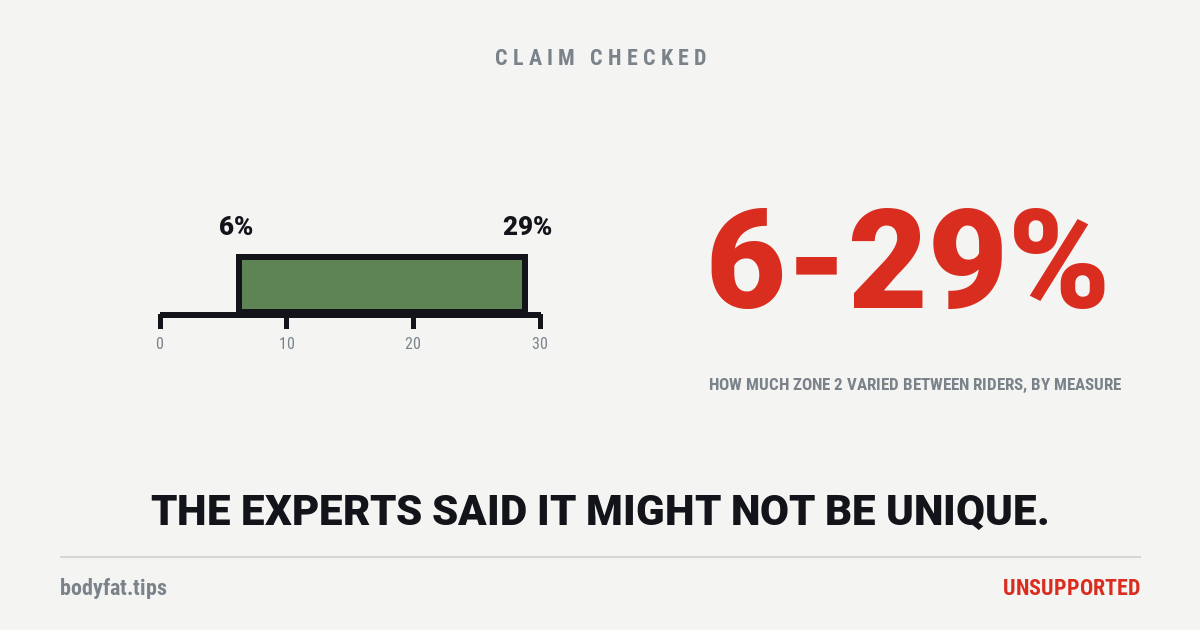
In 2025 researchers put fifty cyclists — thirty men, twenty women — through ramp and step tests, measuring power, heart rate, blood lactate, breathing and which fuel they were burning. Then they compared the common ways of defining zone 2 against each other [3].
| How zone 2 was defined | How much it varied |
| Between riders, across the markers they tested (heart rate varied least, power most) | 6% to 29% |
| Breathing threshold and a lactate marker (each rider’s baseline + 0.5 mmol/L) | agreed well with each other |
| Fixed percentage of maximum heart rate — the basis of age-based calculators | wide individual differences |
Two of the markers lined up closely, rider by rider: the ventilatory threshold — the breathing change — and a blood-lactate marker set at each rider’s own baseline plus 0.5 mmol/L [3]. The point of maximum fat oxidation, which the authors say is often athletes’ reason to train at this intensity, sat about a quarter lower than the breathing threshold, and they call the two distinct intensity domains [3]. (The paper’s abstract says those two aligned strongly. Its own table and discussion say otherwise, and we have gone with the data.)
The marker a heart-rate calculator hands you behaved differently. On average, 82 percent of each rider’s measured maximum heart rate landed on almost the same power as the breathing threshold, 202 watts against 200; rider by rider, it missed widely, some above and some below, and the authors’ conclusion is that fixed percentages “may inaccurately reflect metabolic responses” [3].
Which is awkward, because the questions people actually type are zone 2 cardio calculator and zone 2 cardio heart rate by age. A calculator by age takes a fixed percentage of a maximum estimated from your age; others use heart-rate reserve (the gap between your resting and maximum heart rate) or 180 minus your age, which are rules of thumb too. The lab study measured every rider’s maximum on the bike, and the fixed percentages still missed rider by rider [3]. Starting from an age estimate adds a second source of error on top — that is our reasoning, not something the study tested. It is an estimate stacked on an estimate, aimed at a band the experts defined by a lactate or breathing threshold.
But is zone 2 the best intensity for your mitochondria?
This is the big claim — that low-intensity work is uniquely good at building the machinery your cells use to burn fat. In 2025 a review in Sports Medicine went at it directly. It is called “Much Ado About Zone 2”, which tells you where it lands [1].
Its first move is to name where the recommendation came from, and this is worth quoting because it is the whole provenance problem in one sentence. The recommendations, they write, “largely stem from observational data of elite endurance athletes who engage in large volumes of Zone 2 training and possess high mitochondrial and fatty acid oxidative capacity” [1].
Elite endurance athletes do enormous volumes of easy riding and running, and they have superb mitochondria. Both true. The leap is deciding the first caused the second, and then prescribing it to someone training four hours a week instead of twenty.
The review’s conclusion: current evidence does not support zone 2 as the optimal intensity for improving mitochondrial or fat-oxidation capacity, and higher intensities look more important — particularly when training volume is low [1].
That last clause is the one to keep. If you have twenty hours a week, the argument is genuinely open. If you have four, the case for spending all of them easy is not there.
The disclosure we are putting on our own best source
One of that review’s authors is the researcher behind much of the low-volume high-intensity interval training literature — the alternative the review argues for. He also discloses advising and holding equity in a company whose services relate to exercise [1].
We are flagging that on the source that supports our own conclusion, which is the easiest disclosure in the world to quietly not mention. It does not make the review wrong. It does mean that when someone with a professional and financial position in favour of high-intensity training writes a review concluding in favour of high-intensity training, you should want the other side’s best evidence too.
So here is the other side’s best evidence
It exists, it is good, and it is narrower than it sounds.
A 2024 meta-analysis reviewed seventeen studies and 437 people to ask whether a polarized training distribution — most sessions easy, a few genuinely hard, little in between — beats the alternatives [4]. Several of those alternatives were mostly easy too, pyramid plans (mostly easy, with more moderate work than hard) and high-volume easy training among them, so what it tests is how the harder work is arranged, not whether most training should be easy [4].
It did, for one outcome, on a search that ended in October 2022. Across 11 of the studies and 284 people, VO2 max improved more on polarized training than on the alternatives taken together, with what the authors graded as high certainty; set against each alternative separately, the differences were too small to rule out chance. The effect size was 0.24 — and on the scale researchers use, 0.2 is small and 0.8 is large, so this is a real but modest edge [4].
Now the scope, which is where it gets interesting. That advantage appeared only in interventions shorter than twelve weeks, and only in highly trained athletes. And on the outcomes that are closer to actually racing — time trial performance, time to exhaustion, power at threshold — there was no clear difference [4].
So the strongest case for the polarized pattern is a small VO2 max advantage, in highly trained athletes, over short blocks, that does not show up in performance. That is a real finding. It is not the finding on the thumbnail.
And it has not held up as a general rule since. A 2025 analysis of individual athletes’ data from 13 studies and 348 athletes, searched to February 2024, found no overall difference in VO2 max between polarized training and any other distribution; within it, competitive athletes may gain more on polarized training and recreational ones on a pyramid [5]. A 2025 pooling of 41 studies of trained cyclists, 797 riders in all, found the polarized groups improved VO2 max a little more than the rest, by a gap too small to rule out chance; its authors call that a potential benefit, and add that polarized training may be less suited to time-trial performance [6].
What this verdict is rated, and what it is not saying
Unsupported — and the scope matters more here than on almost any page we have written, so we are going to be explicit.
The rating is on the claim that zone 2 is the optimal intensity, uniquely good for your mitochondria and metabolic health. That is the claim in the marketing, it is the claim driving the searches, and a 2025 review assessed it and said the evidence is not there.
In the terms our method page uses, this is the kind of Unsupported where the claim was tested and did not hold up. Zone 2 has been compared with harder training, and not only by that review. An independent 2025 analysis of 353 studies of mitochondrial content, which declared no funding and no conflicts, found that continuous training below the second threshold — a band that takes in zone 2 and the moderate intensity just above it — raised mitochondrial content by about 23 percent, against about 27 percent for hard intervals and 27 percent for sprints, a gap it could not tell apart from chance. Per hour of exercise, the continuous training was the least efficient of the three [7]. Where it did come out ahead was capillary density, the number of tiny blood vessels in each square millimetre of muscle, which rose more after continuous training [7].
The slogan’s other half, that most of your cardio should be in zone 2, is not what this rating covers, and the answer depends on how much you do. Endurance athletes who train many hours a week already do most of it at low intensity [5]; for someone training a few hours a week, the 2025 review argues for putting more of it at higher intensity [1]. The advice below says what we would do with that.
It is not a rating on easy cardio. Nothing in this literature says low-intensity exercise is a waste of time, and this page is not saying it either. Easy aerobic work is sustainable, it is repeatable, it is pleasant, it does not wreck you for tomorrow, and it raises your VO2 max — which large cohort studies link with living longer, though a five-year randomised trial of training in 1,567 older adults found no clear difference in deaths overall [8].
What the evidence does not support is that it has to be that band, found with that calculator, to the exclusion of going hard sometimes.
What we would actually do
Treat a heart-rate calculator as a rough guide, not your zone. In the lab study, a fixed percentage of each rider’s measured maximum landed near the breathing threshold on average and missed it widely for individual riders [3]; the authors still call such percentages useful guidelines where testing is not possible [3]. Check it with the talk test: zone 2 is where you can hold a conversation but would rather not sing, close to the panel’s own description, “can converse with some effort” [2]. That is a plain-language stand-in for the first lactate or breathing threshold, which is what the experts defined it by [2].
If you train a lot, most of it should be easy anyway. Not because of mitochondria — because you cannot do twelve hours a week hard without breaking. That is how endurance athletes already train: most of their volume is at low intensity [5].
If you train a little, do not spend all of it easy. This is the single most practical line in the 2025 review: higher intensities matter more when volume is low [1]. Four hours a week entirely in zone 2 is the case the evidence argues against most directly.
And do not buy anything to find your zone. That one is our advice, not the panel’s: the experts locate zone 2 with lab testing and suggest lactate measurements to check that training is working [2], and the lab study recommends individual testing over percentages [3] (one of its first author’s listed affiliations is a sports-medicine practice that offers that kind of testing). Our reason is the panel’s other line. They describe the body’s response to intensity as a continuum rather than switches flipped at zone boundaries, and expect the benefits of zone 2 from slightly easier and slightly harder sessions too [2]. If the benefit does not depend on hitting the band exactly, paying to find it exactly buys little. The chest straps, the lactate meters, the subscriptions are selling precision about a target with soft edges. A conversation is free.
This is journalism about research, not medical advice. How we read a study · How to improve your VO2 max · Does jogging burn fat · Does cardio burn muscle · How many steps a day
Corrected on 9 October 2026, after our VO2 max verdict was corrected the same day. This page called raising your VO2 max one of the better-evidenced things you can do for how long you live. The link between fitness and a longer life comes from cohort studies that compare fitter people with less fit people; the five-year randomised trial built to test training against deaths, in older adults, found no clear difference overall. The sentence now says both. A heading and a sentence that said nobody quotes the experts’ caveat now give what an ordinary web search showed instead. Nothing else on this page changed, and the rating is unchanged.
A second, separate correction was made on 9 October 2026, after an independent editorial review of this page. We had misreported the lab study of 50 cyclists that this page relies on. We said fixed percentages of maximum heart rate were the least reliable zone 2 marker it tested; they were not, and heart-rate measures varied least between riders. We called that maximum age-estimated; the study measured it on the bike. Our search snippet said heart-rate calculators vary by up to 29 percent; that 29 percent is the rider-to-rider spread in power output at a lactate marker, and heart rate varied by 6 to 11 percent. And, following the paper’s abstract, we said the breathing threshold and the point of maximum fat oxidation agreed well; the paper’s own table puts the fat-oxidation point about a quarter lower, its authors call the two distinct, and the pair it found well aligned is the breathing threshold and a lactate marker. What the study does show is that fixed percentages matched the breathing threshold on average and missed it rider by rider, and the page now says that.
We had also cited the fourteen-expert panel for our own advice not to buy anything to find your zone. The panel locates zone 2 by lab-tested thresholds, expects it at roughly 70 to 80 percent of maximum heart rate, and several of its members recommend monitoring heart rate, so that advice is now labelled as ours, and “not a percentage of anything” now says what the panel expected; the panel also worked by email rather than sitting down together. “Every calculator” was too broad. The polarized-training section now gives its meta-analysis’s search date (October 2022), says its VO2 max result came from 11 studies and 284 people, reports two 2025 poolings that did not find the advantage overall, and says “no clear difference” where it said “no difference at all”. We added an independent 2025 analysis of mitochondrial gains by intensity, said which kind of Unsupported this is, narrowed the claim in the provenance chain to the half the rating covers, added a source for the Generation 100 trial, and completed the funding line: among the lab study’s first author’s listed affiliations is a sports-medicine practice that offers lactate and breathing-gas testing. The rating is unchanged.