Does Dancing Help You Lose Weight? A Zumba Class Burned 369 Calories, Not 1,000. Eight Pooled Trials Couldn’t Find the Fat Loss.

The thumbnail says lose weight fast, the music is good, and you are already sweating at minute six. Which raises the only two questions worth asking about it.
How much does a dance session actually burn? And — the one nobody puts on a thumbnail — does the burning turn into weight that stays off?
The first has been measured. The second has been tested eight times. And the answer to both sends this page somewhere the videos never go.
How many calories does a dance class actually burn?
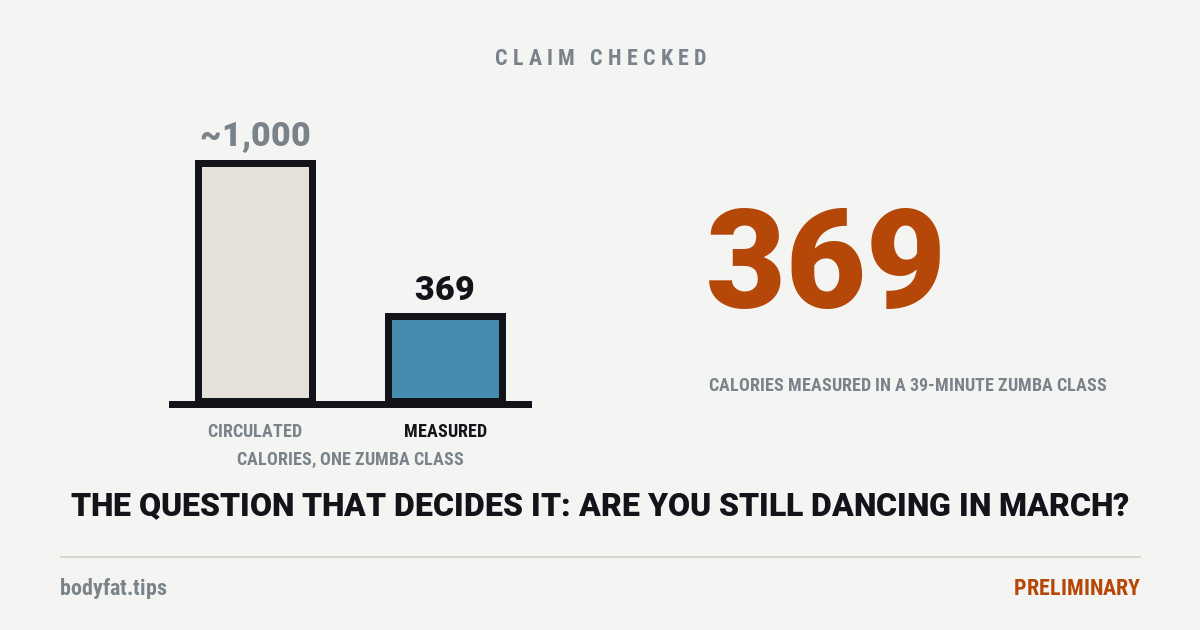
Nineteen young women wore heart-rate monitors that had been calibrated to each person’s own treadmill test, so their heart rate could be turned into oxygen use and oxygen into calories [3]. The class averaged about 39 minutes. It came out at 9.5 calories a minute — 369 calories for the class — with hearts running at 79% of maximum [3].
That is a genuine workout. It is also about a third of the “1,000 calories a class” figure that circulates about Zumba, a number that is repeated everywhere and, as far as we can find, sourced nowhere. The only other measurement the researchers could point to had come in even lower, at 6.6 to 7.4 calories a minute [3].
And a video is not a class. Fifteen women did the same Zumba workout both ways [4]: in the room, 6.8 calories a minute; from the DVD at home, 5.6. Time spent with the heart working really hard — above 85% of its reserve — was 14.7% of the class and 1.7% of the video [4]. Nobody pushes as hard alone in the living room, which matters for a genre built on living-room videos.
For the thirty-minute question people actually type, here is the arithmetic, done from published effort values and labelled as ours:
| Activity | METs | About |
|---|---|---|
| Aerobic, general (Compendium code 02000) | 7.3 | 290 kcal |
| Zumba, group class (02310) | 6.5 | 255 kcal |
| Zumba, home video (02315) | 5.5 | 215 kcal |
| Salsa to a video | 6.3 | 250 kcal |
| Ballet, modern or jazz class (03010) | 5.0 | 200 kcal |
| Very brisk walk, 4 mph | 5.5 | 215 kcal |
| Brisk walk, 3.5 mph | 4.8 | 190 kcal |
A MET is a unit of effort: one MET is the energy of sitting still, and an activity rated 7.3 costs 7.3 times that [5]. Multiply by bodyweight and minutes and you get calories. The Compendium’s general aerobic value of 7.3 works out at about 9.6 calories a minute for a 165 lb (75 kg) person, and its own Zumba-class value of 6.5 at about 8.5 [5]. The measured class ran at about 8.8 METs, in women averaging 136 lb (61.8 kg) [3] — so the table brackets a hard class rather than reproducing it, and the calorie figures for a heavier person run above what was measured.
So: half an hour of hard dancing, about 200 to 290 calories for a 165 lb person; less for a lighter one. An hour, roughly double.
And how much weight is that?
Here is where the thumbnail and the arithmetic part company.
On the crude rule everybody uses — 3,500 calories to a pound — 290 calories is about a twelfth of a pound. And this site has already checked that rule: it is roughly right for a week and badly wrong over a year, because the body adjusts. So the honest sentence is not “a class loses you a twelfth of a pound.” It is: a class is a snack’s worth of energy, not a pound’s.
Which is not a knock on dancing. It is true of every half hour of every exercise there is. The videos just promise something no half hour can do.
What happened when people actually danced for weeks?
This is the second question, and it has an answer.
A 2020 meta-analysis pooled every randomised trial of Zumba it could find — eight of them with fat-mass data [1]. The pooled effect on body fat was −0.25, on a scale where 0.2 is a small effect, 0.5 moderate, 0.8 large. The range the true answer probably sits in ran from −0.67 to plus 0.16 — it includes zero, and the p-value in the paper’s results section was 0.23 (its abstract prints 0.69, which is the figure for the subgroup with inactive controls), nowhere near the line researchers use for “probably not chance” [1]. The reviewers’ own words: they “cannot conclude that Zumba is effective at reducing body mass.”
Fitness was a different story. Across three trials that measured it, maximal oxygen uptake — the best single number for how fit your heart and lungs are — improved by a moderate 0.53, and that one did clear the line, p = 0.03 [1].
The best single trial in the pile says the same thing in miniature. Twenty overweight, inactive women, eight weeks, one or two classes a week: fitness up by 3.1 units, body fat down 1.2 points, an inflammation marker down [2]. Real movement, small numbers, twenty people.
The longest trial in the review is not in the pooled number, and it deserves a line. One hundred and eighteen female hospital employees were randomised to soccer, Zumba or nothing for 40 weeks, and both exercise groups ended with less body fat than the controls [7]. It was left out of the pooling only because it reports the same people as a 12-week paper that was included. So the one long trial points the claim’s way — one trial, one workplace, and worth knowing about.
Read the two results together and you get the calibrated version of the claim. Dancing reliably makes you fitter. It has not reliably made the pooled trials’ participants leaner. That is what Preliminary means on this site: a signal pointing the right way, in trials too small to be sure.
Is walking or dancing better for weight loss?
Per minute, dancing. A brisk walk is about 4.8 METs; hard aerobic dance is 7.3 [5] — call it half again as much energy for the same clock time. And walking is rated Supported for weight loss on this site, on trials that actually measured people over months, which dancing does not yet have.
So walking wins on evidence and dancing wins on the stopwatch. Which tells you the stopwatch is the wrong instrument, and brings us to the part of this page the videos never reach.
Can you lose belly fat by dancing?
You cannot choose where fat comes off, with dance or anything else. That is its own verdict, and it is one of the most thoroughly settled findings on this site.
Then why does anyone lose weight dancing?
Because plenty of people do. The before-and-afters are not all invented. So if a class is a snack’s worth of energy and the pooled trials could not find the fat loss, where does it come from? This section is the desk’s own reasoning, and it is labelled as such: three candidate answers, with the evidence we could find for each.
Answer one: minutes. People dance longer than they walk. The trials ran one-hour classes [2] [4], and nobody sets out to walk briskly for an hour twice a week for fun. If you do 90 minutes of dancing a week and would otherwise have done 40 of walking, the stopwatch difference goes the other way. We have no trial that measured this; it is arithmetic and a hunch.
Answer two: how it feels while you do it. The premise here has evidence; that dance in particular feels better in the moment than a walk does is our surmise. A review of 24 studies asked whether the way exercise feels during the session predicts whether people are still active later [6]. It does: a better in-session experience at moderate intensity was linked to future activity. How you felt afterwards — the virtuous glow — predicted nothing [6]. That is the strongest single fact on this page for the dance-lover. Exercise that is fun in the moment is exercise that survives.
Answer three: the room. The same workout burned 21% more in a class than on a DVD, with eight times as much time in the hard zone [4]. A room full of people at 7pm on a Tuesday is a commitment device. A video is a suggestion.
Put the three together and here is what we think is true, stated plainly so you can disagree with it: the exercise that survives your calendar beats the exercise that wins the calorie table. Dancing loses the per-minute contest to a good run and the evidence contest to walking, and it may still be the right choice for a lot of people, because it is the one they will be doing in March.
What we could not find, and would like to: a trial that pitted a dance class against a walking programme on who was still going a year later. That is the study this question actually needs. If you know of one, the corrections line on this site is open.
Where the 1,000-calorie number came from
Zumba started in the mid-1990s when a Colombian instructor, Alberto “Beto” Pérez, forgot his usual class music and taught to the salsa and merengue tapes in his bag instead. He took it to Miami in 1999, and in 2001 it became a company with two business partners and a run of infomercial workout videos — the medium whose whole grammar is a big number and a before-and-after.
Somewhere in that decade the class acquired a calorie figure: a thousand an hour, give or take, repeated on studio walls and in a hundred articles. In 2012 a university exercise-science lab put heart-rate monitors on actual participants and measured 369 [3]. The number did not go away. Measured numbers rarely beat circulated ones.
Then the format changed hands. K-pop choreography videos took the same promise — lose weight fast — to YouTube, where the burning happens on a living-room DVD-equivalent that the one comparison study found runs about 20% cooler than a class [4].
And where it lives now: ask Google whether dancing helps you lose weight and its AI Overview answers by citing Healthline and Medical News Today — and also two websites belonging to a chain of ballroom dance studios, a fitness streaming service, and Reddit. Studios answering whether you should take dance classes.
None of this is aimed at anyone dancing to lose weight. The thing you are doing is good for you. It is the thumbnail that owes you an apology.
What this is rated, and what the rating covers
Preliminary — for the claim that dancing helps you lose weight.
It is rated Preliminary because the only meta-analysis found a pooled fat-loss effect that points the right way and includes zero, in eight small trials with large heterogeneity [1]; because the best individual trial found a real but small reduction in twenty people [2]; and because the calorie cost of a session, measured [3] and calculated [5], is ordinary for exercise rather than exceptional. A signal, not a finding. One more limit: the calorie measurements and the pooled trials are almost entirely in women, aged roughly 19 to 47.
What is not rated here: dancing as a way to get fitter, where the same meta-analysis found a significant improvement and which would earn its own Supported [1] — see what fitness gains are actually worth; any particular style, which the trials do not separate; and the frame in the section above, which is this desk’s reasoning from the evidence rather than a result the evidence delivered. It is marked as ours so that you can weigh it as ours. How many steps a day matter is the nearest page for the walking side of the comparison. How we read a study, and what each tier means, is set out here.
Three points were corrected on 15 September 2026 after an independent editorial review. The p-value quoted for the pooled fat-mass result, 0.69, is the figure the review’s abstract prints for its inactive-control subgroup; the results section gives 0.23 for the pooled effect, and the page now quotes that (the conclusion, not significant, is unchanged). The claim that the Compendium arithmetic and the class measurement “landed on the same number” was an artefact: the 7.3 row is the Compendium’s general aerobic value, not an aerobic-dance value, and the measured class ran at about 8.8 METs in women lighter than the 165 lb person the table assumes, so the two methods do not reproduce each other; the table now uses the Compendium’s own labels and adds its Zumba rows, and the replication line in the evidence panel is rewritten. And the review’s longest trial, 40 weeks in 118 hospital employees, found less body fat than controls; it was excluded from the pooled number as a duplicate cohort, and the page now says so.
Also added: that the measurements and pooled trials are almost entirely in women; that the eight-week trial’s twenty participants were overweight, inactive women; a rating for the second posed answer that separates the evidenced premise from the desk’s surmise; and public funders for two sources the panel had said carried no grant data. The rating is unchanged.
- Exercise for Lower Back Pain: 249 Trials, 15 Points Less Pain on a 100-Point Scale. If the Pain Is New, the Answer Changes.
established - Time Under Tension: 14 Studies Put Slow Reps Against Fast. The Slow Group Grew the Same — If Anything, a Shade Less.
unsupported - Does Soreness Mean Muscle Growth? 110 Men Did 12, 24 or 60 All-Out Reps and Hurt About the Same.
unsupported