Can You Burn Fat Off One Specific Body Part?

You can train a muscle. You cannot tell your body where to take the fat from. That is the whole finding, and it has been the finding for over fifty years.
What makes this one worth reading is not the verdict — it is where the belief came from. Most health myths start with a real study that got stretched. This one didn’t. It has no founding study at all. The earliest version we found in print is a physical-culture manual from 1890, which told readers that a man may box, fence and walk without losing his “terrible abdominal accumulation”, but that if he puts the effort “on the abdomen itself” the fat “will gradually disappear” [11]. No study sat behind that sentence. It was simply printed, and it has been repeated ever since. The vibrating belt did not invent the idea; it was hardware sold on an idea already in print.
The machine came before the science
In the late nineteenth century, Gustav Zander built vibrating apparatus and sold it as massage equipment. By 1927 John Harvey Kellogg was promoting a version at his Battle Creek sanitarium. Nobody was claiming it burned fat yet.
That claim got attached later, when the same shaking belts needed a sharper sales pitch. The story was that vibration breaks up fat where it is applied. No study said so. The mechanism was asserted, and the belts sold anyway — for roughly forty years before anyone properly tested it.
Which is the pattern worth learning. The product did not follow the science. The science arrived decades late, and by then the belief was already load-bearing.
Then the research showed up
The first controlled tests ran through the 1960s. The one people still cite came in 1971, when researchers examined tennis players — people who had spent years doing heavy one-sided work with one arm and comparatively little with the other.
Their playing arms were visibly bigger. The muscle was there. But the layer of fat over each arm was not measurably different between the two sides [5]. Years of targeted work had built the muscle underneath and left the fat on top alone.
In 2019 researchers repeated the idea with modern imaging on seven tennis players aged 10 to 12, matched against seven inactive children of the same age and height. The result held: the players carried substantially less abdominal fat than non-players, and still showed no meaningful difference between their two arms [6]. Exercise had lowered their body fat. It had not chosen a location.
The sit-up study
In 1984 a group of men did just over five thousand sit-ups across 27 days. Researchers took fat samples before and after — not tape measurements, actual tissue — from the abdomen, the upper back, and the buttocks.
Fat cells shrank at all three sites. The rate of change was not significantly different between them [3]. Body weight, total body fat, skinfolds and girths did not change at all. Nothing measurable came off anywhere. The abdomen got no special treatment for having done all the labour.
A 2011 trial ran the modern version: six weeks of abdominal exercises, five days a week, diet held steady. Their abs could do more curl-ups. Body fat percentage, waist circumference and abdominal fat did not significantly change [4].
Why your trainer might still believe it
Here is the most useful study in the set, because it explains how the myth survives among people who genuinely want to help you.
In 2007, 104 people trained one arm — only the non-dominant one — for twelve weeks. Researchers measured the result two ways. With skinfold calipers, the kind of tool you find in most gyms, the numbers hinted at spot reduction in the men. With MRI, which scans the whole upper arm, the fat loss turned out to be the same in the trained and untrained arm, in men and women alike [2].
The cheap tool said yes. The accurate tool said no. If your evidence is a pair of calipers and a tape measure, you will keep finding spot reduction — and you will keep being wrong.
The part most debunks leave out
There is a real scientific argument on the other side, and it deserves to be stated properly rather than waved away.
Fat mobilisation near working muscle is genuinely measurable. In a 2007 experiment, blood flow and fat breakdown were higher in the tissue sitting next to the muscle doing the work than next to the resting one [7]. So the mechanism people imagine is not fantasy.
But mobilising fat is not the same as losing it. Fatty acids released into the bloodstream can be burned anywhere, or simply put back. The question is whether that local release adds up to less fat in that spot after weeks — and that is what the long trials keep failing to find.
A handful of small recent studies do report a regional effect [9], including one 2023 trial whose title states plainly that spot reduction exists [8]. Worth knowing about. Also worth knowing that it had sixteen participants, all men; that the abdominal group trained for eighty-four minutes a session against the control’s forty-five — on purpose, so that both groups burned the same energy, and total fat loss did come out similar in both; and that diet was instructed to stay the same but never measured. It is a result to test further, not a result to sell a product on.
And note what those studies actually did: local resistance work paired with substantial cardio. None of them tested the thing you were sold — that crunches alone flatten a stomach.
What settles it
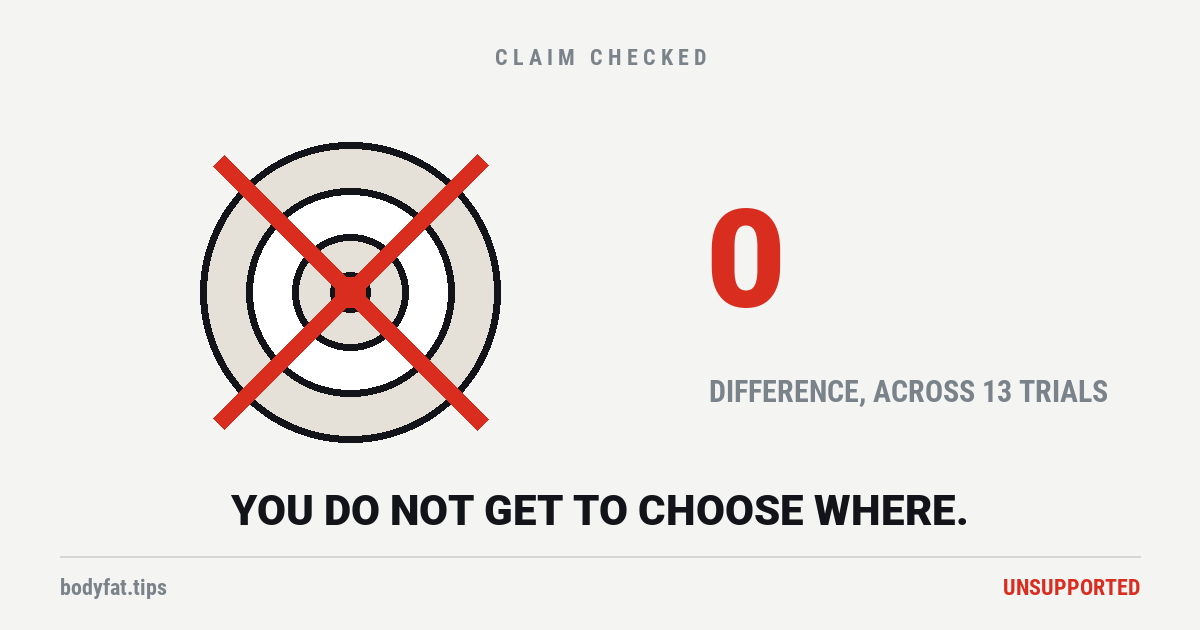
The strongest evidence is the one that pools everything. Thirteen controlled trials, 1,158 people aged 14 to 71, six different ways of measuring fat — MRI, DEXA scans, CT, ultrasound, skinfold callipers and fat cells measured under a microscope. Every one of them trained an arm or a leg on one side of the body, for two to twenty weeks, and used the untrained limb on the other side as its own control — the cleanest test there is, because diet and genetics are identical on both sides of one person. The combined effect of targeted training on targeted fat came out statistically indistinguishable from zero [1]. The abdomen was not in that pool. For the belly specifically, the evidence is the smaller trials above: the two that tested abdominal exercise on its own found nothing [3] [4], and the two that found a little had paired the abdominal work with cardio [8] [9].
Not small. Not promising. Zero.
What it costs people
This is where the belief stops being harmless. In 2002 the US Federal Trade Commission opened a case series it named Project ABSurd, going after electrical ab belts sold on the promise of losing fat and inches without exercise [10].
One case ended in a judgment of $83 million. Another settled for over $5 million, over claims including that ten minutes of the belt equalled six hundred sit-ups. A third returned more than $1.4 million to buyers.
Those figures are the size of the market for one sentence that was never true.
So what actually works
Fat comes off your whole body, in an order you do not get to choose, when you are in an energy deficit over time. The stubborn area is usually the last to go, which is exactly why it feels like it needs targeting.
Training that area is still worth doing — the muscle you build is real, and it is what shows once the fat above it goes. It just is not the lever that removes the fat.
Nobody sells a tub for that, which is roughly the point.
Two descriptions of the evidence and the origin story were corrected on 15 September 2026 after an independent editorial review. The pooled result was described as covering “arms and legs and abdomens” across four measurement methods; every one of the thirteen trials in that meta-analysis trained an arm or a leg on one side against the untrained limb on the other, none of them trained the abdomen, and six measurement methods were used. The evidence panel gave the longest follow-up as 12 weeks; the pooled trials ran 2 to 20 weeks. And the page said the belief “started with a machine”; it is in print in an 1890 physical-culture manual, decades before the vibrating belts, and the page now says so and cites the book.
Also changed: the 1984 sit-up study did not show fat coming off the whole body — total body fat, weight, skinfolds and girths did not change at all; the 2023 abdominal trial’s longer sessions were a deliberate design to match the energy both groups burned, and the caveat now says so; the 2007 arm study’s MRI result is described as the same in both arms rather than “across the body”; an unsourced line about what belts “now promise” was removed; and the FTC source entry now links the four releases, with the $83 million figure linked to the release that states it. The rating is unchanged.
- Does Calisthenics Build Muscle? The Light-Load Leg Grew 6.8%, the Heavy-Load Leg 7.2%. Muscle Can’t Tell What It’s Lifting, Only How Close to Failure You Got.
supported - Does Dancing Help You Lose Weight? A Zumba Class Burned 369 Calories, Not 1,000. Eight Pooled Trials Couldn’t Find the Fat Loss.
preliminary - Exercise for Lower Back Pain: 249 Trials, 15 Points Less Pain on a 100-Point Scale. If the Pain Is New, the Answer Changes.
established