Does Coffee Help You Lose Weight? A Little — Nobody Knows How Much

Probably a little. Nobody can honestly tell you how much.
And the most famous version of this claim — the one that sold green coffee bean extract to the world — ended with a $3.5 million cheque to the Federal Trade Commission and a retracted paper [2][3].
Let’s do the real evidence first, then the crime.
What 13 trials actually found
A 2019 review pooled thirteen randomised trials covering 606 people and asked a narrow question: does taking caffeine change body weight [1]?
All three measures moved in the right direction — weight, BMI and fat mass — and none of the results were compatible with “nothing at all”.
Better still, there was a dose-response relationship, which is one of the things that separates a real effect from a coincidence. More caffeine, more reduction. Specifically, every doubling of caffeine intake corresponded to about 22% more weight reduction, 17% more BMI reduction and 28% more fat-mass reduction [1].
That sounds terrific. Here is why we are still calling this Preliminary.
The trials do not agree with each other
Every meta-analysis reports a number called I-squared, and almost nobody quotes it, which is a shame because it is often the most informative figure in the paper.
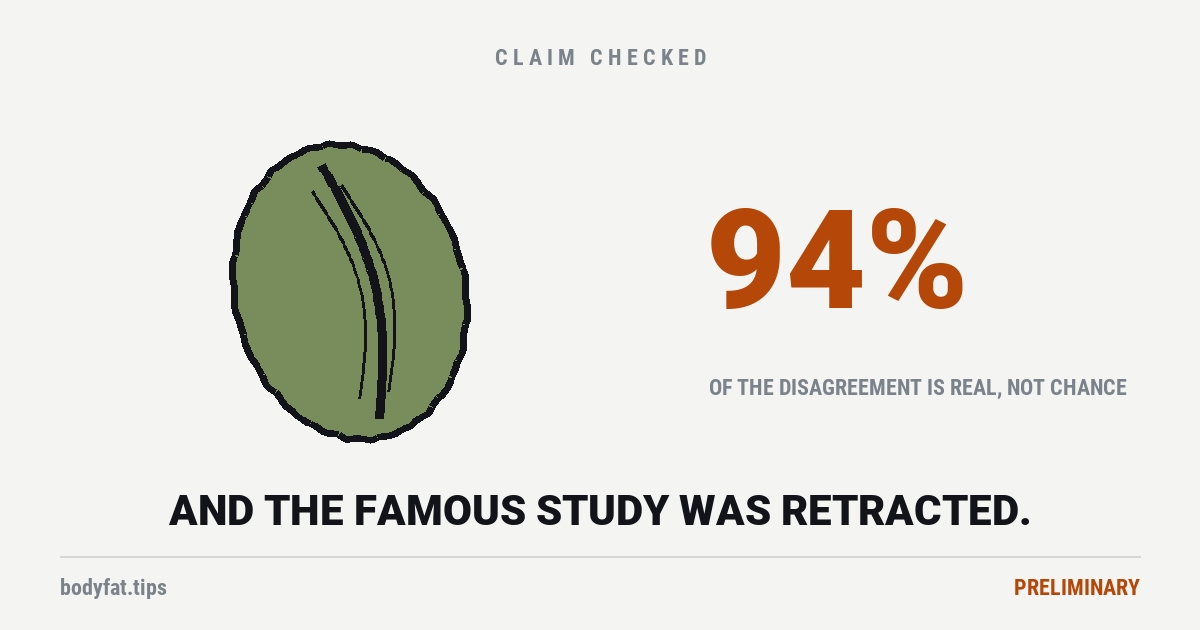
I-squared asks: how much of the disagreement between these trials is real disagreement, rather than the ordinary noise you would expect by chance? Zero percent means the trials are all telling the same story. Above about 75% is usually described as considerable.
This analysis came in at 91.2%, 93.0% and 94.0% for the three outcomes [1].
Learn More:
That is about as high as it goes. It means the thirteen trials genuinely conflict — some found a lot, some found little — and the pooled average is a number that no individual trial actually observed.
There is a second problem, quieter but just as limiting. The pooled figure is a regression coefficient on a double-log scale [1]. In plain terms: it describes the shape of the relationship, not an amount. There is no “you will lose X pounds” anywhere in this paper, and anyone who gives you one from it has made it up.
And they tested caffeine, not coffee
Worth saying plainly, because the whole internet slides between the two.
The trials above dosed caffeine — largely as supplements, at controlled amounts [1]. Coffee is caffeine plus several hundred other compounds, in a dose that varies with the bean, the roast, the grind and how heavy-handed you were this morning.
So the honest translation is: the active ingredient in your coffee has thirteen conflicting trials behind it. Your actual cup of coffee has considerably less than that.
Now the crime
In 2010 a Texas company called Applied Food Sciences paid researchers in India to run a trial on its green coffee extract [2].
According to the FTC’s complaint, the study’s lead investigator “repeatedly altered the weights and other key measurements of the subjects, changed the length of the trial, and misstated which subjects were taking the placebo” [2].
Read that again. The weights were altered. In a weight-loss study.
When the investigator could not get it published, the FTC says the company hired two researchers at the University of Scranton to rewrite it [2]. It was published in 2012 [3].
Off the back of that paper, the company claimed its product caused users to lose 17.7 pounds, 10.5% of body weight and 16% of body fat — with or without diet and exercise — in 22 weeks [2].
The FTC’s position was that the study was, in its words, so “seriously flawed” that no reliable conclusion could be drawn from it at all [2].
The extract was then featured on a daytime television show, and here the FTC is scrupulous in a way worth repeating: the company “played no part” in that happening. What it did do was issue a press release riding the publicity afterwards — one claiming subjects had lost weight “without diet or exercise”, when the subjects had in fact been instructed to restrict their diet and exercise more [2].
September 2014: $3.5 million, and an order requiring two adequate, well-controlled human trials before it makes another weight-loss claim [2]. The Commission voted 5–0.
The paper was retracted. PubMed now files it under the publication type “Retracted Publication” [3], which is the permanent version of an asterisk.
Does that mean green coffee does nothing?
No — and this is the part where it would be easy, and wrong, to let the fraud do our arguing for us.
A 2023 meta-analysis looked at green coffee extract supplying at least 500 mg a day of chlorogenic acid, the compound green coffee is actually sold on. Three trials, 103 people total. Average weight difference: down 2.9 lb (1.30 kg), with the plausible range running from about 1.1 lb to 4.6 lb [4].
And unlike the caffeine analysis, those three trials agreed with each other — I-squared of 0% [4].
So: a small, consistent, real-looking effect, from a very small evidence base. About three pounds. Which is a long way from 17.7 pounds without diet or exercise, and that gap is the whole business model.
A fabricated study does not prove an ingredient useless. It proves the company had nothing honest to sell you at the time it was selling.
What to actually do
Drink coffee if you like coffee. On this evidence it is not a weight-loss intervention, and treating it as one means quietly expecting a cup to do work that thirteen conflicting trials could not pin down.
If a product puts a specific pound-count on a coffee compound, that number did not come from this literature, because this literature does not contain one.
And “with or without diet and exercise” is the phrase to walk away from. It cost one company $3.5 million, and the subjects in the study behind it had been told to diet and exercise [2].