Do Cold Plunges Burn Fat? What Human Research Actually Shows

Before the evidence — make a guess.
In lab studies, sitting in cool air (16–19°C) raised the calories a person burned. Researchers reported it as a daily figure. What was it?
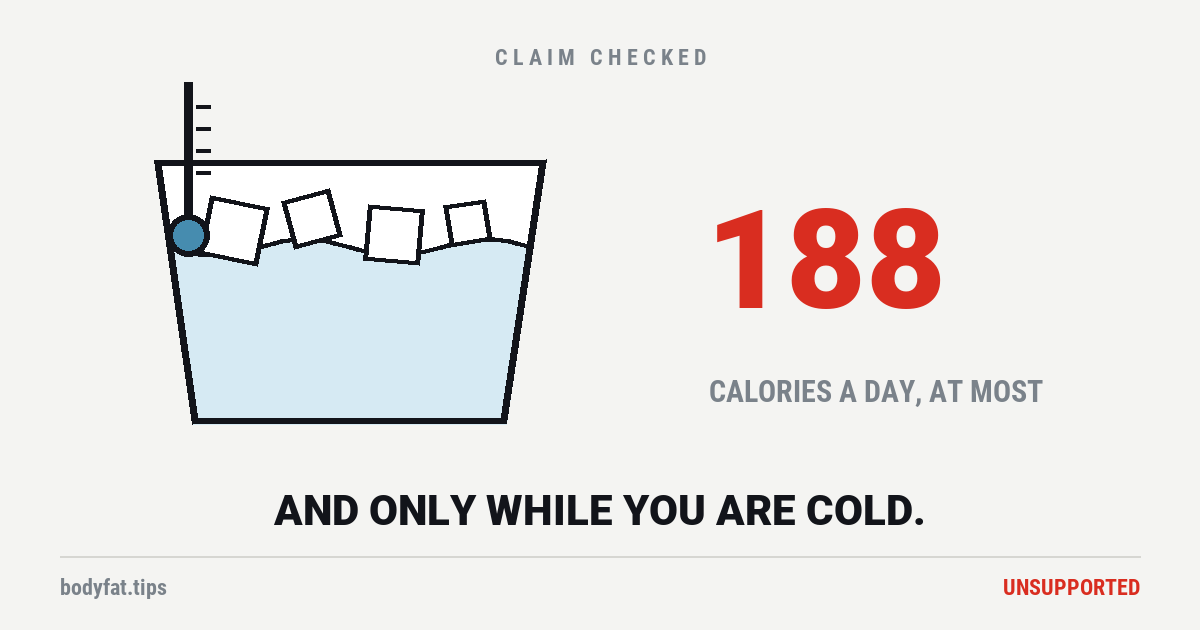
About 188 calories a day — but that number is not what it looks like.
That 188 is a rate. Researchers measured people in cool air for anywhere from 30 minutes to 12 hours, then scaled the result to a full day. Nobody sat in the cold for 24 hours, and nobody was in a 3-minute plunge — a plunge delivers only a fraction of it. Over weeks, daily multi-hour cold air has nudged fat mass down slightly in one study, with no change in body weight. A brief plunge has never been shown to do even that.
Cold-plunge marketing promises to melt your body fat. The claim rests on something real — and then walks a long way past it.
Here is the honest shape of it up front: cold does raise the calories you burn, and over weeks of daily cold exposure one study even nudged fat mass down a little. But the studies used hours of cool air, not a three-minute plunge; body weight did not budge; and no one has shown a cold plunge itself takes fat off. Let me walk you through where the claim comes from and how far the evidence actually reaches.
It starts with a mouse
Much of the “cold burns fat” story traces back to research on mice.
Researchers use mice because they are cheap, breed fast, and let you control every variable. Put a mouse in the cold and it burns through fat to stay warm; some studies found chilled mice resisted getting fat at all. Genuinely interesting.
But a mouse is tiny, and small bodies lose heat far faster than large ones. Mice lean much harder on heat-generating tissue to survive the cold than we ever do. Chilling a mouse is not a miniature version of chilling a person — it is a different animal in a different situation. The mouse result is a reason to go look in humans, not a finding you can sell a tub on.
What brown fat actually is
That heat-generating tissue has a name you will see in every cold-plunge ad: brown fat.
Ordinary body fat — the kind you want to lose — is storage. It sits there holding energy. Brown fat does the opposite job: its purpose is to spend energy and throw it off as heat. Babies carry a lot of it, because babies cannot shiver.
Scientists long assumed adults lost theirs. Then in 2009, separate teams scanned adults in cool rooms and found it there, switched on. Real science, a real surprise — and the vocabulary the whole cold-plunge industry now borrows.
The number, and the fine print that swallows it
So how much does cold actually burn in a human?
Researchers pooled the controlled trials and landed on roughly 188 extra calories a day. That is the real figure, and it is worth holding onto. It is also where you have to read carefully, because that number is quietly doing more than it looks.
First, the temperature. It comes from sitting in cool air at 61–66°F (16–19°C) — roughly an office with the air conditioning turned up too high.
Second, and this matters most: it is a daily rate, not a measured day. The actual sessions ran from 30 minutes to 12 hours, and researchers then scaled the result to 24 hours so studies could be compared. Nobody in these studies sat in the cold for a full day — and nobody was in a plunge.
A cold plunge lasts about three minutes. It delivers some fraction of a figure built from hours of cold, and how large a fraction nobody has measured. That is the first quiet gap between the claim and the evidence.
Does the burn actually become lost fat?
Burning more calories is not the same as losing fat, so this is the question that settles it. Here the evidence is genuinely mixed, and I am going to give you both halves.
On one side: in a six-week study, people who spent two hours a day in cool air saw a small drop in body-fat mass. So “cold does nothing to fat” would be too strong — that is not what the record says.
On the other side, three catches the marketing leaves out. Their body weight did not meaningfully change. The exposure was two hours a day, every day, for six weeks — not a three-minute dip. And the review notes that longer cold exposure tends to make people eat more, offsetting part of the effect — though that point leans largely on animal data, and how much a human eats back is not pinned down.
Put plainly: the strongest human result behind “cold burns fat” came from a regime nobody buying a tub is going to follow, and it moved fat mass a little while moving the scale not at all. A cold plunge has never been shown to do even that much.
If you lift, one more thing worth knowing
Plenty of tubs are sold on recovery rather than fat loss — plunge after training, come back stronger. That specific claim has a wrinkle.
In a study where people got into cold water within a few minutes of finishing a weights session, regularly over several weeks, they built less muscle than a group who cooled down normally. Their strength rose too, but by roughly a third less than in the group who cooled down normally, and the measured muscle growth was smaller still.
Read that precisely, because it is narrow: it is about cold water immediately after lifting, done regularly. It does not mean an occasional plunge, or one taken hours away from training, blunts your gains. But if you lift to build muscle and you plunge right after, you may be working slightly against yourself.
What a cold plunge is actually good for
None of this means cold water is useless. This is not an article arguing that everything is fake.
People report feeling sharply awake afterwards, and the wellbeing research has something real in it: across eleven trials, stress was lower twelve hours after immersion and sleep quality and quality of life improved in some trials, while mood, in the one trial that measured it, did not change. If you climb out of that water feeling fantastic and that is why you do it, that is a perfectly good reason. It is simply a different claim from fat loss — and only one of the two survives being checked.
The bottom line
Strip out the marketing and here is what is left. Cold exposure raises the calories you burn — a measured increase, reported as about 188 a day, from hours of cool air. Those measurements were made in healthy adults, mostly young and more often men than women; the six-week study was in lean young men, and the lifting study in 21 active men in their early twenties. Sustained daily cold over weeks has trimmed fat mass slightly in one study, without changing body weight. A three-minute plunge has not been shown to do any of it.
The mechanism is real. The size of it is small, and the leap from “cold raises your metabolism” to “a cold plunge melts your fat” is a leap the evidence does not make.
Two statements on this page were wrong from 20 July to 15 September 2026, and an independent editorial review caught them. The search snippet said that twelve weeks later the cold-water group “looked like everyone else”; no twelve-week cold-water body-composition result exists in the sources, the longest follow-up here is six weeks, and in the only twelve-week study cited the cold-water group ended up behind. The snippet has been rewritten from the page’s own bottom line. And the lifting section said strength “held up” with cold water after training; in that trial strength rose by roughly a third less with cold water, and muscle growth by less still, and the sentence now says so.
Also changed: every source now carries its authors and a DOI link (the original list had neither); the wellbeing sentence now reports what its cited review found (stress lower twelve hours after immersion, sleep and quality of life improved in some trials, mood unchanged in the one trial that measured it); the evidence panel’s participant count is replaced with figures the sources state; and the populations the measurements were made in are named. The rating is unchanged.
Corrected on 7 October 2026. The provenance chain at the foot of this page gave a price range for plunge tubs that we could not trace to any source, put marketing phrases in quotation marks that we could not trace either, and described one step as a process rather than naming anything. The price range and the untraced quotes are gone. The chain now names the 2013 study that called recruited brown fat an anti-obesity agent, and a tub seller’s 2023 blog post telling readers that cold-activated brown fat can help them lose weight. Nothing in the verdict above changed, and the rating is unchanged.
Corrected on 9 October 2026. The evidence panel said PubMed lists no grant data for three of this page’s studies. PubMed’s grant field is not where a paper states its funding, and all three papers say something. The six-week cold study was paid for by a Japanese government research grant, and one of its eight authors works for a food company. The strength-training study was funded by two sports-science bodies and a university, with supplements from a supplement company. The Dutch scan study names no funder and reports no conflict. The panel and the three source entries now say so. None of the three was paid for by a company, and the rating is unchanged.
- Does Sauna Burn Fat? The 400-Calorie Claim Came From a Wristwatch
preliminary - Does Castor Oil Help Hair Growth? Tested on Eyelashes and on Bald Patches, It Did Not Clearly Beat the Comparison
preliminary - How to Get Rid of Cellulite: Twelve Weeks of Daily Glute Exercises Left It Where It Was. Nothing Tested So Far Melts It.
unsupported