Resistant Starch: Chilled Rice Cut the Blood-Sugar Rise 18% in the Study a 3-Million-View Video Cites. A 40-Person Rice Trial Found No Difference.

Leftover rice has a reputation. In Indonesia, a team of Jakarta researchers wrote in 2015, there is a belief that yesterday’s rice is better for people with diabetes than rice fresh from the cooker [1]. On 27 October 2025 a physician’s health-video channel gave the idea a big audience: a nine-minute video promising viewers they could eat bread, rice and potatoes without blood-sugar spikes. Its first chapter is resistant starch. Its first reference is a 2015 trial of chilled rice. When we read the count on 10 October 2026 it had 3,217,591 views.
The claim goes like this. Cook your rice, potatoes or pasta, chill it, then eat it, cold or warmed up. Some of the starch turns “resistant”. It slips past digestion, feeds your gut bacteria instead of your bloodstream, and the spike never comes.
People want to know. “Resistant starch” is searched about 22,200 times a month in the US (from a paid keyword database, pulled 10 October 2026). So we read the trials of the food itself, the trials of the supplements, and the two regulators that have ruled on parts of it. Here is what each one found, and who it found it in.
What is resistant starch, and what does cooling do to it?
Resistant starch is starch that gets through your small intestine without being digested. It reaches the large intestine, where gut bacteria ferment it, much as they do fibre. A 2023 review sorts it into types: starch locked inside intact plant cells, as in intact grains and legumes; starch packed so tightly it resists enzymes, as in high-amylose grains; starch that has been cooked and then cooled; and starch changed in a factory [22].
The cooled kind is the one this claim is about. When cooked starch cools, some of its long chains pack back together into a tighter structure that digestive enzymes struggle to cut. Researchers call it retrogradation [1] [2]. Reheating undoes some of it, but not all [1].
How much does it make? Less than the word “resistant” suggests. In the Jakarta trial the video cites, freshly cooked white rice held 0.64 grams of resistant starch per 3.5 oz (100 g). After 24 hours in the fridge and a reheat, it held 1.65 grams [1]. That is about one gram more. Other labs, using other methods, get very different numbers for the same kind of food: a Hawaii lab found three days in the fridge left the resistant starch of most rices it tested unchanged [31], while a Polish lab measured 7.5 grams in fresh rice and 12 in chilled [18]. Hold that thought. It matters later.
Does chilling rice, pasta or potatoes lower the blood-sugar spike?
In about half the trials we read, a little, at one meal. Here is how the one the video cites went.
In 2015 a team at Universitas Indonesia fed 15 healthy adults, aged 20 to 40, a 4.4-oz (125 g) portion of white rice with an omelette, twice [1]. Once the rice was fresh. Once it had spent 24 hours in the fridge and been reheated. Each volunteer ate both, on different days, in random order; that design, a crossover, makes each person their own comparison [1].
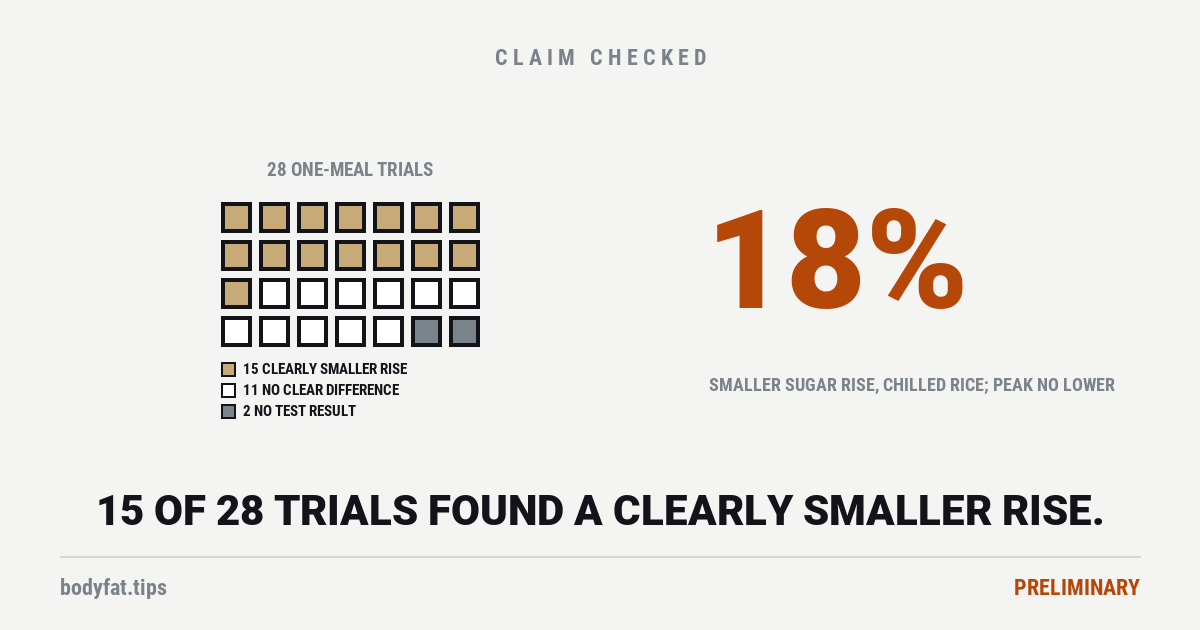
The researchers measured the area under the blood-sugar curve. That is a way of adding up how far blood sugar climbs above where it started, minute by minute, over two hours. A smaller area means a smaller or shorter rise. After the chilled rice, the area was 18% smaller [1]. (One volunteer had exercised hard before a session, so 14 were analysed [1].)
Now the part a promise of no spikes leaves out. The spike itself, the highest reading, was the same height either way: about 130 mg/dL (7.2 mmol/L) [1]. Fifteen minutes after eating, blood sugar was actually a little higher after the chilled rice. It came down sooner afterwards, and that is where the smaller area came from [1]. The authors also say their blinding may not have worked: some volunteers could tell the two rices apart [1].
One trial of 14 people is a start. So we went looking for trials that fed people the same food fresh and after cooling. We found and could read 28 in people without diabetes, two in type 1 diabetes and two in type 2 diabetes. Most measured the area under the blood-sugar curve or the glycaemic index, which is a score of how far a food raises blood sugar compared with pure glucose. This is a count of what we found, not of every trial ever run.
| Trial | Who ate it | What was cooled | Blood-sugar rise after the cooled version |
|---|---|---|---|
| Jakarta, 2015 [1] | 15 healthy adults, 20 to 40 (14 analysed) | White rice, 24 hours in the fridge, reheated | Smaller: area 18% smaller; the peak the same height |
| Dunedin, 2017 [2] | 28 healthy young adults | Parboiled rice, overnight in the fridge, served warm | No clear difference from the same rice fresh |
| Toronto, 2021 [3] | 12, then 40 healthy adults | White rice, overnight in the fridge, eaten cold | No clear difference in either trial |
| Jammu, 2021 [4] | 40 healthy adults, aged 24 to 68 (the summary says 20) | White rice, 12 hours in the fridge, reheated | No clear difference in the glycaemic index; single readings lower from 15 to 90 minutes (the summary says only at 30); peak 143 against 156 mg/dL |
| Beijing, 2024 [5] | 18 healthy young women | Ordinary and sticky rice and millet, 24 hours in the fridge | Smaller: ordinary rice, area 24% smaller. Ordinary millet about 20% smaller than fresh millet, by our arithmetic (the paper tests it only against fresh rice). Sticky rice and sticky millet: no clear difference |
| China, 2013 [35] | 10 healthy adults | Sticky (waxy) long-grain rice, refrigerated | No clear difference reported: fresh and refrigerated sticky rice both raised blood sugar more than ordinary rice |
| Semarang, 2013 [36] | 18 women with prediabetes (blood sugar raised, short of diabetes), in two separate groups | White rice cooked the day before | No clear difference at 30, 60 or 120 minutes |
| New Delhi, 1998 [32] | 8 healthy adults (rice) and 5 (potato) | Rice and potatoes, 16 to 20 hours in a fridge at about 50°F (10°C), rewarmed | Smaller: both foods, by the area and at several readings |
| Ludhiana, 2024 [43] | 10 healthy adults | Basmati rice, 24 hours in the fridge, eaten cold or reheated | Lower, not tested: glycaemic index 46 cold against about 62 fresh for the usual cooking method (the fresh figure read off the paper’s chart); about 59 reheated; the methods name a test, but no result for this comparison is printed |
| Kudus, 2026 [44] | 10 healthy adults | White rice, 24 hours in the freezer, steamed | Smaller: glycaemic index 76 against 83 |
| Chișinău, 2026 [45] | 10 healthy adults | Rice, one to five days in the fridge or one to three months in the freezer, reheated | Smaller: glycaemic index 67 after a day in the fridge and 44 after three months frozen, against 83 fresh |
| Guildford, 2018 and 2021 [6] [7] | 10 healthy adults | Pasta meal, chilled, then reheated | Smaller: area 41% smaller for chilled-and-reheated; peak about 18 mg/dL lower |
| Guildford, 2018 [10] | 10 overweight adults | Pasta meal, chilled, then reheated | No clear difference in blood sugar |
| Brighton, 2019 [9] | 45 students aged 20 to 24 | Pasta, chilled; or chilled and reheated | Smaller: reheated, total area 4% smaller, about 23% less rise above the starting level by our arithmetic from the published averages; no single reading differed. Chilled and eaten cold: no clear difference |
| Riyadh, 2022 [11] | 8 healthy young men | Pasta, chilled overnight, reheated | No clear difference; peak 151 against 149 mg/dL |
| Warsaw, 2024 [12] | 12 healthy adults | Chickpea pasta, 24 hours in the fridge, reheated | Smaller: area 15% smaller |
| Beirut, 2004 [33] | 9 men whose response to insulin varied | Potato, served hot or cooled to 79°F (26°C) | Smaller: area and glycaemic index lower |
| Lund, 2005 [13] | 13 healthy adults | Boiled potatoes, 24 hours in the fridge | No clear difference in blood sugar reported; insulin 28% lower; blood sugar clearly lower only once vinegar dressing was added |
| Toronto, 2005 [14] | 10, then 12 adults | Potatoes cooked the day before, eaten cold or reheated | Smaller: russet potatoes, by the area; red potatoes eaten cold scored 56 on the glycaemic index against 89 hot; no change for white |
| Toronto, 2011 [34] | Groups of 10 healthy adults | Four new kinds of potato, boiled, then cooled and eaten cold or reheated | Smaller: two kinds, glycaemic index 40 to 50% lower; 8 to 10%, not clearly, for the other two |
| Houston, 2019 [15] [16] | 30 overweight women, fasting blood sugar above normal on average | Baked potatoes, five days in the fridge, eaten cold, against boiled | No clear difference in the area; readings lower at 15 and 30 minutes; insulin lower; a 2022 reanalysis found a smaller rise by another measure |
| Guildford, 2020 [39] | 8 adults | Mashed potato with butter, 66 hours in the fridge, reheated | No clear difference in blood sugar; insulin 24% lower |
| Guildford, 2020 [40] | 10 healthy adults | Mashed potato made with butter or one of two oil spreads, two days in the fridge, reheated | Smaller: with butter; no clear difference with either spread |
| Twickenham, 2019 [38] | 10 women | Boiled sweet potato, 24 hours in the fridge, reheated | No clear difference |
| Auckland, 2017 [37] | 10 healthy adults | Red kumara, a sweet potato, cooled | Lower, not tested: glycaemic index 79 against 99; no test of that pair reported |
| Oxford, 2008 [17] | 10 healthy adults | White bread, frozen and thawed, or toasted | Smaller: area 31% smaller for frozen homemade bread |
| Baghdad, 2021 [41] | 12 healthy adults | Commercial white bread, frozen one or two weeks, thawed | Smaller: area 7 to 10% smaller, by our arithmetic |
| Ludhiana, 2023 [42] | 10 healthy adults | Wheat porridge (dalia), 24 hours in the fridge, eaten cold or reheated; flatbread (chapati), chilled then reheated | Smaller: porridge, glycaemic index 41 cold and 48 reheated against 50 fresh; flatbread 51 against 54 |
| Poznan, 2022 [18] | 32 adults with type 1 diabetes, on insulin pumps | White rice, 24 hours in the fridge, reheated | Smaller: area 60% smaller; a low followed 12 of the 32 meals, against 3 after fresh rice |
| Poznan, 2026 [19] | 32 adults with type 1 diabetes, on insulin pumps | Pasta, 24 hours in the fridge, reheated | Smaller: area 60% smaller; lows 2 against 1 |
| Melbourne, 2021 [46] | 24 adults with type 2 diabetes | Boiled potato, 24 hours in the fridge, reheated, in an evening meal | No clear difference from the same potato fresh; more insulin than after a rice meal |
| China, 2012 [47] | Patients with type 2 diabetes fed through a tube | Steamed rice, refrigerated, blended into the feed | Readings lower at 60 and 120 minutes; the summary gives no area |
Read down the table and a pattern shows. Of the 28 trials we found and could read in people without diabetes, 15 found a clearly smaller blood-sugar rise for at least one cooled food, 11 found no clear difference, and 2 reported lower numbers without testing them [1] [2] [3] [4] [5] [6] [9] [10] [11] [12] [13] [14] [15] [17] [32] [33] [34] [35] [36] [37] [38] [39] [40] [41] [42] [43] [44] [45]. Three of the eleven did find less insulin [13] [15] [39]. The size of the drop ran from about 4% in Brighton’s total area and 7 to 10% for the Baghdad bread and the Kudus rice, by our arithmetic from their figures [9] [41] [44], to about half, for two of four potato kinds in Toronto and for rice frozen for three months in Chișinău [34] [45], and the biggest drops came from groups of ten.
The biggest trials disagree with each other. The 40-person Toronto trial, run with the people measuring blood sugar not told which rice was which, found the glycaemic index of chilled rice was 75 against 70 for hot, which its authors judged to be the same [3]. The Jammu trial, which counts 40 people in its results and 20 in its summary, found no clear difference in the glycaemic index either, though most of its single readings were lower [4]. The 45 Brighton students had a total area 4% smaller after reheated pasta [9]. A total area counts the blood sugar people started with as well as the rise, so it shrinks less; measured above the starting level, the rise was about 23% smaller, by our arithmetic from the paper’s published averages, though no single reading differed [9]. The 41% came from ten people [7].
And the “spike”? The trials that reported the peak split. It barely moved in Jakarta, 130 against 130 mg/dL [1], in Brighton, 128 against 125 (7.10 against 6.94 mmol/L) [9], and in Riyadh, 151 against 149 [11]; in Beijing the cooled grains peaked lower on average, by about 11 mg/dL for rice and 7 for millet (0.6 and 0.4 mmol/L, our conversion), but not clearly [5], and in Melbourne the cooled potato peaked no lower than the fresh one [46]. It was lower in the ten-person Guildford pasta pilot, by about 18 mg/dL (1 mmol/L) [7], in Jammu, 143 against 156 mg/dL [4], and in both type 1 diabetes trials, 178 against 198 mg/dL and 193 against 227 mg/dL (9.9 against 11, and 10.7 against 12.6 mmol/L) [18] [19].
Freezing is a second route to the same place. In a ten-person Oxford trial, white bread that had been frozen and thawed raised blood sugar 31% less than the same loaf fresh, and toasting lowered it too [17]; we read that study as its summary only. In a twelve-person Baghdad trial, commercial white bread frozen for one or two weeks raised it less too [41], and two 2026 trials found the same for rice frozen and reheated [44] [45].
One more thing worth knowing. A 2021 review that set out to pool trials of how a starchy food’s structure changes blood sugar found only two on cooled starch, both of rice, 36 people in all [21]. It found a moderate effect, and said plainly that “chronic effects have not been investigated” [21]. One of its two is the Jakarta trial. The other, a 1992 Dutch trial of 22 men, is listed in the review as reheated rice against fresh, but its own summary describes hot mixed lunches whose starch differed in its amylose content, and mentions no rice and no reheating, and its text is behind the publisher’s login, so we have not counted it [51]. We found no review that has pooled the rest.
Do resistant starches actually work?
It depends which promise you mean. There are three, and they have very different evidence.
The first promise: swap some starch for resistant starch and that meal raises your blood sugar less. This one has a regulator behind it. The European Union authorises food makers to say that “replacing digestible starches with resistant starch in a meal contributes to a reduction in the blood glucose rise after that meal” [28]. The condition is that resistant starch makes up at least 14% of the food’s starch [28]. In people with type 2 diabetes or prediabetes, a 2023 pooling of short tests found the high-amylose kind lowered the rise after a meal by a standardised mean difference of 0.96 [22]. That is a way of putting different studies on one scale, where 0.2 is small, 0.5 moderate and 0.8 large; so, a large effect [22].
Does a chilled leftover meet that bar? Not the rice in the trial the video cites. By our arithmetic, the Jakarta trial’s chilled rice held 1.65 grams of resistant starch in 31.6 grams of starch per 3.5 oz (100 g), about 5% of its starch, a third of the 14% the European claim requires [1] [28]. And the same 2023 pooling found that the cooked-and-cooled type of resistant starch had no clear effect: the range the true answer probably sits in still included no effect at all [22]. Its two studies of that type tested parboiled rice and a bread made with a resistant-starch ingredient, not leftovers [22].
The second promise: take resistant starch every day and your blood-sugar control improves. This is the supplement claim, and the trials disagree. A 2019 pooling of 22 trials and 670 people, at 8 grams a day or more for one to twelve weeks, found no effect on fasting blood sugar, HbA1c or insulin resistance, and called the benefit “limited” [23]. HbA1c is a blood test that reads your average blood sugar over the past three months. A 2021 pooling of 19 trials found fasting blood sugar about 1.6 mg/dL (0.09 mmol/L) lower [24]. A 2025 pooling found fasting blood sugar unchanged across 16 trials and HbA1c down 0.14 of a point [25].
The clearest single test we read is the STARCH trial. Sixty-eight adults with prediabetes took 1.6 oz (45 g) a day of a high-amylose maize starch, or a look-alike ordinary starch, for 12 weeks; neither they nor the researchers knew who had which [26]. HbA1c fell by 0.1 of a point, which the authors call “clinically insignificant”. Insulin sensitivity, how well the body responds to insulin, did not change [26]. It was paid for by the US National Institutes of Health; both starches were provided by the resistant starch’s maker, and two of its authors, the senior author among them, report research funding from that company [26].
The FDA looked at the same question in 2016, when a maker of high-amylose maize starch asked to put a diabetes-risk claim on food labels. Of the 25 intervention studies the agency reviewed, it could draw no conclusions from 17, 14 of them because they were single meals or lasted a day or less [27]. It allowed a qualified health claim, a label claim that has to say how weak its evidence is: “FDA has concluded that there is limited scientific evidence for this claim” [27].
The third promise: it feeds your gut bacteria. That part is measured. A 2022 review of 39 trials found the short-chain fatty acids that bacteria make from it went up in 16 of the 23 studies that measured them [29]. Whether that does you any good is a different question, and no study on this page answers it. The gut-supplement shelf has its own ranking, and fibre has its own verdict.
What food is the highest in resistant starches?
The honest answer is that it depends on who measured it, and how. The trials of daily resistant starch did not use leftovers. They used ingredients made for the purpose: 6 to 40 grams a day in the 2023 review [22], 45 grams of high-amylose maize starch in the STARCH trial [26]. Cooling a meal adds about a gram per 3.5 oz (100 g) of rice in the trial the video cites [1]. Legumes and intact grains carry the kind locked inside plant cells [22].
How do I increase resistant starch in my diet?
If you want to try the leftover route, the food-safety rules are the part with a firm answer. The US Department of Agriculture says to refrigerate cooked food within two hours, eat leftovers within three to four days, and reheat them to 165°F [30]. The Jakarta team made a second version, left on the counter for ten hours, measured its resistant starch, did not feed it to anyone, and wrote that it could not be kept longer because of the risk of food poisoning from bacteria [1]. The video’s chapter title points viewers to a pinned comment on proper handling; our pull of the video did not include the comments, and we did not read it.
The other ways to lower the rise after a starchy meal have their own verdicts on this site: a walk after eating, the order and combination of foods, and vinegar, which in the Lund potato trial did more than the fridge [13]. If fibre in a tub is what you are after, psyllium has its own verdict.
Who should not eat resistant starch?
Two groups should think before they change anything.
Anyone who doses insulin by counting carbohydrate. This is the strongest finding on the page, and it cuts both ways. In Poznan, 32 adults with type 1 diabetes, all using insulin pumps, ate rice fresh and rice chilled for 24 hours and reheated, dosing insulin the usual way for each [18]. After the chilled rice, the area under the curve was 60% smaller and the peak about 178 against 198 mg/dL (9.9 against 11 mmol/L) [18]. But a low blood sugar followed 12 of the 32 chilled-rice meals, against 3 after fresh rice [18]. The same team repeated it with pasta in 2026, in 32 adults also on pumps, and found the same 60% drop with no extra lows, 2 against 1 [19]. One trial says the insulin dose may need changing; the second says it may not. Neither is something to try without your diabetes team.
Anyone taking a supplement dose. Most trials of 20 to 40 grams a day reported it was tolerated. Of the 20 studies in healthy people that reported on it, 5 found gas, bloating or stomach cramps, and in one, at 45 grams a day, the dose the STARCH trial used, some people had to stop [29].
Does any of this apply to you?
Who were the volunteers? Mostly healthy, mostly young, mostly a normal weight. The Brighton students were 20 to 24 [9], the Jakarta adults 20 to 40 with normal fasting blood sugar [1], the Riyadh men around 29 [11]. Two trials allowed adults up to 65 and 70, but the volunteers were younger than that: the Warsaw group averaged 25 [12], and Jammu’s ran from 24 to 68, averaging 43 [4]. One trial was in women with prediabetes [36], one in men whose response to insulin varied [33], and one in women whose fasting blood sugar was above normal [15].
| Who you are | Chilled rice, pasta or potatoes | Resistant starch as an ingredient or supplement |
|---|---|---|
| Healthy, mostly young, mostly normal weight | 24 single-meal trials: a clearly smaller rise in 14, no clear difference in 8, lower but not tested in 2 [1] [2] [3] [4] [5] [6] [9] [11] [12] [13] [14] [17] [32] [34] [35] [37] [38] [39] [40] [41] [42] [43] [44] [45] | Replacing a meal’s starch with resistant starch lowers that meal’s rise [28] |
| Overweight, or blood sugar or insulin above normal, no diabetes | Four single-meal trials: a clearly smaller rise in one, in men whose response to insulin varied [33]; no clear difference in three, one of them in women with prediabetes [10] [15] [36]; one day of chilled potatoes left insulin sensitivity unchanged [20] | 12 weeks at 1.6 oz (45 g) a day in prediabetes: HbA1c down 0.1 of a point, insulin sensitivity unchanged [26] |
| Type 2 diabetes | Two trials: a cooled, reheated potato in an evening meal made no difference in 24 adults [46]; refrigerated rice in a tube feed gave lower readings at one and two hours [47] | Lower rise after a meal in short tests; slightly lower fasting blood sugar in longer ones [22] |
| Type 1 diabetes, dosing insulin by the carbohydrate count | Two trials, 32 people each, all on insulin pumps: the rise 60% smaller; more lows after rice [18] [19] | Not covered by the reviews on this page |
The type 2 diabetes cell is the one most readers will care about. People with type 2 diabetes are the group the Jakarta authors had in mind [1], and the evidence in them is thin. In a 2021 Melbourne trial, 24 adults with type 2 diabetes ate an evening meal with potato boiled fresh, or boiled the day before, left to cool for 24 hours and reheated; the cooled potato did not lower blood sugar after the meal, and the authors report that cooling “did not lower the postprandial glycemic response” as they had expected [46]. That trial was funded by a potato-industry research group [46]. A 2012 Chinese study of patients with type 2 diabetes fed through a tube found lower readings at one and two hours when the rice blended into the feed had been refrigerated; its summary does not say how many patients, and we read only the summary [47]. Neither is a trial of chilled rice eaten as a meal.
This is journalism, not medical advice. If you have diabetes, the person to ask about any change to your meals, and to your medicine, is the clinician who knows both.
If chilling adds about a gram of resistant starch, why does the sugar rise fall by a fifth in one trial and not at all in another?
This section is the desk’s own reasoning, and it is labelled as such. The trials disagree, and the disagreement is the interesting part. Here are three explanations, and what each is worth.
Answer one: the arithmetic does not reach that far. In the Jakarta trial, chilling added about 1.3 grams of resistant starch to a portion holding about 42.5 grams of carbohydrate, by our arithmetic from the paper’s own table [1]. Taking 3% of the carbohydrate out of reach cannot by itself take 18% off the rise. Europe’s food-safety agency, reviewing resistant starch in 2011, found that its effect on a meal “is generally not observed when the amount of available carbohydrates is maintained constant”: it works by replacing digestible carbohydrate [28], and the Jakarta authors put their own result down to the same thing [1]. So either something other than resistant starch is at work, or the 18% is partly luck. That is arithmetic, not a measurement, and it leans on a figure that other labs measure very differently [18]. The Hawaii lab tested the other direction: 21 healthy adults ate chilled rice measured at 2.55 grams of resistant starch per 3.5 oz (100 g) and chilled rice measured at 0.20, and their blood sugar could not tell the two apart [31].
Answer two: chilling changes how fast the starch digests more than how much. In the two trials whose curves we read closely, the chilled food came down sooner rather than peaking lower: in Jakarta the peak matched and the later readings fell [1]; in Brighton the reheated pasta was back to its starting level by 90 minutes, the fresh pasta not by 120 [9]. The shapes are measured. That slower digestion is the reason is a surmise.
Answer three: the trials are too small to agree. Ten people in Guildford gave 41% [7]; eight in Riyadh, eating a chilled and reheated pasta meal, gave nothing [11]. Even the biggest part company: about a quarter less rise in Brighton’s 45, by our arithmetic [9], and no difference in Toronto’s 40 [3]. A modest true effect measured one meal at a time in small groups would scatter like that, and it is an observation across the trials we found, not a test of it.
Put the three together and here is what we think is true, stated plainly so you can disagree with it: chilling cooked starch makes a real but small and unreliable change in a healthy person, and a large one in exactly the place it can hurt: an insulin dose counted for the fresh food.
What we could not find, and would like to: a trial in which people ate chilled rice, potatoes or pasta every day for weeks, with nothing else changed, and then had their HbA1c measured. The longest test of chilled food alone that measured blood sugar lasted 24 hours, and in it insulin sensitivity did not change [20]. A small Indonesian trial fed 39 adults with obesity rice kept in the fridge for a day, three times a day for three days, and measured body fat and a product of gut bacteria, not blood sugar [49]. The nearest thing to the trial we want is a 2025 French one. For 12 weeks, 51 people with type 2 diabetes ate supplied starchy foods chosen to digest slowly, or quickly, with cooking advice that included eating some foods cold. HbA1c fell 0.3 of a point in the slow group and 0.05 in the other, a gap that could still be chance; a snack-food maker part-funded the trial, helped design and write it, and employed three of its authors [48]. Its main measure, how far blood sugar swung up and down across the day on a continuous monitor, ended about a sixth lower on the slow-digesting foods, a clear difference; that diet also carried more fibre, which the authors allowed for in their analysis [48]. It cannot say what the cooling did on its own. We would also like a trial of chilled rice eaten as a meal by people with type 2 diabetes. If you know of either, the corrections line on this site is open.
Where “cook, cool, then eat” came from
The advice is older than the video, and older than both of the claim’s modern parents. In 2005 a Toronto team that measured the glycaemic index of North American potatoes concluded that people who want a lower one “can be advised to precook potatoes and consume them cold or reheated” [14]. The modern version of the claim has two parents. On 16 October 2014 a British public broadcaster’s health programme reported an experiment: volunteers ate pasta hot, cold, and chilled then reheated, and the reheated pasta “reduced the rise in blood glucose by 50%” [8]. The piece went further than its numbers: “You will also absorb fewer calories”, and leftovers could be turned from a “carb-loaded meal into a more healthy fibre-loaded one” just by changing the temperature [8]. The university team the piece names later published a pilot of the same three pasta meals, part-funded by the broadcaster [6]: ten people, a 41% smaller rise, and resistant starch not measured [7]. A second abstract from the same lab, in the same year, describes “a pilot study in our laboratory” with that result and gives the programme’s web page as its reference [10].
The second parent is the Jakarta trial of 2015. Its volunteers were healthy, with normal fasting blood sugar; its conclusion recommends chilled, reheated rice “for diabetic patients in everyday diet” [1]. In October 2023 a Philippine news site presented it to readers as good news for “rice-loving diabetics”. In October 2025 it became the first reference in the video, titled “Eat Bread, Rice, Potatoes WITHOUT Blood Sugar Spikes”. Its description carries affiliate links to four supplements and three home gadgets, none of them a resistant-starch product, which is to its credit.
Where the claim turns into something to buy is the supplement aisle. The first related search a search engine offered us for “resistant starch” on 10 October 2026 was “resistant starch supplement”. One of the ingredients sold for it, high-amylose maize starch, has a US label claim, and that claim has to carry the FDA’s own words about the evidence: limited [27].
None of this is aimed at anyone who keeps leftovers or buys a tub of starch. The finding is real at the level of one meal in some trials. The trouble starts where one small trial of healthy people becomes advice for people with diabetes.
What this is rated, and what the rating covers
Preliminary — for the claim that chilling cooked rice, potatoes or pasta, and reheating it, lowers the blood-sugar rise after the meal.
It is rated Preliminary because the trials are small and single meals, and they do not all agree: of the 28 we found and could read in people without diabetes, 15 found a clearly smaller rise, 11 found no clear difference and 2 reported no test result for it [1] [2] [3] [4] [5] [6] [9] [10] [11] [12] [13] [14] [15] [17] [32] [33] [34] [35] [36] [37] [38] [39] [40] [41] [42] [43] [44] [45]; the peak often barely moved; the only pooling we found covered two rice trials [21]; the largest effects came from groups of ten; and the one trial of a cooled food eaten as a meal by people with type 2 diabetes found no difference [46]. Two trials in type 1 diabetes found large drops [18] [19], and one of them found more low blood sugars [18].
What is not rated by the tier, rated in words: replacing a meal’s starch with resistant starch lowers that meal’s rise, which would be Supported on its own, with an authorised European claim and a large pooled effect behind it [28] [22]; taking a resistant-starch supplement to improve blood-sugar control over weeks, which would be Preliminary, because the poolings disagree and the best single trial found a change its own authors call clinically insignificant [23] [24] [25] [26]; and “feeds your gut bacteria”, where the fermentation is measured [29] and any health benefit from it is not rated here. Weight and belly fat are not rated. The frame in the section above is this desk’s reasoning from the evidence rather than a result the evidence delivered, and it is marked as ours so that you can weigh it as ours. How we read a study, and what each tier means, is set out here.
Corrected on 10 October 2026. Source [47], a 2012 Chinese study of tube feeding, carried a link to a different paper, a 1992 American study of enteral feeding products in type 1 diabetes. The entry already said we had found no DOI for the study; the wrong link has been removed. No figure on the page came from the linked paper.
- Does Alcohol Make You Gain Weight? Fat-Burning Drops By A Third. Thirty-One Studies Still Could Not Agree.
preliminary - Does Alcohol Cause Cancer? Yes, and More Drinking Means More Risk
established - Is Saturated Fat Bad for You? Cutting It Probably Reduced Cardiovascular Events. Deaths Barely Moved.
supported