Do Fat Burners Work? 21 Trials, and the Effect Crosses Zero

No. And this is the one category where the evidence and the enforcement record point the same way, which does not happen often.
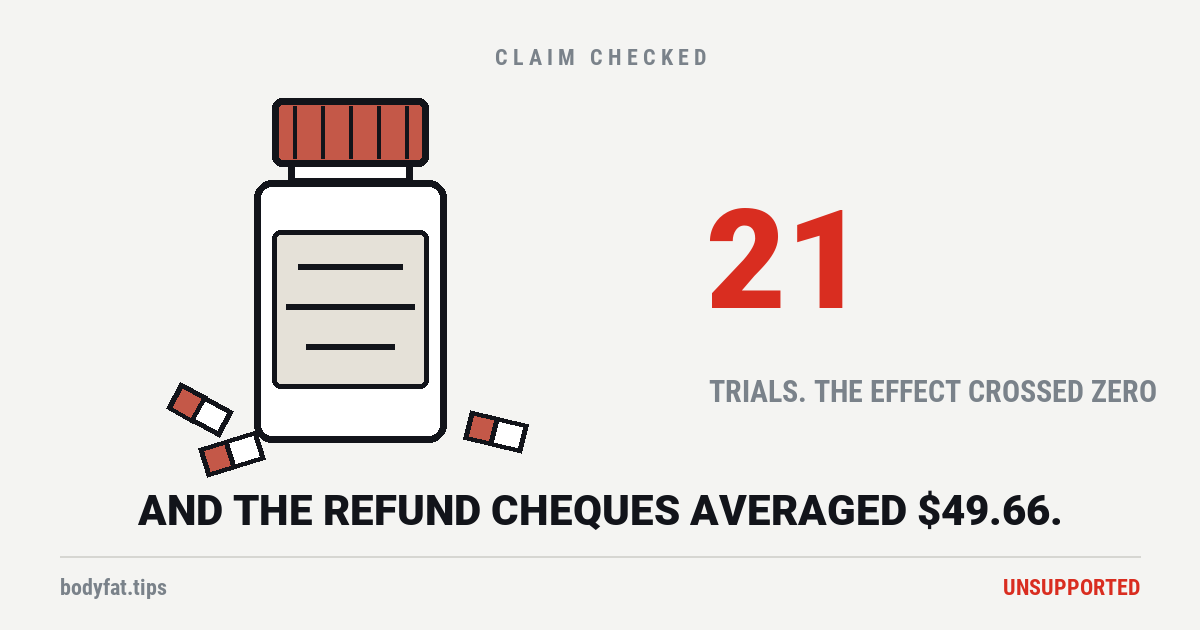
21 trials, and the effect crosses zero
Somebody pooled it properly. Twenty-one studies, every one running longer than eight weeks, in people with a BMI above 24.9 — sifted out of 23,441 database records [1].
There was a trend toward benefit. Then the confidence interval arrived: it crossed 0.00 [1]. In plain terms, the range of plausible true effects includes “does nothing.”
The same analysis compared the supplements against exercise alone, and against diet plus exercise. They lost to both [1].
So why is this an entire aisle? For that, read what a regulator found when it took one of these products apart.
The study was altered while it was running
In 2010 an Austin ingredient company paid researchers in India to run a trial of green coffee extract on overweight adults.
According to the Federal Trade Commission, the study’s lead investigator “repeatedly altered the weights and other key measurements of the subjects, changed the length of the trial, and misstated which subjects were taking the placebo” [2].
Read that as a list. The weights. The trial length. Who got the placebo. Those are not details around the edges of a study — between them they are the study.
When the investigator could not get it published, the company hired university researchers to rewrite it [2]. It was published. It was later retracted.
And here is the sentence that gives the game away
The company’s press release said subjects lost weight “without diet or exercise.”
Learn More:
The FTC’s response, in its own words: the subjects “were instructed to restrict their diet and increase their exercise” [2].
So the people in the trial dieted and exercised. The marketing said they did not. That is not a study being over-interpreted — that is the one fact that would make the product worth buying, asserted in direct contradiction of the protocol.
The Commission’s director put it plainly: the company “knew or should have known that this botched study didn’t prove anything” [2]. It paid $3.5 million.
Then the marketing operation
A separate action, four months later, went after the people selling the finished product to the public. The claim there was that you would lose 17 pounds and 16% of your body fat in 12 weeks without diet or exercise [3].
The sequencing is the part worth knowing. The marketer began selling the extract after agreeing to appear on a television programme but before it aired. During the taping he urged viewers to search for the product using specific phrases — phrases his own companies were buying search advertising on. He worked to get stock into Walmart and onto Amazon timed to the broadcast [3].
The FTC also alleged that spokespeople presented themselves on television as independent sources while concealing their financial ties to the companies [3].
Tens of millions of dollars of product sold. $9 million in consumer redress ordered [3].
What about caffeine? That works, doesn’t it?
Caffeine does raise energy expenditure. That is not in dispute, and it is why it is in almost every product in the category.
But look at what the pooled analysis was testing: real supplements, over eight weeks and longer, in the people who buy them. Whatever caffeine does in a laboratory over ninety minutes, it did not survive into a body-mass difference distinguishable from zero across 21 trials [1].
We have now watched this exact shape three times — with the sauna, with drinking water, and here. A real, measurable, short-term bump in expenditure that does not turn into anything on a scale months later. A mechanism is not a result.
What to actually do
If you like caffeine before training, have a coffee. Same drug, a fraction of the price, and nobody has had to refund anyone for it.
And treat the phrase without diet or exercise as the tell it is. It is the only thing a fat burner can offer that food and training cannot — which is exactly why, when a regulator went and checked, it turned out the people in the study had been told to diet and exercise.
An earlier version of this article, published the same day, told readers we could not reach the Federal Trade Commission — that its press release and case page had refused our requests — and sourced the enforcement facts to news coverage instead. That was true of the one tool we tried and wrong as a claim about what was available: the pages open normally in a browser, which we should have checked before telling anyone a primary source was out of reach. Both FTC releases have now been read at source and are cited directly. Doing so added the separate $3.5 million settlement with the ingredient supplier, which the first version omitted, and the FTC's finding that the study's subjects were instructed to diet and exercise while the marketing said they were not.