Does Pilates Help You Lose Weight? A Little, Maybe. It Burns Like a Slow Walk

“Do Pilates help lose weight” is typed into Google about 8,100 times a month in the United States, and “is Pilates good for weight loss” about 4,400 times (from a paid keyword database, pulled 22 October 2026) [1]. Ask, and the top of the results answers yes, with a calorie range, a promise about muscle and metabolism, and links to six studio and gym brands [1].
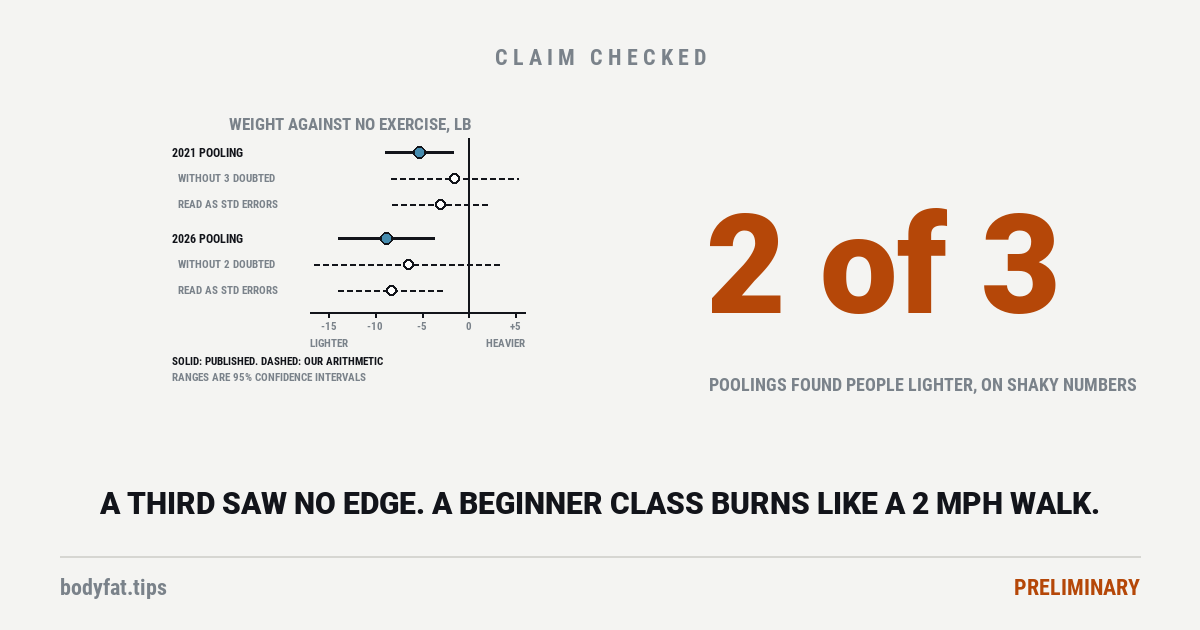
A little, maybe, and the evidence is early. Pooled small trials found people doing Pilates about 5.3 lb (2.4 kg) lighter than people doing no exercise, and that figure leans on three trials with improbably tidy numbers. A beginner mat class burns about what a 2 mph walk does.
That makes Pilates neither useless nor a weight-loss plan. It is roughly a slow walk’s worth of calories with strength and control work attached, and the trials that found more than a slow walk would explain are small enough that one of them moves the answer. Here is the evidence, the arithmetic, and where the bigger promise came from.
This is journalism, not medical advice. If you have an injury, osteoporosis, a recent pregnancy or a heart condition, ask your clinician which exercise suits you.
Do Pilates help lose weight? What the trials found
In 2021 a team in Guangzhou pooled the randomised trials of Pilates in adults with overweight or obesity, in a meta-analysis, a study that combines trials to get one estimate [2]. It found 11 trials and 393 adults, 303 of them women, followed for 8 to 24 weeks [2]. Every one set Pilates against doing nothing, and trials that added a diet were left out [2]. Across the 10 trials that weighed people, the Pilates groups ended up 5.3 lb (2.40 kg) lighter than the groups that did no exercise, with a confidence interval, the range the true average probably sits in, of 1.7 to 8.9 lb (0.77 to 4.04 kg) [2].
Its summary calls that a dramatic reduction [2]. Three things in its own pages make it less dramatic. Its authors rate the evidence for weight low to moderate. When they took out one trial, of 39 Chinese college students, the result was no longer significant: P = 0.06, just the wrong side of the line researchers use for “probably not chance” [2]. And its chart compares the groups’ weights at the end of the trials, not how much each group lost, by our reading; in trials this small, a difference the groups started with is counted as if it were weight lost [2].
Before printing a pooled figure we look for the trials that carry it. Here, three trials carry 60% of the weight, by our sum of the chart’s own percentages, and in all three the groups’ body weights spread only 2.1 to 3.2 kg (4.6 to 7.1 lb) either side of the average, where most of the other groups spread 7 to 12.5 kg (15 to 28 lb) [2]. A narrow spread makes a trial count for more. In groups of 14 to 30 adults with overweight or obesity, spreads that tight are improbable. We did not read the three trials’ own reports, so we could not check them; one describes itself, in its summary, as a quasi-experimental study of bone markers whose women were randomly divided into two groups [3]. Spreads that tight look more like standard errors, a measure of how precise an average is, rather than of how much people vary; papers print the two the same way. So we tested the result both ways. Leave those three out and re-pool the other seven, and the difference shrinks to 1.5 lb (0.68 kg), with a range from 8.3 lb lighter to 5.3 lb heavier. Keep them, read their spreads as standard errors, and turn each back into a spread of people by multiplying it by the square root of the group’s size, and the difference is 3.0 lb (1.34 kg), with a range from 8.2 lb lighter to 2.2 lb heavier. That is our arithmetic, not the authors’, and we mark it as ours. We used the same random-effects method the review did, on the rows of its own chart. Either way, the range includes gaining weight.
| Pooling | Who, and against what | Weight result | What sits underneath |
|---|---|---|---|
| 2021 [2] | 10 randomised trials, 363 adults with overweight or obesity, 8 to 24 weeks, against no exercise | 5.3 lb (2.40 kg) lighter; range 1.7 to 8.9 lb | Three trials with improbably narrow spreads carry 60% of the weight; without them, 1.5 lb lighter, range 8.3 lb lighter to 5.3 lb heavier; with their spreads read as standard errors, 3.0 lb lighter, range 8.2 lb lighter to 2.2 lb heavier (our arithmetic) |
| 2026 [4] | 5 studies, 173 women, some not randomised, 5 to 12 weeks, against no exercise or usual activity | 8.8 lb (3.99 kg) lighter; range 3.7 to 13.9 lb | Two studies with spreads under 3 kg carry 59%; without them, 6.5 lb lighter, range 16.5 lb lighter to 3.5 lb heavier; with their spreads read as standard errors, 8.3 lb lighter, range 2.6 to 13.9 lb, leaning most on one 40-woman study whose Pilates group lost 18.6 lb in eight weeks (our arithmetic) |
| 2020 [5] | 10 studies of mat Pilates in the review, against no exercise or other exercise; how many were pooled for each measure its summary does not say | Not more effective than either, for body-mass index, body fat, lean mass or waist | Read as its published summary |
A 2026 pooling of studies in women only, from a team in Serbia, points the same way and is weaker underneath [4]. It found 12 studies and about 540 women, some of them not randomised, and pooled weight from five: 8.8 lb (3.99 kg) lighter, range 3.7 to 13.9 lb, evidence its own authors rate as very low certainty [4]. It too compared end-of-trial values [4]. Two of its five studies carry 59% of the weight and report spreads under 3 kg in both groups. One of them, a 2017 trial in older women, gives its participants’ ages as 66.0 ± 1.4 and 63.3 ± 0.9 years, spreads small enough to be standard errors [6]. If the weights in the chart are the same kind, that trial counted for far more than it should; that is our inference, and we could not open its tables. The other, a 2022 Ukrainian study, prints its weights with spreads of 3.1 to 3.3 lb (1.42 to 1.50 kg), and its table calls them standard deviations, spreads of people. Its test scores cannot settle which they are. Most of the t values it prints (the bigger the t, the less likely a change is chance), 0.87 for the exercisers’ weight change among them, are what its numbers give if the spreads are standard errors; read as spreads of people, the weights would give a t of about 3.7. But its methods name a paired test, which cannot be redone from the table, and the same arithmetic fits its height row, where reading the spreads as standard errors would mean the exercisers’ heights spread 5.2 to 5.7 in (13.2 to 14.4 cm) either side of the average, an improbably wide spread. So either the spreads are standard errors or the tests were not worked out the way the methods say, and the numbers cannot tell us which; our arithmetic, all of it. Its authors found that the two groups’ body measurements did not differ significantly at the end [7]. Leave those two out and the other three pool to 6.5 lb (2.96 kg) lighter, with a range from 16.5 lb lighter to 3.5 lb heavier; our arithmetic again. Read their spreads as standard errors instead, and the result holds: 8.3 lb (3.75 kg) lighter, range 2.6 to 13.9 lb. But it then leans most on a 2023 Iranian study of 40 women from one sports club, which calls itself controlled, randomised and quasi-experimental, with its groups drawn by lottery, and in which the Pilates group lost 18.6 lb (8.45 kg) in eight weeks, about 2.3 lb a week, while the control group gained 0.4 lb (0.19 kg); leave that one out as well, and the range runs from 11.6 lb lighter to 0.1 lb heavier [8]. Our arithmetic, both.
A 2020 review of 10 studies of mat Pilates, whose summary does not say how many of them it pooled for each measure, reached a different conclusion: mat Pilates was “not more effective” than control conditions or traditional exercise for body-mass index, lean mass, body fat or waist [5]. We read it as its published summary; the paper is behind a paywall [5].
One newer trial is worth its own lines. In 2025 a randomised trial, registered after it began, gave 23 women with overweight or obesity eight weeks of reformer Pilates, three times a week, and 24 women nothing [9]. The reformer group went from 167.6 to 164.6 lb (76.04 to 74.67 kg) and the comparison group from 165.4 to 166.1 lb (75.03 to 75.32 kg), a gap of about 3.7 lb (1.66 kg) in the change, by our arithmetic [9]. The people measuring them knew who was in which group [9]. And the largest trial in the 2026 pooling’s table, 109 women over 60, found body-mass index fell only in the Pilates group, by an effect size of 0.07, on the scale where 0.2 is small and 0.8 large, and that the classes “failed to induce any changes on body composition” [10].
Does Pilates burn fat?
The fat results disagree. The 2021 pooling found body fat 4.2 percentage points lower after Pilates, across eight trials [2]. Its I-squared, the share of the spread between the trials’ results that is more than chance would produce, was 88%; zero would mean they differed no more than luck allows [2]. One row stands out: an eight-week trial whose Pilates group ended at 22.1% body fat and its comparison group at 37.3%, a 15-point gap that no other trial in the chart comes near [2]. We could not find that trial’s report in PubMed, Europe PMC or an ordinary web search, so we could not check the row [3]. Take it out and the other seven pool to 3.2 points lower, range 1.9 to 4.5, with an I-squared of 64%; our arithmetic. So the 2021 fat result does not rest on that row alone.
The 2026 pooling of four studies found no significant difference in body fat percentage: a standardised difference, the gap measured in units of how much people varied, of 0.06, with a range that includes zero [4]. The 2020 pooling found mat Pilates not more effective for body fat than control conditions [5].
A 2019 trial in São Paulo measured fat with a DXA scan, a low-dose X-ray that separates fat, lean tissue and bone [11]. Its Pilates group’s fat percentage fell from 50.9 to 49.1, an effect size of 0.19, small; its walking group’s did not change significantly; and the authors found no significant difference between the groups at the end [11]. Many of the other trials measured fat with bioelectrical impedance, a weak current passed through the body, the principle a body-fat scale uses [2] [9]. Our verdict on body-fat scales is about one person’s reading, which can be far off; a trial compares group averages, which is a fairer use, but a 15-point gap after eight weeks is the kind of number that method should make anyone check.
Does Pilates burn calories?
Yes, about as many as a gentle walk. The figure several of these pages quote comes from 2005: a lab at the University of Wisconsin–La Crosse, paid by the American Council on Exercise, a fitness-certification organisation, measured 15 women aged 18 to 26, all with at least an intermediate level of Pilates experience, following 50-minute mat sessions on video [12]. The beginner routine burned 175 calories and the advanced one 254 [12]. In the report’s own comparison, the beginner session was “equivalent to walking at about 2 miles per hour”, and the advanced one to walking 3.5 to 4 [12]. The women averaged 138.5 lb, and the report appeared in the council’s magazine, not a journal [12].
Measurements since point the same way. A 2026 review pooled six studies that measured a Pilates session [13]. The four that measured the oxygen people breathed, and were not at high risk of bias, averaged 3.0 METs, a unit of effort where 1 is sitting still, and 2.9 calories a minute; on the Compendium’s scale, 3.0 is the bottom of moderate effort [13] [14]. Its authors call even that an exploratory figure from small, varied studies, mostly in young women of normal weight [13]. The highest figure in the review, 9.2 METs for a session on the machines, was estimated from heart rate, and the authors treat it as an outlier from a formula that may overestimate [13]. In a 2024 crossover study of 31 young adults, a 45-minute mat session cost about the same as walking at 2.0 mph (3.2 km/h) and less than walking at 3.0 mph (4.8 km/h) [15]. Pace matters: in one study the same twelve exercises ran from 1.8 METs, one set with two-minute rests, to 3.1, three sets with half-minute rests [13].
| Activity | METs | About |
|---|---|---|
| Pilates, traditional mat (Compendium code 02103) [14] | 1.8 | 120 kcal |
| Pilates, general (02105) [14] | 2.8 | 185 kcal |
| Pilates sessions as measured, the four best-measured studies [13] | 3.0 | 195 kcal |
| Walking, 2.0 to 2.4 mph (17152) [14] | 2.8 | 185 kcal |
| Walking, 2.8 to 3.4 mph (17190) [14] | 3.8 | 250 kcal |
| Walking, 3.5 to 3.9 mph, brisk (17200) [14] | 4.8 | 315 kcal |
Compare that with what studios print. The AI answer at the top of Google’s results says a typical 50-minute session burns 175 to 450 calories [1]. The same sentence, nearly word for word, sits in a New York studio’s FAQ; the 175 matches the 2005 beginner figure, and we could not trace the 450 to a measurement [1] [12] [3]. A reformer-studio franchise lists 250 to 350 calories for its foundational reformer class, for a 150 lb person [16]. A reformer session measured with a gas analyser, in 18 young women, ran at 2.5 METs, which is about 150 calories in 50 minutes for a 150 lb person, by our arithmetic [17] [13]. That study rested two minutes between exercises, and a faster class would burn more; the franchise’s figure is still about double that measurement.
How much weight is a class? On the crude rule that 3,500 calories make a pound, a 195-calorie session is about an eighteenth of a pound, and this site has checked that rule: it is a conversion, not a forecast, because the body adjusts. A class is a snack’s worth of energy. That is true of every half hour or hour of moderate exercise, and it is why the trials matter more than the calorie table.
Is reformer Pilates better for weight loss than mat?
Per minute, a little: in the measured comparison above, the reformer session cost 2.5 METs and the mat session 1.8 [13]. Over weeks, the trials do not show a reliable difference. We read six small comparisons of mat with machine Pilates, and found one more we could not open [3]. Three found no significant difference in weight or body fat between the two [18] [19] [20]. A fourth, a 2025 randomised trial in 36 women with obesity, eight weeks of classes three times a week, found weight and body fat fell significantly within both groups, and the groups’ end weights did not differ significantly [21]. The reformer group did lose about 4.1 lb (1.88 kg) more, by our arithmetic, a gap the paper did not test: it compared where the groups ended, not how much each lost. A fifth, a 2019 Turkish master’s thesis that, as far as we can tell, was published as a paper in 2025, put 32 women through ten sessions in two and a half weeks [22]. Body fat percentage fell in both groups, by under a point; weight fell significantly only on the mat; and again the paper compared the groups’ values at the end, not their changes, with the reformer group leaner from the start [22].
One of those first three is the study a reformer-studio franchise cites for the opposite. Its blog says that in a trial of eight weeks of mat and reformer Pilates, reformer users “achieved significantly greater reductions” in body fat mass (−5.35%) and body-mass index (−1.87%) than mat users [16]. The trial’s own results section says there was no difference between the mat and reformer groups (p > 0.05) on body-mass index, fat mass, fat-free mass or waist-to-hip ratio [18]. The percentages are each group’s change from its own start, not a comparison; the authors’ discussion does suggest the reformer for lowering body-mass index, on those within-group figures [18]. And on body-mass index and fat mass, the change over the eight weeks did not differ significantly from the comparison group’s either, a group that started 6.8 to 7.2 points of body-mass index heavier than the exercisers [18]. The AI answer’s line, that studies show the reformer often leads to greater reductions in body fat than mat, cites the franchise among others [1].
The sixth, published in September 2026, did find a clear difference [23]. In 45 women with obesity past menopause, it compared eight weeks of twice-weekly reformer classes at a Pilates centre, mat Pilates at home, and a lifestyle-education group, which was given one hour-long session with a physiotherapist and a dietitian, a booklet that included advice on eating, and a weekly check-in message. Adjusted for where each woman started, the reformer group ended 6.0 lb (2.71 kg) lighter than the mat group, with a range of 2.8 to 9.1 lb [23]. Its own authors give the reasons to hold that loosely. The reformer classes were supervised in person, while the mat group did one session a week on a video call with the physiotherapist and the other alone, so the trial compared supervision as much as machines. One investigator, who knew which group each woman was in, took every measurement. The trial was registered after its data were collected, it was designed to test menopausal symptoms rather than weight, nobody tracked what the women ate, and the education group’s advice on eating, they write, may have affected its body composition [23]. Two more things, by our reading of its tables: the reformer group’s average weights before and after differ by 8.6 lb (3.90 kg), not the 9.3 lb (4.20 kg) the table gives as its change, and its lean-mass figures carry spreads under 4.4 lb (2 kg) in all three groups, the kind of narrow spread flagged above [23]. So in the six we read, the one clear lead for the machine comes from the trial that also gave its machine group a physiotherapist in the room.
Is Pilates better than walking for weight loss?
Per minute, no: walking at 3 mph or faster costs more [15] [14]. And in the head-to-head trials we read, Pilates did not come out significantly ahead on weight. In the São Paulo trial, eight weeks of Pilates and eight weeks of walking, three hours a week each, left weight in both groups without a significant change, and the groups did not differ significantly on fat at the end [11]. The walkers trained at a higher heart rate, and food diaries showed calorie intake did not change significantly [11].
In a 2015 Polish study of 196 women past menopause, not randomised, 147 of whom finished, 10 weeks of Nordic walking took off 6.4% of body weight and Pilates 1.7% [24]. The paper’s summary mentions a dietary intervention it does not describe; a trade-magazine research column says every participant was given the same 1,500-calorie diet, which we could not check against the paper [25]. In a 2021 Cypriot study of 42 inactive women, a group class lifting light weights for many repetitions beat Pilates on body composition over three months, which the study measured as total and trunk body fat by bioelectrical impedance; its summary gives no result for weight [26].
Four more pointed the other way or nowhere. In a 2026 Korean trial of 18 women with obesity, a Pilates circuit group lost 6.8 lb (3.09 kg) in eight weeks and a weights-circuit group 4.4 lb (2.00 kg), a gap that was not significant [27]. Its table does mark one fat result in Pilates’ favour, 3.4 lb (1.52 kg) less fat mass, but by our arithmetic that row compares where the groups ended, and the Pilates group started 1.9 lb (0.88 kg) lower; its text reports no significant difference in how body composition changed [27]. In a 2024 Turkish trial of 43 sedentary women, body-mass index fell with Pilates and with a dance-based fitness class, and the groups ended similar [28]. In a 2026 Korean trial of 23 adults under moderate stress, eight weeks of Pilates or yoga, twice a week, changed body composition significantly in neither group [29]. And in a 2026 Brazilian trial of 52 women treated for breast cancer, 16 weeks of mat Pilates, belly dance or neither, waist circumference fell across all three groups, most with Pilates, 3.9 in (9.8 cm); at the 6- and 12-month follow-ups both exercise groups had lower body fat percentage, and waists had grown again [30]. Walking for weight loss is rated Supported on this site, on trials that measured people over months; dancing sits where Pilates does, at Preliminary.
Can you lose weight doing Pilates every day?
The trials in the two poolings ran Pilates one to six times a week, most of them three [2] [4]. What daily sessions would add is arithmetic. Seven 50-minute beginner sessions at the 2005 figure of 175 calories come to about 1,225 calories a week burned in class, about a third of a pound on the 3,500-calorie conversion [12]. The nearest trial we found to the question held the total fixed: a 2024 Turkish thesis gave 31 women with overweight or obesity the same 36 mat sessions, three a week for 12 weeks or two a week for 18, and found no significant difference between the groups [31]. So spreading the same sessions out costs little; what adding sessions does, it cannot say.
Pilates for weight loss at home for beginners
Home and online classes have been tried. In a 2023 Korean trial of 30 middle-aged women with obesity, 12 weeks of mat Pilates online, in person, or not at all left no significant differences in body composition between the groups [32]. In a 2024 Italian trial, 35 women with obesity all followed a Mediterranean diet, and those who added 12 weeks of online home Pilates, three hours a week, saw their body fat percentage fall more than those who ate the same way and did not [33]. Read together, and this is our reading: on its own, home Pilates did not significantly beat its comparison in the trials we read that tested it without a diet, the online classes here and the home mat sessions in the 2026 machine trial above, whose home group ended 1.75 points higher in body fat than the lifestyle-education group, which had been given advice on eating, after adjusting for where they started [23]; added to a diet, it moved body fat further. For a beginner, the 2005 measurement is the useful one: the beginner routine on video burned about what a 2 mph walk does [12].
Can Pilates change your body shape?
Shape is mostly fat, muscle and posture. On the waist, the 2021 pooling of two trials found a gap of 1.0 in (2.65 cm) with a range that includes zero [2], and the 2026 pooling of three studies 1.4 in (3.61 cm), with a range from 2.8 in smaller to a difference of zero, P = 0.05, on the line researchers use [4]. In the São Paulo trial the waist shrank about as much with walking as with Pilates [11]. Targeted exercise does not choose where fat comes off; that verdict rests on 13 controlled trials that each trained one arm or leg against the other, and on smaller trials of the abdomen. Posture may move more readily: a 2025 trial found posture scores improved after eight weeks in women with and without obesity [34].
And muscle, the thing studio pages say will raise your metabolism? The pooled lean-mass results were close to zero in both reviews, 0.00 kg across three trials and 0.46 kg, range −2.35 to 3.27, across two [2] [4], though two single trials found small gains [11] [9], and in the 2026 machine trial the reformer group gained 5.1 lb (2.33 kg) of lean mass in eight weeks, on the narrow spreads noted above [23]. Whether Pilates builds muscle is a question for another page. For weight, the claim that it builds enough muscle to raise your resting burn is not one these trials support; lifting weights has the stronger record on fat, and body recomposition explains why the scale can hide it.
What is the 80/20 rule in Pilates?
It is not a Pilates rule, and it has more than one meaning. A Pilates-video creator’s blog, asked about it in 2021, took it as “80% diet 20% exercise”, called the numbers “not an exact science”, and offered a second meaning, eating well 80% of the time [35]. Neither split comes from a trial, and this page does not rate it. The arithmetic above makes the point it gestures at: a class burns a snack’s worth of energy.
Is Pilates good for back pain?
Yes, as far as the trials go. In the two ranking analyses that our verdict on exercise for back pain reads closely, Pilates led for pain in both, and the one that grades its evidence calls it low quality; that page rates exercise for chronic low back pain Supported. It is a different question from weight.
What are the disadvantages of Pilates?
For weight, the main one is the arithmetic above: a beginner class burns about what a slow walk does. The second is the evidence: small trials, without blinding, where one trial can move the pooled answer [2]. On safety the trials say little; the 2021 pooling’s authors report that none of its 11 trials reported an adverse event, so they could not judge safety [2]. If you have an injury, osteoporosis, a recent pregnancy or a heart condition, ask your clinician; our verdict on exercise for osteoporosis covers what is known about exercise and fragile bones.
Who these studies were done on
Mostly women with overweight or obesity, followed for weeks, not years. In the 2021 pooling, 303 of 393 people were women, 9 of its 11 trials enrolled women only, and the trials came from Turkey, Iran, India, Korea, China and the United States [2]. The 2026 pooling was women only, from young adults to women over 60 [4]. The energy measurements are mostly young adults of normal weight [13] [12]. Men appear in two all-male trials in the 2021 pooling and in the São Paulo and walking-speed studies [2] [11] [15].
So read yourself against them. If you are a woman with overweight or obesity, the trials are about you, and they are small. If you are a man, older, or not overweight, the weight evidence is thinner still; in women over 60, a 109-woman trial found body-mass index barely moved [10]. The energy measurements, which do transfer, say the same thing for everyone: a beginner session costs about what a slow walk does.
If a class burns what a slow walk does, why did the pooled trials find 5 lb?
This section is the desk’s own reasoning, and it is labelled as such. The calorie measurements and the pooled weight result do not sit easily together. Here are three ways they might fit, each rated.
Answer one: the arithmetic says less. Most trials in the 2021 pooling ran three classes a week of 50 to 90 minutes, for 8 to 16 weeks [2]. Take 12 weeks of one-hour classes, 36 sessions. At 3.0 METs a 165 lb adult burns about 160 calories a session more than sitting would, so 36 sessions come to about 5,700 calories, about 1.6 lb on the 3,500-calorie conversion [13]. The pooled answer is 5.3 lb. That gap is arithmetic, not a measurement, and the conversion it leans on is rough.
Answer two: the trials are small enough to wobble. Drop one trial and the 2021 result loses significance [2]; drop the three with improbably narrow spreads, or read their spreads as standard errors, and it shrinks to 1.5 or 3.0 lb, with a range that includes gaining weight. The fragility is measured, in the authors’ own test and in our re-pool of their chart. That it explains the gap between the arithmetic and the pooled figure is a surmise.
Answer three: the plate moved. Exercise can change eating in either direction. In one 2025 trial, women with obesity who did Pilates scored lower on a questionnaire about emotional eating [34]; in the São Paulo trial, food diaries showed calorie intake did not change significantly, and weight did not change significantly either [11]. The 2026 pooling’s authors note that diet was not consistently reported or controlled across its studies [4]. That eating explains part of the gap is a surmise, with one questionnaire for it and one set of food diaries against it.
Put the three together and here is what we think is true, stated plainly so you can disagree with it: count a Pilates class as a slow walk’s worth of calories; the trials that credit it with more are not yet strong enough to be believed on their own. That is not a reason to stop. It is a reason to value the class for what it measurably does, and to look elsewhere for the calories.
What we could not find, and would like to: a trial that set Pilates against brisk walking for the same hours each week, for six months or more, with food recorded and fat measured by DXA [3]. The head-to-head trials on this page trained people for 8 to 16 weeks, and the one that measured them again a year later set Pilates against belly dance, not walking [11] [24] [26] [30]. The nearest in sight is a registered 12-week trial of 80 young women, Pilates against treadmill training against both against neither, with DXA, listed as completed in December 2025; it had posted no results on the registry when we looked [3]. If you know of the longer trial, the corrections line on this site is open.
Where “Pilates helps you lose weight” came from
Joseph Pilates built his method in the 1920s for strength and control, and the 2021 pooling’s authors note that it was “not designed to reduce body weight” [2]. We could not trace who first sold it for weight loss.
By 2006 the pitch was on television. That June a US network news magazine reported on infomercials for a home Pilates DVD set in which ordinary customers said they had “lost over 100 pounds” using the program; the report pointed out that a bonus aerobics tape and a weight-loss plan came with the set, and the company said you had to follow the whole program to lose the weight [36].
The research came later, and today’s pages cite it. The 2021 pooling, whose summary calls the result dramatic, is cited by the reformer-studio franchise and by a prescription-discount site [2] [16] [1]. The calorie figure several of these pages repeat, 175 for a beginner class, is the 2005 measurement paid for by a fitness-certification body, which put that class level with a 2 mph walk; a studio FAQ puts a session at 175 to 450, and Google’s AI answer repeats that range [12] [1].
And it sells. For this search the AI answer cites six studio and gym brands, a health site, a video, and a prescription-discount site whose menu, on the same page, sells subscriptions to weight-loss drugs [1]. The reformer franchise’s page carries a free first class and a banner offering to let members pay with pre-tax health-account money, and tells readers that a 2026 study found Pilates “directly lowers circulating cortisol levels, halting stress-induced fat retention” [16]. That study had no comparison group, followed 30 women for four weeks, found cortisol lower in the older half only, and did not measure fat storage; it measured body-mass index and waist [37]. What meditation and yoga do to cortisol has its own verdict.
None of this is aimed at anyone doing Pilates. It is a good class, and the trials say it does real things. It is the calorie table on the studio wall that owes you a correction.
What this is rated, and what the rating covers
Preliminary — for the claim that Pilates helps you lose weight.
It is rated Preliminary because the evidence in its favour is small and conflicting. Two poolings of small trials against doing nothing found people a few pounds lighter after Pilates, on evidence their own authors rate low to moderate in one and very low in the other [2] [4]. The first shrinks to a range that includes gaining weight when its three trials with improbably narrow spreads are dropped or read as standard errors; the second falls to a range that includes gaining weight when its two narrow-spread studies are dropped, and holds when their spreads are read as standard errors, but then leans most on one 40-woman study whose Pilates group lost 18.6 lb in eight weeks, by our arithmetic [8]. A third pooling found mat Pilates not more effective than doing nothing [5]. A randomised reformer trial, registered after it began, found a 3.7 lb gap in eight weeks [9], a 2026 trial put supervised reformer classes 7.4 lb (3.36 kg) ahead of a lifestyle-education group that had been given advice on eating, while home mat sessions were not significantly ahead of it [23], and the head-to-head trial against walking that measured fat by DXA found neither group’s weight changed significantly [11]. The longest training on this page, six months of mat and machine Pilates twice a week against no exercise, in 20 sedentary women aged 60 to 69, found no significant difference between the groups in weight or in body fat measured by DXA; the Pilates group weighed 149.5 lb (67.8 kg) at the start and 149.3 lb (67.7 kg) at the end [38]. A session burns about what a slow walk does [12] [13] [15], which is enough to help a little and not enough to explain the bigger pooled figures.
Each narrower claim, rated alone, in words. That Pilates lowers body fat: Preliminary; one pooling found 4.2 points less, or 3.2 without a 15-point row we could not check, and another found no significant difference [2] [4]. That Pilates beats walking or other exercise for weight loss: Unsupported, of the tested kind; it was tested in small head-to-head trials, where walking, yoga and a dance-based class matched it, Nordic walking beat it, a light-weights class beat it on body fat, and its lead over a weights circuit was not significant; and brisk walking burns more a minute [11] [29] [28] [24] [26] [27] [15]. That Pilates tones you, read as more muscle and less fat where you can see it: Preliminary, with the evidence leaning against; the pooled lean-mass and waist results include no difference, two small trials found small gains and a third, on improbably narrow spreads, a larger one, and targeted exercise does not choose where fat goes [2] [4] [11] [9] [23]. That doing it every day makes it a weight-loss method: Preliminary, on the same small trials, one of which ran five or six sessions a week and measured body fat only; daily classes add about a slow walk a day, by arithmetic [2] [12].
What is not rated here: Pilates for back pain, which has its own verdict; muscle and strength, a question for another page; and the frame in the section above, which is this desk’s reasoning from the evidence rather than a result the evidence delivered. It is marked as ours so that you can weigh it as ours.
This is journalism, not medical advice. How we read a study, and what each tier means, is set out here.
Two source descriptions were corrected on 23 October 2026. We called the 2020 review of mat Pilates [5] a pooling of 10 studies. Ten is the number of studies the review selected; its summary does not say how many of them went into the pooled result for each measure. And we said a light-weights circuit class beat Pilates on body composition in the 2021 Cypriot study [26]. Its summary and its trial registration describe a group class lifting light weights for many repetitions, not a circuit, and the body composition it measured was body fat, total and around the trunk, by impedance; the summary gives no result for weight. We found both while writing our page on Pilates and muscle, which cites the same two papers. No figure in our findings changes, and no rating changes.
- Vibration Plate Benefits: The Three Biggest Randomised Bone Trials We Found With Results, 1,086 People, Showed No Clear Gain. Stronger Legs Are Another Matter.
preliminary - Exercise for Osteoporosis: Lifting and Jumping Left Women About 1% Ahead on Bone Density, by Our Reading. Fewer Fractures Is Less Certain
supported - How to Calculate Max Heart Rate: 220 Minus Age Missed 70 of 230 Adults by Over 10 Beats in One Lab (Our Count)
established