Does Castor Oil Help Hair Growth? Tested on Eyelashes and on Bald Patches, It Did Not Clearly Beat the Comparison

“Does castor oil help hair growth” is typed into Google about 6,600 times a month in the United States (from a paid keyword database, pulled 22 October 2026) [1]. “Can castor oil grow eyelashes” is searched about 3,600 times a month (from a paid keyword database, pulled 22 October 2026). The bottle is cheap, the routine is pleasant, and the before-and-after photos are everywhere. It is a fair question.
And it has a better answer than most of the people giving it seem to know, because castor oil has been tested. Not much, and not well, but tested.
Short answer: not shown. In the two studies that compared it fairly with something else, castor oil did not clearly beat the comparison: on eyelashes, against a placebo, in 11 people; and on bald patches, added to a steroid cream, in 59 people compared with 100 on the cream alone [2] [3]. The scientific-sounding reason it should work, that it blocks a hair-loss signal called prostaglandin D2, is a computer prediction from 2015 [4] that, as far as we could find, has not been tested in a lab since [5].
This is journalism, not medical advice. If you are losing hair suddenly or in patches, see a doctor first: some causes are treatable, and the treatment depends on the cause. And keep oils out of your eyes.
What happened when castor oil was tried on hair in people?
Here is every study in people we found that put castor oil, or a product containing it, on scalp hair, eyelashes or eyelids and measured what happened.
| Who and what | Compared with | What happened |
|---|---|---|
| Eyelashes: 11 adults aged 20 to 40, a treatment containing 35% castor oil on one side, nightly, 12 weeks [2] | A placebo on the other side; described as double-blind | Thickness: no significant difference between the sides. Length: no significant difference at the inner or outer corner; about a fortieth of an inch (0.64 mm) longer at the middle. The study’s own summaries report no significant difference |
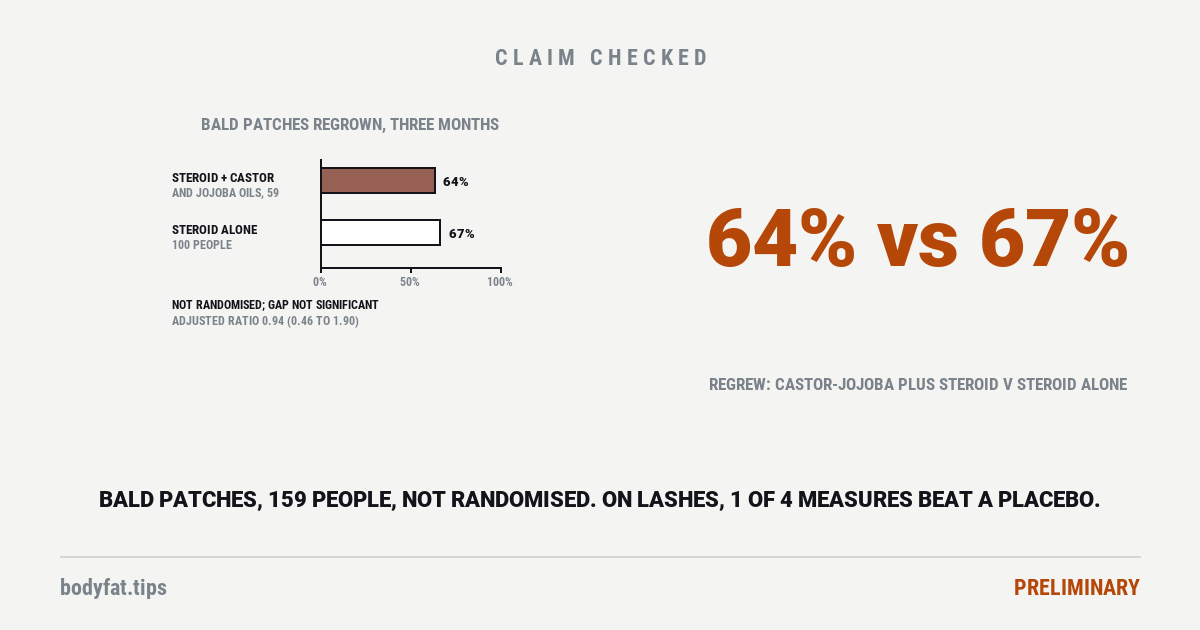
| Patchy hair loss (alopecia areata): 59 people adding castor and jojoba oils to a steroid cream, 3 months [3] | 100 people on the steroid cream alone; not randomised | Regrowth in 64% against 67%; not a significant difference |
| Thinning hair: 26 adults on a rosemary-and-castor oil blend, three times a week, 90 days [6] | 27 on coconut oil, which the paper calls the placebo, and 29 on a second blend | Every group improved on the camera and hair-fall measures, coconut oil included (though not on a dermatologist’s grades of shine and volume); no test between the groups reported; paid for by the oils’ maker |
| Inflamed eyelids (blepharitis): 26 adults, castor oil on one eye’s lids twice a day, 4 weeks [7] | The other eye, untreated | Lash loss and other signs improved in the treated eyes and not in the untreated ones; no side effects reported |
| Hair loss and other hair problems: 16 volunteers on a blend of castor, sunflower, jojoba, olive, pumpkin and other oils, 3 months [8] | Nothing | About half reported more growth and less hair fall |
Two rows in that table are worth slowing down for, because they are the only two that compared castor oil with something fairly. One is about bald patches, the other about lashes. Before them, the trial that sounds best and says least.
In a trial published in 2025, a hair-oil company paid a contract research firm in India to test two of its oils [6]. Ninety adults complaining of thinning hair were split into three groups: a rosemary-and-lavender blend, a rosemary-and-castor blend, and coconut oil, which the paper calls the placebo (a dummy treatment meant to do nothing). Each was massaged in three times a week for 90 days. Eight people dropped out; 26 in the rosemary-and-castor group were analysed.
By the firm’s scalp camera, the rosemary-and-castor group’s hair growth rate rose by 48% by the end (0.23 to 0.33 mm a day), and their hair density rose by about a third [6]. But the coconut oil group improved too, on every camera and hair-fall measure: growth rate up 21%, density up 10%, each change significant within the group [6]. The paper tests each group against its own starting point and reports no test of one group against another; its comparisons are ratios of the percentage changes [6]. The rosemary cannot be separated from the castor, and the other blend, which also contains castor oil among nine oils and vitamin E, did about as well.
One more thing we noticed, and it is our observation rather than the paper’s. The camera put the average strand at 16 to 20 micrometres wide at the end of the trial (a micrometre is a thousandth of a millimetre) [6]. A hair-loss drug trial later on this page counted a scalp hair as a full-grown “terminal” hair only from 30 micrometres [9]. We cannot tell from the paper what the camera was measuring.
A sixth study is cited on a skincare brand’s website: 15 people on a castor oil tonic and 15 on a placebo for 60 days in Brazil in 2018, with, the brand says, more hair growth in the tonic group by the end [10]. The brand gives no numbers and no concentration. We could not find the study itself, so it is not counted here; if you know where it is, the corrections line on this site is open.
Does castor oil grow hair on bald spots?
There are two common kinds of bald spot, and the evidence differs.
Round bald patches are usually alopecia areata, in which the immune system attacks hair follicles; it tends to come and go. In a study published in 2025, doctors at seven clinics in the West Bank followed 278 people with it for three months [3]. Everyone used a steroid cream; some also used minoxidil, and 59 added castor and jojoba oils, three drops for every third of a square inch of patch (2 cm2) twice a day, the herbal mix the authors say is most used locally. Hair regrew in 64% of the castor-and-jojoba group and 67% of those on the steroid alone [3]. Allowing for differences between the groups, the authors put the oil group’s chance of regrowth at 0.94 times the steroid group’s, where 1.00 means no difference [3]. The confidence interval, the range the true answer probably sits in, ran from 0.46 to 1.90: not a significant difference, and too wide to rule out the oil helping or hindering by a fair margin.
Minoxidil, added the same way, did better: regrowth in 83%, a significant difference [3]. This was not a randomised trial. People got whatever their dermatologist chose, and the groups differed in age, schooling and history [3]. It is still the biggest test of castor oil on hair we found, and it had no funding from anyone.
A receding hairline or thinning crown is usually pattern hair loss, the kind driven by DHT, a hormone made from testosterone (our creatine and hair loss verdict explains it). We found no study of castor oil in people diagnosed with pattern hair loss. The 2025 alopecia study excluded them [3]. This is the kind of hair loss the castor oil mechanism story is about, which makes the gap worth noticing.
Can castor oil grow eyelashes?
The one trial we found that tested castor oil on lashes in a way that could tell was a student’s [2]. For a master’s degree at a Thai university, eleven volunteers aged 20 to 40 were given two tubes: a treatment containing 35% castor oil and a placebo, labelled left and right, to be applied at the base of the lashes on each side every night before bed for 12 weeks [2]. That is a split-face design: each person is their own comparison. The paper describes it as double-blind, meaning neither the volunteers nor the people measuring knew which side got the oil.
Lash thickness rose on both sides, by 4.64 micrometres with the oil and 3.82 with the placebo; a lash was about 70 micrometres across to start with [2]. The gap between the sides had a p-value of 0.45. A p-value says how easily luck alone could produce a gap that size; researchers usually want it below 0.05 before they call a difference real, and 0.45 is nowhere near.
Length was measured with a lash ruler at three points: the inner corner, the middle and the outer corner. On the placebo side not one reading moved at any visit, at any point [2]. On the oil side, the corners lengthened by amounts that were not significantly different from the placebo’s zero, and the middle by 0.64 mm on average, about a fortieth of an inch, with a p-value of 0.026 [2]. By our arithmetic that average equals seven millimetre marks spread across the eleven people.
So one of the four measures crossed the line, in eleven people. Measure four things and one can cross it by luck; the student’s own summaries, in English and in Thai, both report no significant difference between the sides [2]. Three volunteers had mild discomfort in both eyes in the mornings, which the paper puts down to the liquids running into their eyes overnight [2]. This is a degree project, not a journal paper, and it does not list what was in the placebo.
The other lash result comes from a different problem. In blepharitis, inflamed eyelid margins, lashes can thin and fall out, which doctors call madarosis. A 2021 trial in New Zealand had 26 people with blepharitis paint pure castor oil on one eye’s lids twice a day for four weeks and leave the other eye alone [7]. Lash loss, lid thickening and other signs improved in the treated eyes and not in the untreated ones, crusting fell more in the treated eyes, and no side effects were reported [7]. The summary we read reports a direct comparison between the eyes for crusting; the paper’s discussion, in the extract we could read, speaks of “greater reductions” in lash loss as well, and the table that would show whether lash loss was compared between the eyes we did not read. Improving in one eye but not the other is not the same as one eye beating the other. It is also a different claim: calming a diseased eyelid so lashes stop falling out, not growing healthy lashes longer. A larger trial from the same university, six months of a castor oil preparation against salt water on the lids of both eyes in 100 adults with blepharitis, funded by a company, finished collecting data in February 2025; it measures lash crusting, not lash loss, its registry record holds no results, and we found no report of it [11] [5].
How long does it take for castor oil to help lashes?
Nothing we read shows clearly that it does, so nothing can say how long. What we can tell you is how lashes grow. A lash grows about a two-hundredth of an inch a day (0.12 to 0.14 mm), grows for four to ten weeks, and is replaced on a cycle of four to eleven months; lashes rarely grow past half an inch (12 mm) [12]. That, by our reading, rules out the overnight version of the claim: at that rate there is nothing visible to gain in one night.
For comparison, the prescription lash drug bimatoprost does not show a significant effect in most people until about two months, according to its label [13]. The castor oil lash trial ran twelve weeks, long enough for that drug to show, by the label’s own timeline.
How long does castor oil take to grow hair?
The same answer: the studies we found have not shown that it grows hair, so they cannot say how long it takes. None of them ran longer than three months [2] [3] [6]. The drugs that do grow scalp hair were tested for 48 weeks to two years, in the trials below [14] [15]. If you are giving any hair treatment a fair try, months are the unit, not weeks.
Castor oil for eyebrows
We found no study of castor oil on eyebrows, in any design. The brow claim travels on the lash claim, and the lash claim is the one with a test behind it. That test is above. The nearest other results are in rabbits’ fur, further down.
Where the prostaglandin story comes from
If you have read that castor oil works because of “prostaglandin D2”, here is where that comes from, and where it stops.
Prostaglandins are signalling chemicals the body makes in its tissues. In 2012 a University of Pennsylvania team found one of them, prostaglandin D2 (PGD2), at about twice the level in bald scalp as in haired scalp from the same men: 53.5 against 25.6 nanograms per gram of tissue in samples from 17 men [16]. Added to hair follicles kept alive in a dish, a high dose left the hairs 62% shorter; applied to mice it slowed hair growth too [16]. The enzyme that makes PGD2 was also raised in bald scalp. That made the enzyme, and the receptor PGD2 acts on, targets for a hair-loss drug. Three of the authors are named on patents involving PGD2 and hair [16].
In 2015 a team in Macao went looking for plant compounds that might block that enzyme, using a computer [4]. In silico, the term the paper uses, means on a computer: software scores how snugly each molecule’s shape fits the enzyme’s working pocket. They scored 389 compounds from 12 herbs used in traditional Chinese medicine, and five came out as the best candidates. One was ricinoleic acid, about 90% of the fatty acid in castor oil [4] [17]. The authors wrote that these compounds had “the highest potential for further in vitro and in vivo investigation”: tests in cells and in animals, next [4].
We looked for those tests and did not find them [5]. The one laboratory measurement we found of ricinoleic acid and PGD2 together is older and points the other way: in 1987, added to gut tissue in a dish, ricinoleic acid increased the tissue’s output of prostaglandins, PGD2 among them [18]. That was gut, not skin, and it is one study. It is still more than the computer prediction has had.
Then the idea was tested in people from the other end, with a drug built for the job. Setipiprant blocks the receptor PGD2 acts on. In a trial of 169 men with pattern hair loss, 83 on setipiprant, 74 on a dummy pill and 12 on finasteride, 24 weeks of it was not significantly better than the dummy pill: full-grown hairs rose by about 7 per square centimetre (about 45 per square inch) in both groups, and the difference the trial tested, 0.4 per square centimetre after allowing for starting counts and age, had a p-value of 0.92 [9]. That trial blocked the receptor, not the enzyme the castor oil story is about, so it does not settle the castor question. What it adds is that a drug built to block PGD2’s receptor was not shown to grow hair beyond a dummy pill in the trial that tested it. A second way into the pathway has been tried too: cetirizine, an allergy drug, rubbed on the scalp on the reasoning that it lowers PGD2 [19]. A 2022 review that found three trials of it, at moderate to high risk of bias, judged it likely to beat a placebo [20]. Later trials point both ways. In 66 women also using minoxidil, cetirizine lotion was tested against a dummy lotion in a double-blind trial, and the hair measured through a magnifying scalp camera was not significantly different between the groups, apart from one count at one visit, though the women on cetirizine rated their improvement higher [19]. In 80 men, cetirizine pushed into the scalp by microneedling, pricking the skin with fine needles, beat salt water given the same way: after eight weeks the paper’s summary reports denser hair in 80% of the cetirizine group against 25% of the salt-water group, in a single-blind trial, meaning one side of it, the patients or the assessors, did not know who got which [21]. And in 62 men and women, adding it once a day to minoxidil was not significantly better than minoxidil alone on a dermatologist’s scores of hair density and thickness, or on photographs, judged without knowing who got which; people on it were more satisfied, which the authors say may be down to the extra daily application, since the other group had no dummy lotion. That trial assigned people by whether their national identity number was odd or even [22]. The other later trials for pattern hair loss that we found compared it with minoxidil or had no comparison group, which cannot show whether it beats a dummy [5]. None of this involved castor oil, and an allergy drug does more than lower PGD2.
What castor oil’s acid is known to do is in our castor oil pack verdict: swallowed, it is released in the gut and switches on a prostaglandin E receptor there, which is why castor oil is a laxative. A cosmetics safety panel noted in 2007 that ricinoleic acid is chemically similar to a prostaglandin but did not have the same effects in the body in the studies it reviewed [23]. The lash trial above was built on that resemblance: its hypothesis was that a prostaglandin-like acid might do what prostaglandin drugs do for lashes [2].
What does grow lashes and scalp hair in trials?
For a yardstick, here is what a treatment that works looks like in a trial.
Lashes: bimatoprost. A prescription solution brushed on the upper lid. In its main trial, 278 adults for 16 weeks, 78% of those on the drug had visibly more prominent lashes by at least one grade, against 18% on the plain solution; lashes grew about 0.06 inch (1.4 mm) longer, against 0.1 mm [13]. It has side effects: itchy or red eyes and darkened eyelid skin in about 3 to 4%, and a brown change in iris colour that is likely permanent [13]. So what is the best oil for eyelash growth? Of the trials we found, none showed an oil clearly growing lashes; the product with a large trial behind it is a drug [5].
Scalp: minoxidil and finasteride. In a 48-week trial of 393 men, 5% minoxidil solution beat both 2% and a placebo [14]. In two year-long trials of 1,553 men, finasteride tablets left men with 107 more hairs than placebo in a one-inch circle of the crown (5.1 cm2), while the placebo groups kept losing hair [15]. Our finasteride verdict covers what the drug does to hormones and its side effects.
Those are drugs, with prescribers, labels and side effects. The point here is the size and length of the tests that found them working: hundreds of people, months to years, against a dummy. A castor oil treatment has had eleven people for twelve weeks on lashes; castor oil on its own has had no test on scalp hair that we found.
The US Food and Drug Administration drew a line of its own in 1989. Its rule, still in force, says there are not enough data to recognise any ingredient sold over the counter to be rubbed on as a hair grower as safe and effective, naming jojoba oil and lanolin among those sold that way, and it treats any such product promoted as a hair grower as a new drug that needs the agency’s approval [24]. Castor oil is not named; the rule covers “any other ingredients” too. It is a regulator’s judgement on the evidence it had in 1989, not a test of castor oil.
Which castor oil is best for hair growth? And black castor oil?
No study we found compared kinds of castor oil for hair, and we found no study of black castor oil, the dark Jamaican and Haitian kind, on hair at all [5]. A 2020 review of natural treatments for a scarring hair loss that commonly affects women of African descent searched specifically for black castor oil and found no clinical trials of natural ingredients for that condition [25]. Which bottle is best is a question about smell, thickness and price, not growth.
Castor oil and rosemary oil for hair growth
The one trial of the two together cannot separate them, as above [6]. Rosemary oil has a trial of its own: in 2015, 100 people with pattern hair loss used rosemary oil or 2% minoxidil for six months, hair counts rose in both groups, and the groups did not differ significantly [26]. There was no placebo group, so that does not show either beats nothing.
A 2026 pilot study in mice tried both oils, alone and mixed, on shaved backs for 28 days, with three mice in each group [27]. Rosemary oil and the mix grew longer fur than untreated mice. Castor oil on its own did not: 10.1 mm against 10.6 mm for mice given nothing, which the authors call no clear difference [27]. Three mice a group is a hint, not a result, and the authors say so. On what is there, if the blend does anything, it is pointing at the rosemary.
To be fair to castor oil, two rabbit studies we found have gone its way. In 2008 in Romania, patches of skin cleared of hair on 20 rabbits were treated every other day for 35 days with lotions of 35% or 40% castor oil, beside an untreated patch on each animal [28]. With the 35% lotion, the hair in more than half the animals grew longer than 1.2 inches (30 mm), against about 0.7 to 1 inch (18 to 25 mm) on the untreated patches; the stronger 40% lotion did worse, its hair growing “slower and non-uniform” [28]. The paper reports no statistical test. Its 35% lotion was a milky emulsion that also held lanolin, the grease from sheep’s wool, and cetyl alcohol, a waxy fat used to thicken creams, and it was compared only with the untreated patch, never with the same lotion minus the castor oil, so the oil’s part cannot be told from the rest of the lotion’s. The 40% lotion, the one that did worse, had more castor oil and no lanolin, and the paper says it showed “even a slightly allergic effect” [28]. The lash trial above cites it and used the same 35% strength [2]. And in 2021, in a study of eight shaved rabbits, those given an ointment of castor oil and shea butter for 28 days grew longer hair than untreated controls [29].
Which is better, coconut oil or castor oil?
For growth, neither has shown much. In the one trial that set them side by side, coconut oil was called the placebo and improved on every camera and hair-fall measure too [6]. A 2022 systematic review of 22 articles found coconut oil had clinical evidence for brittle hair and head lice, castor oil weaker evidence for shine, and neither had strong evidence for growth [30]. The shine is real: in a laboratory test on cut hair, castor oil made hair reflect light more [31]. In the side-by-side trial, a dermatologist’s grade of shine improved in the rosemary-and-castor group and stayed where it started in the coconut group, in a trial of a blend, paid for by its maker, that tested neither group against the other [6]. So is castor oil good for hair growth? Not on the studies above. Good for shine, on a test in a lab.
Castor oil for hair: side effects
Felting. In 2017 doctors in India reported a 20-year-old woman who put coconut and castor oil on her long hair for the first time, “for hair growth”, then washed it as usual [32]. As it dried, the whole of her hair twisted into a hard mass the doctors compared to a bird’s nest. It could not be undone, so she was advised to have it cut off, and she was treated for an acute stress reaction [32]. The authors blame the oil’s thickness on long hair in warm water. It is one case report, the only one we found naming castor oil, so it says the risk exists, not how often it happens [5].
Skin reactions. In the 2025 alopecia study, 35 of the 59 people using castor and jojoba oils reported an allergic reaction, against 9 of the 100 on the steroid alone [3]. The paper’s percentages for side effects use smaller groups that it does not explain, and jojoba was in the mix too. A 2007 cosmetics safety review found castor oil was not a significant irritant or allergen in human tests, while noting that people with existing work-related skin disease reacted more often [23]. If it stings, itches or reddens, stop.
What are the negative effects of castor oil on eyes?
“Can you put castor oil in your eyes” is among the rising Google searches for castor oil this month [1]. In the studies, the record is mixed and small. The lash trial had three of eleven volunteers with mild morning discomfort in both eyes, likely from liquid running in overnight [2]. The eyelid trial, with pure oil on the lids for four weeks, reported no side effects in 26 people [7]. The 2007 safety review summarises two older studies of castor oil dropped into people’s eyes: mild, passing discomfort and minor surface changes in nine people, and damage to surface cells of the cornea, the clear front of the eye, in another study of 100 [23]. We read the summary, not those studies.
Castor oil can also be made into proper eye drops: a 2% castor oil emulsion, mixed so it disperses in water, was tested as drops for a kind of dry eye in 20 patients without complications [33]. That is a formulated medicine, not oil from a bottle on a mascara wand. Keep oils out of the eye itself; if your eye stings, reddens or your vision blurs and does not clear, stop and see a clinician.
Who these studies were done on
The lash trial: eleven adults aged 20 to 40, at a Thai university [2]. The bald-patch study: Palestinian patients from age 8, average age 28, 56% male, all with alopecia areata covering less than half the scalp [3]. The rosemary-and-castor trial: Indian adults aged 19 to 54, three in five women, with complaints of thinning but no diagnosis [6]. The eyelid trial: New Zealand adults with blepharitis [7].
What is missing matters as much. None of these studies was of people diagnosed with pattern hair loss, and none, as far as we found, tested castor oil in the communities with textured hair where, a 2026 review notes, it has long been a staple of hair care [17] [5]. If that is you, we found no study of people like you either way.
When hair loss has a medical cause
Hair loss can come from illness, stress, cancer treatment, weight loss or iron deficiency, and much of it is temporary; the NHS advises seeing a doctor to find out the cause before paying a commercial hair clinic [34]. Sudden or patchy loss in particular deserves a clinician’s look, because some causes are treatable and the treatment depends on the cause. A bottle of oil should not be the thing that delays that visit.
Then why do the before-and-after photos look so good?
This section is the desk’s own reasoning, and it is labelled as such. The studies say castor oil has not been shown to grow hair or lashes. The photos, the reviews and the people who swear by it are real. Both can be true, and here are three reasons why, with the evidence for each.
Answer one: the oil changes the hair that is already there. Castor oil is thick and glossy. In a laboratory test it made cut hair reflect light more [31]. A coated strand looks shinier, lashes slicked with oil look darker and clump into fewer, thicker-looking points, and none of that needs a single new hair. The shine is measured, on cut hair in a lab. That it explains the photos is our inference.
Answer two: the comparison groups got better too. In the three hair studies here with a comparison group, the comparison improved too: placebo-side lashes thickened [2], the coconut oil group’s hair grew faster and denser [6], and two-thirds of the people with bald patches regrew hair on the steroid alone [3]. Much hair loss is temporary and grows back by itself [34], and, we suspect, people tend to start a remedy when things look worst. The improvement in the comparison groups is measured, in all three studies. That the same thing is behind people’s photos is a surmise.
Answer three: a lash serum that works may be working for a reason not on its front. A 2026 survey of 79 lash serums found about 30% contained a prostaglandin-like drug, the prescription lash drug’s own ingredient among them, and the authors note these are not regulated for use in cosmetics; the rest relied on ingredients such as castor oil, amino acids and peptides [35]. So a dramatic result from a product with castor oil on its label may owe nothing to the castor oil. The survey is a measurement of labels. Whether it explains anyone’s photos is a surmise, and we checked no product ourselves.
Put the three together and here is what we think is true, stated plainly so you can disagree with it: castor oil changes how the hair you already have looks; nothing we read shows clearly that it changes how much of it grows in people.
What we could not find, and would like to: a trial of plain castor oil against a plain comparison oil, in people with thinning scalp hair or sparse lashes, measured by someone who does not know which is which, for at least six months. The eleven-person lash trial is a start that, as far as we found, nobody has followed. And we would like to read the 2018 Brazilian study the skincare brand describes [10]. If you know of either, the corrections line on this site is open.
Where “castor oil grows hair” came from
We could not trace who first said it. The practice is old: a 2022 dermatology review says castor oil was used on hair in ancient Egypt, “allegedly” by Cleopatra herself [30], and a 2025 review lists it among ancient Egyptian hair remedies, citing an undated source [36]. We did not follow either back to an ancient source, and an old habit is not a test.
The modern, scientific-sounding version we can trace step by step, and it is a story about a prediction growing more certain each time it was retold. In 2015 a computer predicted that ricinoleic acid might block the enzyme that makes PGD2, and asked for lab tests [4]. In 2022 a review of hair oils wrote that ricinoleic acid “has been shown to penetrate skin and act as an inhibitor” of that enzyme, citing the computer study [37]. In 2026 a dermatology review wrote that researchers “found” it “binds and inhibits” the enzyme [17].
By August 2026 a consumer health site was telling readers: “Research shows ricinoleic acid in castor oil can block” it [38]. In October a dermatology trade magazine called the prediction “laboratory research”, while warning that a mechanism is not proof [39]. Google’s AI answer now says “laboratory studies suggest” ricinoleic acid might interact with prostaglandins [1]. None of those steps involved a new laboratory test that we could find.
And here is the turn. Ask Google whether castor oil grows hair or lashes today and its answer is mostly no, citing, among others, a lash-serum seller, a laser-helmet maker and a hair-care brand [1]. The sellers have moved on to the next product. The serum seller’s page calls castor oil for hair growth “simply a myth” and, a few lines later, offers its own “clinically proven serum”, on the strength of its own 16-week evaluation; the laser-helmet maker’s page lists its helmets among the treatments with stronger support [1]. We have not checked either product, and neither is rated here.
None of this is aimed at anyone who has rubbed castor oil into their hair or brushed it on their lashes. It is pleasant, it is cheap, it makes hair shine, and the story you were told about it came with citations. The citations just turned out to lead to a computer, a student’s eleven volunteers and a clinic study where it did not beat the cream it was added to.
What this is rated, and what the rating covers
Preliminary — for the claim that castor oil grows your hair and eyelashes.
It has been tested fairly in people twice, both times small and short, and neither test showed a clear benefit; what leans its way is rabbits, one lash measure, blends with no fair comparison and inflamed eyelids. On lashes, a 35% castor oil treatment was compared with a placebo once, in eleven people for twelve weeks: three of the four measures showed no significant difference, and one, length at the middle of the lash line, favoured the oil [2]. On bald patches, adding castor and jojoba oils to a steroid cream made no significant difference in a three-month study of 159 people that was not randomised, and its range of plausible answers was too wide to rule out a fair benefit or a fair harm [3]. In its favour: two rabbit studies, one of them at only one of its two strengths and in a lotion never tested without the oil [28] [29]; blends with no fair comparison [6] [8]; and inflamed eyelids [7]. Against it: mice given castor oil alone grew no more fur than mice given nothing [27]. The mechanism is a computer prediction [4]. That is early, small and conflicting evidence, which is what Preliminary means here: not shown to work, and not shown not to. A large trial would settle it; nobody has run one that we could find.
In parts, alone: castor oil making ordinary scalp hair grow longer or thicker, the question at the top of this page, would be Preliminary: we found no fair test of it in people; what points its way is blends with no fair comparison [6] [8] and rabbits given castor oil lotions and ointments [28] [29], while mice given castor oil alone grew no more fur than mice given nothing [27]. The animal results count here, as they do for brows below, because they test hair regrowing on healthy skin; they do not count for pattern baldness, where follicles shrink under hormones. Castor oil growing healthy eyelashes would be Preliminary, on one small trial with one measure of four in its favour, and on rabbits’ fur. Castor oil regrowing patchy hair loss would be Unsupported, of the tested kind, though the test was weak: the one study, observational, where it was mixed with jojoba and added to a steroid, found no significant benefit, its range could not rule out a fair benefit or a fair harm, and nothing else we found points its way for that condition. Castor oil for pattern baldness would be Unsupported, of the untested kind: we found no study in people, and nothing tested in its favour beyond the prediction; the animal studies test fur regrowing after shaving, not hair lost to hormones. Castor oil for eyebrows would be Preliminary: we found no study of brows, and what points its way is the rabbits’ fur and the lash trial’s one measure. Shine is not rated; it is a laboratory result on cut hair [31]. Castor oil for inflamed eyelids is not rated here; one small trial favoured it [7], and a larger one has not reported [11].
What is not rated here: castor oil swallowed or used as a pack, which has its own verdict; collagen for hair, which has another; and the frame in the section above, which is this desk’s reasoning from the evidence rather than a result the evidence delivered. It is marked as ours so you can weigh it as ours. For the same shape of promise on skin, something natural applied from the outside, see beef tallow for skin.
This is journalism, not medical advice. For hair loss that is sudden, patchy or worrying, see a doctor; for an eye that stays sore or red, see a clinician. How we read a study, and what each tier means, is set out here.
- How to Get Rid of Cellulite: Twelve Weeks of Daily Glute Exercises Left It Where It Was. Nothing Tested So Far Melts It.
unsupported - Grounding Sheets: Engineers Measured the Current. It Was Nanoamperes, and It Only Tracked You Moving.
preliminary - Massage for Sore Muscles: It Eases the Ache. A Strength Boost Is Unproven
supported