Exercise for Osteoporosis: Lifting and Jumping Left Women About 1% Ahead on Bone Density, by Our Reading. Fewer Fractures Is Less Certain

Here is the claim, the way a physicians’ explainer channel run by two orthopaedic surgeons puts it to millions of viewers: lift weights and do impact exercise for your bones, especially after menopause, because walking or cardio alone does less [1]. Its “Boost Your Bone Density with These 6 Life-Changing Tips” had 2,695,567 views when we read its description on 10 October 2026, and “Best Exercises to Strengthen Your Bones (Backed by Science)” had 1,165,019 [1]. We read the descriptions, not the videos.
People in the US type “exercise for osteoporosis” into Google about 3,600 times a month (from a paid keyword database, pulled 10 October 2026) [2]. So does it work?
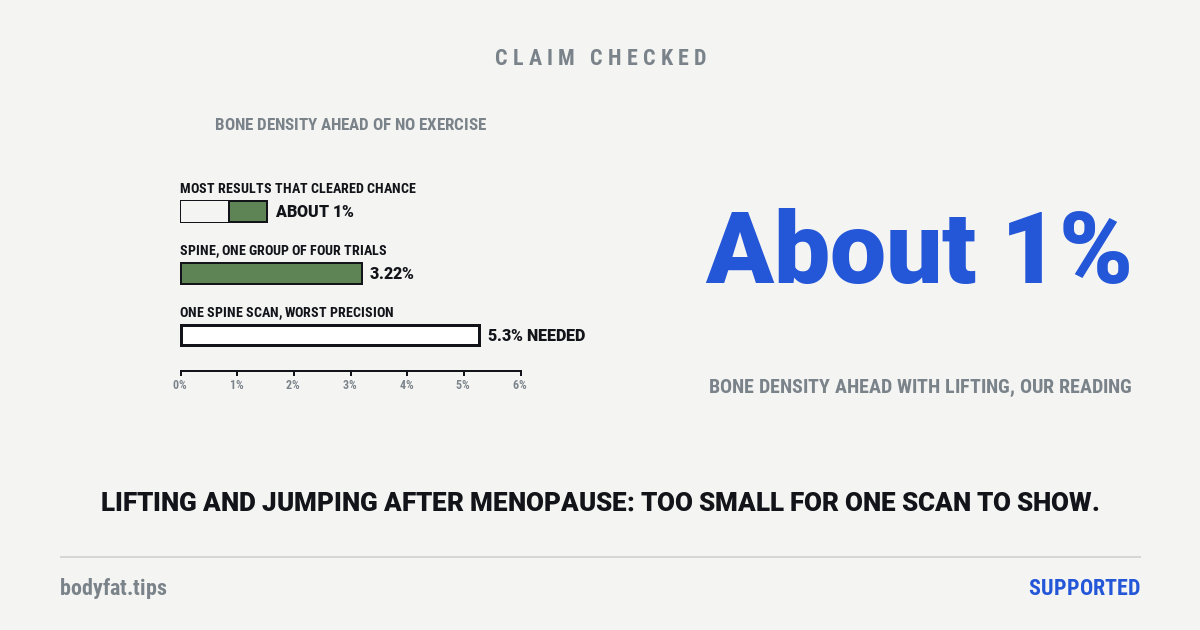
Mostly, and in a smaller way than the word “build” suggests. Across dozens of randomised trials, women past menopause who did weight training, impact exercise or both ended up ahead on bone density at the spine and hip, compared with women who did not exercise: by around 1% in most of the Cochrane review’s pooled results that cleared chance and by about 3% at the spine in one group of four trials, though more than half of its results at those sites were too uncertain to call (our count and reading of that review’s results); part of that lead was bone the women who did not exercise lost. [3] [4] Whether it means fewer broken bones is a separate and less certain question. And “walking alone isn’t enough” is less settled than it sounds.
Does exercise increase bone density after menopause?
The longest-standing summary is a Cochrane review, the kind that gathers every randomised trial it can find on a question and grades how far to trust them. Its 2011 version, still the latest PubMed lists, pooled 43 trials and 4,320 women past menopause [3]. Across all kinds of exercise, spine density came out 0.85% ahead of the comparison groups. Weight training aimed at the legs did best at the femoral neck, the narrow top of the thigh bone where hips break: 1.03% ahead. Programmes that mixed several kinds of exercise did best at the spine: 3.22% ahead [3].
| Kind of exercise | Spine | Hip | Trials |
|---|---|---|---|
| Any exercise | +0.85% | Femoral neck −0.08%, too uncertain to call; total hip +0.41%, too uncertain to call | 24, 19 and 13 |
| Weight training aimed at the legs | +0.86% | Femoral neck +1.03%; total hip +0.11%, too uncertain to call | 8, 8 and 5 |
| High-force weight-bearing: jogging, jumping, dancing and, in this review’s grouping, vibration plates | Too uncertain to call | Hip +1.55% | 4 for the hip |
| Walking and tai chi | +0.87% | Femoral neck too uncertain to call | 7 for the spine |
| Several kinds combined | +3.22% | Femoral neck +0.45%; total hip −1.07%, in favour of the comparison groups | 4, 3 and 4 |
Not every number pointed the same way, and you should see the ones that did not. Pooled across every kind of exercise, the femoral neck came out 0.08% behind, with a confidence interval, the range the true answer probably sits in, running from 1.08% behind to 0.92% ahead [3]. That range includes zero, so “no difference at all” is still on the table. The mixed programmes that did best at the spine came out 1.07% behind the comparison groups at the total hip, in four trials [3]. And the review judged the reporting of the trials it pooled to be low in quality [3].
A research group at the University of Erlangen-Nuremberg in Germany has pooled the field again since. Its 2023 update took in 80 trials and 5,581 women, every trial at least six months long [4]. Exercise came out ahead at the spine, the femoral neck and the total hip, by effect sizes of 0.29, 0.27 and 0.41 [4]. An effect size measures the gap between groups in units of how much the women varied; on the usual scale 0.2 is small, 0.5 moderate and 0.8 large. The authors call their own results small, and “moderate at best” [4].
Two cautions sit inside that pooling. At the spine the I-squared was 68%: the share of the spread between the trials’ results that is more than chance would produce [4]. When “exercise” means anything from brisk walks to heavy deadlifts, that is what you would expect. And the spine result showed signs that small trials with disappointing results had gone unpublished: a standard correction estimated nine missing studies, and exercise still came out ahead after it [4].
Note who did the pooling. The group’s 2023 update added six trials to its own 2020 pooling, and its separate 2020 analyses by type of exercise and of weight training alone draw on the same body of trials [4] [5] [6]. That is one team re-checking its work as the field grew, not three independent confirmations. The 2011 Cochrane review was done by a different team, and its picture has the same shape: real, small and uneven from one part of the skeleton to another [3]. Different reviewers are not different trials, though: by our matching of first authors and years, at least 24 of the Cochrane review’s 43 trials are among the 2023 pooling’s 80 [3] [4]. Teams with no link to Erlangen have pooled the field since, and they agree on the direction: a 2026 pooling of 74 trials and 5,331 women [7], a 2025 network pooling of 55 trials in older women [8] and a 2025 pooling of 40 studies in women aged 50 to 60 [9] all found exercise, or some kinds of it, ahead on bone density. A 2023 review of the reviews was mixed: it called the results for aerobic and for resistance exercise “inconsistent”, found jumping effective at the hip, and found two kinds of mixed programme, which it calls concurrent training and combined resistance protocols, ahead at the spine and the hip [10]. We read these four as their summaries.
What does about 1% actually mean?
Less than the videos imply, and more than nothing. About 1% is our reading across the Cochrane review’s results, not one pooled figure. By our count, the review has 23 results at the spine and the hip that pool two or more trials, and they overlap, since its any-exercise results take in the others: nine put exercise ahead by margins that cleared chance, seven of them by 0.85% to 1.55%; one put the comparison groups ahead; 13 were too uncertain to call [3]. The Erlangen group’s poolings report effect sizes, not percentages [3] [4]. Three things to hold on to.
First, part of it is bone not lost. In the trial the channel’s “Backed by Science” video links, women on a light home programme lost 1.2% of their spine density in eight months while the women lifting heavy gained 2.9% [11]. In the Cochrane review, the comparison groups’ spine readings ran from a 4.38% loss to a 1.05% gain [3]. The exercise effect is the gap between two lines, and part of that gap is the comparison group sliding.
Second, it may be smaller than one scan can see in one person. The Erlangen group quotes the guidance on scanner precision: at the worst precision a scan operator is allowed, one person’s change has to reach about 5.3% at the spine, 5.0% at the total hip and 6.9% at the femoral neck to count as real [4]. A more precise scanner sets a lower bar; the pooling does not say how low. A 2% gain is real in the average of a hundred women and can be lost in the noise of your own follow-up scan. If your scan has not moved after a year of lifting, that is not evidence the lifting failed.
Third, it is a change in a measurement, not in fractures. Trials use bone density because it moves within months and fractures take years and thousands of people to count. A programme that moves density has not, by that alone, shown that you will break fewer bones. We come to the fracture evidence below.
What are the best strengthening exercises for osteoporosis?
The trials do not crown one. The Erlangen group sorted 84 exercise groups into weight-bearing exercise (walking, jogging, jumping, dancing, tai chi and the like), weight training, and the two combined, and found gains at the spine, femoral neck and total hip from every type, “largely independent of the type of exercise” [5]. Weight-bearing exercise did least at the spine, an effect size of 0.26 against 0.40 for weight training, which the authors put down to the 11 walking groups among its 30 [5].
Within weight training, the group’s separate pooling of 17 studies found gains at all three sites, small to moderate [6]. It also found that women who trained fewer than twice a week did better at the spine and hip than women who trained more often, which nobody had predicted, and its authors concluded that their breakdowns “did not allow meaningful exercise recommendations” [6]. In the Cochrane review, high-force weight-bearing exercise, a group it defined to include jogging, jumping, dancing and vibration plates, put the hip 1.55% ahead in four small trials [3].
The trial that tested heavy lifting head-on in women with weak bones is LIFTMOR, from Griffith University in Australia, and its DOI is the one the channel’s “Backed by Science” video links [11] [1]. 101 women past menopause with low bone density, average age 65, were randomly assigned either to eight months of supervised deadlifts, overhead presses and back squats at more than 80 to 85% of the most they could lift once, plus jumping chin-ups with heavy landings, twice a week, or to a light home programme with hand weights of up to 6.6 lb (3 kg) [11]. Spine density rose 2.9% with the lifting and fell 1.2% on the home programme; at the femoral neck the lifters held roughly level, +0.3%, while the home group lost 1.9% [11]. Our verdict on whether squats are bad for your knees reads LIFTMOR in full as well, and explains why a light daily squat habit is a different thing.
One finding matters for anyone planning to do this alone. In the 2023 pooling, programmes done mostly unsupervised, at home, did not show a significant gain at the spine or the femoral neck on their own (p = 0.09 at each, just the wrong side of the line researchers use for “probably not chance”), though the difference between supervised and unsupervised programmes was not significant either [4]. The largest home test fits that picture. In a European trial of adults aged 70 and over, most of them active already, a simple home programme of sit-to-stands, one-leg stands, step-ups and light elastic-band pulls, three times a week for three years and never made harder, showed no benefit to bone density at the spine or hip over the comparison group’s mobility exercises; 1,493 people across the trial’s eight groups had scans [12].
What do the national guidelines say? The UK consensus statement recommends weight training and impact exercise for people with osteoporosis, with brief bursts of about 50 moderate impacts, for example five sets of ten, and impact no harder than brisk walking for people who have had a spine fracture or several low-trauma fractures [13]. Our calisthenics verdict rates bodyweight training for muscle, not bone.
The channel’s video on the “jump down and hop” exercise (31 October 2025, 214,020 views) lists three references [1]. One is a 2006 trial of ten maximal jumps a day in 36 female college students, which is a different question from bone after menopause [14]. One is a 2023 review of impact exercise and bone structure, which in women past menopause found a small gain at the shin and did not find a significant effect at the spine in any group [15]. And one link resolves to a 1977 Japanese article on nursing education [1].
Is walking enough for your bones?
This is the part of the claim on shakiest ground, in both directions. The channel’s “Why Walking Alone Isn’t Enough After 50” (28 August 2026, 160,182 views) is careful about it: walking “may not provide enough stimulus to maintain bone density”, and its first advice is “Keep walking” [1].
Two older poolings of walking-only programmes in women past menopause found no significant gain at the spine and a borderline result at the femoral neck: eight trials in 2008, ten in 2013, the second finding a femoral-neck gain only in programmes longer than six months [16] [17]. A 2021 pooling in people over 50 at raised fracture risk found only one walking-only trial to include; programmes that combined walking with other exercise put the spine a little ahead, at low certainty, and its authors concluded that “one may need to combine walking with other exercises to be of benefit” [18].
But the Cochrane review’s group that included walking and tai chi put the spine 0.87% ahead, much the same as weight training’s 0.86% [3]. And the newest pooling, a 2026 network meta-analysis, a method that ranks several kinds of exercise against each other across many trials at once, took in 124 trials and 18,429 adults aged 40 and over [19]. It found brisk walking or jogging among the most effective at all three sites and ranked it first at the total hip, at low certainty, and estimated that meaningful benefits might come at about two to three hours of brisk walking or jogging a week [19]. We could read only its summary, so we cannot tell you how much of that is walking and how much jogging.
One more wrinkle. The UK consensus notes some evidence that brisk walking raised fracture risk in people already at risk of falls, and advises strength and balance work first for frailer people [13]. So walking is not risk-free for everyone, and it is not useless for bone either.
Does exercise prevent fractures?
This is the question bone density stands in for, and the honest answer is: probably a little, mostly through falls, and for bone-loading exercise on its own, hinted at by small trials rather than shown.
The Cochrane review found four trials, 539 women, that counted fractures: 67 per 1,000 in the exercise groups against 106 per 1,000 in the comparison groups, a difference too uncertain to call (an odds ratio of 0.61, with a range from 0.23 to 1.64) [3]. Its plain-language summary puts it fairly: exercise “will reduce the chances of having a fracture slightly”, and “these results might have happened by chance” [3].
A 2023 pooling by the Erlangen group found more: 11 studies, about 19,300 person-years of follow-up, and about a quarter fewer major osteoporotic fractures with exercise, a risk ratio of 0.75 (0.59 to 0.94) [20]. A risk ratio of 0.75 means three fractures for every four in the comparison groups. Before a pooled figure like that goes on a page, it is worth opening the list of studies.
| Study | Who, and what kind of programme | Fractures: exercise v comparison |
|---|---|---|
| English general-practice trial, 2020 | About 6,500 people aged about 78, half of them women; screening plus falls-prevention exercise for those at risk; 18 months | 49 v 53 |
| Activity trial, 2016 | About 1,600 people aged about 79 with limited physical function, two-thirds of them women; walking, strength and balance; 31 months | 34 v 42 |
| The Erlangen group’s own programme, 2015 | 137 women with low bone density, early after menopause; 16 years; not randomised | 7 v 15 |
| The other eight studies, together | Mostly women; bone-strengthening, falls-prevention or mixed programmes; 6 months to 4 years | 39 v 57 |
The two largest studies hold 178 of the 296 fractures counted, and neither was a bone-building programme: the pooling itself classes both as falls prevention [20]. Neither found a clear difference on its own [20]. The English trial, on its own main measure of all fractures, recorded slightly more in the exercise arm than with mailed advice alone, a rate ratio of 1.20 (0.91 to 1.59), a difference that could be chance [21]. The one study whose result cleared chance on its own was the Erlangen group’s 16-year programme in women with low bone density, and it was not randomised [20].
The pooling’s reference list also holds three long follow-up reports, which it left out of its analyses because their exercise programmes had ended six months or more earlier [20]. They are not three more trials. Two follow Finnish trials that are already among the pooling’s 11 studies, where it counts their fractures during the programmes, 2 against 1 and 4 against 9 [20]. The same two are among the Cochrane review’s four, and that review, pooling them on their own as its group of combined programmes, found fewer fractures with exercise, an odds ratio of 0.33 (0.13 to 0.85), roughly a third of the comparison groups’ odds, with 89% of the weight on the larger of the two [3]. The follow-ups count the same women for longer. In the first, 149 women aged 70 to 78 had been randomly assigned to a year of weight training, of balance and jumping exercise, of both, or to no programme; over the next five years, health-care records showed 26 fractures among the 145 followed, and the summary reports a fracture rate only for the women who had done both kinds: about a quarter of the comparison group’s (a risk ratio of 0.26, with a range from 0.07 to 0.97), a result its authors say still needs confirming [22]. In the second, 160 women aged 70 to 73 with low bone density had been randomly assigned to 30 months of mainly home-based impact, balance and strength exercise, or none [20] [23]; over an average of seven years counted from the start of the trial, the exercise group had fewer fractures, a rate ratio of 0.68, but with a range from 0.34 to 1.32 that includes no difference, and no hip fractures against five [23]. The third follows a separate trial, from the US, that is not in the pooling: 50 women past menopause who had done two years of progressive back-strengthening exercise, or none, were checked eight years later, with 6 compression fractures in 378 vertebrae examined in the exercise group against 14 in 322 in the comparison group, a difference the authors’ test called significant, though it counted vertebrae rather than women [24].
The large randomised trials we found that made fractures a main outcome from the start tested falls prevention, like the English trial above, or a light home programme. In the European trial above, which randomised 2,157 adults aged 70 and over, the simple home strength programme made no significant difference to fractures outside the spine over three years [25]; its exercise-only group is also one of the 2023 pooling’s 11 studies, at 10 fractures against 12 [20]. A later analysis of the trial’s spine scans found fewer spine fractures among the women who did the programme, a rate ratio of 0.52 (0.28 to 0.98), though not among everyone in the trial [26]. The authors also ran secondary checks, which they call sensitivity analyses. Counting only new spine fractures, or leaving out people taking bone medicines, they found no significant difference between the groups. Among the 157 people, men and women, who already had a spine fracture, an existing fracture got worse 10 times in the 83 on the home programme against 25 times in the 74 doing the comparison exercises, a rate ratio of 0.34 (0.16 to 0.75); the authors say these findings need confirming in a larger sample [26].
So where would a fracture benefit come from? Falls. A 2019 Cochrane review of 108 trials and 23,407 people living at home, average age 76, found that exercise cut the rate of falls by about a quarter, at high certainty, with balance and functional exercises the best-supported kind [27]. It estimated 27% fewer people with a fall-related fracture, at low certainty [27]. For programmes that were mainly weight training it said it was “uncertain” of the effect on falls [27]. The 2026 network pooling’s fracture analysis, 26 trials and 11,132 people, found possible reductions with mixed aerobic exercise and with what it calls mind-body exercise, a class that usually means practices such as tai chi and yoga, both at low certainty, and called the other kinds “neutral” [19].
Canada’s “Too Fit To Fracture” panel said it plainly in 2014: “The outcome for which evidence is strongest is falls” [28].
Can you reverse osteoporosis by exercising?
Not on the evidence of these trials, if reverse means what it sounds like. A bone scan reports a T-score: how many standard deviations, a statistical unit of spread, your density sits from a healthy young adult’s average [29]. A T-score below about −2.5 is the osteoporosis range [13].
LIFTMOR’s women started with an average spine T-score of −2.1, and 44 of the 101 were in the osteoporosis range at the spine or the hip [11]. Eight months of heavy supervised lifting and jumping raised their spine density 2.9% [11]. That moved the group’s average. The paper reports T-scores only at the start, so it cannot tell you whether anyone left the osteoporosis range, and a gain that size is less than the 5.3% a spine scan has to show at the worst precision the guidance allows [11] [4].
Women with low bone density may gain a little more than women without. In the 2023 pooling, groups with low bone density, osteoporosis or past fractures showed a larger spine effect, 0.54 against 0.23, but the difference could be chance (p = 0.094) [4]. A 2021 pooling of nine trials of heavy weight training in people with osteoporosis or low bone density, men among them, found large gains on the effect-size scale, but the trials varied far more than chance allows, and its funnel plots, a check for missing small studies, were lopsided at every site [30]. We read it as its summary.
Our verdict on resistance training for seniors reached the same place from the other direction: a real, small gain at the hip, much less certain than the strength result. Osteoporosis medicines are a separate question, which this page does not rate.
Is heavy lifting safe with osteoporosis, and which exercises should you avoid?
LIFTMOR reported one adverse event in more than 2,600 supervised sessions: a mild low-back muscle strain on the last deadlift of a set, which cost the woman two sessions [11]. Seven women fell during the trial, five of them lifters, all outside the sessions and none injured [11]. That is reassuring, with limits the authors state themselves: the trial was not big enough to judge safety; it screened out women with a fracture in the past year, back pain or conditions that made heavy training unwise; and every session was supervised, eight women at most to each instructor, a qualified exercise scientist and physiotherapist [11]. Of the 406 women who wanted to take part, 101 qualified [11]. Two of the six authors were directors of a bone clinic in Brisbane that was one of the trial’s two training sites, which the paper discloses [11].
The same Australian group has run two more checks. Spine scans of the LIFTMOR women found that none of the lifters’ vertebrae changed fracture grade over the eight months, and found one new wedge-shaped deformity in the comparison group [31]. In a second trial, 115 women past menopause with low bone density, some of them on osteoporosis medicine, did eight months of the same heavy programme or a low-intensity, Pilates-based one; spine density rose 1.9% against 0.1%, and the authors counted seven adverse events, four with the heavy lifting and three with the light programme, and called both well tolerated [32]. Two supervised, screened trials from one group are not independent confirmation, and the poolings are thin. One, of six trials comparing high- with moderate-intensity training in 391 women with osteoporosis, says almost all of them reported minimal adverse events, and rates its own certainty extremely low [33]. A 2026 pooling of 18 trials in 1,283 adults aged 50 and over compared heavy with lighter weight training: by its central estimates the heavy groups had more falls and more adverse events, risk ratios of 2.68 and 2.42, but both ranges ran from fewer events (0.65 and 0.66) to many more (11.11 and 8.88), so neither difference is clear, and its authors read the result as similar safety [34]. Read both ways, it is not a measured harm, and it is not proof of safety either; the trials that went well were supervised and screened.
The common advice to avoid loaded forward bending of the spine, such as sit-ups and toe touches with weight, rests mainly on expert consensus and case reports, not on trials. It traces back to a 1984 study of 59 women with spinal osteoporosis who were given extension, flexion, combined or no exercises: new spinal fractures followed in 89% of the nine women on flexion exercises, 53% of the 19 on both kinds, 67% of the six given no exercises and 16% of the 25 on extension exercises [35]. Set against the six who did no exercises, the flexion group’s excess is small; the clearer contrast is the extension group, which had the fewest. Nothing in its summary says the women were randomly assigned, and nine is a very small group [35]. We read it as its summary.
The UK consensus recommends avoiding “postures involving a high degree of spinal flexion”, citing reports of spinal fractures with sit-ups and some yoga positions, and adds that “there is limited evidence of harms from exercise” [13]. On twisting it is more relaxed than most exercise lists: “Rotation (twisting) movements should be safe if performed smoothly and comfortably” [13]. The Canadian panel advised people with osteoporosis to learn to move safely, or take precautions, when twisting or bending, and said there was not enough evidence to put a number on the risks of exercise in osteoporosis [28]. That is sensible caution from expert panels, not a measured risk.
If you have osteoporosis, a past fracture, or a spine fracture you know about, plan loading exercise with a clinician or a physiotherapist who knows bone. The Canadian panel advises people at high fracture risk to consider seeing a physical therapist with osteoporosis expertise before starting, and the UK consensus asks for personal advice before harder impact after a spine fracture [28] [13].
Does rebounding build bone? The 1980 NASA study and its 68%
Credit where it is due: on rebounding, the channel is the skeptic. Its “Does Rebounding Actually Build Stronger Bones?” (26 August 2026, 153,927 views) says rebounding “has not been shown to be a superior bone-building exercise”, and sets out to explain what “68% more mechanical work” really means [1]. The question gets about 10 searches a month in the US (from a paid keyword database, pulled 10 October 2026) [2]; the NASA line travels much further.
The study is real. In 1980, researchers at NASA’s Ames Research Center measured eight young men, aged 19 to 26, walking and running on a treadmill at four speeds and jumping on a trampoline at four heights, recording how hard their ankles, backs and heads were jolted, along with their oxygen use and heart rate [36]. At similar heart rates and oxygen use, the jolting on the trampoline was larger and spread more evenly through the body, a finding they hoped might help design ways to stop people losing condition in weightlessness [36]. Its summary states no percentage [36].
A consumer-technology site’s fitness feature in June 2025 quoted the paper as saying “the greatest difference was about 68%”, and turned it into “just 10 minutes of rebounding could be 68% more effective than a 30-minute run” [37]. We could not open the paper to check the quote: the publisher’s site served a bot check to every request we made, and the Internet Archive had no copy [36]. What the summary does tell you is enough: the study measured jolts and oxygen in eight young men. It did not measure bone, or women, or anyone past menopause [36].
What happened when someone tested rebounding on bone? We found one randomised trial in older women that scanned bone. In Austria, 40 women aged 56 to 83 with low bone density did 12 weeks of balance, strength and jumping exercise on mini-trampolines, or carried on as usual [29]. Balance, strength, walking speed and fear of falling all improved against the comparison group [29]. Bone density did not differ significantly between the groups at the spine or the femoral neck (p = 0.064 and 0.073, just the wrong side of the line); within the trampoline group, femoral-neck density rose 2% [29]. Twelve weeks is short for bone, as the authors say [29]. A trampoline-park business supplied the facilities and equipment, and one of the six authors lists it as an affiliation; the authors declare no conflicts [29].
A 2023 New Zealand study of 37 women past menopause, published in a physical-therapy journal, reported bone density up significantly against its comparison group after 12 weeks of mini-trampoline classes [38]. The doctoral thesis behind it gives the detail: heel bone readings up 8%, falling back by 4% three months after the classes ended [39]. The women chose their own group rather than being randomly assigned, only 8 were in the comparison group, and the heel was measured by ultrasound rather than the hip or spine by the standard scan [39].
And a caution from the other side: a Seoul hospital reported seven people, six of them women, with ten compression fractures in the middle of the spine after they started regular mini-trampoline exercise; all said they had bounced hunched over while holding the safety bar, and none had been shown how [40]. A case series cannot tell you how often that happens. It tells you it can.
Is rebounding better for bone than other exercise? We found no randomised trial comparing the two on bone density in women past menopause. We searched PubMed’s titles and abstracts in two wordings, the four poolings of exercise and bone above, a 2024 review of rebound-exercise studies, ClinicalTrials.gov and an ordinary web search [3] [4] [5] [6] [41]. The nearest things to a comparison are two. A 2019 study, a journal paper we could not find in PubMed and know only from that review’s summary, had adult women do 16 weeks of rebound training either on land or in water: femoral-neck density improved in both groups, and spine density in the land group [41]. Both groups bounced; it compared two kinds of rebounding, not rebounding with other exercise. And a 2015 Thai study divided 63 working women aged 35 to 45 into aerobic dance on mini-trampolines, the same dance on a wooden floor, or no programme, for 12 weeks: blood markers of bone turnover moved in a favourable direction with both kinds of dance, the differences it reported between the two surfaces were in leg strength, balance and foot pressure, and it did not scan bone [42]. Neither tested rebounding against other exercise on bone density after menopause.
What is the quickest way to increase bone density?
Exercise is not a quick way, and nothing on this page is quick. Bone rebuilds itself in cycles of about four months, and new bone takes longer still to show on a scan, which is why LIFTMOR ran for eight months and the 2023 pooling counted only trials of six months or more [11] [4]. What to eat is not this page’s subject. Whether to take calcium supplements, and what vibration plates do for bone, each have a verdict of their own. Weighted vests have their own verdict, and so does creatine sold to women past menopause.
Who the trials were done on
| Who | What the studies found | Source |
|---|---|---|
| Women past menopause, most with ordinary bone density | Small gains at the spine and hip, around 1% in most pooled results that cleared chance and about 3% at the spine in one group of four trials (our reading), against no exercise; most trials six months to two years | [3] [4] |
| Women past menopause with low bone density or osteoporosis | 14 of 85 spine comparisons in the 2023 pooling: a somewhat larger effect that could be chance; two supervised heavy-lifting trials from one group, of 101 and 115 women: spine +2.9% against −1.2%, and +1.9% against +0.1% | [4] [11] [32] |
| People who have had a spine fracture | Not what these bone trials studied; the UK consensus advises impact no harder than brisk walking without personal advice | [13] |
| Men | Not in the poolings of women past menopause; the 2026 network pooling covered adults aged 40 and over, and its summary does not say how many were men. The Australian heavy-lifting group’s trial in 93 men with low bone density, only partly randomised, found spine density up 4.1% with the heavy programme against 0.9% in a comparison group that was not randomised, with five minor adverse events | [19] [43] |
| Women before menopause | One jumping trial in 36 college students; a different question from this page’s | [14] |
| People in their late 70s at risk of falls | Where most of the fracture evidence comes from, in falls-prevention programmes | [20] [27] |
If the gain is too small to see on your own scan, why lift at all?
This section is the desk’s own reasoning, and it is labelled as such. The trials say weight training and impact exercise move bone density by around 1% (our reading), far below the 5.3% one person’s spine scan needs at the worst precision allowed, and that fewer fractures from bone loading on its own rests on small trials. Both consensus statements still put weight training and impact exercise at the top of their lists [28] [13]. Is that a contradiction? Here are three answers, each rated.
Answer one: part of the gain is a loss that did not happen, and losses add up. In LIFTMOR the light programme lost 1.2% at the spine in eight months [11]. If a gap like that kept widening by a percent or two a year for a decade, it would be far larger than any one trial measured. That is arithmetic, not a measurement, and the two long randomised follow-ups we found that scanned bone again do not settle it. In the Finnish trial of 160 women aged 70 to 73, bone density fell much the same in both groups over six years [23]. In the US back-strengthening trial, the two groups’ bone density did not differ significantly at two years and did at ten, a difference whose direction the trial’s summary does not state [24]. Both are small, and in both the programme had ended years before the last scan.
Answer two: the fracture benefit, if there is one, probably runs through falls. That exercise reduces falls is measured, at high certainty [27]. The fracture pooling’s two biggest studies were falls programmes [20]. LIFTMOR’s lifters also did better on balance and strength tests [11]. That bone-loading programmes protect mainly by making you harder to knock over, and less by the density they add, is a surmise, with the make-up of the fracture pooling on its side.
Answer three: the programme you keep doing, with someone watching, may matter more than which programme it is. Unsupervised programmes did not clear the bar at the spine or femoral neck on their own in the 2023 pooling, and LIFTMOR’s supervised women came to 92% of their sessions [4] [11]. But the difference between supervised and unsupervised programmes was not significant [4]. This one is a hunch the pooling leans toward and did not confirm.
Put the three together and here is what we think is true, stated plainly so you can disagree with it: lifting and jumping for your bones is a slow bet on keeping what you have and staying on your feet, not a way to rebuild what menopause took.
What we could not find, and would like to: a randomised trial of progressive weight training and impact exercise in women past menopause, large and long enough to count fractures as its main result. We searched PubMed’s titles and abstracts in two wordings, the wider class of exercise trials that counted fractures, ClinicalTrials.gov, the 2023 fracture pooling’s studies and reference list and an ordinary web search, and did not find one. The nearest are small. Two Finnish trials, of 149 and 160 older women, are already in the 2023 pooling and the Cochrane review; their later follow-ups, of five and about seven years, found fewer fractures with exercise, in the first for the group that did weight training and jumping combined, the only group its summary reports, from 26 fractures in all, and in the second by a margin that could be chance [22] [23]. A ten-year US follow-up found fewer, counted by vertebra rather than by woman [24]; and the Erlangen group’s 16-year programme, the longest, was not randomised [20]. The large randomised trials that counted fractures from the start tested falls prevention or a light home programme [21] [25]. The 2026 network pooling counted fractures in 26 trials, and because we could read only its summary we cannot rule out that one of them is the trial we mean [19]. If you know of it, the corrections line on this site is open.
Where “lift heavy, walking isn’t enough” came from
The expert advice came first, and it was careful. Canada’s 2014 recommendations for people with osteoporosis or spine fractures told them not to do aerobic training “to the exclusion of resistance or balance training”, in recommendations whose strongest evidence, by the panel’s own account, was for falls, and which were written for people with a diagnosis [28]. LIFTMOR in 2018 then showed that heavy, supervised lifting raised spine density in screened women with low bone density [11].
By the time it reached video, some of the care had gone. The “Backed by Science” video’s one reference line names an author and a title about exercise and bone density in women past menopause, and links a DOI that belongs to LIFTMOR; a second references line in the same description is an unfilled template that begins “Insert 3–5 recent studies” [1]. The walking video, to its credit, says keep walking [1]. Google’s AI answer for “exercise for osteoporosis” cites a US government health institute, YouTube, osteoporosis charities on both sides of the Atlantic and three hospital or university health sites [2].
And the shopping: the fitness feature that turned 1980’s eight young men into “68% more effective than a 30-minute run” carries an affiliate notice and a deal on a folding mini-trampoline under the claim [37]. The study it rests on measured jolts and oxygen, not bone [36].
None of this is a mark against anyone who has started lifting or jumping for their bones. You are doing what the trials and both consensus panels support [28] [13]; this page is about what to expect from it.
What this is rated, and what the rating covers
Supported — for the claim that weight training and impact exercise improve bone density a little after menopause: in pooled randomised trials, women who did them ended up ahead of women who did not at the spine and hip, by around 1% in most of the Cochrane review’s results that cleared chance and about 3% at the spine in one group of four trials (our reading), partly by losing less.
It is rated Supported because the direction holds across an independent Cochrane review of 43 trials and a series of larger poolings of up to 80, at the spine and both hip sites [3] [4] [5] [6], and because two supervised heavy-lifting trials in women with low bone density, both from one group, point the same way [11] [32]. It is not Established because the gains are small and uneven by site; the Cochrane review found the any-exercise results at the femoral neck and total hip too uncertain to call; the reviews draw largely on the same trials, so their agreement is less than their number suggests; the spine results show signs of unpublished small studies; unsupervised programmes did not clear the bar on their own; and none of it is a fracture result [3] [4].
Rated alone, in words. Bone-loading exercise prevents fractures is Preliminary: the pooling that found fewer osteoporotic fractures leaned on falls-prevention programmes, and the only study in it significant on its own was not randomised. The randomised trials of bone-loading programmes we found that counted fractures are small. Two Finnish trials, of 149 and 160 women, sit in that pooling and among the Cochrane bone review’s four, which together were too few to tell; pooled on their own they cleared chance, most of the weight on the larger one, and their long follow-ups count the same women for longer, not more trials. A US follow-up of 50 women cleared chance on a count of vertebrae rather than women. The one large trial of a home strength programme that made fractures a main outcome found no significant difference outside the spine, and fewer spine fractures only in a subgroup and a secondary check.
You can reverse osteoporosis by exercising is Unsupported, of the tested kind: trials in women with low bone density and osteoporosis measured bone density, and the largest gain we read in percentage terms was 2.9%, not a return to normal bone.
Walking alone isn’t enough for your bones is Preliminary: the older walking poolings and the newest network pooling disagree.
Heavy supervised lifting is safe with low bone density is Preliminary: two supervised trials from one Australian group, of 101 and 115 screened women, reported few adverse events, the first too small, by its authors’ own account, to judge safety; and the poolings of heavy against lighter training are small and imprecise in both directions.
Rebounding raises bone density is Preliminary: one small randomised trial found no significant difference from no exercise at 12 weeks, and one non-randomised study found heel readings that rose and then fell back.
Rebounding builds more bone than other exercise, the “68%” reading, is Unsupported, of the untested kind: the 1980 study measured jolts and oxygen in eight young men, not bone, and nothing we found that compared the two on bone favoured rebounding.
Loaded or extreme forward bending causes spine fractures in osteoporosis is Preliminary: one small study and case reports. Balance and functional exercise prevents falls is Established, on 108 trials [27].
What is not rated here: osteoporosis medicines; calcium, vitamin D and diet; vibration plates; men’s bones; and the frame above, which is this desk’s reasoning from the evidence rather than a result the evidence delivered. It is marked as ours so that you can weigh it as ours.
This is journalism, not medical advice. Anyone with osteoporosis or a past fracture should plan loading exercise with a clinician or physiotherapist. How we read a study, and what each tier means, is set out here.
- How to Calculate Max Heart Rate: 220 Minus Age Missed 70 of 230 Adults by Over 10 Beats in One Lab (Our Count)
established - Is Running Bad for Your Knees? For Recreational Runners, No. That It Protects Them Is Less Certain.
unsupported - How to Raise HDL: Exercise Lifts It About 2 mg/dL. Two Pills Approved Partly to Raise It Lost Approval After Heart Trials Found No Clear Benefit.
supported