Does Testosterone Raise Blood Pressure? A Little: About 1.5 Points Against Placebo in the Biggest Trial, and 4.9 on One Oral Form

Ask Google whether testosterone raises blood pressure and its AI answer starts with a yes: testosterone therapy “can raise blood pressure in some individuals, particularly during the first few months of treatment” [1]. A few results further down, a low-testosterone clinic chain says the opposite. Treat the low testosterone, its page says, and “you can help minimize the risk of hypertension” [1].
Both can’t be right. And plenty of people want to know which: “does testosterone raise blood pressure” is searched about 720 times a month in the United States (from a paid keyword database, pulled 20 October 2026) [1]. The searches around it are practical ones: can I take testosterone if I have high blood pressure, and how do I lower it while I’m on it [1].
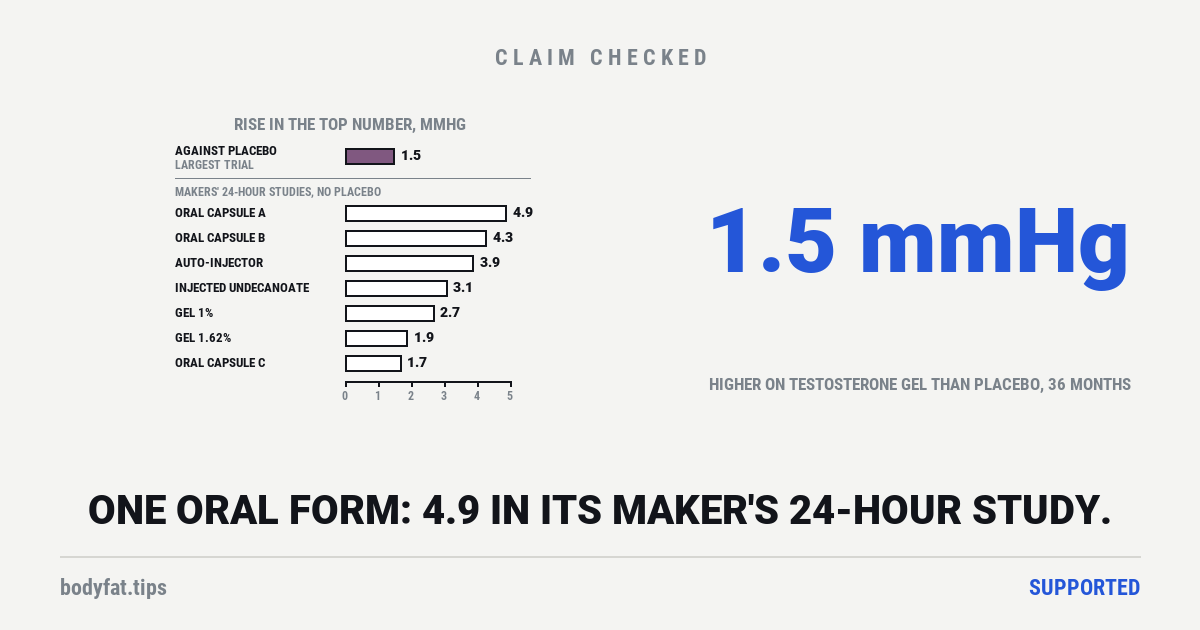
Yes, it raises blood pressure, and by a little. The US regulator says monitoring studies it required “confirmed an increase in blood pressure with use of all testosterone products, class-wide” [2]. In the one large trial with a dummy treatment for comparison, the top number ended about 1.5 points higher on testosterone gel after three years [3]. The makers’ own 24-hour studies found average rises of 1.7 to 4.9 points, highest on one oral form [3]. The claim that testosterone brings blood pressure down leans on studies in which men chose whether to be treated: one clinic’s records, and a 2016 pooling of studies like it [4] [5].
Blood pressure comes as two numbers: the top one, systolic, is the pressure while your heart pushes, and the bottom one, diastolic, is the pressure between beats. Both are in mmHg, millimetres of mercury, the unit on every monitor. Most of the figures on this page are the top number. A 24-hour monitor is a cuff worn through the day and night that takes a reading by itself, every 20 minutes in one of the trials here [6]; our white-coat hypertension verdict explains why doctors trust it more than a single reading in the clinic.
Why did the FDA change every testosterone label?
Because the studies it asked for kept finding the same thing. In 2016 and 2017 the FDA asked the makers of two new products, one injected under the skin and one swallowed, to measure blood pressure with 24-hour monitors before approval. “Consistent results” from those two raised its concern, and in March 2018 it required the same kind of study for every testosterone product [2].
On 28 February 2025 it announced the result: the completed studies “confirmed an increase in blood pressure with use of all testosterone products, class-wide” [2]. Products with a finished study had to print their own figure; products without a blood-pressure warning had to add one [2]. On the same day the FDA recommended removing boxed-warning language “related to an increased risk of adverse cardiovascular outcomes”, after reviewing the large heart-safety trial described below [2]. A medical news piece in JAMA, one of the pages Google’s answer cites, summed it up: testosterone “did appear to raise blood pressure”, with “no increase in the risk of adverse cardiovascular outcomes” [7].
The labels now say testosterone “can increase blood pressure, which can increase cardiovascular risk over time. Measure blood pressure periodically. Not recommended for use in men with uncontrolled hypertension” [3]. All three oral capsules and the weekly auto-injector under the skin carried a boxed warning, the black-bordered warning at the top of a drug’s label, about blood pressure until 2025; their labels record that the box was removed, in March or July 2025, and the warning now sits in the body of the label [3].
How much does testosterone raise blood pressure, and does the form matter?
Here is what each product’s label, or its maker’s paper, reports for the top number over 24 hours.
| Form | Change from the start | Men measured | After |
|---|---|---|---|
| Testosterone gel 1.62% against a dummy gel, in the largest trial; the trial’s own readings, not given as a 24-hour average [3] | 1.5 higher than placebo | 5,246 randomised; fewer measured by 36 months | 36 months |
| Oral testosterone undecanoate, capsule A [3] | +4.9 | 135 | about 4.5 months |
| Oral testosterone undecanoate, capsule B [3] | +4.3 | 123 | about 4 months |
| Oral testosterone undecanoate, capsule C [3] | +1.7, then +1.8 | 151 | 4 and 6 months |
| Testosterone enanthate, weekly auto-injector under the skin [3] | +3.9 | 62 | 12 weeks |
| Testosterone patch [8] | +3.5 | 62 | 16 weeks |
| Testosterone undecanoate, injected into muscle [3] | +3.1 | 139 | 16 weeks |
| Testosterone gel 1% [3] | +2.7 | 113 | 16 weeks |
| Testosterone gel 1.62% [3] | +1.9 | 169 | 16 weeks |
| Testosterone cypionate injection; a nasal gel [3] | Class warning only; no product figure on the label | – | – |
Every row goes up. That is the finding the FDA acted on [2]. The size is small: on the highest figure, oral capsule A’s, the average rise was 4.9 points, and the confidence interval, the range the true average probably sits in, ran from 3.5 to 6.4 [3]. That is an average across the men in the study, not a forecast for any one man. Capsule A’s figure and the randomised trial described next are one study, not two: the same capsule, the same 166 men and the same four months, by our matching of the label to the trial’s paper. The label counts the 135 men whose recordings could be used, the paper counts 162, and both report a rise of 4.9 [3] [6].
The ranking between forms is less clean than it looks. The three oral capsules, all testosterone undecanoate, span 1.7 to 4.9 points, in different men in different studies [3]. We found four randomised trials that set one of these oral capsules against a skin product and reported blood pressure, all open-label and each funded by the company behind its capsule [6] [9] [10] [11] [12]. The one with 24-hour monitors put 166 men on the capsule and 55 on a testosterone solution for three to four months. The top number rose 4.9 points on the capsule and 0.2 on the solution, a gap with a P value of 0.0013, far below the line researchers use for “probably not chance” [6]. It had no placebo group [6]. Two others set a capsule against a 1.62% testosterone gel for a year, and neither used 24-hour monitors. In one, of 315 men, the authors write that “neither treatment group exhibited meaningful changes in systolic or diastolic blood pressure”, and they print no figures for it [9]. In the other, of 314 men, the top number taken in the clinic rose 2.16 points on the capsule and 3.07 on the gel at three months, and 2.75 and 3.38 at a year, by the results posted on its registry record [10]. Against a gel, then, these two capsules did not show the bigger rise that the 24-hour trial found against a solution. The fourth, run from 2011 to 2013, set capsule A against a 1% gel for a year in 325 men, also without 24-hour monitors. Its blood pressure is reported in a review by the trial’s lead investigator and an employee of the capsule’s maker: at a year the top number, taken by cuff, was up from the start by about 5 points on the capsule and about 3 on the gel, and the review gives no test of the gap [11]. The trial’s registry record lists high blood pressure as a side effect in 6 of the 161 men treated with the capsule and 11 of the 160 treated with the gel [13].
Does it settle after the first few months, as the AI answer suggests? Not in the studies that kept measuring. One oral capsule’s rise was 1.7 points at four months and 1.8 at six [3]. Another’s label says “Average blood pressures had not plateaued at the end of the trial” [3]. And in the large placebo trial the gap was there at six months and still there at three years [14] [3]. The rise shows up within months. Where trials kept looking, it stayed.
What did the placebo-controlled trials find?
A study that measures the same men before and after can’t tell the drug from everything else that changed in those months: the season, the men’s weight, their other pills, getting used to the cuff. A placebo, a dummy gel or injection given to a comparison group chosen at random, can. These are the trials that had one.
The biggest is TRAVERSE, the heart-safety trial the FDA required. It randomised 5,246 men aged 45 to 80 who had heart disease or a high risk of it, with symptoms and low testosterone, to a daily testosterone gel or a dummy gel [14]. Over the first six months the top number rose 0.3 points on testosterone and fell 1.5 on placebo, a gap of 1.8 by our arithmetic, with a P value below 0.001 [14]. At 36 months, by the FDA’s reading of the trial, it was 1.0 points up on testosterone and 0.5 down on placebo, a gap of 1.5 [3]. That later figure comes from the men still being measured: 61.4% of the testosterone group stopped the gel at some point [14].
Heart attacks, strokes and heart deaths were about as common on testosterone as on placebo, 7.0% against 7.3% [14]. What else the trial found, the heart-rhythm problems and blood clots among it, is on our TRT verdict, which rates what the treatment does for the men who take it.
The second piece of evidence pools many smaller trials. A 2022 meta-analysis, a pooling that combines trials to get one estimate, gathered 35 placebo-controlled trials of testosterone in men with low levels and obtained the raw data from 17 of them [15]. It used each trial’s own blood-pressure readings at 12 months, or at the time closest to it, and the 14 trials in its blood-pressure figures ran from 12 weeks to a year, so for some that reading came well short of a year [15]. In 10 trials, 1,069 men on testosterone and 1,041 on placebo, the top number was 0.99 points higher on testosterone, with a range from −0.08 to 2.06 that still includes zero [15]. The authors wrote that they “observed no overall effect of testosterone on systolic or diastolic blood pressure” [15].
Their appendix tells it a little differently. Add the four trials that published results but did not share raw data, and the 14 trials together put the top number 1.19 points higher on testosterone, with a range from 0.18 to 2.19 that stays clear of zero [15]. The I-squared for those 14 trials, the share of the spread between the trials’ results that is more than chance would produce, was 0%: zero means they differed no more than luck allows [15]. Before printing a pooled figure we look for the biggest study in it: a 2016 trial of a testosterone solution, which ran 12 weeks, carried 36% of the weight and the US Testosterone Trials 25%, so no single trial carries most of the result [15].
Two other poolings of randomised trials are worth setting beside it. One, published at the end of 2021, gathered 16 trials in men with obesity and low testosterone, 12 of them against a placebo and 4 against no treatment. In the 8 trials with blood-pressure results, 698 men, the top number was 1.6 points higher on testosterone, with a range from −0.58 to 3.79 that includes zero [16]. Its authors concluded that testosterone “did not affect the blood pressure”, and graded that evidence as of moderate certainty [16]; what the trials measured is a rise of about the size of the 14-trial figure, which they could not tell from chance. At least four of its trials are also among those 14, so the two poolings are not independent results [16] [15]. The other, a pooling in a Chinese andrology journal of 19 randomised trials and 1,553 men with low testosterone, reported both numbers higher on testosterone than on placebo; we read its English abstract, which gives no figures [17].
Then there are smaller trials in particular groups of men. STRIDE randomised 65 men with low testosterone and poorly controlled type 2 diabetes to injections of testosterone undecanoate or placebo, 32 and 33 by our reading of its baseline table, for six months. Their 24-hour top number was 2.1 points higher on testosterone, with a range from −2.9 to 7.2, a result within chance [18]. Its authors concluded that testosterone “does not increase” 24-hour blood pressure [18]; what the trial measured is a small rise it could not tell from chance, not a measured zero. It is reported in a conference abstract and a thesis [18].
In 40 men on long-term opioid painkillers whose testosterone was low, six months of placebo injections or of testosterone undecanoate, the drug the clinic registry below used, left the top number 13.2 points higher on testosterone when measured in the clinic, with a range from 3.4 to 23.1; on a 24-hour monitor, the daytime gap was 5.2 points, within chance [19]. And in 80 Australian men aged 50 to 70 with a waist of 37.4 inches (95 cm) or more and testosterone at the low end of normal, not a diagnosis of low testosterone, a testosterone cream raised the 24-hour top number against a placebo cream over 12 weeks, most clearly in the men who also exercised: 3.0 points up, against 3.0 down in the men given placebo and no exercise [20].
Put those together. The large trial, the poolings and the 24-hour studies point the same way, and the size is small: about 1 to 2 points against placebo, and roughly 2 to 5 in the makers’ before-and-after studies. The smaller placebo trials pointed up too; two had ranges wide enough to include no rise at all, and the one in opioid users found a large rise in clinic readings.
Can TRT lower blood pressure?
Several clinic pages say it can. A men’s-health clinic chain whose page Google’s answer cites says testosterone therapy’s effects on body fat and fitness “can reduce blood pressure over time, especially in men with a higher baseline BP”, and links a 2024 paper for it [1]. An online testosterone seller says “Most studies looking at TRT show that it does not increase blood pressure, with some even showing an improvement in numbers” [1].
The paper is a registry: a record of men followed in ordinary practice, who chose their own treatment. At a urology practice in Germany, 737 men with low testosterone were offered injections of testosterone undecanoate every 12 weeks. 353 took them; 384 declined, “for financial reasons or negative perceptions of TTh”, testosterone therapy [4]. In the 151 treated men who never took a blood-pressure drug, the top number fell by a median of 12.5 points by their last visit; in the men who declined, blood pressure rose [4].
Two things in the paper itself limit what it can show. The groups were split “based on their choice rather than randomization”, so the treated men were compared mainly with themselves [4]. And the readings were taken by cuff in the clinic, around each injection; the authors write that 24-hour or home readings “were not routinely made, and we recognise that BP determined in the clinic can be imprecise” [4]. Two of its authors report research grants and speaking fees from a company that made injected testosterone undecanoate [4].
The same drug has been tested against placebo in nine trials on this page. In the 35-trial pooling above, the BLAST trial of testosterone undecanoate in men with type 2 diabetes recorded the top number 4.07 points higher on testosterone, with a range from −0.26 to 8.40 [15], and STRIDE’s injections, 2.1 points higher on 24-hour monitors [18]. Neither cleared chance. The opioid trial above used the same drug, and read blood pressure in the clinic, as the registry did: there the top number ended 13.2 points higher on testosterone than on placebo, a gap that did clear chance [19]. The pooling’s blood-pressure figure holds six more trials of the drug against placebo. Five gave it only by injection into muscle: in four the top number ended 3.7 to 4.6 points higher on testosterone, and in one, in Australian men with type 2 diabetes, 1.1 points lower. The sixth gave it by injection to one group and by mouth, for the first six months, to another, and ended 4.0 points higher. None of the six cleared chance on its own [15] [16]. Of the nine, then, eight pointed up and one down, and only the opioid trial’s clinic readings cleared chance.
The reassurance has also crept into expert summaries. A 2026 position statement from a European panel of testosterone researchers, paid for by a company that sells a prescription testosterone gel, described TRAVERSE as a trial in which “blood pressure and well as glycometabolic control remained stable across groups” [21]. The trial’s own paper reported a gap of 1.8 points at six months with a P value below 0.001 [14], and the FDA a gap of 1.5 at three years [3]. Small, yes. Stable across groups, no.
Is it the thicker blood?
Google’s answer says testosterone raises the red-cell count, which thickens the blood, and “Thicker blood requires more force from the heart to circulate” [1]. The first half is solid. In the pooled trials, haematocrit, the share of the blood made up of red cells, was 3.15 points higher on testosterone, with a range from 2.42 to 3.88 [15]. The labels tell prescribers to check it before and during treatment [3].
The second half, that this is why blood pressure rises, is less settled. In one oral capsule’s 24-hour study, the 27 men whose haematocrit rose most, by 6 to 14 points, had the biggest rise in the top number, 8.3 points, against 1.9, 3.3 and 2.1 in the other three quarters of the men [22]. But the correlation between the two across all the men, a measure of how closely they moved together on a scale where 0 is no link and 1 a perfect one, was 0.16 for the top number, with a P value of 0.075, just the wrong side of the line researchers use for “probably not chance” [22]. In the opioid trial, the men whose haematocrit rose more had bigger rises in clinic readings [19]. A plausible mechanism with suggestive numbers, then, not a measured cause.
The other mechanism the clinic pages give is salt and water retention. The labels warn of swelling, with or without heart failure, in men with existing heart, kidney or liver disease [3]. We did not look for trials that measured salt retention as the cause of the rise, and this page does not rate it.
Can I take testosterone if I have high blood pressure?
The labels’ answer is a qualified yes: testosterone is “not recommended for use in patients with uncontrolled hypertension”, and prescribers should monitor blood pressure, “especially men with hypertension” [3]. In TRAVERSE, 93% of the men already had high blood pressure [3].
Do men already on blood-pressure pills see bigger rises? The labels’ own subgroups disagree. On one oral capsule the rise was 5.4 points in men treated for high blood pressure and 4.4 in men without it; on the 1.62% gel, 3.0 and 1.2; on another oral capsule, 3.4 and 0.7 [3]. But on the injection into muscle it was 2.1 and 3.3, on the 1% gel 1.9 and 2.2, and on the auto-injector 3.9 and 4.1 [3]. So the evidence does not say who will see the biggest rise, which is the reason to measure.
If you are on testosterone, the useful number is your own, measured properly over time. Our guide to measuring blood pressure at home covers the cuff size and the sitting position that matter more than most people think.
How to lower blood pressure while on testosterone
This is journalism, not medical advice. Anyone on testosterone should have their blood pressure checked by their prescriber, and nobody should start, stop or change testosterone, or a blood-pressure pill, on the strength of this page. Whether a rise means changing the dose or the form is a decision for the prescriber who knows your numbers. What lowers blood pressure in anyone, and by how much, is set out in our verdict on lowering blood pressure naturally.
Does low testosterone cause high blood pressure?
The two do go together. In a German study of 1,484 men followed for five years, the men in the lowest quarter of testosterone had higher odds of developing high blood pressure, an odds ratio of 1.19, meaning about a fifth higher odds, with a range from 1.10 to 1.28 [23]. But going together is not causing.
To test the arrow, researchers used Mendelian randomisation: the genes that set a man’s testosterone level are dealt out at conception, before diet, weight or illness can bend them, so they work as a natural experiment. In 1,882 men from the same German study, the links between testosterone and heart risk factors, blood pressure among them, were not significant in the genetic analysis, and the authors suggested the earlier associations “might largely result from residual confounding or reverse causation” [24]. In 161,268 men in the UK Biobank, genetically higher free testosterone, the part not bound to carrier proteins, went with more high blood pressure, not less: an odds ratio of 1.17 for each 0.1 nmol/L, with a range from 1.08 to 1.26, though measured blood pressure itself was not significantly higher [25]. Our free-versus-total verdict explains the two measures.
And raising testosterone in trials did not bring blood pressure down; it nudged it up [14] [15]. Something else, such as body weight, may drive both low testosterone and high blood pressure; that is our surmise, and the German study adjusted for waist size [23]. If extra weight is part of your picture, losing it raises testosterone too.
What about steroid users?
Men who inject steroids to build muscle take doses far above a prescription, and it shows. In a Dutch study of 100 men followed through a self-administered cycle, the top number rose 6.87 points during use, with a range from 4.34 to 9.40, and the bottom number 3.17, and both were back at their starting values three months after the cycle [26]. In a Danish comparison on 24-hour monitors, 37 current users averaged 132 on the top number against 124 in 30 men who did not use them [27]. Those are doses this page’s prescription evidence does not cover, and the reverse holds too: a steroid cycle tells you little about a prescription.
Women and trans men on testosterone
The evidence here is thin and different, so it is fenced off from the rating above. Women are sometimes prescribed testosterone at low doses for low sexual desire after menopause. A 2019 consensus statement by several medical societies, built on a pooling of trials, says that at doses aimed at a premenopausal woman’s levels, testosterone “has not been associated with increases in blood pressure” [28]. We read the statement, not the pooling’s blood-pressure data.
For trans men, a 2021 systematic review found 14 before-and-after studies without comparison groups, 1,309 people, about half of them trans men; most of the studies in trans men did not find a clear shift in blood pressure, and the authors judged the data insufficient [29]. A later study of 223 transmasculine adults at two clinics in Washington, DC found the top number 2.6 points higher within two to four months of starting testosterone, a level held over the years that followed [30]. Younger people, other doses, and no placebo groups: these do not change the rating above.
If the trials say blood pressure goes up, why did one clinic’s records say it came down?
This section is the desk’s own reasoning, and it is labelled as such. The placebo-controlled evidence finds a rise of a point or two; the registry found a fall of 12.5. Here are three ways that can happen without the hormone lowering anything, each rated.
Answer one: the men chose. 353 men took injections and came back to the clinic every 12 weeks; 384 said no, for money or for worry about their heart and prostate [4]. Men who choose a treatment and keep turning up for it may not be like the men who refuse it, and the treated men were seen at the clinic for every injection [4]. That the groups were self-selected is measured; that it explains the gap is our inference.
Answer two: the reading. The registry used a clinic cuff at the injection visit; the trials the FDA relied on used a monitor worn for 24 hours [4] [2]. The authors of one 24-hour study write that the FDA has advocated these monitors for drug-safety research, since they can pick up small changes reproducibly and with “minimal-to-no placebo effects” [22]. The opioid trial above took its readings the same way, in the clinic, on the same drug. There the top number rose 6.2 points over six months in the men on testosterone rather than falling, so the method is not the whole story; but it fell 7.0 points in the men on placebo injections, with no active drug, which is what clinic readings can do on their own [19]. The difference in method is documented; that it moved the registry’s result is a surmise.
Answer three: high readings come down. The registry’s biggest falls were in the men who started highest; its authors call this Wilder’s principle [4]. Regression to the mean, the tendency of an unusually high first reading to be followed by a lower one with or without a drug, predicts the same pattern. The paper did not test for it. One fact cuts against this being the whole story: in the men who declined treatment, blood pressure rose [4]. This one is a known statistical effect applied by us, and we cannot say how much of the 12.5 points it covers.
Put the three together and here is what we think is true, stated plainly so you can disagree with it: testosterone nudges blood pressure up a little on average; when a clinic’s records show it falling, look first at who chose the treatment, how the reading was taken and where it started.
What we could not find, and would like to: a 24-hour monitoring result for testosterone cypionate, the injection one of the clinic chains above lists as its best seller [1]. The US labels we read for it carry the class warning with no product figure [3], we found no published 24-hour result [12], and a maker’s single-group 24-hour study of it is registered but, when we read the registry on 20 October 2026, listed as not yet recruiting [31]. If you know of a result, the corrections line on this site is open.
Who these studies were done on
TRAVERSE was men aged 45 to 80 with heart disease or a high risk of it, most of them with high blood pressure, and nearly seven in ten with diabetes [14] [3]. The 35-trial pooling took trials of men whose average testosterone was 12 nmol/L or less, about 346 ng/dL by our conversion, treated for three months or more [15]. One oral capsule’s 24-hour study had a median age of 54, and nearly half the men had high blood pressure [3]. The registry was one German urology practice [4].
So if you are a middle-aged or older man with diagnosed low testosterone, these trials were about men like you. If you are young, a woman, trans, or using steroids without a prescription, they mostly were not, and the sections above say what little is known. Whether your levels are low in the first place is on our normal-levels verdict and our testing verdict.
Where “testosterone raises your blood pressure” came from
We could not trace who first said that prescribed testosterone raises blood pressure. The earliest measured version we found is in the studies the FDA asked for. When the weekly auto-injector was approved in September 2018, its label carried a boxed warning about blood-pressure increases and reported that on 24-hour monitors the top number had risen 3.9 points after 12 weeks, in 62 men [32]. A randomised comparison followed in 2020: in an oral capsule’s trial, the 24-hour top number rose 4.9 points on the capsule and 0.2 on a skin solution [6]. The framing came from the regulator: in February 2025 the FDA said its required studies “confirmed an increase in blood pressure with use of all testosterone products, class-wide”, and put a warning on every label [2].
Then it spread as a short yes. Google’s AI answer opens “Yes” and adds “particularly during the first few months of treatment”, citing a family-practice clinic’s blog, the JAMA news item and men’s-health clinics [1] [7]. The clinic blog says “For some men, yes, especially in the first few months of treatment” [1]. The trials say the rise stayed where they kept measuring [14] [3].
And it sells, both ways. The clinics that sell testosterone sell the monitoring with it, and some sell the reassurance: the chain that calls testosterone cypionate injections its best seller tells readers TRT can reduce blood pressure over time [1].
None of this is aimed at anyone on testosterone or thinking about it. The rise is small and worth measuring, and the treatment has real effects that our TRT verdict rates. It is the promise in either direction, that it will wreck your blood pressure or fix it, that the trials did not keep.
What this is rated, and what the rating covers
Supported — for the claim that testosterone therapy raises blood pressure a little in men treated for low testosterone.
It is rated Supported because the large placebo-controlled trial, a pooling of 14 placebo-controlled trials and every product’s 24-hour study point the same way, and the FDA judged the rise class-wide [14] [15] [3] [2]. The pooling in men with obesity found a rise of about the same size that it could not tell from chance, which fits a small rise rather than counting against one, and the Chinese pooling reported a rise [16] [17]. It is not Established because the rise is small and its size uncertain: against placebo it is 1 to 2 points, the per-form figures come from the makers’ studies without placebo groups, the 35-trial pooling’s raw-data analysis had a range that included zero, and of the nine placebo trials of testosterone undecanoate on this page, eight found the top number higher on testosterone and one lower, and only one, the opioid trial in clinic readings, cleared chance [15] [3] [18] [19].
Each part, rated alone, in words. That oral testosterone undecanoate raises blood pressure more than gels: Preliminary. Four randomised, open-label comparisons, each funded by the company behind its capsule, point different ways: the one with 24-hour monitors found a bigger rise on a capsule than on a skin solution; of the three that set a capsule against a gel without 24-hour monitors, two did not find one, and the third reported about 5 points on the capsule against about 3 on the gel with no test of the gap, while its registry counted high blood pressure as a side effect less often on the capsule [6] [9] [10] [11] [13]. In figures from separate studies, another oral capsule rose least [3].
That testosterone therapy lowers blood pressure: Unsupported, of the tested kind. It was tested in placebo-controlled trials and did not hold up; the evidence in its favour is observational, from studies in which nobody was assigned treatment at random: the registry above, in which men chose their treatment, and a 2016 pooling of 32 observational studies and registries, 4,513 men, whose abstract reports improvements in both numbers without giving figures [14] [15] [4] [5]. The authors of the 35-trial pooling set their placebo-controlled result against that one [15].
That thicker blood is the reason: Preliminary, on one study’s pattern across quarters of the men, whose overall correlation fell short of chance’s line, and one small trial [22] [19].
That naturally low testosterone causes high blood pressure: Unsupported, of the tested kind. The link appears in cohorts, but genetic studies did not find low testosterone causing it, one found the opposite, and raising testosterone in trials did not bring blood pressure down [23] [24] [25] [15].
That steroids at misuse doses raise blood pressure: Supported, by a before, during and after study of 100 men and a 24-hour comparison of users with non-users [26] [27].
That testosterone at women’s doses raises blood pressure: Unsupported, of the tested kind, as the 2019 consensus statement reads its trials; we did not read those trials’ blood-pressure data [28]. That it raises blood pressure in trans men: Preliminary, on before-and-after studies without comparison groups that mostly found no clear shift, and one clinic study that found a rise of 2.6 points [29] [30].
What is not rated here: heart attacks, strokes and the treatment’s benefits, which are on our TRT verdict; the supplements sold to raise testosterone, which are on our boosters verdict; and the frame above, which is this desk’s reasoning from the evidence rather than a result the evidence delivered. It is marked as ours so that you can weigh it as ours.
This is journalism, not medical advice. Your blood pressure on testosterone is a question for the prescriber who knows your numbers. How we read a study, and what each tier means, is set out here.
- Does Ozempic Cause Vision Loss? In Diabetes, Europe’s Regulator Says a Rare Optic-Nerve Stroke Shows Up About Twice as Often on It: Roughly 1 Extra Case per 10,000 a Year. The Trials Are Too Small to Tell.
preliminary - Do Statins Raise Blood Sugar? Yes, by About 0.7 mg/dL. On a Standard Dose, That Is About One Extra Diabetes Diagnosis per 1,000 People a Year.
established - Tirzepatide vs Semaglutide: Tirzepatide Lost 20.2% to Semaglutide’s 13.7% in the Only Head-to-Head Obesity Trial. Only Semaglutide Has Beaten Placebo on Heart Outcomes.
established