Does TRT Work? Clearly For Sex Drive. Barely For Energy.

This is the part of the series where something works.
After a series of pages on testing, on what normal means and on supplements that do not do what the label says, testosterone replacement therapy is the intervention with real trials behind it and a real effect. It is also the one with a bill attached, and the bill includes a result from 2024 that almost nobody saw coming.
| Sexual desire and activity | Improved |
| Erections | Small gain; none in the largest trial |
| Quality of life scores | Improved |
| Heart attack, stroke, cardiovascular death | No difference |
| Heart-rhythm problems, lung clots, kidney injury | More |
| Blood pressure | Rises slightly |
| Red-cell count (haematocrit) | Rises |
| Energy and fatigue | Small at best |
| Mood and depressive symptoms | Small gain |
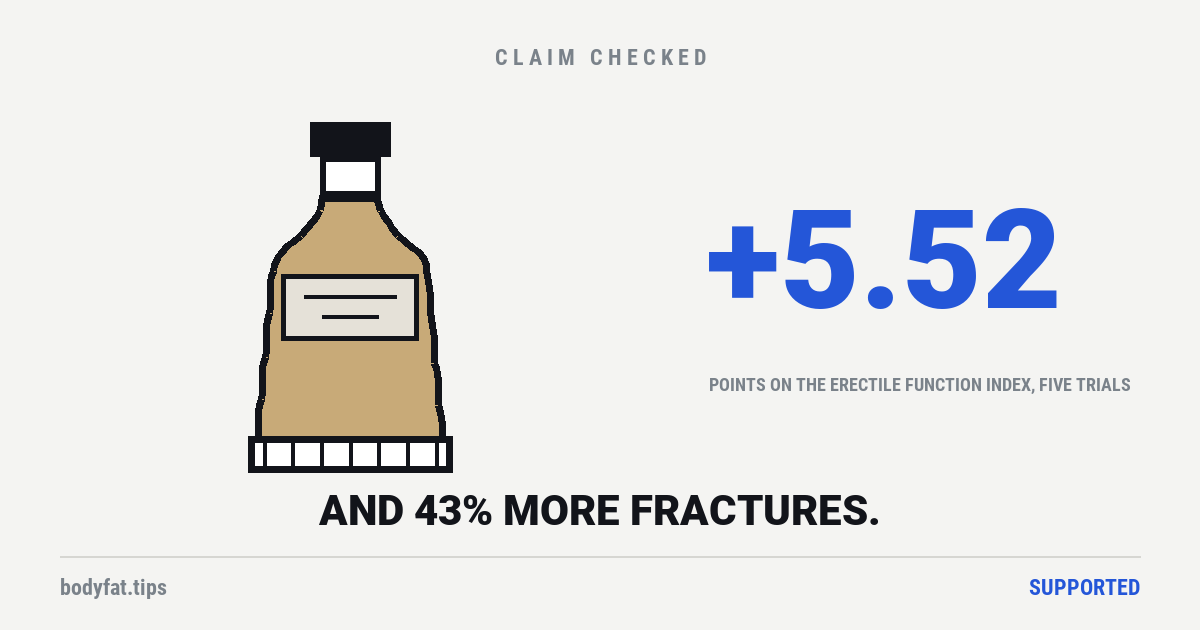
| Fractures | 43% more |
| Sperm production | Suppressed |
What it definitely does
In 2016 researchers funded mainly by the US National Institutes of Health published the Testosterone Trials: 790 men aged 65 and over, all with testosterone under 275 ng/dL and symptoms, randomised to testosterone gel or placebo gel for a year. [1]
Treatment lifted their testosterone into the mid-normal range for men aged 19 to 40. And it “significantly increased sexual activity… as well as significantly increased sexual desire and erectile function” (P < 0.001). [1]
That finding has held up under much harder scrutiny since. In 2023 a team went back to 35 trials covering 5,601 men and, crucially, obtained the individual participant data from 17 of them — the raw per-man records rather than the published averages. That is the strongest form a meta-analysis takes [2]. The Testosterone Trials are one of the 17 [3], so this is a harder look at a pool that includes them rather than an independent repeat.
Five of those trials used the full 15-question International Index of Erectile Function, a standard sexual-function questionnaire. In them, testosterone raised the total score by 5.52 points, across 1,412 men, and its erectile-function part by 2.14 [3] — enough to reach what researchers call the minimal clinically important difference for mild erectile dysfunction [2]. In plain terms: for a man with mild erection problems, a change he would probably notice.
The bar rises with severity. One estimate of it, worked out from 17 trials of the erection drug tadalafil, puts the smallest change that counts as an improvement at 2 points on that erectile-function score for mild problems, 5 for moderate and 7 for severe [8], so for moderate or severe problems, 2.14 falls short. Five more trials in the same analysis, 442 men, used a shorter five-question version and found no clear difference [3]. And the T-Trials’ own authors note that testosterone did less for erections than has been reported for the class of drugs that includes sildenafil (Viagra) [1].
And the accompanying health technology assessment, working from the same dataset, found testosterone “improved quality of life and sexual function in almost all patient subgroups.” [3]
One more trial has tested it since, independently of all of these. Inside TRAVERSE, the heart-safety trial described below, 1,161 men who reported low sexual desire had a sexual-function study of their own. Over two years, testosterone “improved sexual activity, hypogonadal symptoms, and sexual desire, but not erectile function” [9] — hypogonadal symptoms being the symptoms of low testosterone.
Who it works for — and a distinction worth holding on to
The individual-data analysis was able to ask a question the averages cannot: does it matter who you are?
The improvement itself was “not found to be dependent on participant age, obesity, presence of diabetes, or baseline serum total testosterone.” [2] Older men benefited. Heavier men benefited. Men who started only mildly low benefited about as much as men who started very low.
But the same paper adds something that gets lost: the absolute level reached during treatment did depend on age and starting testosterone. [2]
Those are two different statements and both are useful. The size of the improvement is roughly the same for everyone. Where you end up is not — because men who are older or heavier start from worse symptoms, and the same improvement from a lower floor lands lower.
What it barely does — including the thing men come in for
Start with the pitch. Hone Health, which sells testosterone therapy online by monthly membership, opens its page for it with “clinically proven boosts in energy, focus, and strength” [10]. The trials say something smaller.
Six in ten of the T-Trials’ 790 men, 474 of them, qualified for its Vitality Trial, which was built specifically to test energy and fatigue. The result on its main measure: “no significant benefit with respect to vitality, as assessed by the Functional Assessment of Chronic Illness Therapy-Fatigue scale.” [1]
That is not the whole result. On the trial’s other measures, the men on testosterone came out slightly ahead: on a second vitality score, on mood, and on the PHQ-9, a nine-question checklist of depressive symptoms. They were also more likely to say their energy had improved, and across all three trials together even the fatigue score edged their way [1]. Slightly is the word. An effect size compares the gap between the groups with how much the men differed to begin with; 0.8 is what researchers call large and 0.2 is barely there, and the paper puts every one of those score differences below 0.20 [1].
TRAVERSE, the much larger heart-safety trial described below, found the same pattern. Across all 5,204 men analysed, testosterone brought “modest but significantly greater improvements in mood and energy” than placebo, and none in sleep or thinking skills [11]. Significant here means probably not chance, not large; the authors’ own summary is “small improvements in mood and energy” [11].
The individual-data meta-analysis found no significant effect on one depression measure: testosterone “did not significantly improve psychological symptoms” on the Beck Depression Inventory [2]. That result comes from three trials and 246 men, not from all 35 [3]. The same analysis found a small gain on the mental-health summary score of a standard quality-of-life questionnaire [3].
Body composition is the part of the pitch with the steadiest evidence behind it. The T-Trials paper opens by noting that in earlier trials in older men, testosterone “consistently increased muscle mass and decreased fat mass” [1]. The same sentence carries the catch: its effects on physical performance, sexual function and energy had been inconsistent, which is the uncertainty the T-Trials were set up to settle [1]. More muscle did not reliably mean a man could do more with it.
Walking is the honest middle case. The Physical Function Trial asked whether more men could improve their six-minute walking distance by at least 164 feet (50 m). Within that trial, no significant difference. Pooled across all three trials, there was one: 20.5% versus 12.6%. [1] Both numbers are in the paper and both belong in any summary of it.
If you arrived here from part two, this should sound familiar. The European ageing study found that fatigue and low mood were related to the testosterone level too, but only three sexual symptoms — poor morning erections, low desire and erectile dysfunction — clustered with falling testosterone as a syndrome, a set of symptoms that travel together [12]. Treatment turns out to work best on that same short list. Tiredness is harder to pin on the hormone: low energy, libido and mood, in the Endocrine Society’s words, “are common in aging men with many causes” [13].
The result nobody expected
Testosterone improves bone density. That has been known for years, it is the opening sentence of the paper we are about to describe, and it is why people assumed it would prevent fractures.
In 2024, researchers counted the fractures. Inside the big cardiovascular safety trial, 5,204 men were followed for a median of 3.19 years, with every reported fracture checked against medical records. [4]
Fractures occurred in 3.50% of the testosterone group and 2.46% of the placebo group. That is a hazard ratio of 1.43 — the rate of fractures on testosterone divided by the rate on placebo — with a confidence interval of 1.04 to 1.97, the range the true figure probably sits in, which leaves “no difference” outside it. And the paper adds that the incidence “also appeared to be higher in the testosterone group for all other fracture end points.” [4]
More testosterone. Better bones on a scan. More broken bones in real life.
This is the third time in this series we have run into the same trap. Ashwagandha lowered cortisol more clearly than it lowered the stress people said they felt. A testosterone number can read normal while the man has symptoms. And now bone density — the thing you can measure easily — improves while the thing you actually care about gets worse.
Nobody knows why. One reasonable guess is that men who feel better move more, and men who move more fall over more, but that is a hypothesis and the paper does not establish it: the trial did not record falls, except among men who broke something, or how active anyone was, and it did not scan anyone’s bones [4]. What the paper establishes is that if you were told testosterone would protect your bones, the only trial big enough to check found the opposite.
Worth noting who ran it. The parent trial was paid for by four testosterone makers, led by AbbVie, after the FDA required manufacturers to run such a trial [5]. The fracture analysis inside it was designed by a separate fracture committee and analysed at the University of Wisconsin’s statistics centre; AbbVie’s representatives suggested revisions to the paper, and the committee made the final decisions [4]. It was built to find a benefit, sized to detect 30% fewer fractures on testosterone, and its authors write that they “did not expect these results” [4]. The same company helped pay for the Testosterone Trials above and supplied their gels [1], so industry money sits behind the good news on this page as well as the bad.
The costs that are certain
Fertility. This one is not a risk, it is a mechanism. Taking testosterone tells your brain to stop asking your testes to make it, which collapses the testosterone concentration inside the testicle — and that is what sperm production runs on. A 2025 review puts it plainly: exogenous testosterone “drastically reduces intratesticular testosterone, consequently impairing spermatogenesis”, and “is contraindicated in men trying to conceive.” [6]
Production often restarts after stopping, slowly, and with “highly variable kinetics that might complicate family planning.” [6] Often. Slowly. Variable. If you are 35 and not finished having children, that is the sentence to read twice.
The heart question, answered in part. This used to be the great worry, and its main part has now been tested properly: in 5,246 men at high cardiovascular risk followed for a mean 33 months, a heart attack, a stroke or death from cardiovascular causes occurred in 7.0% on testosterone and 7.3% on placebo [5]. The evidence synthesis agrees — 7.5% versus 7.2%, an odds ratio of 1.07 (the odds of an event on testosterone divided by the odds on placebo, so 1.07 means about the same), and its conclusion is that the findings “do not support a relationship between testosterone replacement therapy and cardiovascular/cerebrovascular events in the short-to-medium term.” [3]
The rest of the heart question came back with problems. In the same trial, the men on testosterone had more heart-rhythm problems serious enough to need treatment (5.2% against 3.3% on placebo), more atrial fibrillation, an irregular heartbeat (3.5% against 2.4%), more acute kidney injury, a sudden fall in kidney function (2.3% against 1.5%), and more clots in the lung, pulmonary embolisms (0.9% against 0.5%) [5]. The first three each passed the usual bar for ‘probably not chance’, and the lung clots were one part of a wider count of clots the trial tracked. None was the question the trial was built to answer, so they are signals rather than settled findings, and the authors write that “these adverse events were not expected” [5]. Blood pressure moved the wrong way too, if only slightly: over six months, systolic pressure, the top number, rose 0.3 mm Hg on testosterone and fell 1.5 on placebo [5]. The evidence synthesis had found no adverse effect on blood pressure [3].
The regulator has acted on both halves. In February 2025 the FDA, having reviewed the trial, called for boxed-warning language “related to an increased risk of adverse cardiovascular outcomes” to come off all testosterone labels, a boxed warning being the black-bordered warning at the top of a drug’s label. In the same announcement it required a warning about raised blood pressure on every product that lacked one, because monitoring studies it had ordered “confirmed an increase in blood pressure with use of all testosterone products, class-wide” [14]. The labels still say that safety and efficacy in “age-related hypogonadism”, low testosterone put down to ageing alone, “have not been established” [14]. And the Endocrine Society’s July 2026 statement says long-term safety “(including for prostate cancer) remains unestablished” [13].
And the list of men who should not start. The Endocrine Society names them: men planning fertility in the near term, men with breast or prostate cancer or a suspicious prostate exam or PSA, elevated haematocrit, untreated severe sleep apnoea, severe urinary symptoms, uncontrolled heart failure, a heart attack or stroke in the last six months, or a clotting disorder. [7] Monitoring afterwards is not optional either, and this is what it watches.
Testosterone raises the red-cell count: in the T-Trials, 7 men on testosterone and none on placebo reached a haemoglobin of 17.5 g/dL or more [1], and the evidence synthesis found raised haematocrit, the share of the blood made up of red cells, on treatment [3]. The guideline tells doctors to check haematocrit, testosterone levels and prostate cancer risk during the first year [7]; TRAVERSE cut the dose, and stopped treatment if that failed, in any man whose haematocrit went above 54% [5]. Add blood pressure, which the FDA now requires every testosterone label to warn about [14].
About “before and after”
A lot of people arrive at this question through photographs. It is worth saying what the trials did and did not measure.
They measured sexual function questionnaires, walking distance, fatigue scales, mood inventories, cardiovascular events and fractures. They were not photograph studies, and a photograph cannot tell you what a man was eating, lifting or taking alongside the prescription.
The honest before-and-after is the table at the top of this page.
The verdict
Testosterone therapy works, for a specific list of things, in men who genuinely have low testosterone and symptoms to go with it. We rate it Supported: a 790-man trial funded mainly by the NIH found clear gains in sexual desire and activity; the heart-safety trial’s own 1,161-man sexual-function study found them again; and an individual-participant meta-analysis, which includes the first trial, found gains in sexual function and quality of life. The heart-attack-and-stroke alarm has been properly tested and did not ring, though the same trial found more heart-rhythm problems, lung clots and kidney injury on testosterone, and the FDA now requires a blood-pressure warning on every testosterone product.
It is not Established, for three reasons. The erection benefit is small: enough to notice only for mild problems, and absent in the largest trial to test it. The effects on energy and mood are small too, and low energy was the complaint that qualified six in ten of the T-Trials’ men for its Vitality Trial. And the costs are still being counted: the largest trial to count fractures found 43% more of them on treatment, and the Endocrine Society says long-term safety “(including for prostate cancer) remains unestablished” [13].
So the useful framing is not “does TRT work”. It is: for what, and at what cost. If you have two confirmed low morning readings and the sexual symptoms that actually track with them, the evidence says treatment helps, and in the largest trial it did not raise the rate of heart attacks or strokes; heart rhythm, clots and blood pressure are what to watch. If what you have is tiredness, the trial built to test that missed its main measure, and the gains it and TRAVERSE did find were small. And if you want children in the next few years, this is the wrong drug.
It is also worth remembering what the rest of this series found. If your low reading comes with extra weight, losing weight raises the number too, without the fertility cost; for low testosterone put down to excess weight with no other cause, the Endocrine Society calls weight loss “typically the first-line therapy” [13]. It has bone questions of its own: weight-loss surgery appears to raise the risk of fractures, and for diet-and-exercise programmes the effect is unclear, though the largest trial reported more of what it called frailty fractures [15]. And for the supplements sold to do the same job, see whether boosters work.
Part 8 of a series on testosterone. Earlier: whether to get tested, what normal means, free versus total, what actually raises it, and whether boosters work.
Related: should you get your testosterone tested · normal testosterone levels by age · how to increase testosterone naturally · do testosterone boosters work
An independent editorial review on 18 September 2026 found that this page closed the heart question too early and said testosterone therapy does nothing for energy or mood, when the trials it cites say otherwise. We wrote that “the heart worry has been retired”. The heart-safety trial, TRAVERSE, found no rise in heart attack, stroke or cardiovascular death, but more heart-rhythm problems needing treatment, more atrial fibrillation, more acute kidney injury and more clots in the lung on testosterone, and since February 2025 the FDA has required a blood-pressure warning on every testosterone product. We wrote that the trial built to test energy “found nothing”; it missed its main fatigue measure but found small gains in mood, depressive symptoms and self-reported energy, and TRAVERSE later found small gains in mood and energy across 5,204 men. The table, the verdict, the evidence panel and the search description now say small, not none. Our headline said testosterone therapy worked “not at all” for energy; it now says barely.
Also corrected. Our funding row said the Testosterone Trials were funded by the National Institutes of Health; AbbVie also funded them and supplied the testosterone and placebo gels. It named AbbVie alone for TRAVERSE, which a consortium of four testosterone makers paid for after the FDA required such a trial, and it implied that the manufacturer ran the fracture study, which a separate fracture committee designed and a university statistics centre analysed; the argument we built on that is withdrawn. The erection figures came from five trials and 1,412 men, not 35 trials; the gain is big enough to notice only for mild erection problems, and TRAVERSE’s own sexual-function study found better desire and activity but no better erections. The depression-inventory result we quoted came from three trials and 246 men. The European ageing study found fatigue and low mood related to testosterone level, so we no longer say the tiredness “was never the hormone”. We said weight loss carries no fracture signal; after weight-loss surgery it appears to raise fracture risk. We had not said what monitoring watches for; the page now names haematocrit and blood pressure. We said ashwagandha made nobody feel less stressed; our ashwagandha page finds a weak yes, with one review dissenting. The fertility review says sperm production often restarts slowly, not that it usually restarts. The provenance chain now credits the National Institute on Aging’s own 2016 release with reporting the vitality result plainly, names a dated sales page for the marketing it describes in place of claims we could not source, and states the claim in our words rather than in quotation marks; the body-composition part of that claim is now addressed. The rating is unchanged: Supported.