Why Does Caffeine Make Me Sleepy? It Doesn’t While It’s Working. Going Without It Does, and the Next Cup Mostly Just Gets You Back to Normal.

You drink the coffee and, instead of waking up, you want to put your head on the desk. Plenty of people know the feeling: “why does caffeine make me sleepy” is searched about 12,100 times a month in the United States (from a paid keyword database, pulled 20 October 2026) [1].
Google’s AI answer to that search has an explanation ready. Caffeine blocks your brain’s sleep signal instead of giving you energy, it says, and when caffeine leaves your system, “all the accumulated adenosine floods the receptors at once”, bringing a sudden wave of exhaustion. Then it lists tolerance, a fast metabolism, sugar crashes, dehydration and lost sleep [1]. The pages it cites, a coffee seller’s blog among them, tell much the same story, and so does a mushroom-coffee brand further down the results [1].
Here is what the trials found. Caffeine does not make you sleepy while it is working. Going without it does, once you are used to it, and the next cup mostly just brings you back to normal. When regular users had their caffeine swapped for a dummy pill, they grew sleepier and more tired within a day or two [2] [3]. In a trial of 369 adults, people who usually had a fair amount of caffeine were the sleepiest of anyone by the afternoon if they had been given dummy capsules, and about as sleepy as people who rarely touch it if they had been given caffeine [4]. The crash a few hours after a single cup, the part the explanations lead with, is another matter: trials that followed people for hours after one dose, against a dummy dose, did not find the caffeine group ending up sleepier [5] [6] [7].
Two words before going on. A placebo, or dummy pill, looks and tastes like the real thing and contains no caffeine, so nobody knows which they had. Withdrawal is what the body does when a drug it has got used to is taken away; for caffeine, the symptoms researchers have confirmed include headache, fatigue, drowsiness and lower alertness [3].
Does coffee make you sleepy or awake?
Awake, while it is working. The 369 adults were volunteers in a trial at the University of Bristol, who went without caffeine from 7 p.m. the evening before, then took a capsule of 100 mg of caffeine, about the amount in a cup of ground coffee, and another of 150 mg ninety minutes later, or dummy capsules both times. Within each group, by usual intake, chance decided who got which [8]. Among people who normally had almost no caffeine, less than 40 mg a day, the real capsules left them less sleepy through the afternoon than the dummy ones did [4]. The trial’s results came out in two papers, in 2010 and 2013; they describe the same people, so on this page they count once [8] [4].
Sleepiness measured with a stopwatch says the same. In a 1990 trial, 24 young men took 250 mg of caffeine or a dummy pill twice a day for two days, and several times a day they lay down in a dark room to see how quickly they fell asleep, a standard test called the multiple sleep latency test: the faster you drop off, the sleepier you are. On caffeine they took longer to fall asleep [9]. The same trial saw that effect fade over the four doses, which is the first hint of where this page is going [9].
Can caffeine have the opposite effect and make you tired?
Yes, but by being missed, not by being taken. In 1992 a Johns Hopkins team took 62 adults who had a low to moderate amount of caffeine, 235 mg a day on average, which the paper puts at about two and a half cups of coffee, and put them on a caffeine-free diet for two two-day spells, taking capsules that held their usual daily dose in one spell and dummy capsules in the other, in random order, without telling them which was which [2]. People who usually had more caffeine reported more drowsiness on the dummy days: a weak link, but more than chance [2].
| Trial | Who and how long | What happened |
|---|---|---|
| 1992, Johns Hopkins [2] | 62 adults on about 235 mg a day; two days on capsules of their usual dose or a dummy | On the dummy days 8% had abnormally high fatigue scores and 11% abnormally low vigour, against none on their normal diet; 52% had a moderate or severe headache |
| 2009, Johns Hopkins [10] | 16 regular users; at least two weeks on 400 mg a day and at least two weeks on dummy capsules | About a day after the switch to dummies: more tired, fatigued, sluggish and weary; the two fortnights themselves differed on one of 21 measures |
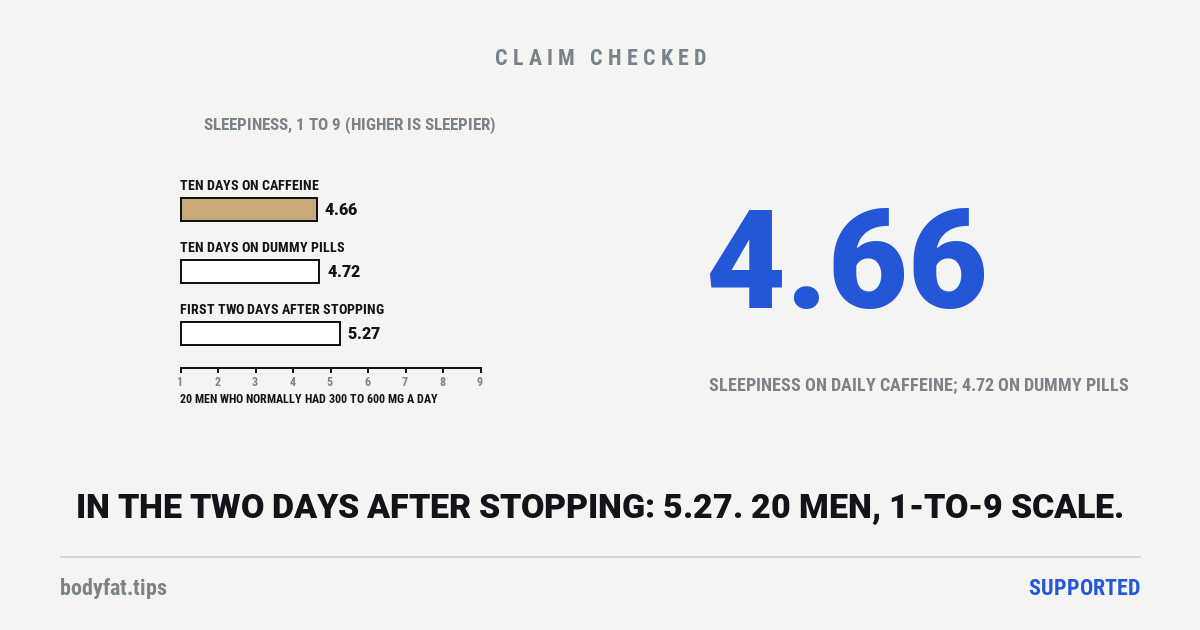
| 2020, Basel [11] | 20 young men on 300 to 600 mg a day; ten days each on 450 mg a day, on dummies, and on caffeine then two days of dummies | Sleepiness 4.66 on caffeine, 4.72 on dummies, 5.27 in the two days after stopping, on a 1-to-9 scale |
A 2004 review of 57 experiments counted fatigue, drowsiness, lower energy and lower alertness among ten caffeine withdrawal symptoms it judged well established. They usually began 12 to 24 hours after the last dose, peaked 20 to 51 hours in, lasted two to nine days, and turned up after stopping as little as 100 mg a day. We read the review as its summary [3].
The Basel trial in the table is the cleanest test of the whole idea. Its 20 men, who normally had 300 to 600 mg a day, spent ten days on 150 mg three times a day, ten days on dummy capsules and ten days on caffeine with the last two on dummies, without knowing the order [11]. They rated their sleepiness on the Karolinska Sleepiness Scale, a 1-to-9 rating where higher means sleepier. It averaged 4.66 on daily caffeine and 4.72 on daily dummy pills, about the same; in the two days after the switch to dummies it averaged 5.27, higher than both, and they had more lapses on an attention test [11]. Given an hour to nap in the evening, every one of the 20 reached non-REM sleep, the kind that makes up most of a night, during the withdrawal days; four did not on dummy pills and six did not on caffeine [11].
Ten days of caffeine had not left them more alert than ten days without it, by any clear margin. Stopping it had made them sleepier. That is most of this page, in one trial of 20 men.
Then why does the first coffee feel like it works?
Because, for a regular drinker, it does: it lifts a sleepiness the habit put there. In the Bristol trial, after a night and a morning without caffeine, the people who usually had a fair amount and were then given dummy capsules were the least alert and the sleepiest of the four groups by the afternoon; in those given caffeine instead, it brought them back to about the level of light users on dummy capsules, and not significantly further [4]. In the light users, caffeine eased sleepiness but did not raise mental alertness, because it also made them more anxious and jittery [4]. Speed was different. In both groups caffeine made people tap a key faster, by about the same amount, and heavy users on dummy capsules tapped no slower than light users on them, so on that test of motor speed its authors count caffeine a net gain [4]. Two of the researchers in this field had made the general case in a 2005 review: that the lift regular users feel is almost entirely the reversal of withdrawal [12].
Not everyone agrees, and the disagreement is worth knowing. A 2005 trial at Northumbria University gave 24 habitual users and 24 non-users caffeine or a dummy drink after a night without it, and found caffeine raised alertness and eased mental fatigue in both groups, which its authors said did not fit the withdrawal-only explanation [13]. The Bristol researchers answered that saliva tests in that trial suggested its non-users were not caffeine-free: their average was twice that of the Bristol trial’s own medium users [8]. The Johns Hopkins trial in the table found caffeine had clear effects on people who had been off it for two weeks, which its authors said runs against withdrawal explaining everything, while also finding that a fortnight of daily caffeine and a fortnight of dummy pills differed on one of 21 measures, a brain-wave reading [10]. And a 2025 pooling of 31 trials in rested adults found caffeine sharpened attention, and found no link between the size of that effect and how much caffeine people usually had; we read it as its summary, and it measured attention tasks, not how sleepy anyone felt [14].
So the fairest reading is this. Caffeine does something real to a brain that is not used to it. In a brain that is, most of what the morning cup does is lift a sleepiness the habit put there, and on caffeine the regular user ends up about where a non-user is without it, in how sleepy and alert they feel [4] [10] [11]. Whether a coffee habit also blunts caffeine’s boost to exercise is a separate question, and our pre-workout caffeine verdict finds it open.
So is it a crash when the caffeine wears off?
This is the part the explanations lead with, and it is the part with the least behind it. The story goes that caffeine holds adenosine back, adenosine piles up behind the block, and when the caffeine clears it all lands at once [1]. Adenosine and the block are real: the Basel researchers describe adenosine as a proposed driver of the sleep pressure that builds while you are awake, and caffeine as blocking two kinds of its receptors, the docking points on brain cells it acts through [11]. Trials have looked for the crash itself, by following people for hours after one dose against a dummy dose, and none we read found the caffeine group ending up sleepier or more tired than the dummy group.
Start with people who had slept normally. Fourteen young adults who averaged about a 12 fl oz cup of coffee’s worth of caffeine a day went eight hours without it, then had an energy shot holding about 200 mg of caffeine by its maker’s figure, a dummy drink, or nothing. Over six ratings spread across nearly six hours they were less fatigued on the shot, and at the last rating, 340 minutes after it, their average was still lower than on the dummy drink: 2.50 against 3.86 on the trial’s fatigue scale, where higher means more tired [5]. Twelve people who used little or no caffeine took 200 mg or a dummy capsule: a drowsiness score taken from how they blinked stayed lower on caffeine for three to four hours, and their own ratings of sleepiness were significantly lower only at the first check, half an hour in [6]. Seven adults who took 250 mg or a dummy pill rated themselves less sedated on caffeine across the next eight hours, a result the paper reports only as a total for the whole stretch [15].
A larger trial kept testing after the effect had faded, though it measured attention, not sleepiness. In a trial of 96 adults split into four groups of 24, who usually had about two cups of coffee or tea a day and had gone 48 hours without, paid for by the maker of a plant extract it tested alongside caffeine, the 24 given 200 mg of caffeine did better than the 24 given a dummy powder on attention tests at one and three hours, then no longer differed significantly from them at five and eight, slightly ahead on some tests and slightly behind on others [16]. People kept awake for days have been followed longer. In 68 navy trainees after 72 hours without sleep, 200 or 300 mg cut their fatigue and sleepiness, and some significant effects were still there eight hours later; the summary does not say which [7]. Ten adults given 600 mg after 41.5 hours awake, against ten on a dummy pill, were tested every hour for the next 12, and the authors report that caffeine kept up their performance and alertness through the early morning [17]. And when 600 mg was followed with a reaction-time test of attention every two hours, until people had been awake for 61 hours, its help wore off sooner than that of two prescription stimulants [18]; that summary does not say whether the caffeine group then fell behind the dummy group.
One trial may point the other way. Thirty healthy volunteers had 50 mg of caffeine, an herbal drink or a dummy drink after lunch, on three different days, and were tested half an hour and two hours later. Its summary says that by two hours performance “had deteriorated” in the caffeine group, while the herbal drink, the product under test, beat both; it does not say whether caffeine fell below the dummy drink, and we could not read the paper [19]. We read the 2008 trial of light users, the three in people kept awake and this one as their summaries.
One trial whose conclusion names the crash, and which measured attention, was paid for by a company that sells a plant extract, galangal, as an ingredient for energy drinks. Its 59 volunteers, all moderate caffeine users, took caffeine, the extract, both, or a dummy pill on separate days, and its 2017 summary concluded that the extract taken with caffeine “impedes the caffeine crash”, without giving a figure for caffeine alone [20]. A 2018 analysis of the same 59 people, by one of the company’s employees, gives one measure in full: five hours after the dose, the caffeine group was making fewer errors per second on an attention test than the dummy-pill group, 3.34 against 3.64, a gap small enough to be chance [21]. What the paper calls a crash is the caffeine group’s error rate rising back to slightly above where it started, while the dummy group’s rose further [21]. Our reading: that is caffeine wearing off, not a fall below where you would have been without it.
Short courses of caffeine, stopped, have not always brought sleepiness either. In the 1990 trial, the men who had taken caffeine for two days were given a dummy pill on the third, alongside the dummy-pill group, and were the more alert of the two [9]. In a 1992 trial, 12 young men took 400 mg three times a day for a week; when it stopped, the daytime sleep test did not show rebound sleepiness [22]. Against them stand the Basel men above, long-time users, who were sleepier after stopping [11], and a 2017 trial of 48 people kept to five hours in bed for five nights: 200 mg of caffeine twice a day held off sleepiness for three days but not by the fourth, and after it stopped, the caffeine group took longer to get back to their usual alertness than the dummy group [23]. We read the 1992 and 2017 trials as their summaries.
The other half of the story, that regular users’ brains grow extra adenosine receptors, has thinner support than the pages suggest. In 45 volunteers, 400 mg a day for two weeks, or 600 mg a day, increased one kind of adenosine receptor on blood platelets, the cells that help blood clot; 400 mg for one week did not [24]. In rats given caffeinated water for 12 weeks, brain scans found another kind back around its starting level about a day after the caffeine stopped, and the authors concluded the caffeine had not changed them for good [25]. Both read as summaries. The Basel researchers list receptor changes among possible adaptations behind withdrawal [11]. Something in the brain adapts; a rise in receptors is one proposed way, and the human evidence for it comes from blood cells.
Why do I feel sleepy after drinking coffee or an energy drink?
If your coffee is closer to dessert, or your caffeine comes in a can full of sugar, the pages blame the sugar: a spike, then a crash [1]. A 2019 pooling of 31 studies and 1,259 people tested what sugars and other carbohydrates do to mood, against comparison drinks that, in the studies of fatigue in its first time window, were all artificially sweetened [26]. It found no lift at any point. In the first half hour, people given carbohydrate reported slightly more fatigue: a standardised difference of 0.15, the gap measured in units of how much people varied, where 0.2 is what researchers call small [26]. The confidence interval, the range the true average probably sits in, ran from 0.05 to 0.26, so even its top end is closer to small than to moderate [26].
Read that with its limits. No single study in that first window found a significant difference on its own; the largest, 114 people, supplied two of its nine comparisons; and one study of 112 people was set aside as an outlier, its result too far from the rest, in a direction we could not tell from the text [26]. Between half an hour and an hour, people rated themselves slightly less alert; after an hour, the fatigue gap had gone and leaned slightly the other way, within chance [26]. So sugar showed no rush and no later crash, just a small dip soon after.
With caffeine in the can, the picture changes. Twelve young adults who had slept five hours drove a simulator for two hours after an 8.5 fl oz (250 ml) energy drink with sugar and 80 mg of caffeine, or a drink that tasted the same without the caffeine or two other added ingredients, taurine and glucuronolactone: the energy drink cut their sleepiness and their sleep-related driving errors for the first 90 minutes [27]. The same lab gave ten short-of-sleep people a sugary drink with 42 g of sugars and only 30 mg of caffeine, against a sugar-free, caffeine-free drink: it did not lift their sleepiness, and about 80 minutes later their reactions were slower and they had more lapses [28]. Both read as summaries; both are small.
Is it dehydration?
The pages also blame dehydration: caffeine makes you pass more urine, you dry out, you flag [1]. This site rates that claim on its own page, where, at the intakes people ordinarily drink, coffee and tea hydrated about as well as water in trials, and the claim that they dehydrate you is rated Unsupported; big doses at once are rated separately there. The evidence is on our caffeine and dehydration verdict, and this page does not rate it again.
Does caffeine make you sleepy if you have ADHD?
This is the most specific version of the claim, and the one with a business attached. A psychiatric telehealth practice that prescribes ADHD medication tells readers that caffeine may make some people with ADHD tired because of how their brains handle dopamine, cites no study for it, and ends with a button to book an appointment [1]. A health-information site’s version is more careful: it says the question has not been well studied [1].
The idea behind it is older than the internet: that stimulants calm hyperactive children because their brains react to stimulants in reverse. It was tested in 1978 and 1980 with a single dose of dextroamphetamine, a much stronger stimulant than caffeine, given to boys with and without hyperactivity and to college-age men. All three groups moved less and paid attention better; the men reported feeling euphoric, and the boys, with or without hyperactivity, reported feeling “tired” or “different” [29] [30]. The response was not peculiar to hyperactivity. We read both as summaries.
For caffeine itself, one small trial measured arousal directly: 18 children with ADHD and 18 matched children without it took caffeine and, a week apart, a placebo, and caffeine raised their skin conductance, how readily the skin carries a tiny electric current, which rises with arousal, in both groups by about the same amount. Its authors still read it as a sign of an unusual arousal mechanism in ADHD, because the rise kept step with the dose in the other children but not in those with ADHD [31]. A 2023 review found seven small trials in 104 children aged 5 to 15, every one a crossover in which each child had both caffeine and a placebo. Pooling the four it could combine, 76 children, it found no significant difference from a placebo in overall ADHD symptoms. Of the three it could not pool, one, in six boys, found inattention and hyperactivity improved at the lower of two doses but not the higher, and another found better sustained attention but more impulsive responses [32]. On side effects, it lists none in two trials, slight discomfort in one and weight loss in one, and says the other three did not mention them; sleepiness is not on the list, which, with three trials silent, tells us little [32]. In 302 young teenagers, those with ADHD were more likely to have caffeine in the afternoon and evening, and afternoon caffeine went with more reported sleep problems in both groups, which, if anything, points away from caffeine as a sleep aid; that study observed, it did not test [33].
The nearest thing to a sleep benefit in adults comes from a prescription stimulant, not caffeine. In a small study, ten adults with ADHD who started methylphenidate slept more efficiently and fell asleep faster after at least 26 days, and said their sleep felt more restorative; it was open-label, meaning everyone knew they were taking the drug, and its authors call for proper placebo-controlled trials [34]. That is night-time sleep improving on a treatment, not daytime sleepiness after a coffee. We found no trial that tested whether caffeine makes adults with ADHD sleepy [35].
Is it bad if caffeine makes you sleepy?
It can be, in two ways, and it can be a sign of something else. The first way is the cycle the pages describe: late caffeine costs sleep, and the lost sleep makes the next day sleepier [1]. The first half is well measured. In a 2013 trial, 12 normal sleepers took 400 mg of caffeine at bedtime, three hours before or six hours before, on separate nights, or a dummy pill; even at six hours, a home sleep monitor recorded more than an hour less sleep than on the dummy night [36]. A 2023 pooling of 24 studies, which we read as its summary, found caffeine shortened sleep and cut deep sleep [37].
Whether that leaves the next day sleepier is less clear, because the trials that checked disagree. Thirteen male rowers who took 6 or 9 mg of caffeine per kilogram of body weight in the evening, about 450 or 675 mg for a 165 lb (75 kg) person by our arithmetic, rated themselves sleepier the next afternoon: 4.2 and 4.3 on the Karolinska scale, where 1 means extremely alert and 9 very sleepy, against 3.2 after a dummy capsule. At 3 mg per kilogram it was 3.5, a difference the paper did not count as significant [38]. But 19 light caffeine users who took 250 mg at bedtime for five nights at home, against five nights of dummy capsules, spent about 81% of their time in bed asleep against about 86%, and did not rate themselves significantly less energetic the next day [39]. Four of that trial’s dropouts had taken caffeine in the first week and gave the lost sleep and how they felt the next day as their reasons, so the people most affected left before the end [39]. What short sleep does over months has its own verdict.
The second way is the habit itself: on the evidence above, a regular drinker spends some of each day sleepier than a non-user would be, between cups, and buys that time back with the next one [4] [11]. That is not dangerous. It is just not free.
And the other possibility is the one this page cannot help with. If you are sleepy every day, coffee or not, there are causes worth ruling out: the NHS lists sleep apnoea, iron-deficiency anaemia, diabetes and an overactive thyroid among the conditions behind ongoing tiredness, and tells people to see a doctor if they have felt tired for a few weeks without knowing why [40]. This is journalism, not medical advice. Persistent daytime sleepiness belongs with a clinician.
How do I stop caffeine from making me tired?
If the sleepiness is withdrawal, the trials point to two things you can do, and neither is a product. One is steadiness: in the Basel trial, steady daily caffeine left the men about as alert as steady dummy pills, and the sleepiness came when the caffeine stopped [11]. The other is a reset: withdrawal symptoms usually last two to nine days, by the 2004 review [3], and after the Johns Hopkins volunteers had been off caffeine for two weeks, a dose had clear effects again [10]. Whether cutting down gradually spares you the symptoms is not something we checked for this page. And keep it away from bedtime: six hours was not enough at 400 mg [36]. Cutting late caffeine is one of the standard sleep-hygiene rules, which work better as part of a treatment than as a list on their own.
If coffee makes me sleepy, what will wake me up?
For a regular drinker, the honest answer is the next coffee, which is the trap. For someone genuinely short of sleep, a 1996 trial of ten sleepy volunteers in a driving simulator found that a nap of under 15 minutes and 150 mg of caffeine in coffee both cut their sleepiness and their driving errors against a dummy coffee, while a break on its own did not help, the authors report [41]. We read it as its summary. Caffeine borrows against sleep; it does not replace it.
Who these studies were done on
Mostly young and middle-aged adults in Britain, the United States and Switzerland. The Bristol trial was 18 to 62, slightly more women than men, and 95% white European [8]. The 1992 volunteers averaged 30 [2]; the 2009 trial was 12 women and 4 men aged 24 to 54 [10]; the Basel trial was men aged 18 to 35 only, and its authors say the results may not transfer to teenagers or adults over 40 [11]. The bedtime trials were 12 and 19 adults and 13 young male rowers [36] [39] [38]. The ADHD evidence is almost all children and teenagers [32] [33].
So read yourself against them. If you have a coffee or two most days and feel flat without them, these trials were about people like you. If you are older, pregnant, a teenager or on medication, few of them were, and the question of what caffeine does to you belongs with someone who knows your health.
If caffeine doesn’t make you sleepy, why does it feel like it does?
This section is the desk’s own reasoning, and it is labelled as such. The trials say caffeine reduces sleepiness while it acts, and that regular users get sleepy without it. Yet plenty of people, as the search figure at the top shows, are asking why it makes them sleepy. Here are three ways to fit those together, each rated.
Answer one: the cup arrives at the low point. A regular drinker’s first cup comes after a night without caffeine, and in the Bristol trial, the gap between heavy users and light users without caffeine was wider by the afternoon than in the morning [4]. If a cup comes late, the dip has already arrived, and it is easy to blame the last cup for a sleepiness that is really the gap since it. The timing is measured; that this is what people are describing when they say coffee makes them tired is our surmise.
Answer two: the habit moves your normal. On caffeine, regular users were about as alert as people without the habit; off it, they were sleepier [4] [11]. A regular drinker’s ordinary day is spent climbing back to where a non-user starts, so on a day when the climb falls short, a cup that no longer feels like a boost will feel like it did nothing. Measured in two trials; that people experience it as coffee making them tired is a surmise.
Answer three: the sleep you lost. Late caffeine costs sleep, which is measured [36]. Whether that leaves you sleepier the next day is conflicting: yes in one small trial of large evening doses, not significantly in another of a bedtime dose [38] [39]. A hunch with mixed support.
Put the three together and here is what we think is true, stated plainly so you can disagree with it: caffeine doesn’t make you sleepy; it moves where your normal is, and you feel the gap whenever you are between cups.
What we could not find, and would like to: a trial that gave rested people who rarely use caffeine a single ordinary dose in the morning and reported, against a dummy dose, how sleepy they felt hour by hour into the evening, long after the caffeine had stopped working [35]. The single-dose trials above that rated how sleepy, tired or sedated rested people felt stopped at four to eight hours, and the one that ran to eight gave a single total for the whole stretch [6] [5] [15]. A registered trial of an energy shot, plain caffeine and a dummy, which planned to measure wakefulness at one, three and five hours, finished in 2013; its registry record posts no results, and we found no published report [35]. A beverage company registered a trial in 2021 that planned alertness ratings at intervals for 12 hours after single doses of caffeine, with no dummy dose; it posts no results either, and we found no report of it [35]. If you know of the trial we describe, or of a report of either registered one, the corrections line on this site is open.
Where “the caffeine crash” came from
The research behind the true part is more than three decades old. The 1992 double-blind trial showed that ordinary drinkers who stop caffeine get headache, fatigue and low vigour within two days [2], and the 2004 review counted drowsiness and fatigue among the established symptoms and argued that caffeine withdrawal belonged in psychiatry’s diagnostic manual [3].
The framing that regular users gain nothing came next, in the 2005 review’s case that caffeine’s lift is mostly the reversal of withdrawal [12]. Somewhere between there and the explainer pages, the story changed shape. Withdrawal, which builds over 12 to 24 hours [3], became a crash a few hours after a cup, and adenosine flooding back became the reason. We could not trace who first told it that way. The oldest page we read that does is a health-information article updated in September 2018 [1].
By 2026 it was the standard answer. A prescription-discount company’s health article (February 2026), a sleep-information site (updated July 2026) and a health-information site all explain the sleepiness with adenosine rushing back in; Google’s AI answer cites them, with two short videos, and leads with the crash [1]. The prescription-discount article backs its fast-metabolism point with a study of a caffeine gene and kidney function; for its surge, the sleep site cites a 2011 general review of coffee’s benefits and risks [1].
And it sells. A coffee seller’s blog walks readers through the crash and ends by selling its own beans as coffee that leaves you awake, not burned out [1]. A mushroom-coffee brand explains the crash with extra adenosine and receptors, then recommends its own blend at 45 mg of caffeine a serving [1]. An ingredient maker funded the trial that says its plant extract, taken with caffeine, impedes the caffeine crash [20]. On the same results page, the sleep site offers home sleep tests and the ADHD practice offers appointments [1].
None of this is aimed at anyone who reaches for a second cup at three in the afternoon. The sleepiness is real. It is the explanation that has been sold back to you as a reason to buy a different drink.
What this is rated, and what the rating covers
Supported — for the claim that caffeine can leave you sleepier instead of more awake, in one specific way: in regular users, going without it brings on sleepiness within a day or two, and the next dose mostly returns them to where people who rarely use caffeine already are, in how sleepy and alert they feel.
It is rated Supported because double-blind trials that swapped regular users’ caffeine for dummy pills found more fatigue, tiredness or sleepiness in each of them [2] [10] [11], a 2004 review of 57 experiments, co-written by the senior author of the 1992 and 2009 trials and citing the 1992 one, counted drowsiness and fatigue among the established withdrawal symptoms [3], and the largest trial found caffeine returned heavy users to the level of light users on dummy capsules [4]. It is not Established because whether a regular habit gives any net gain is disputed: one trial found caffeine raised alertness in non-users as well as users [13], caffeine had clear effects after weeks without it [10], a 2025 pooling found its effect on attention unrelated to usual intake [14], and the Bristol trial itself found it made regular users tap faster, a net gain in motor speed by its authors’ reading, though not in alertness [4]; and because one trial that stopped a week of high doses did not find rebound sleepiness on the daytime sleep test [22].
Each part, rated alone, in words. That caffeine makes you sleepy while it is acting: Unsupported, of the tested kind: in the trials on this page it reduced sleepiness, on questionnaires and on the daytime sleep test [4] [9]. That withdrawal makes regular users sleepy and tired: Established [2] [3] [10] [11].
That a single cup leaves you sleepier than before once it wears off, the crash the pages lead with: Unsupported, of the tested kind, as far as it has been tested: in trials that followed people for hours after one dose against a dummy dose, rested in some and kept awake for days in others, none we read found the caffeine group ending up sleepier or more tired [5] [6] [15] [7] [17], and in the galangal trial, which names the crash, the caffeine group was not behind the dummy group on attention errors five hours later, 3.34 against 3.64 a second, a gap within chance [21]. What we found untested is a rested person’s sleepiness followed hour by hour into the evening, long after a single dose [35]. That regular users’ brains grow extra adenosine receptors: Preliminary, on platelet receptors in people and on animal studies, one of which found no lasting change [24] [25].
That sugar in your drink causes a crash: Preliminary. Pooled studies found a small rise in fatigue in the first half hour after carbohydrate, with no lift before it and no further fall after an hour, and one ten-person trial of a sugary, low-caffeine drink in sleepy people pointed the same way [26] [28]. That caffeine makes you sleepy by dehydrating you: rated on its own page, where the claim that coffee and tea dehydrate you at ordinary intakes is Unsupported.
That stimulants work in reverse in people with ADHD: Unsupported, of the tested kind, as far as it was tested, in boys given dextroamphetamine [29] [30]. That caffeine makes adults with ADHD sleepy: Preliminary, because no trial we found tested it and the nearest evidence points both ways: caffeine raised arousal in children with ADHD about as much as in other children, though that trial’s authors read an unusual arousal mechanism into how the rise followed the dose, and a stimulant medicine improved night sleep in a small open study of adults [31] [34].
That late caffeine costs you sleep: Established [36] [37] [39]. That the lost sleep leaves you sleepier the next day: Preliminary, on two small trials pointing different ways [38] [39].
What is not rated here: whether a fast caffeine metabolism makes the lift shorter, which the pages claim and which would need the genetics literature we did not search; whether hot or cold coffee differs, which people also search; caffeine and anxiety; coffee and weight loss and evening light and sleep, which have their own verdicts; and the frame above, which is this desk’s reasoning from the evidence rather than a result the evidence delivered. It is marked as ours so that you can weigh it as ours.
This is journalism, not medical advice. If you are sleepy most days whatever you drink, that belongs with a clinician, who can look for the causes a coffee habit can hide. How we read a study, and what each tier means, is set out here.
- Vagus Nerve Reset: The Neck Device’s 56% Drop in “Stress Symptoms” Was a Depression Score, From a Study With No Sham Group
preliminary - Mouth Taping: The Best Result Was in Mild Sleep Apnea, With a Working Nose
preliminary - Forest Bathing: People Feel Better. You Cannot Blind Anyone to a Forest.
preliminary