Do Peanuts Raise Blood Sugar? Hardly, in Glycemic Index Tests and 8 Trials

“Do peanuts raise blood sugar” is searched about 720 times a month in the United States (from a paid keyword database, pulled 20 October 2026) [1]. The question gets two loud answers. One, in a diabetes forum thread that Google’s AI answer cites, is titled “anyone know why peanuts spike blood sugar”. The other comes from the peanut industry itself: peanuts and peanut butter “don’t cause blood glucose to spike” and are “like a secret weapon” for people with diabetes, in the words of the industry’s promotion board [1].
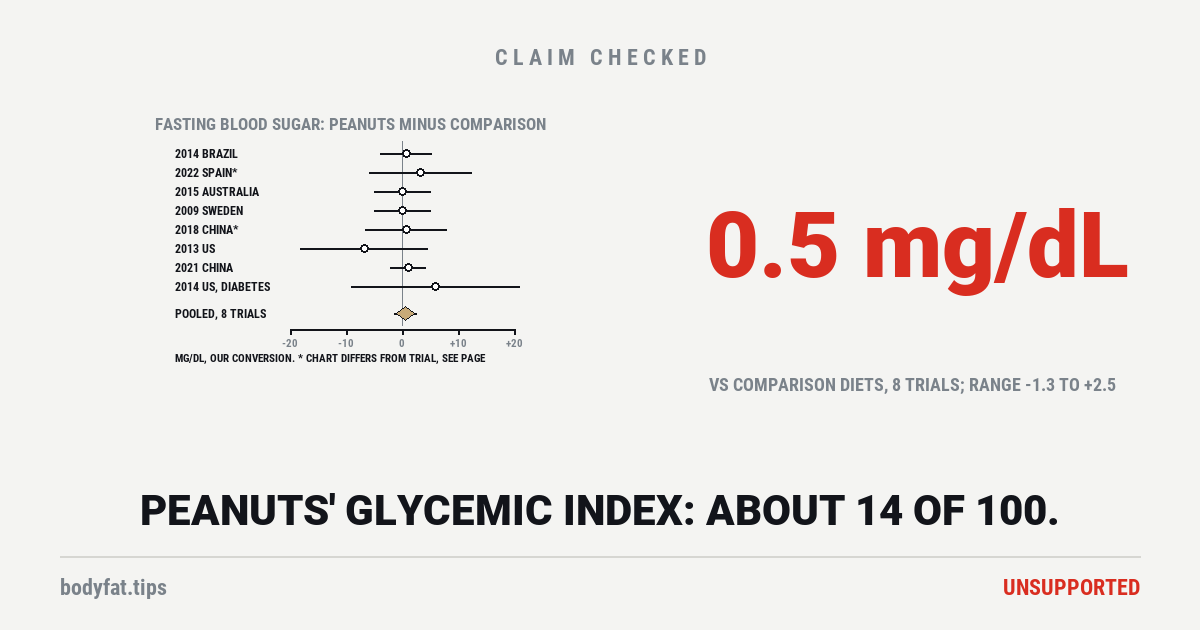
Hardly. Eaten on their own, peanuts move blood sugar very little, and over weeks of eating them, fasting blood sugar came out about even with the comparison diets. In the published tests, the rise in blood sugar after peanuts averaged about a seventh of the rise after the same carbohydrate as plain glucose [2] [3]. In eight randomised trials pooled in 2022, fasting blood sugar with peanuts averaged about 0.5 mg/dL higher than on the comparison diets, with a range that includes no difference at all [4]. What can change the answer is what comes with the peanuts, in the jar or on the plate, and that is covered below.
This is journalism, not medical advice. If you have diabetes or prediabetes, plan changes to what you eat with your clinician or dietitian, who knows your medicines and your numbers.
What is the glycemic index of peanuts?
The glycemic index scores how far a food raises blood sugar over two hours, against the same amount of carbohydrate eaten as plain glucose, which scores 100 [2]. It compares portions holding the same carbohydrate, not the same handful, as our oatmeal verdict explains. A score of 55 or less counts as low [5].
The figure everyone quotes for peanuts, “around 13 to 14”, traces to three small tests. The first, in 1981, gave 5 healthy volunteers enough peanuts to supply 25 g of carbohydrate; their blood sugar rose 13% as much as it did after glucose [2]. Peanuts hold little carbohydrate that is not fibre, about 4 to 7 g in 1.8 oz (50 g) by the tables’ figures [3] [6], so supplying 25 g of it took about 6.3 oz (about 180 g) of peanuts even at the higher figure, by our arithmetic; the paper notes that some volunteers found the peanuts hard to finish [2]. A test of crushed peanuts in South Africa came out at 7, and one in Mexico at 23; the 2002 international tables averaged the three to 14 [3].
| Test | Who ate the peanuts | Glycemic index (glucose = 100) |
|---|---|---|
| Canada and England, 1981 [2] | 5 healthy volunteers | 13 |
| South Africa, crushed peanuts [3] | 6 healthy volunteers | 7 |
| Mexico [3] | 21 healthy volunteers and 27 with type 2 diabetes | 23 |
| The 2002 tables’ average of the three [3] | 14 | |
| Philippines, boiled peanuts [5] | Volunteers with and without type 2 diabetes | 5 and 7 |
| For comparison: white bread, average of 16 tests [6] | 75 |
The index scores the carbohydrate, not the serving. The glycemic load does both: the glycemic index multiplied by the grams of carbohydrate in a serving, divided by 100 [6]. For a 1.8 oz (50 g) serving of peanuts the tables give 0 to 2 [3] [6]. For a 1 oz (30 g) slice of white bread, averaged over 16 tests, they give 11 [6].
Two cautions. None of these peanut tests is large, and the 2008 tables keep only the South African one in their main list [6]; the University of Sydney’s database marks every peanut value as coming from a test that departed from the standard method or showed wide variability [5]. All five still came out low, from 5 to 23 [3] [5]. And the tables list no glycemic index for plain peanut butter; its entries are snack bars and bread spread with it [6] [5].
What happens when you eat peanuts with a carb-heavy meal?
This is the test for peanuts eaten with other food, and the small studies of it mostly point one way. In a 2019 pilot study, 16 healthy adults ate two slices of white bread and a glass of apple juice, 60 g of carbohydrate, on one morning, and the same with 2 tablespoons (32 g) of peanut butter on another; the peak rise in blood sugar was 35.8 mg/dL with the peanut butter against 51.0 without it [7]. Every volunteer had the plain meal first, so the order was not randomised [7]. In 2005, adding peanut products to a bagel and juice cut the rise over the first hour by about 55% in 11 adults, and the cut was significant only for that meal, the one with the higher glycemic load, not for a chicken and rice one [8]. In 1984, butter or cheese added to bread did little to the rise in volunteers with type 2 diabetes, but peanut butter reduced it, in tests the 2002 tables list as run in a separate group of 6 people with type 1 diabetes [9] [3].
A randomised test that followed blood sugar from breakfast through lunch found less. In 2013, 15 Brazilian women with obesity ate a breakfast holding 75 g of carbohydrate with 1.5 oz (42.5 g) of peanuts, the same of peanut butter, or neither, on separate mornings in random order [10]. Over the four hours after breakfast, the rise in blood sugar did not differ significantly between the three; it was lower with peanut butter at 15 minutes [10]. After a standard lunch that followed, it was significantly lower on the peanut butter day [10]. In a 2013 American test, blood sugar was higher an hour after a grain bar than after peanuts, but over the two hours after the meal that followed, the totals did not differ [11]; and in 15 overweight men given a high-fat shake with 3 oz (85 g) of ground peanuts or a matched shake without them, glucose responses were similar [12].
One study points the other way, and it matters for the “spike” people report hours later. In 1987 a study found that a breakfast with fat in it, whether the fat was butter or peanut butter, worsened the blood sugar response to a standard lunch four hours later, against a breakfast with the same carbohydrate and protein but without the fat [13]. That is the opposite of the 2013 Brazilian result after lunch [10]. Both are small, and we read the 1987 study as its summary only.
Do peanuts raise blood sugar over weeks?
This is the test of the claim as most people mean it, and it has been run. A 2022 pooling, a meta-analysis that combines trials to get one estimate, gathered eight randomised trials that measured fasting blood sugar, the reading taken before breakfast [4]. With peanuts it averaged 0.03 mmol/L higher than on the comparison diets, about 0.5 mg/dL by our conversion, with a confidence interval, the range the true average probably sits in, from about 1.3 mg/dL lower to 2.5 higher [4]. No difference at all is inside that range, and so is a very small one either way. For scale, the line for diabetes on a fasting test is 126 mg/dL (7.0 mmol/L), as our statins verdict sets out.
| Trial | What the comparison group ate | Fasting blood sugar with peanuts, mg/dL |
|---|---|---|
| 2014, 65 Brazilian men with overweight or obesity, 4 weeks [4] [14] | A calorie-cut diet without peanuts | About 0.7 higher (0.04); range 3.8 lower to 5.2 higher |
| 2022, 63 young Spanish adults, 6 months (ARISTOTLE) [4] | A butter made from peanut oil, on top of their usual food | About 3.2 higher (0.18) in the chart; range 5.8 lower to 12.3 higher. From the trial’s own table, about 0.5 higher (0.03), by our arithmetic |
| 2015, 61 Australians, average age 65, 12 weeks on each diet [4] | A nut-free diet | About even (0.00); range 5.0 lower to 5.0 higher |
| 2009, 25 young Swedish adults, 2 weeks of overeating [4] | Candy, same calories | About even (0.00); range 5.0 lower to 5.0 higher |
| 2018, 25 Chinese adults with type 2 diabetes, 3 months [4] | Almonds | About 0.7 higher (0.04) in the chart; range 6.5 lower to 7.9 higher. From the paper’s figures, about 8.5 lower to 10.0 higher, by our arithmetic |
| 2013, 39 US adults, 8 weeks [4] | A grain bar before the evening meal | About 6.8 lower (-0.38); range 18.2 lower to 4.5 higher |
| 2021, 223 Chinese adults with or near the metabolic syndrome, 12 weeks [4] | White rice snack bars, same calories | About 1.1 higher (0.06); range 2.0 lower to 4.1 higher |
| 2014, 57 US adults with type 2 diabetes, 24 weeks [4] | A peanut-free diabetes meal plan | About 5.9 higher (0.33); range 9.0 lower to 20.9 higher |
| All eight, pooled: 558 people [4] | About 0.5 higher (0.03); range 1.3 lower to 2.5 higher |
Before printing a pooled figure we look for the biggest study inside it. Here it is a 12-week Chinese trial that gave 224 adults (223 in the pooling’s chart) with or near the metabolic syndrome 2 oz (56 g) of peanuts or white rice bars as a daily snack: 36.9% of the pooling’s weight, and a difference of about 1.1 mg/dL higher on peanuts, with a range from 2.0 lower to 4.1 higher, by our conversion [4]. Its own authors found that peanuts in place of the rice bars did not significantly change fasting glucose [15].
Two trials lean towards the worry, and we report them. In the 24-week American trial of 60 adults with type 2 diabetes, the peanut group’s HbA1c, a blood test that reads your average blood sugar over the past three months, ended at 6.71% against 6.53% on the peanut-free plan, and fasting blood sugar at about 117 mg/dL against 111 (6.49 and 6.16 mmol/L) [16]. Neither difference cleared chance: the P values were 0.38 and 0.48, nowhere near the line researchers use for “probably not chance” [16]. By our arithmetic from the ranges the paper gives for each group, the HbA1c difference could lie anywhere from about 0.2 points lower to 0.6 higher: the trial was too small to show a rise, or to rule out one of about half a point [16]. The peanut butter that trial handed out had added salt and oil [16]. And in the six-month Spanish trial, fasting blood sugar went from about 82 to 86 mg/dL in the group eating peanuts (4.54 to 4.76 mmol/L), a rise short of that line against where the group started (P = 0.087); the peanut butter group went from about 83 to 84 and the control butter group from about 81 to 83, and neither peanut group was significantly different from the control group (P = 0.266) [4]. The pooling’s chart, in the table above, enters this trial with the control group’s blood sugar falling rather than rising, and so with a bigger gap; from the trial’s own table, blood sugar rose about 0.5 mg/dL more in the peanut groups than in the control group, by our arithmetic [4].
Newer trials, not in that pooling, agree with it. In 50 American adults whose fasting blood sugar was already around 100 mg/dL, 1 oz (28 g) of unsalted dry-roasted peanuts as a bedtime snack, and a snack of crackers and cheese with the same calories, each for six weeks in random order, left fasting blood sugar 0.6 mg/dL lower on the peanuts, with a range from 2.7 lower to 1.6 higher [17]. In a six-month Australian trial, 107 adults at risk of type 2 diabetes were randomised to a calorie-cut diet with 1.2 oz (35 g) of lightly salted peanuts before two meals a day, or a low-fat calorie-cut diet; 44 and 32 came to the last visit [18]. Fasting blood sugar fell in both, from about 92 to 90 mg/dL on peanuts and 92 to 88 on the low-fat diet (5.12 to 4.99 and 5.13 to 4.90 mmol/L), and HbA1c from 5.61% to 5.48% and 5.49%; the diets could not be told apart on either [18].
Wider poolings point the same way. A 2019 review of 40 trials of tree nuts and peanuts, 2,832 people, found fasting blood sugar 0.52 mg/dL lower with nuts, with a range from 1.43 lower to 0.38 higher, and HbA1c 0.02 points higher, from 0.01 lower to 0.04 higher [19]. It found fasting insulin, the hormone that moves sugar out of the blood, a little lower with nuts, and in its split by kind of nut, the four peanut trials came out like almonds, cashews and walnuts on fasting blood sugar [19]. The peanut figures sit in supplementary tables we could not retrieve. A 2020 pooling of 13 peanut trials found fasting blood sugar 0.57 mg/dL higher, with a P value of 0.604; we read it as its summary [20]. In the 2022 pooling, the four trials that measured insulin could not be separated from the comparison diets either [4]; the one with most of the weight, a two-week Swedish trial of overeating, is titled “Two weeks of overfeeding with candy, but not peanuts, increases insulin levels and body weight” [21].
One trial found a difference against peanuts. In 2013, 44 American adults ate 1 oz (28 g) of peanuts or a grain bar an hour before the evening meal for eight weeks: HbA1c fell 0.25 points on the grain bar and 0.18 on peanuts, a significant difference, though the peanut group had started higher, and eight weeks after the trial ended the gap was no longer significant [11]. The newest trial we found, of 31 older Dutch adults eating 2.1 oz (60 g) of unsalted peanuts a day for 16 weeks, reports no shift in fasting markers of blood sugar control between the two periods; we read it as its summary [22].
Who paid? Of the 14 studies on this page whose funding statements we read, ten had money, peanuts or a research partnership from industry. Eight had them from peanut industry bodies or a peanut company [11] [12] [4] [15] [16] [17] [18] [23]; in one, the paper says the funder “participated in protocol design and data discussions” [11]. The ninth is the 1981 test, whose peanuts a snack company supplied, though a diabetes charity and a government research council paid for it [2]. The tenth is the 2014 Brazilian trial, whose peanuts a Brazilian peanut company and a state agricultural research institute donated, though a US government peanut research programme and two Brazilian government research agencies paid for it [14]. Two more were paid for, at least in part, by the same US government programme [10] [24]. The newest trial, whose funding statement we could not read, lists a peanut industry research foundation as a collaborator in its registry record [22]. The ones paid for from outside the industry, by a Chinese city’s science programme [25] and a university award [7], found what the others found.
Are peanuts a good choice for people with diabetes?
For blood sugar, neither trial in people with type 2 diabetes found a significant difference between peanuts and what they replaced, though on HbA1c both leaned the worrying way. In the 24-week trial above, HbA1c and fasting blood sugar could not be told apart from the peanut-free plan, in a trial too small to rule out a rise in HbA1c of about half a point [16]. In a three-month Chinese trial, 32 adults with type 2 diabetes on a lower-carbohydrate diet swapped some of their staple food for about 2 oz (60 g) of peanuts a day for men and 1.8 oz (50 g) for women, or a similar amount of almonds; 25 finished [25]. Fasting and after-meal blood sugar fell from where they started in both groups, and the difference between the groups was not significant; HbA1c fell from where it started only in the almond group, which had started higher (7.39% against 6.81%), and at three months, adjusted for where each group started, it was 6.97% on peanuts against 6.65% on almonds, a difference the paper reports as not significant [25]. Those falls came with a diet that cut starchy food, so they cannot be credited to the nuts.
Whether peanuts fit your own plan, and in what amount, is a question for your clinician or dietitian. A handful carries calories as well as carbohydrate, and in the 2022 pooling, adults with or at risk of the metabolic syndrome given peanuts ended about 2.1 lb (0.97 kg) heavier than the comparison groups, in six trials [4].
Does peanut butter raise blood sugar more than peanuts?
Plain peanut butter, not by much. USDA’s reference entry for smooth peanut butter without salt gives 22.3 g of carbohydrate per 100 g, of which 5.0 g is fibre; for dry-roasted peanuts without salt, 21.3 g, of which 8.4 g is fibre [26]. That is about 7.1 g of carbohydrate in 2 tablespoons (32 g) of peanut butter, by our arithmetic [26]. The sugars differ more: 10.5 g per 100 g in the peanut butter entry against 4.9 g in the dry-roasted peanuts, and USDA does not say how much of the peanut butter’s was added [26]. In the Brazilian breakfast study, peanut butter did a little more than whole peanuts to lower blood sugar after lunch, which its authors put down to the fat in peanut butter being easier for the body to get at [10].
The jar to check is the reduced-fat kind. USDA’s entry for smooth reduced-fat peanut butter gives 35.6 g of carbohydrate per 100 g, against 22.3 g in the regular smooth entry, and 540 mg of sodium [26]. In its serving of 2 tablespoons (36 g), that is about 12.8 g of carbohydrate, by our arithmetic [26]. Peanut butter made to the US standard may contain added seasonings and stabilisers of no more than 10% of its weight in all, and no artificial sweeteners [27]; sugar, where a jar has it, counts inside that 10%, by our reading, and in 2 tablespoons the 10% caps everything added at 3.2 g, by our arithmetic. That cap does not bind a reduced-fat jar, which comes under one of two other federal rules. A jar called “reduced fat peanut butter” may depart from the standard only as far as it needs to make the claim and still work like the regular food, using added ingredients to improve texture or add sweetness, among other purposes; it may still not add artificial sweeteners, by our reading, and it must mark with an asterisk, in its ingredient list, anything not in the regular food or used beyond the regular food’s limit [27]. Some reduced-fat jars are called a “spread” instead [26]. A spreadable peanut product that does not meet the peanut butter standard, and is more than 10% other ingredients, must be called a peanut spread and say what share of it, by weight, is peanuts; that rule sets no limit on what is added and asks for no asterisks, though a spread short of peanut butter’s protein and certain vitamins and minerals must be labelled an imitation [27]. So a spread with no asterisks may still have had sugar added. On either kind of jar, the ingredient list shows what was added, and the Nutrition Facts label gives the grams of carbohydrate and of added sugars in a serving [27]. We do not recommend brands.
Do salted or honey-roasted peanuts raise blood sugar?
Salt adds sodium, not carbohydrate. USDA’s entries for the same Spanish peanuts, oil-roasted with and without salt, both give 17.4 g of carbohydrate per 100 g; the salted ones carry 433 mg of sodium against 6 mg [26]. Salt is a blood pressure question, and our blood pressure verdict covers what lowers it.
Flavours have been tested once that we found. In a 12-week trial, 151 adults without diabetes ate 1.5 oz (42 g) of peanuts a day, salted, unsalted, honey-roasted, spicy, or a mix; their fasting blood sugar and insulin were not significantly different after 12 weeks, and the authors report that the flavour eaten did not affect them [24]. The honey-roasted kind added only about 6 g of sugar a day, the authors note [24]. Two limits: everyone in the trial ate peanuts, so there was no group without them, and it measured blood sugar before breakfast, not after the peanuts [24].
Does roasting peanuts change their effect on blood sugar?
In the two small tests we found, roasting did not raise it. In 2011, 13 healthy Brazilian adults ate 2.2 oz (63 g) of raw peanuts with their skins, roasted peanuts, ground roasted peanuts, or a cheese sandwich with the same carbohydrate, on separate mornings; over two hours, blood sugar rose less after the ground roasted peanuts than after the raw ones [28]. A US trial registered to compare dry-roasted with boiled peanuts stopped in March 2020 with 24 people enrolled, when the pandemic halted it [29]. Two of the researchers named on its registry record reported a test of the same question in July 2026, as a conference abstract. Between 14 and 17 people drank a glucose drink on its own, then with roasted peanuts and with boiled peanuts, and again after two weeks of eating each kind every day. None of the four peanut tests left blood sugar different from the drink alone by more than chance would explain, and the authors conclude that the two kinds appear to act alike [32]. An abstract is a summary, not the full paper: it gives no comparison of the two kinds in numbers, and it does not say how the order of the tests was decided.
Do peanuts raise triglycerides?
Not in the trials, which point the other way. Our peanut butter and cholesterol verdict rates it, and finds that peanuts and peanut butter lower triglycerides, a fat carried in the blood, a little: Supported. LDL cholesterol there came out about even, and the foods that do lower it have their own verdict.
Do peanuts cause inflammation?
This page does not rate it. Of the trials here, the 12-week Australian crossover measured C-reactive protein, a blood marker of inflammation, and found 2.1 mg/L on peanuts against 2.3 off them, a difference well within chance (P = 0.620) [23].
What is the difference between a groundnut and a peanut?
None: they are the same plant, Arachis hypogaea, and the University of Sydney’s database files its Philippine tests under “Peanuts/Groundnuts” [5]. Botanically a peanut is a legume, a relative of beans, not a tree nut; the 2019 review above included peanuts anyway, because people eat them the way they eat nuts [19].
Who these studies were done on
A wide spread of people, mostly in small numbers. The trials included adults with type 2 diabetes in the US and China [16] [25], adults with raised fasting blood sugar or at risk of diabetes in the US and Australia [17] [18], Chinese adults with or near the metabolic syndrome [15], Australians averaging 65 years of age [23], young Spanish adults [4] and older Dutch adults [22]. The glycemic index tests were in healthy volunteers, apart from part of the Mexican one and one of the Philippine ones [3] [5]. No trial on this page was in children.
On women, since it is one of the searches people run: the Brazilian breakfast study was entirely women with obesity [10], about two-thirds of the six-month Australian trial were women, and that trial found no sign that fasting blood sugar responded differently in men and women [18]. If you take insulin or a medicine that lowers blood sugar, the trials do not tell you how to adjust it around a meal with peanuts; that is your clinician’s call.
If peanuts barely move blood sugar, why do some people see a spike?
This section is the desk’s own reasoning, and it is labelled as such. The tests say peanuts on their own move blood sugar very little. Some people with a glucose meter are sure they saw a jump after eating them, and the forum thread that Google’s AI answer cites asks exactly why [1]. Here are two ways those fit together, each rated.
Answer one: the jar and the plate. Reduced-fat peanut butter carries about 60% more carbohydrate, gram for gram, than the regular kind [26]; a regular jar may add sugar within its 10% allowance, and a reduced-fat one is not held to it [27]; and peanut butter on white bread brings the bread with it, which the tables score at 75 against the peanut’s 14 [3] [6]. The figures are measured. That they explain most of the spikes people report is our inference.
Answer two: the rise may come later, at the next meal. In the 1987 study, a breakfast with fat in it, peanut butter included, worsened the blood sugar response to lunch four hours later [13]; in the 2013 study, peanut butter at breakfast lowered the response to lunch [10]. Two small studies that disagree; that a late rise hours after a large, fatty snack is what some people see is a surmise, and the AI answer’s own line about a “delayed blood sugar response” comes from forum posts, not a trial [1].
Put the two together and here is what we think is true, stated plainly so you can disagree with it: on their own, peanuts barely move blood sugar; when a reading jumps after peanuts, look first at what came with them, in the jar or on the plate.
What we could not find, and would like to: a trial that measured blood sugar after people ate sweetened peanut butter or honey-roasted peanuts against the plain kind; the flavourings trial measured only the morning reading [24] [29]. And a randomised trial lasting a year or more in people with type 2 diabetes that measured HbA1c: the longest we found ran six months [18] [29]. Two registered trials will measure HbA1c in people with prediabetes, one over six months, now recruiting, and one over 12 weeks, not yet started [29]. If you know of the trials we describe, the corrections line on this site is open.
Where “peanuts raise blood sugar” came from
We could not trace who first said peanuts raise blood sugar. It turns up as a question: the forum thread asking why peanuts spike it, and related searches about salted and roasted peanuts [1]. The raw material is real enough: peanuts hold some carbohydrate, and the health-information pages that answer this search warn, fairly, that some peanut butters and peanut snacks add sugar and salt [1] [26].
The other answer has a traceable number. The 1981 test gave 13 [2], and the 2002 tables averaged it with two others to 14 [3]. The peanut promotion board’s page now says “Peanuts and peanut butter have a low glycemic index”, of “just 14”, though the tables give no figure for plain peanut butter [1] [6]. Health-information pages first published in 2017 and 2019, and updated in 2025 and 2026, repeat 13; one adds that peanuts or peanut butter in the morning may help manage blood sugar through the day, a claim the industry’s research body credits to the 15-woman breakfast study [1] [10].
And it sells. On 10 November 2020 the peanut industry’s research body put out a press release headed “Recent Research Shows Peanuts Help Control Glucose Levels”, saying that people with elevated fasting blood sugar who ate about an ounce of peanuts as an evening snack “had improved blood sugar levels in the morning” [30]. It cited a conference abstract of the bedtime-snack trial [30]. That abstract reports fasting blood sugar not significantly different from where people started after either snack; only in a subgroup picked after the fact did it fall, and it fell on the crackers and cheese as well as on the peanuts [31]. The finished trial, paid for by the same body, found the two snacks about even [17]. The research body’s diabetes page tells readers that in the peanut and almond trial “both groups showed improvement in hemoglobin A1c levels” [1]; the trial reports HbA1c falling from where it started only in the almond group [25]. A telehealth app’s blog, also cited by the AI answer, ends its answer with an invitation to book a consultation [1].
None of this is aimed at anyone checking a meter after a snack. Wanting to know what a food does to your blood sugar is the right question, and a reading that jumps deserves a look. It is the sellers on both sides who turned a small, steady result into a scare or a superfood.
What this is rated, and what the rating covers
Unsupported, of the tested kind — for the claim that peanuts and peanut butter raise blood sugar, as a spike after eating or as higher fasting blood sugar over weeks.
It was tested, and it did not hold up, for a spike after eating and for fasting blood sugar over weeks; HbA1c, the three-month reading, we rate on its own below, in people with diabetes and without, because there the trials are too small or too mixed to say as much. In the literal sense any food with carbohydrate raises blood sugar a little, and peanuts do too: in the glycemic index tests the rise ran from about a twentieth to under a quarter of glucose’s, about a seventh on the tables’ average [2] [3] [5]. The claim as it circulates is that they raise it enough to matter, as a spike after eating or as higher fasting blood sugar or HbA1c over weeks; this rating covers the first two. Every glycemic index test of peanuts we found came out low [3] [5]; in the 2022 pooling, fasting blood sugar with peanuts was about 0.5 mg/dL higher, a range that includes no difference and does not stretch to an average rise of more than about 2.5 mg/dL [4]; and the newer trials, in people with raised blood sugar or at risk of diabetes, agree [17] [18]. Findings lean the other way too, and we report them: HbA1c ended 0.18 points higher in the 24-week diabetes trial, within chance, though that trial was too small to rule out a rise of about half a point [16]; in the three-month diabetes trial against almonds, it ended 6.97% on peanuts against 6.65%, adjusted, a difference the paper reports as not significant [25]; one eight-week trial found HbA1c falling less on peanuts than on a grain bar [11]; and one 1987 study found a breakfast with fat, peanut butter or butter, left blood sugar higher after lunch [13]. The trials are mostly small and short, the longest we found six months, and most were paid for by the peanut industry.
One part of the claim, rated alone, in words. That peanuts raise HbA1c: Preliminary, in people with diabetes and in people without, for different reasons. In people with diabetes the trials are too small. One 24-week trial of 60 people found it 0.18 points higher on peanuts, within chance, and by our arithmetic its result allows anything from about 0.2 points lower to 0.6 higher [16]; a three-month trial against almonds, which 25 people finished, leaned the same way, also not significantly [25]. Neither is large enough to show a rise, or to rule one out. In people without diabetes the results are small and mixed. In the eight-week American trial, HbA1c fell less on peanuts than on a grain bar, a gap no longer significant eight weeks after the trial ended [11]; in the six-month Australian trial, the diets could not be told apart on it [18]; and across the 2019 nut pooling’s trials of healthy people, HbA1c came out 0.03 points higher with nuts, from 0.01 to 0.06 higher, a rise seen in its trials shorter than three months and not in its longer ones, where the difference was 0.001 points [19]. A completed US trial of 80 adults that listed HbA1c among its main measures has posted no results, and we found no report of it [29].
The reverse claims, rated alone, in words. That peanuts lower fasting blood sugar or HbA1c over weeks: also Unsupported, of the tested kind; the poolings could not separate peanuts from the comparison diets [4] [19] [20]. That peanuts or peanut butter blunt the rise in blood sugar from a carbohydrate meal they are eaten with: Preliminary, on small single-meal studies, one of them not randomised. Four found a smaller rise with peanuts or peanut butter, at that meal or the next [7] [8] [9] [10]; three found no significant difference over the meal itself: the breakfast of the study that followed blood sugar through to lunch [10], the 2013 test whose two-hour totals did not differ (P = 0.901) [11] and the 2017 shake test, whose responses were similar [12]; and one found the next meal’s rise larger after a breakfast with fat [13].
What is not rated here: diabetes risk in the long run, which this page did not examine; inflammation; cholesterol and triglycerides, rated on our peanut butter verdict; weight; allergy; and the frame in the section above, which is this desk’s reasoning from the evidence rather than a result the evidence delivered. It is marked as ours so that you can weigh it as ours.
This is journalism, not medical advice. If you have diabetes or prediabetes, or take a medicine that lowers blood sugar, plan changes to what you eat with your clinician or dietitian. How we read a study, and what each tier means, is set out here.
Within hours of publication, the desk’s own search found a July 2026 conference abstract in which researchers tested boiled against roasted peanuts with a glucose drink. Two of them are named on the registered trial this page had described only as stopped in 2020. The roasting section said “the one small test we found”; it now describes both tests, and the funding row and the record of searches include the new source [32]. It points the same way as the rest, and the rating is unchanged.
- Is Shrimp High in Cholesterol? Yes. Two-Thirds of a Pound a Day Raised LDL 7%, About as Much as Two Eggs.
preliminary - Is Peanut Butter Bad for Cholesterol? Not in Nine Trials of Peanuts and Peanut Butter. In Place of Saturated Fat, LDL Fell About 14%; Otherwise It Came Out About Even.
unsupported - Is Avocado Oil Good for You? Its Fat Is Close to Olive Oil’s, Its Own Trials Are Small, and Most Bottles Tested in 2020 Were Stale or Mixed
preliminary