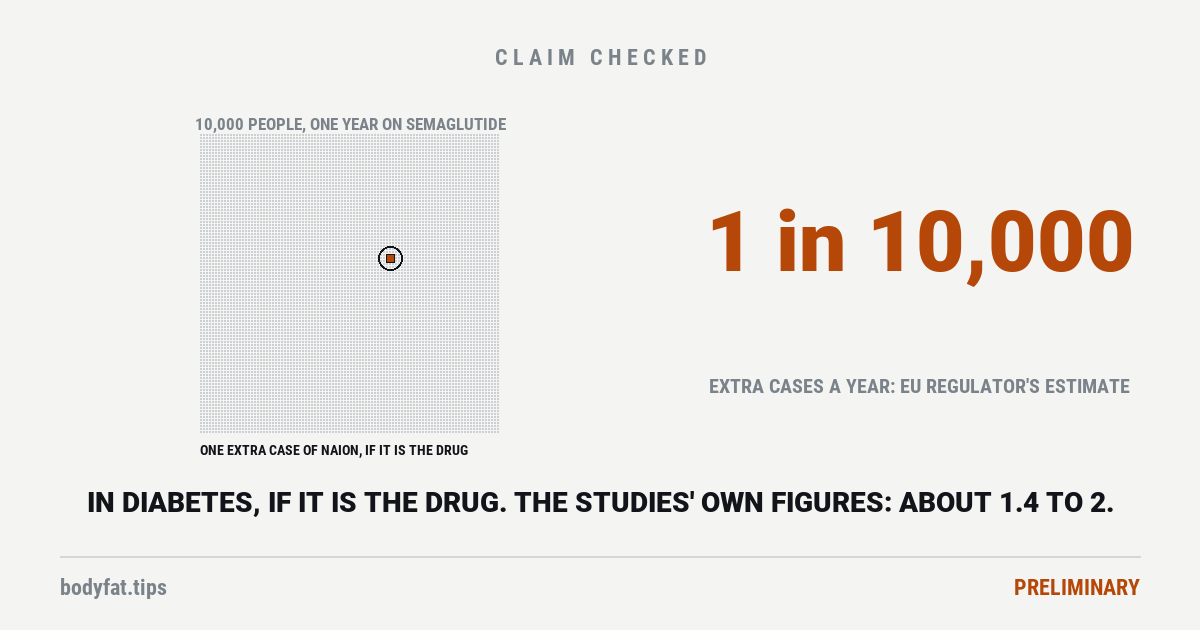
Does Ozempic Cause Vision Loss? In Diabetes, Europe’s Regulator Says a Rare Optic-Nerve Stroke Shows Up About Twice as Often on It: Roughly 1 Extra Case per 10,000 a Year. The Trials Are Too Small to Tell.

“Ozempic blindness” is a search phrase now, and so is “Ozempic blindness lawsuit” [1]. The plain question, “ozempic vision loss”, is searched about 1,300 times a month in the United States (from a paid keyword database, pulled 20 October 2026) [1]. The fear has a name, NAION, and a start date: a study from a Boston eye hospital published on 3 July 2024 [2].
Possibly, and rarely. In people with type 2 diabetes, Denmark’s national registry finds NAION, a stroke of the optic nerve, diagnosed about twice as often among people taking semaglutide as among everyone else with type 2 diabetes there, and so do three studies that compared semaglutide with another newly started diabetes drug, in Denmark and Norway, in US insurance claims and in US veterans [3] [4] [5] [6]. The largest such study we read, across fourteen US health databases, found smaller rises, mostly not significant [7]; other records studies we read found a smaller rise, no clear difference or less, and the table below lists them. Twice a very small number is still a small number: Europe’s medicines regulator puts it at about one extra case for every 10,000 people taking the drug for a year [8]. The randomised trials are too small to settle it [9] [10], a careful Swedish study saw it shrink when it compared more similar patients [11], and in people taking semaglutide only for weight the studies cannot tell either way [12].
One thing does not wait for the evidence. Sudden loss of vision, or eyesight that gets worse quickly, in one eye or both, is an emergency: get seen the same day, at an emergency department or an urgent eye service, whatever medicine you take [13]. If your sight blurs or changes more gradually after starting the drug, tell whoever prescribed it without waiting: Europe’s label asks patients to contact their doctor immediately about gradually worsening eyesight, and the US label asks them to report any change in vision [14] [15]. If you have already had NAION in one eye, or rely on one eye, raise it before starting [16]. And nobody should stop or change a prescribed medicine on the strength of a web page, this one included. That is a decision to make with whoever prescribed it [17].
Semaglutide is the drug in Ozempic and Rybelsus, sold for type 2 diabetes, and in Wegovy, sold for weight management [8] [13]. It belongs to a class called GLP-1 drugs, which act like a gut hormone that raises insulin after meals and curbs appetite [8]. Tirzepatide, sold as Mounjaro and Zepbound [15], is a close cousin and has its own section below.
What is NAION, the “eye stroke”?
NAION stands for non-arteritic anterior ischemic optic neuropathy. Take it apart: the optic nerve carries what the eye sees to the brain; ischemic means starved of blood; anterior means at the front, where the nerve leaves the eye; non-arteritic means not caused by inflamed arteries, which is a different disease. The front of the nerve loses its blood supply, swells, and vision in that eye is lost, usually suddenly and without pain, often described as a blurring or a cloud [13]. The loss is often severe and permanent [3].
It is rare. The UK medicines regulator’s notice gives roughly 8 to 11 new cases per 100,000 people a year among people over 40, about 15 per 100,000 among people over 60, and anywhere from 11 to 82 per 100,000 a year among people with type 2 diabetes, who are at higher risk because of the disease itself [13]. Smoking, high blood pressure and high cholesterol raise the risk too [13].
Does Ozempic cause blindness in both eyes?
NAION usually affects one eye at a time [13]. In a long follow-up of people aged 50 and over who had already had NAION in one eye, the second eye was affected in 14.7% of the 326 still at risk over about five years, roughly one in seven [18]. That study predates semaglutide and says nothing about the drug; it says what the condition does. So “blindness” in the headlines usually means lost vision in one eye, which is serious enough, and the studies on this page counted NAION diagnoses, not blindness.
The Ozempic blindness study: what the 2024 study found
The doctors behind it had seen three patients with NAION in one week in the late summer of 2023, all taking semaglutide [19]. They searched six years of records from their neuro-ophthalmology service, the clinic that sees people referred with possible optic-nerve problems: 16,827 patients [2]. Among 710 with type 2 diabetes, 194 had been prescribed semaglutide. After matching them with similar patients on other drugs, 17 on semaglutide and 6 on other drugs developed NAION [2]. Among 979 with overweight or obesity, 361 had been prescribed semaglutide, and the count was 20 against 3 [2].
Those became the headline numbers: a hazard ratio of 4.28 in diabetes and 7.64 in overweight [2]. A hazard ratio compares how often something happens over time in two groups; 1 means no difference, 2 means twice as often. Over three years, 8.9% of the semaglutide group with diabetes developed NAION, against 1.8% of the comparison group [2].
That 8.9% is not a risk for anyone reading this. These were people already sent to a specialist clinic for possible optic-nerve trouble, and the authors warn that their results may not carry over to other settings [2]. A later study pointed out that NAION in nearly one in eleven people on a drug shows how selected the group was [4]. The authors’ own conclusion was that “future study is required to assess causality” [2]. The study raised a question. The studies below are the attempts to answer it.
Did the bigger studies find the same thing?
Mostly yes, and at a much smaller size. Since 2024, researchers have checked the records of whole health systems in Denmark, Norway, Sweden, Britain and the United States, and of one network spanning 21 countries. The table lists the ones we read, from searches run up to 20 October 2026 [20], both those that found a raised risk and those that did not.
| Where, and who | Compared with | Relative result | Absolute, where reported |
|---|---|---|---|
| A Boston eye hospital’s referral clinic: 194 people with type 2 diabetes and 361 with overweight on semaglutide [2] | Other diabetes or weight-loss drugs | 4.28 times (diabetes); 7.64 times (overweight) | 8.9% against 1.8% over three years, in people already referred for optic-nerve trouble |
| Denmark, everyone with type 2 diabetes: 106,454 on semaglutide [3] | Everyone else with type 2 diabetes | 2.19 times | 2.3 against 0.9 cases per 10,000 people a year (our conversion) |
| Denmark and Norway: 61,377 starting semaglutide for diabetes; the Danish half partly the same people as the row above [4] | People starting an SGLT2 inhibitor | 2.81 times | 1.4 extra per 10,000 people a year |
| Sweden: 107,518 starting any GLP-1 drug for diabetes [11] | People starting an SGLT2 inhibitor | 1.69 times at five years, not significant; 1.23 among metformin users, not significant | 0.12% against 0.07% over five years |
| Britain: 106,858 starting any GLP-1 drug for diabetes [21] | People starting a DPP-4 inhibitor | 2.56 times in the first year | 18.5 against 7.2 per 100,000 in the first year |
| US insurance claims, three databases: semaglutide against SGLT2 inhibitors, part of 482,912 matched pairs [5] | People starting an SGLT2 inhibitor | 1.80 times | 2.0 extra per 10,000 people a year (our conversion) |
| US insurance claims, ages 18 to 65, any GLP-1 drug, all ischemic optic neuropathy [22] | People starting an SGLT2 inhibitor | about 1.5 times (our arithmetic) | 8.5 against 5.5 per 10,000 over 18 months |
| US veterans on metformin, mostly men: 11,478 starting semaglutide [6] | Veterans starting an SGLT2 inhibitor | 2.33 times | 0.29% against 0.13% over about two years |
| Fourteen US health databases: 810,390 new semaglutide users [7] | Several diabetes drugs; and the same people off the drug | Mostly not significant against other drugs; 1.32 times on the drug against off it | 14.5 per 100,000 a year on semaglutide |
| A US health-records network: 174,584 on semaglutide [23] | Other diabetes drugs | About twice from the second year; not significant in the first | Not in what we read |
| The same kind of US records network, about 130,000 per group [24] | Other diabetes drugs | 0.70 times at five years: lower | 0.065% over five years on semaglutide |
| A records network across 21 countries: 37,314 with diabetes only [25] | Other diabetes drugs | 1.51 times at three years, not significant | Not in the abstract |
| The US military health system: 973,529 with type 2 diabetes [26] | Other diabetes drugs | 0.36 times: lower | Not in the abstract |
| US Medicare: 3,845,171 older people with type 2 diabetes, 188,922 of them prescribed semaglutide [27] | People on other second-line diabetes drugs, leaving out insulin users and people on metformin alone | 1.39 times for semaglutide; 1.15 for any GLP-1 drug | 0.21 per 1,000 person-years on semaglutide, unadjusted; no rate printed for the comparison group |
| US insurance claims, a case-control study that started from 65,612 people with NAION and 641,751 without [28] | People not on a GLP-1 drug | 1.24 times for semaglutide users with diabetes, not significant; 1.19 for any GLP-1 drug in the first year | Not in what we read |
| Denmark again, a case-control study: 123 people with NAION among 201,776 adding a second diabetes drug to metformin, any GLP-1 drug [29] | Other second diabetes drugs | 2.13 times; highest after six to 18 months of use | Not in the abstract |
| A US health-records network, 2015 to 2024: 799,036 on any GLP-1 drug [30] | Other diabetes drugs; separately, SGLT2 inhibitors | 1.38 times; 1.30 against SGLT2 inhibitors | 0.21% against 0.17% over up to nine years |
| The same kind of network: 185,066 with type 2 diabetes on any GLP-1 drug [31] | People not prescribed one | 1.26 times, not significant | Not in the abstract |
| The same network, from the same hospital’s researchers, in people who already had diabetic retinopathy: 30,613 on any GLP-1 drug [32] | People not prescribed one | 0.88 times, not significant | Not in the abstract |
| US private health-plan claims, 2012 to 2024: 9,213 starting any GLP-1 drug, 26 cases of NAION in all [33] | People starting an SGLT2 or DPP-4 inhibitor | 1.86 times, not significant | Not in the abstract |
| The same kind of network, people with type 2 diabetes and a heart risk factor: 350,536 per group, any GLP-1 drug, all ischemic optic neuropathy [34] | People not prescribed one | 0.98 times at five years, not significant | Not in the abstract |
Most of the larger studies compared semaglutide with an active comparator: people starting a different diabetes drug at a similar point in their illness, usually one of the SGLT2 inhibitors, a class of diabetes tablets such as empagliflozin [4] [5] [6]. That is the fairer test, because people prescribed any new diabetes drug differ from people who are not.
The largest, fourteen US health databases holding 37.1 million people with type 2 diabetes and 810,390 new semaglutide users, found a modest signal: comparisons with other drugs that mostly did not reach significance, and a 32% higher rate when the same people were compared on and off the drug, a self-controlled design [7]. US Medicare records of older people with type 2 diabetes found a smaller rise for semaglutide, 1.39 times [27]. Of the studies of semaglutide itself that we read, four found nothing clear or a lower risk: one records network found a risk ratio of 0.70 at five years [24], another found no significant link in diabetes or obesity [25], the US military health system found less NAION on semaglutide [26], and a US insurance study that started from people with NAION found 1.24 times in semaglutide users with diabetes, not significant [28]. A study in the same kind of records network found about twice the risk from the second year on [23]. Studies of the whole drug class split the same way: a records network found 1.38 times [30] and a Danish study 2.13 [29], while four US studies found no significant rise, at 1.26, 0.88, 1.86 and 0.98, the first two by one team from the same network and nearly the same years [31] [32] [33] [34]. Our reading, marked as ours: the same kind of data can give opposite answers depending on how the groups are built.
Two cautions before counting heads. The Danish–Norwegian study says its Danish data partly overlap the first Danish study [4], so Denmark is one population looked at twice, not a replication; the Danish case-control study in the table is a third look at the same national registries [29]. And a second veterans study, of the whole drug class rather than semaglutide alone, found 9.98 more cases per 10,000 people over three years (39.07 against 29.33) [35]; it draws on the same national health system’s records as the first veterans study, so it is not an independent check either.
Pool the studies and the answer depends on what goes in. The newest pooling we found, searched to May 2026, combined eight cohort studies and put the risk at 1.93 times, 1.84 in people with diabetes [36]. Its own chart gives the eight studies near-equal weights, from 4% to 15% each, so the Boston referral clinic counted for about as much as a national registry, 11% against 14%; the review’s text says the records study that found a lower risk carried 21%, but the chart gives it 15% [36]. It also counts both Danish studies. Leaving out any one study kept the result significant, between 1.67 and 2.18 [36]. But a check for missing small studies, the kind with dull results that tend to go unpublished, pulled the estimate down to 1.56, with a range that included no difference, and the authors grade their certainty as low [36]. Another pooling found the overall result fragile: removing one influential study moved it across the line between not significant and significant [37]. A third, published in June 2026, came out level, at 1.01, with a range from 0.62 to 1.64; it pooled five studies of semaglutide in diabetes but entered the fourteen-database study three times, once for each comparison drug, and without that study it gave 1.68, with a range from 1.10 to 2.57 [38]. Our reading, marked as ours: the cohort poolings we read, these three and two more on this page [39] [12], draw on largely the same handful of studies; all five include the Boston referral clinic, and four of them count Denmark twice, so they are not independent checks on one another.
What do the randomised trials show?
A randomised trial is the one design that separates a drug from the people who take it, because chance decides who gets what. The trouble is size. NAION is rare, the trials were built to measure blood sugar, weight and heart attacks, and eye problems were collected only as side-effect reports [10] [9].
The drug’s maker pooled every completed placebo-controlled trial of its two drugs in this class, semaglutide and liraglutide: 112 trials and 96,829 people, 64,917 given a drug and 31,912 a placebo [9]. Its searches of the trials’ safety records found 15 possible cases, 9 on a drug and 6 on placebo, and two ophthalmologists reviewed each one. Confirmed NAION: 3 people on a drug, and 5 cases in 4 people on placebo, about 3 and 6 per 100,000 years of follow-up [9]. All three drug cases were on semaglutide [9]. The analysis was funded by the maker, whose representatives, the paper says, took part in its design, analysis and interpretation and in preparing the manuscript. Every one of its six authors has a tie to the maker. Three are its employees, one of them among the two ophthalmologists who judged the cases; the other judge reports advisory-panel, speaking or clinical-investigator work for five companies, the maker among them; another author co-chairs the maker’s own eye trial, FOCUS, described below; and the lead author reports advisory, speaking, consulting or research-support ties to the maker among other drug companies and, the paper notes, has been employed by it since February 2026 [9] [40]. It also says that a case was found only if the trial doctor had named NAION or written one of a short list of phrases, and that the trials were not powered to detect it [9].
Independent poolings are not much more decisive. Across 20 trials and 83,288 people, mostly with type 2 diabetes, ischemic optic neuropathy was not significantly more common on GLP-1 drugs: an odds ratio, read like the hazard ratio, of 1.50, with a range from 0.49 to 4.63 [10]. Across 78 trials of semaglutide, five reported any NAION, and those five, with 25,330 people, gave an odds ratio of 3.92, just significant, with a range from 1.02 to 15.02 that the authors call substantial imprecision; they put the absolute effect at one more case per 10,000 people and say there were not enough data to settle it [41]. A third pooling counted 5 cases on semaglutide against 1 in diabetes trials, and 4 against 1 in weight-loss trials, neither significant [12].
So the independent trial poolings all lean towards more cases on the drug, one of them just significantly; the maker’s leans the other way; and none has the numbers to settle it. Europe’s regulator read the trial data in June 2025 as pointing to “a slightly higher risk” [8]. The maker’s pooled analysis, published the following April, did not [9].
Ozempic blindness rate: how big is the risk?
Relative risk is the “twice”. Absolute risk is what twice means in people. Europe’s regulator estimates about one additional case per 10,000 person-years, a person-year being one person taking the drug for one year [8]. The European label calls NAION a “very rare” side effect, label language for up to 1 in 10,000 people [8] [14].
A 2026 pooling of the diabetes studies landed in the same place: about 0.014% a year, or one extra case for every 7,000 people treated for a year, with a confidence interval, the range the true average probably sits in, from 0.005% to 0.023% [39]. It pooled five studies, one of them the Boston referral clinic, and its authors grade the certainty low to very low [39]. The largest by people was a US records study of 174,584 on semaglutide [39] [23], but in its main comparison the Danish national study carried 42% of the weight, and with the Danish half of the Danish–Norwegian study, which partly shares its people, Denmark carried 59%, our sum of the review’s own chart [39] [4]. These are averages across large groups, not a forecast for any one person.
The headlines of July 2026, repeated in October, came from a US study of insurance claims for people aged 18 to 65 with type 2 diabetes. Over 18 months, there were 8.5 cases of ischemic optic neuropathy per 10,000 people starting a GLP-1 drug against 5.5 per 10,000 starting an SGLT2 inhibitor: 3 extra per 10,000, with a range from 0.4 to 5.7 [22]. The study turns that into a number needed to harm of 3,333: on its figures, about 3,333 people would have to start the drug for one extra case to appear in 18 months [22]. It counted all ischemic optic neuropathy, of which NAION is most, because there is no diagnosis code for NAION alone, and it covered the whole drug class, not semaglutide alone [22].
The size depends on who you are. Among US veterans, older and mostly men, the rates were far higher on both drugs: 0.29% on semaglutide against 0.13% on an SGLT2 inhibitor over about two years, roughly 16 extra cases per 10,000 [6]. In Denmark, 2.3 against 0.9 cases per 10,000 people a year, by our conversion of the paper’s figures [3].
What did the regulators decide?
Europe first. In June 2025, after reviewing laboratory studies, clinical trials, reports from doctors and patients, and the published research, the European Medicines Agency’s safety committee concluded that NAION is a very rare side effect of semaglutide, with about a two-fold relative increase in type 2 diabetes and about one extra case per 10,000 person-years [8]. The Ozempic label now says that a sudden loss of vision should lead to an eye examination, and that treatment should be stopped if NAION is confirmed [14].
Britain followed in February 2026: semaglutide “may be very rarely associated” with NAION. Its expert advisers agreed to the label change “while noting that there was conflicting evidence in the literature”. The UK’s reporting scheme had received three reports suggestive of NAION by August 2025, against an estimated 10.2 million packs dispensed in five years. Other GLP-1 drugs were not part of the review, and the regulator says it is reviewing them [13].
The US prescribing information for Ozempic and Wegovy, in the versions in force when we read them on 20 October 2026, does not mention NAION; it does warn about diabetic retinopathy [15]. We read the labels, not the FDA’s internal reviews, so we cannot say what the agency is weighing.
Does Wegovy cause vision loss in people without diabetes?
The studies cannot tell yet. The 2024 Boston study’s 7.64 came from 20 cases against 3 in a referral clinic [2]. In the 21-country records network, people with obesity and no diabetes showed a hazard ratio of 0.72 at three years, not significant [25], and a US records study did not find a raised risk in people with a high body-mass index [24]. In Denmark, 156,937 people taking semaglutide for weight, followed for a median of about a year, had 8 cases, 0.53 per 10,000 person-years, with no comparison group; the authors call that analysis inconclusive [4].
Pooled, the weight-loss studies gave 1.57, with a range from 0.69 to 3.59, and the weight-loss trials 4 cases against 1, neither significant [12]; another pooling gave 0.47, with a range from 0.19 to 1.13 [37]. One small study in favour, larger ones that did not find it, and ranges wide enough to hide a small effect either way. The regulators’ warnings cover Wegovy too [8] [13].
Blindness and tirzepatide: does Mounjaro or Zepbound do the same?
Less is known. One US records study grouped the two drugs: of 82,972 people, 77% had taken semaglutide only and 4.6% tirzepatide only, and the pair carried a hazard ratio of 1.76 for NAION against other diabetes drugs [42]. Set directly against each other, 3,806 people on each drug had 2 cases and 1, too few to test [42]. A second records study found NAION less common on tirzepatide than on other GLP-1 drugs, a hazard ratio of 0.45 in 102,590 people per group [43]. The US insurance study above saw its estimate rise to 2.67 when it counted tirzepatide users in with the GLP-1 group [5].
The US reporting system for suspected side effects held 28 reports of ischemic optic neuropathy naming tirzepatide by June 2025, filed more often than for other drugs, a disproportionality signal [44]. That counts reports, not people, and it cannot give a rate. The European and US labels for tirzepatide that we read do not mention NAION [45] [15], and the UK regulator says it is reviewing the other GLP-1 drugs [13]. How the two drugs compare on weight and heart outcomes is on our tirzepatide and semaglutide verdict.
Does Ozempic make diabetic retinopathy worse?
This is a different eye problem, with a trial behind it. Diabetic retinopathy is damage to the small blood vessels at the back of the eye from years of high blood sugar. SUSTAIN-6 assigned 3,297 people with type 2 diabetes at high risk of heart disease to semaglutide (1,648) or placebo (1,649) for two years [46]. Retinopathy complications, such as bleeding inside the eye or needing laser or injection treatment, occurred in 50 people on semaglutide (3.0%) and 29 on placebo (1.8%), a hazard ratio of 1.76, with a range from 1.11 to 2.78 [46] [47]. Among people who already had retinopathy, 8.2% against 5.2%; among those who did not, 0.7% against 0.4% [15]. Five people on semaglutide and one on placebo were judged to have diabetes-related blindness; all five already had advanced retinopathy [47].
Why? The trial team’s later analysis, funded by the maker, found that when it allowed for how far blood sugar fell in the first 16 weeks, the hazard ratio shrank to 1.22, with a range from 0.71 to 2.09 [47]. Blood sugar here is HbA1c, a blood test of average blood sugar over the past two to three months. It was a post hoc analysis, one not planned before the data came in, and it fits a pattern seen decades earlier with insulin: when blood sugar comes down fast, existing retinopathy can get worse for a while [47].
Across 38 trials that reported retinopathy, semaglutide was not linked to more of it overall, an odds ratio of 1.04, with a range from 0.92 to 1.17 [41], and a veterans study found GLP-1 users not more likely to be diagnosed with retinopathy than SGLT2 users, a ratio of 1.01 [35]. The labels ask for people with retinopathy to be monitored [14] [15]. The trial built to answer the question, FOCUS, is due to finish in November 2027 and has posted no results [40].
Does blurred vision from Ozempic go away?
America’s ophthalmology society says blur early in treatment comes from shifting blood sugar changing the shape of the eye’s lens, and quotes a retina specialist calling it “a temporary side effect, usually subsiding after three or four months” [48]. That is a clinician’s experience, not a measurement. The US Ozempic label’s patient information lists blurred vision only among the signs of low blood sugar [15], and in the pooled trials, vision loss or disturbance of any kind was not clearly more common on GLP-1 drugs, an odds ratio of 1.08, with a range from 0.60 to 1.94 [10].
Blur that comes on gradually after starting the drug is usually the eye’s lens changing shape as blood sugar shifts, according to America’s ophthalmology society [48], and a different thing from NAION, which typically takes vision in one eye suddenly [13]. It still needs telling: both labels ask patients to report changes in vision [14] [15], and sight that goes suddenly or gets worse quickly, in one eye or both, needs same-day care [13].
If the trials cannot settle it, why do the records studies keep finding it?
This section is the desk’s own reasoning, and it is labelled as such. Study after study of health records in people with type 2 diabetes finds NAION more often on semaglutide; the trial poolings, built on the better design, mostly do not, and the one that does rests on five trials. Here are three ways to fit that together, each rated.
Answer one: the trials could not have seen it. At about one extra case per 10,000 person-years, the maker’s pooled trials, with 119,393 years on semaglutide or liraglutide, would be expected to show about a dozen extra cases if every case were caught; that is our arithmetic [8] [9]. But their placebo groups recorded about 6 cases per 100,000 years, below even the 8 to 11 per 100,000 the UK regulator gives for people over 40 in general [9] [13], which fits the paper’s own warning that a case was caught only if a trial doctor named it. This is arithmetic, not a measurement.
Answer two: the people who get the drug are different. In Sweden, restricting the comparison to people already on metformin, the usual first diabetes tablet, shrank the five-year risk ratio to 1.23, with a range from 0.65 to 2.33 [11]. In the US insurance study the extra risk against SGLT2 inhibitors was smaller in people on metformin alone, 2.0 per 10,000 over 18 months against 5.7 in people on two or more drugs, though not against the other comparison drug [22]. Against that, veterans who were all on metformin still showed 2.33 times the risk [6]; a Danish study in which everyone was on metformin and adding a second drug found 2.13 for the drug class, a result its authors say held after allowing for HbA1c [29]; and the British study, against a different comparison drug, 2.56 [21]. This is measured, and the measurements disagree.
Answer three: something about fast change. The British study found the risk highest in the first six months and in people whose HbA1c fell by a point or more [21], and the authors of a US claims study suggest falls in blood pressure, rapid weight loss and shifts in body fluid as possible routes [5]. But the Danish national study found cases spread across five years with no high-risk window [3], and the Danish case-control study found no clear rise in the first six months of use and the highest rates after six to 18 months, later than the British study’s window [29]. A hypothesis, with one study’s timing for it and two that do not show its early window.
Put the three together and here is what we think is true, stated plainly so you can disagree with it: in type 2 diabetes the signal has turned up in too many countries to wave away, it is small, and nobody has yet shown that it is the drug rather than the disease the drug is given for.
What we could not find, and would like to: a randomised trial with scheduled eye examinations, built to detect NAION. We found none, completed or registered; the one registered study of NAION in GLP-1 users is observational and not yet recruiting [20]. The trial of semaglutide and diabetic eye disease, FOCUS, will answer the retinopathy question, not this one [40]. If you know of such a trial, the corrections line on this site is open.
Where “Ozempic blindness” came from
The research came first, in July 2024, from the Boston referral clinic [2]. The framing came the same day, in the hospital system’s news release: “Popular Prescription Weight Loss Drugs Linked to Uncommon Blinding Condition”, with patients “more than seven times more likely” to be diagnosed [19]. In fairness, the same release quoted the study’s leader calling the findings “significant but tentative” and listed the study’s limits [19].
Then it spread. A study of 71 English-language news articles from July 2024 to March 2025 found that 21% used causal language and 48% contained misleading claims; British articles made the most causation errors [49]. The newest wave began in July 2026 with a university release that got the size right: “approximately three to four additional cases per 10,000 patients” over 18 months [50]. On 15 October a science-news site reposted it under a new headline, “Ozempic and Wegovy linked to rare risk of sudden vision loss”, naming two brands where the study had looked at the whole drug class in people with diabetes [50] [22]. Ask Google today and its AI answer, citing that repost and a local TV station’s post about “dozens of lawsuits” among others, says semaglutide “has been linked in research and legal claims” to NAION, though it adds that “a direct causal relationship is not yet definitively proven” [1]. We could not trace who first used the phrase “Ozempic blindness”.
And it sells legal services. Among the results for this search is a personal-injury law firm’s “eye damage lawsuit” page offering a free case evaluation, which lists blurred vision first among the vision problems it ties to semaglutide and writes of “semaglutide-induced vision loss” [1]. Blurred vision is the effect the pooled trials did not clearly show and eye doctors describe as temporary [10] [48], and the authors of the two 2026 studies behind the newest headlines say their findings may reflect differences between the patients rather than the drug [11] [22].
None of this is aimed at anyone worried about their eyes, or at anyone who has lost vision. The question was a fair one to ask, and the people asking it deserve the sizes, not the headlines. People who cannot get the drug are sold its imitations too; “nature’s Ozempic” has its own verdict.
Who these studies were done on
Almost all of them were done on adults with type 2 diabetes: median age 65 in Denmark [3], 18 to 65 in the US insurance study [22], and US veterans averaging 60, 85.5% of them men [6]. The 2024 Boston study was people referred to a specialist eye clinic, mostly white [2]. Evidence in people taking semaglutide only for weight is thin [4] [12], and most of the big studies identify NAION from diagnosis codes, which misfile some cases: in the Boston hospital’s own records, 40% of cases coded as ischemic optic neuropathy were something else [2].
So read yourself against them. If you have type 2 diabetes and take semaglutide, these studies were about people like you, and the extra risk they found, if it is the drug’s, was about one case per 10,000 people a year. If you take Wegovy without diabetes, they mostly were not, and they cannot yet tell you either way.
What to do if your vision changes
This is journalism, not medical advice, and these lines are the exception that matters. If vision suddenly goes, or gets worse quickly, in one eye or both, as a dark or missing area, a shadow over the top or bottom, a blur or a dimming, get same-day care at an emergency department or an urgent eye service, whatever medicine you take; the UK regulator tells patients whose eyesight “gets worse very quickly in one or both” eyes to attend eye casualty or A&E urgently [13]. If your eyesight changes more gradually, tell whoever prescribed the drug without waiting for your next appointment: the European label says to contact your doctor immediately about “sudden or gradually worsening eyesight”, and the US label says to tell your healthcare provider about changes in vision [14] [15]. If you have already had NAION in one eye, or rely on one eye, raise it before starting: a European expert panel says the risk should be discussed with people in that position [16], and in the long follow-up above the second eye was affected in about one in seven over five years [18]. And do not stop or change a prescribed medicine without your prescriber: the European label says semaglutide should be stopped if NAION is confirmed [14], and North America’s neuro-ophthalmology society and America’s ophthalmology society say that whether to start, continue or stop these drugs is a decision to share between each patient and their care team [17].
What this is rated, and what the rating covers
Preliminary — for the claim that semaglutide causes NAION, raising the risk of sudden vision loss in one eye.
It is rated Preliminary because the evidence conflicts. In its favour: in people with type 2 diabetes, Denmark’s national registry and four studies against other newly started diabetes drugs, in Denmark and Norway, the United States and Britain, find NAION diagnosed about twice as often on semaglutide, or in the British study on its drug class [3] [4] [5] [6] [21], and Europe’s and Britain’s regulators have listed it as a very rare side effect [8] [13]. Against: the randomised trials, the design that can separate the drug from the disease, have not settled it: one pooling of five trials found a just-significant rise and the others did not, and all were too small to see an effect this size [9] [10] [41]; some records studies, among them the largest against other new diabetes drugs, found a smaller rise, no clear rise, or less NAION [7] [27] [24] [25] [26] [28] [31] [32] [33] [34]; and the Swedish study’s risk shrank when it compared more similar patients [11]. Britain’s own advisers noted conflicting evidence [13]. It is not rated higher because nobody has shown that the drug, rather than the people who are given it, is the cause. It is not rated lower because the evidence in its favour is not small or isolated: it comes from national registries in Denmark and Norway and from large studies in the United States and Britain.
Each part, rated alone, in words. That people with type 2 diabetes who take semaglutide are diagnosed with NAION more often than people on other diabetes drugs: Supported, resting on four studies that compared it with people starting another diabetes drug: 2.81 times in Denmark and Norway, 1.80 in US insurance claims, 2.33 in US veterans, and 2.56 for the drug class in Britain [4] [5] [6] [21]. Its known limits: the largest such study we read found smaller rises against three other drugs, 1.23 to 1.44 times and not significant under its broader definition of NAION, with one significant rise, 2.27 against empagliflozin, under its stricter one [7]; some records studies we read found a smaller rise, no clear difference or less; and the five poolings we read, four of which found a significantly raised risk in diabetes (one only in its diabetes subgroup) and one of which did not, overlap, all include the Boston referral clinic, and grade their certainty low or very low where they grade it [24] [28] [36] [39] [37] [12] [38].
That any extra risk is small in absolute terms: Established. In every population study we read that gave absolute figures (the referral-clinic study is not one) it was at most about one extra case per 1,000 people a year, and in most about one or two per 10,000 a year [8] [39] [22] [6] [4].
That semaglutide raises the risk in people without diabetes taking it for weight: Preliminary, with one small referral-clinic study in its favour and larger studies that did not find a clear rise, on ranges too wide to rule one out [2] [25] [12].
That tirzepatide raises the risk: Preliminary, on reports to a side-effect database and one study that grouped it with semaglutide, against one study that found it lower [44] [42] [43].
That semaglutide can worsen existing diabetic retinopathy early in treatment, in people whose blood sugar falls fast: Supported, for that narrow group, by one large trial, whose finding both the US and European labels carry, with no overall increase across 38 trials of mostly lower-risk people [46] [47] [41].
That semaglutide causes blurred vision: Preliminary, with eye doctors’ reports and a plausible mechanism in its favour and pooled trials in which vision disturbances were not clearly more common on the drug [48] [10].
What is not rated here: whether you should take, keep taking or stop any drug; the lawsuits; and the frame above, which is this desk’s reasoning from the evidence rather than a result the evidence delivered. It is marked as ours so that you can weigh it as ours. How we read a study, and what each tier means, is set out here.
- Do Statins Raise Blood Sugar? Yes, by About 0.7 mg/dL. On a Standard Dose, That Is About One Extra Diabetes Diagnosis per 1,000 People a Year.
established - Tirzepatide vs Semaglutide: Tirzepatide Lost 20.2% to Semaglutide’s 13.7% in the Only Head-to-Head Obesity Trial. Only Semaglutide Has Beaten Placebo on Heart Outcomes.
established - Does TRT Work? Clearly For Sex Drive. Barely For Energy.
supported