Normal Testosterone Levels by Age: The 300 Cutoff Came From Older Men

There isn’t one.
There is a range, it is enormous, it depends on your age and the time of day and which machine ran the sample — and the line in widest clinical use was worked out on men older than many of the ones it is now used on.
Let us start with the range, because it is the part almost nobody sees.
What “normal” is, and where it comes from
In 2017, researchers took 9,054 men from four large cohort studies in the US and Europe and cross-calibrated every assay against a reference method at the CDC — so that a reading from one study meant the same thing as a reading from another. [1]
For healthy non-obese men aged 19 to 39, the middle 95% ran from 264 to 916 ng/dL. The median was 531. [1]
Sit with those numbers. The man at the top of the normal range has roughly three and a half times the testosterone of the man at the bottom. Both are normal. Neither has a problem.
That is because a reference range is not a health target. It is a description of where most of a reference population landed — conventionally the middle 95%. Which means, by construction, that one healthy man in twenty falls outside it. Not because anything is wrong with him. Because that is what “middle 95%” means.
So where does 300 come from?
Three hundred nanograms per decilitre is the number in widest clinical use in the US, and it is a reasonable line for the population it was drawn from. The question is who it gets applied to.
In 2022, a team at Michigan asked a simple question. The American Urological Association tells doctors treating a man with testosterone to aim for the middle third of the normal range, which its guideline puts at 450 to 600 ng/dL [7]. What if you calculated that middle third separately for each age group of young men, and counted anything below it as low? [2]
They used NHANES, the nationally representative US health survey, kept only morning blood draws, and excluded men on hormonal medication. 1,486 men aged 20 to 44.
| Age | Middle third | Proposed cutoff for low |
| 20–24 | 409–558 | below 409 |
| 25–29 | 413–575 | below 413 |
| 30–34 | 359–498 | below 359 |
| 35–39 | 352–478 | below 352 |
| 40–44 | 350–473 | below 350 |
| The cutoff in common use | — | below 300 |
A 27-year-old with a reading of 380 ng/dL is comfortably above the standard cutoff. He is also below the bottom of the middle third for men his own age. Both of those statements are true at once, and only one of them appears on his lab report.
The authors put it plainly: it is “surprising that young men are evaluated for testosterone deficiency with the same cutoff of 300 ng/dL that was developed from samples of older men.” [2]
Be clear about what those numbers are. They are one research team’s proposal, not a guideline’s cutoff: the association’s own line for diagnosing low testosterone is 300 ng/dL, and only on two early-morning tests taken on separate occasions, with symptoms or signs to go with them [7]. Because each line sits at the level a third of that age group fell below, a third of the men in every band count as low by design. Among the healthy, non-obese men aged 19 to 39 in the harmonisation study above, 413 falls between the 10th and 25th percentiles: somewhere between one in ten and one in four of them would be low by it [1]. And the authors list the limits themselves: no randomised trial was done to choose the middle third as a cutoff, and the survey took one blood sample per man and asked nothing about symptoms [2].
So is 300 simply the wrong line for young men? That argument is live, not settled. The Endocrine Society, the largest organisation of hormone doctors and researchers, said in July 2026 that “the approach and definition of the diagnosis is the same for a man of any age”, with a common clinical threshold “near 300 ng/dL” on at least two early-morning, fasting tests [8].
Now the part that genuinely surprised us
Everyone knows testosterone falls with age. It is the premise of an entire industry.
In 2024, researchers went to the UK Biobank and looked at 197,883 men. [3]
In men without metabolic syndrome — a cluster of a large waist, high blood pressure, high blood sugar and abnormal blood fats that tends to come together — average testosterone by decade came out at roughly 358 ng/dL in their forties, 354 in their fifties, and 353 in their sixties. In men with metabolic syndrome it was about 308, 305 and 307 across the same decades — lower throughout, and just as flat.
Two things moved the number. Having metabolic syndrome moved it. And the time of day of the blood draw moved it, from about 367 down to 315 ng/dL. Season moved it slightly too.
Age did not.
Their conclusion, in their own words: “We found significant variation in serum testosterone according to the presence of metabolic syndrome and time of laboratory draw, but not according to age. These data challenge the prior dogma of age-related hypogonadism.” [3]
(Those are our conversions from the paper’s nmol/L into the ng/dL your lab reports. And a caution the paper’s own argument demands: UK Biobank used an immunoassay, a quick antibody-based lab test, so these absolute values are not interchangeable with numbers from studies that used mass spectrometry, the slower reference method that identifies the hormone by its molecular weight. Compare the pattern, not the digits.)
Not every look at that biobank agrees. A 2021 analysis of 208,677 of its men, aged 40 to 69, found both total and free testosterone lower at older ages. The size, though, was small: its summary puts the drop in total testosterone at about 0.5 nmol/L “across ages”, roughly 14 ng/dL, against about 1.5 nmol/L, roughly 43 ng/dL, for a body mass index — weight relative to height — of 30 compared with 25 [9]. Both analyses compare different men at one moment; neither follows the same men as they age.
Except a very good study says the opposite
We are not going to pretend that settles it, because it doesn’t.
The Massachusetts Male Aging Study followed 1,156 men for seven to ten years and measured them repeatedly. Within the same men, total testosterone declined about 1.6% a year, and bioavailable testosterone — the part not tightly bound to a carrier protein, and so free to reach the body’s tissues — 2 to 3% a year. [4]
So which is it?
The interesting thing is what happens when you look at what each study could see. The UK Biobank analysis is a snapshot: it compares different men of different ages at one moment. The Massachusetts study followed the same men through time. And the Massachusetts authors flagged something odd — their longitudinal decline was steeper than their cross-sectional one, which should not happen. Their explanation: “incident poor health may accelerate the age-related decline in androgen levels.” [4]
In the same cohort, men in apparent good health — no chronic illness, no prescription medication, not obese, not heavy drinkers — carried androgen levels 10 to 15% higher. [4]
Which points at the same thing the Biobank found. It is not that the birthdays are harmless. It is that what usually arrives alongside them may count for as much as the birthdays themselves.
The single most useful sentence in this literature
A follow-up study of that same Boston cohort, now with three rounds of measurement, tried to separate ageing from everything that happens while you age. [5]
The finding: a rise in body mass index of 4 to 5 points, or the loss of a spouse, was associated with a fall in testosterone comparable to about ten years of ageing. [5]
For a man 5 feet 10 inches tall, 4 to 5 points of body mass index is about 28 to 35 pounds. Gaining that much went with roughly the fall a decade of ageing brings. So did losing a spouse. Both are associations in one group of men, not the result of an experiment.
The authors’ conclusion is the reason this page exists: “comorbidities and lifestyle influences may be as strongly associated with declining T levels as is aging itself over the short- to midterm,” and therefore “age-related hormone decline may be decelerated through the management of health and lifestyle factors.” [5]
Your testosterone is not simply a readout of how old you are. A meaningful part of it is a readout of how you are doing.
What a low number actually predicts
Here is the last piece, and it reframes the question.
The European Male Ageing Study surveyed 3,369 men aged 40 to 79 across eight countries, measured morning testosterone by mass spectrometry, and asked which symptoms actually travelled with a low level. It then split the men at random into two groups, working out its answer in one and checking it in the other. [6]
Several symptoms were related to testosterone: poor morning erections, low sexual desire, erectile dysfunction, inability to do vigorous activity, depression, and fatigue.
But only three of them hung together as a syndrome. In the paper’s words: “only the three sexual symptoms had a syndromic association with decreased testosterone levels.” [6]
Poor morning erections, low sexual desire, erectile dysfunction. Those three.
Fatigue, low mood and feeling physically flat — the complaints that actually walk into a men’s health clinic — were related to the level but did not form a syndrome with it. They are far too common, and far too easily caused by everything else in a life, to point at a hormone on their own.
The thresholds where those three sexual symptoms started appearing sat between about 230 and 320 ng/dL: about 230 (8 nmol/L) for fewer sexual thoughts, 250 (8.5 nmol/L) for erectile dysfunction and 320 (11 nmol/L) for fewer morning erections. A fourth, about 370 (13 nmol/L), went with feeling less vigorous, a physical complaint rather than a sexual one [6]. Not a line. A zone.
The paper did draw a line in the end, and a strict one. It defined late-onset hypogonadism — the medical name for testosterone deficiency that arrives with age — as at least three sexual symptoms together with a total testosterone below about 320 ng/dL (11 nmol/L) and a free testosterone, the part not bound to proteins in the blood, below 64 pg/mL (220 pmol/L). In the study, 17% of the men had a total testosterone below that 320. Only 2.1% met the definition [6].
The verdict
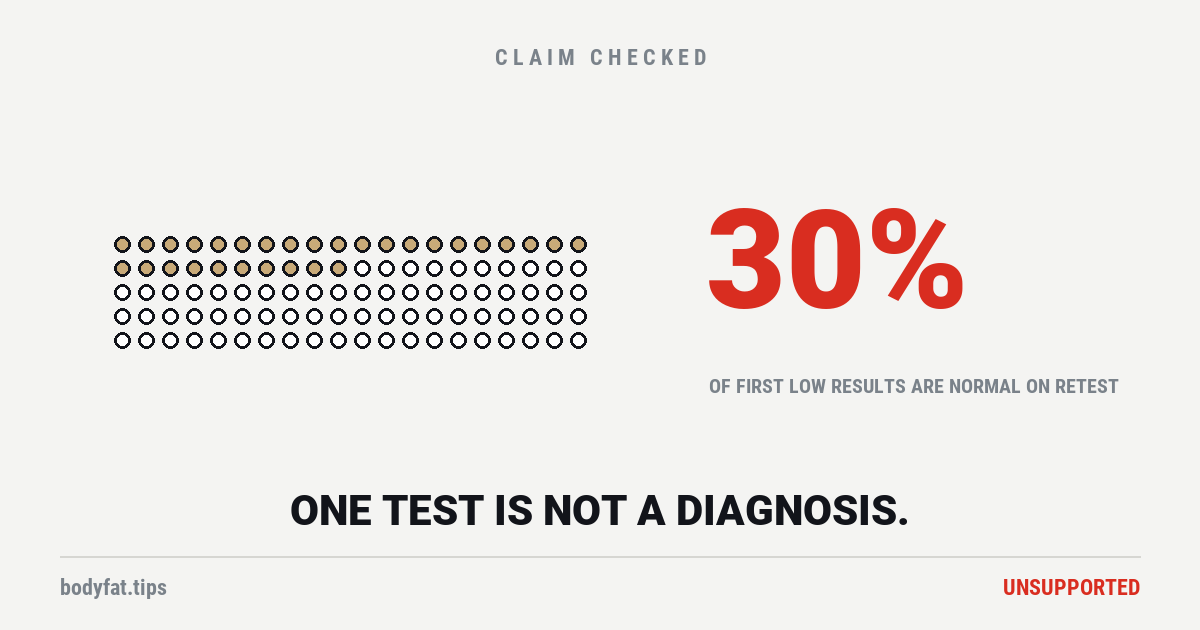
One test under 300 ng/dL does not mean your testosterone is low. Every guideline we read says so. The American Urological Association makes the diagnosis only after two early-morning tests on separate occasions, and only with symptoms or signs to go with them [7]. The Endocrine Society asks for at least two early-morning, fasting tests [8]. And the Defense Health Agency’s guideline, issued on 17 September 2026, says no diagnosis will be made on a single specimen, and that about 30 percent of men with a first low result are normal when retested [10].
It is still how the number gets sold. Hims, which sells at-home testosterone testing and treatment plans, publishes a guide to testing that lists “Low testosterone: <300 ng/dL”, credits the 300 line to the American Urological Association, and mentions a second test only for a result “close to the lower limit” [12].
Whether 300 is also the wrong line for men under 40 is a live argument, not a finding. One research team proposes higher lines by age [2]; the Endocrine Society says the definition is the same for a man of any age [8]; and none of the three guidelines draws a separate line by age [7][8][10].
What is true is narrower and more useful. Normal is a wide band, roughly 264 to 916 ng/dL in healthy young men. Where you sit inside it says very little on its own. The range your lab prints is not the guidelines’ line: Labcorp, for one, prints 264 to 916 ng/dL for men of every adult age, taken from the healthy men aged 19 to 39 in the harmonisation study [11][1], while the guidelines diagnose below 300 [7]. Time of day moves your result too: in one snapshot of nearly 200,000 men it moved the average more than a decade of age did [3], though in men followed through time a decade moved it about as much [4]. And the symptoms that reliably travel with genuinely low testosterone are three sexual ones — not tiredness.
If you are holding a number and wondering what it means, the honest answer is that it means very little without three other things: what time it was taken, whether it was confirmed on a second morning, and whether you have symptoms that the evidence actually links to it.
And if the number is lower than you would like, the most evidence-backed thing you can do about it is not a supplement. For low testosterone that is properly diagnosed, comes with being overweight (a body mass index over 27) and has no other cause, the Endocrine Society calls weight loss “typically the first-line therapy” [8]. The Boston cohort points the same way from the other side: gaining 4 to 5 points of body mass index went with a fall comparable to about ten years of ageing [5]. The studies of what losing weight does are on our page about raising testosterone naturally.
Part 2 of a series on testosterone. Part 1 asked whether you should get tested at all. Next: free versus total testosterone, and why the number your lab prints may not be the one that matters.
Related: should you get your testosterone tested · ashwagandha benefits · does lack of sleep cause weight gain · is creatine safe
An independent editorial review on 18 September 2026 found that this page presented one research team’s proposal as the American Urological Association’s own definition of normal, and gave its lowest rating to a line the guidelines themselves use. We called the middle third of the testosterone range “the American Urological Association’s own definition of a normal level”, and 413 ng/dL the cutoff for a man in his late twenties. The association’s guideline uses that middle third, 450 to 600 ng/dL, as the level to aim for in men already on treatment; its line for diagnosing low testosterone is 300, on two early-morning tests, with symptoms or signs. The 413 is the Michigan team’s proposal, drawn at the level a third of each age group fell below, so a third of the men in every group count as low by design. And the claim our rating scored, that a level below 300 ng/dL means yours is low, is close to what the guidelines say. What the evidence does not support is reading one test that way, which is what this page argued; the claim is now stated in those terms, in our words rather than in quotation marks. The page also now gives the Endocrine Society’s July 2026 statement that the definition is the same for a man of any age, the Defense Health Agency’s September 2026 guideline, and a seller’s testing guide that uses the one-test version, which our provenance chain now names.
Also corrected. We said most labs draw the line at 300 and that the range your lab prints was not built for men under 40; Labcorp prints 264 to 916 ng/dL for every adult age, taken from healthy men aged 19 to 39. Our evidence panel said our sources’ funding was not stated; they state it, and the panel now gives it by role, including declared author ties to companies that sell testosterone. We put the European study’s symptom thresholds at 230 to 370 ng/dL; for its three sexual symptoms they ran from about 230 to 320, and 370 went with diminished vigour. We called the 197,883-man UK Biobank analysis the largest of this question ever run; a 2021 analysis of 208,677 men from the same biobank was larger, and found testosterone slightly lower at older ages. We said time of day moves a result more than a decade of life; that held in one snapshot study, while in men followed over time a decade moved it about as much. And we said two studies put carrying less weight and better health at about ten years; one study found a comparable fall with weight gain, as an association. Smaller fixes: the European study’s split is described as it was reported, a quotation has its closing qualifier restored, four terms are explained, and one source’s author list is marked incomplete. The rating is unchanged: Unsupported, now for the claim that one test under 300 ng/dL means your testosterone is low.
- Should You Get Your Testosterone Tested? Symptoms, Yes. A Birthday, No.
unsupported - Tirzepatide vs Semaglutide: Tirzepatide Lost 20.2% to Semaglutide’s 13.7% in the Only Head-to-Head Obesity Trial. Only Semaglutide Has Beaten Placebo on Heart Outcomes.
established - Does TRT Work? Clearly For Sex Drive. Barely For Energy.
supported