Paraxanthine vs Caffeine: Three Small Trials, No Clear Edge

“Paraxanthine vs caffeine” is searched about 2,400 times a month in the United States (from a paid keyword database, pulled 20 October 2026) [1]. The pitch behind it is simple. Paraxanthine is the compound your liver makes from most of the caffeine you drink, and it is now sold on its own, in capsules, chews, powders and energy drinks, as caffeine without the catch: clean energy, no jitters, no anxiety, no crash, better sleep [1].
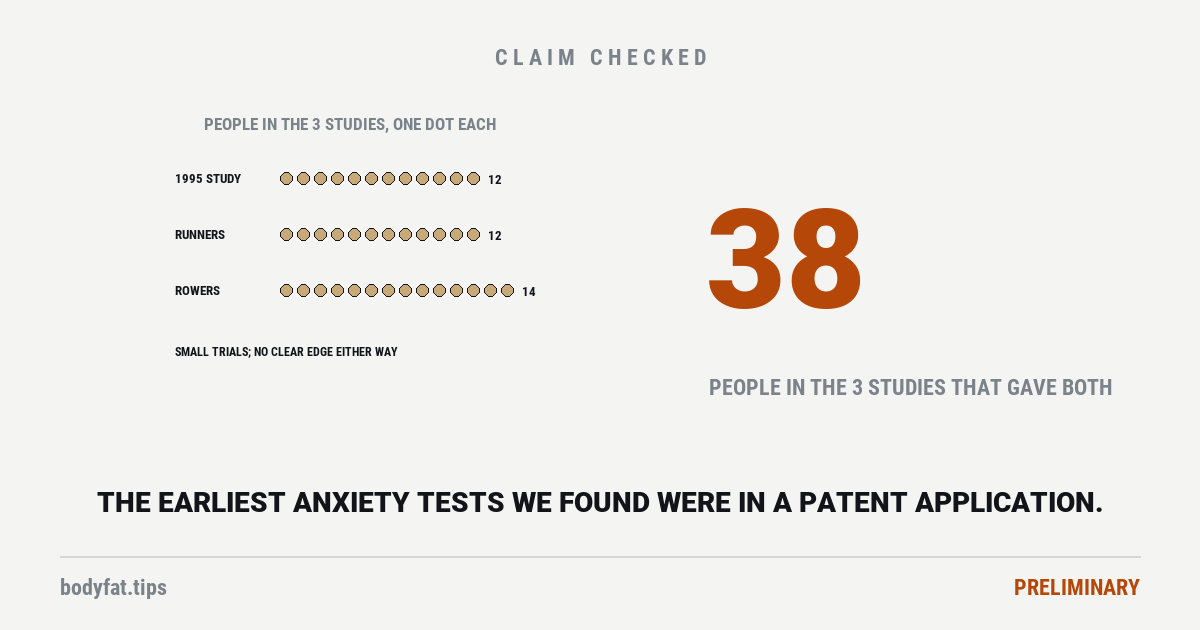
That has not been shown. We found three small trials that gave people both paraxanthine and caffeine, 38 volunteers in all, and between them they do not show it. The earliest test of the fewer-jitters claim we found was in mice. In the one study we found that measured blood pressure and adrenaline after the same dose of each, both raised them, by a similar amount at the higher dose [2]. Paraxanthine does leave the body a little faster, a part of the pitch with a measurement behind it, and the evidence that it works as a stimulant against a dummy pill is early but real. Both are below.
This is journalism, not medical advice. Paraxanthine is a stimulant. If you have a heart rhythm problem, high blood pressure or an anxiety disorder, or you are pregnant, ask a clinician before taking it or any other stimulant. The company that makes the branded version used in most of the trials below says itself that, like caffeine, it is not recommended for children or during pregnancy or breastfeeding [3].
What is paraxanthine?
Paraxanthine, chemically 1,7-dimethylxanthine, is what caffeine mostly becomes. Your liver strips off one of caffeine’s three methyl groups, small bundles of one carbon and three hydrogens. When human liver enzymes made by cells in a laboratory processed caffeine, about 82% of it came out as paraxanthine, 11% as theobromine and 5% as theophylline [4]. A 1995 study puts the figure at 80% on average in people, and reports that regular caffeine users carry about two-thirds as much paraxanthine in their blood as caffeine [2].
The paraxanthine in a capsule is made in a factory. That branded version is “manufactured by chemical synthesis”, and its maker told European regulators that paraxanthine “has no history of use as food in the EU or elsewhere” [3]. A 1988 review from a Canadian government food-safety laboratory said paraxanthine “is not found in plants or foods” [5]. A 2023 toxicology paper says otherwise, citing plant studies: small amounts in green coffee beans, cacao fruit and citrus flowers, among others [6].
Is caffeine a methylxanthine?
Yes. Caffeine is 1,3,7-trimethylxanthine, a xanthine carrying three methyl groups; paraxanthine, theobromine and theophylline each carry two [7] [8]. Caffeine and paraxanthine both block the brain’s receptors for adenosine [2], the chemical signal that our page on why caffeine can make you sleepy explains.
When people were given both, what happened?
This is the question the search is really asking, and the answer is three small studies. Here they are.
| Study | Who, what dose | What it found |
|---|---|---|
| 1995 [2] | 12 people; caffeine or paraxanthine at the same dose, 2 or 4 mg per kilogram of body weight, each against a dummy pill, after three days without either | Both raised diastolic blood pressure, adrenaline and fat in the blood; similar at the higher dose, caffeine apparently stronger at the lower. Read as its summary |
| 2024, runners [9] | 12 trained runners, 11 of them men; each ran 10 km four times, after a dummy capsule, 200 mg of caffeine, 200 mg of paraxanthine, or both | Run times not significantly different. After the run, one card-sorting error score lower on paraxanthine than on caffeine; reaction time not significantly different from caffeine. Paid for by the ingredient’s maker |
| 2026, rowers [7] | 14 male university rowers; each rowed 2,000 m four times in the evening, after a dummy capsule, 200 mg of caffeine, 200 mg of paraxanthine, or both | Only the two together beat the dummy, by about 3.3 seconds; paraxanthine alone showed no clear benefit. Paraxanthine against caffeine on self-rated sleep: “uncertain”. No outside funding |
The runners’ trial is the one sellers point to as proof that paraxanthine beats caffeine. Its title says paraxanthine “provides greater improvement in cognitive function than caffeine” [9]. Read the results and it is narrower. Each runner did a card-sorting test of reasoning and a reaction-time test before and after a 10 km run, four times, in a crossover design, meaning each person took every option in turn [9]. The paper’s main test for differences between the four capsules found none on the card-sorting test, and on that test, the authors write, paraxanthine “did not improve” performance compared with the dummy capsule [9]. After the run, one kind of error, sticking with a sorting rule after it had changed, was 26.9% lower on paraxanthine than on caffeine, with a confidence interval, the range the true average difference probably sits in, of 3.4% to 50.5% lower [9]. On caffeine that error had risen by 25.7% from before the run to after it; on paraxanthine, after the run, it was not significantly different from the dummy capsule [9]. On reaction time paraxanthine beat the dummy capsule and was not significantly different from caffeine [9]. Run times were not significantly different on any of the four [9]. The branded ingredient’s maker paid for the trial, and three of its authors were the maker’s principals and inventors on its patent applications [9].
The rowing trial came from five Turkish universities, with no outside funding and no declared conflicts [7]. After a dummy capsule the 2,000 m took 409.24 seconds on average; after caffeine and paraxanthine together, 405.91, about 3.3 seconds faster, an effect size of 0.30 — on the scale where 0.2 is small, 0.5 moderate and 0.8 large, a small one [7]. Caffeine alone and paraxanthine alone did not show a clear benefit, and the authors write that their findings “do not support paraxanthine as a standalone ergogenic substitute for caffeine”, ergogenic meaning performance-boosting [7]. Caffeine before exercise does improve performance by a small amount on average, which our verdict on caffeine before a workout rates Established; 200 mg was at the low end of the doses used, about 2.6 mg per kilogram of these rowers’ body weight, as the authors note [7].
Does paraxanthine cause fewer jitters and less anxiety than caffeine?
This is the heart of the pitch, and the evidence for it in people is thin. Of the three studies above, the runners’ trial is the one we could read that rated jitter-type side effects with caffeine in the comparison: the runners scored how often and how badly they felt a racing heart, shortness of breath, nervousness and similar effects on a 0 to 5 scale [9]. The rowing paper’s methods say the rowers were asked to report any adverse effects after each session, but its limitations say no feedback on side effects was obtained, and its results give none [7]. The 1995 study’s summary reports blood pressure, adrenaline and blood fats [2]. In the runners’ trial the main test found no significant differences between the four capsules; in follow-up comparisons, caffeine raised some of those ratings and paraxanthine did not, with average ratings typically below 1 on the scale [9]. Twelve runners, one dose each, ratings mostly near the bottom of the scale. That is a lead, not a finding.
A fourth trial set out to measure anxiety with caffeine in the comparison, and we found no report of that comparison. Its registry record, filed in March 2023 after the study had finished, lists seven arms, among them 200 mg of caffeine and caffeine with paraxanthine, and names anxiety among its main outcomes [11]. The published paper, paid for by the branded ingredient’s maker, reports four arms, a dummy pill and three doses of paraxanthine, and lists “the lack of a positive control such as caffeine” among its limitations, a positive control being a comparison treatment known to work [12]. The record does not say whether the other arms were run. The paper describes four conditions, each given to every volunteer, and its statistics section says that how paraxanthine “performed in comparison to CAF, other related metabolites, or combinations of them”, CAF being caffeine, was not a question the study asked [12]; it says nothing more about those arms, and we found no report of them [13]. The paper names energy expenditure, hunger and appetite as its main outcomes and lists anxiety among its “safety assessments” [12]. The registry record also lists, beside anxiety among its main outcomes, ratings of focus, concentration, energy, wakefulness and other feelings, and a mood questionnaire; none of those appears in the paper [11] [12]. Against the dummy pill, anxiety ratings on 100, 200 and 300 mg of paraxanthine were not significantly different [12].
So where does “less anxiety” come from? We followed the papers’ own footnotes. The 2021 trial says paraxanthine has “lesser anxiogenic effects” than caffeine, anxiogenic meaning anxiety-producing, and cites a 1995 study [8]. A 2010 mouse study says the same in its opening, and cites the same 1995 study [14]. That 1995 study, as its summary reads, measured blood pressure, adrenaline and blood fats, and concluded that caffeine and paraxanthine “have similar sympathomimetic actions”, meaning similar effects on the body’s fight-or-flight system; its summary mentions no anxiety test [2]. We could not read its full text, so we cannot say it measured nothing else.
The earliest tests of anxiety we found are older than that 2010 study, and they are not in a journal. In a patent application first filed in June 2006 and published in December 2007, a French drug company and a French university claim paraxanthine as a medicine for conditions such as narcolepsy and depression, and the inventors write that paraxanthine, “in contrast to caffeine, loses its anxiogenic activity in animals” [15]. The examples behind that line are mice given injections of up to 50 mg per kilogram of body weight. In three standard tests of anxious behaviour, in groups of 8 to 20 mice, caffeine looked anxiety-producing or paraxanthine looked calming beside it; two more tests, one of them in rats, gave paraxanthine with no caffeine group [15]. A patent application is its applicants’ own account of their own tests, written to claim a use. It is not a reviewed study, we read its text and figure captions rather than its data, and we found no journal report of these tests [13]. One of its inventors is the 2010 study’s author from the drug company’s research institute [14].
The earliest peer-reviewed test of anxiety we found was that 2010 study, in 10 mice [14]. On a test of how many marbles a nervous mouse buries, caffeine raised the count significantly, and on paraxanthine the count was not significantly different from salt water. On a raised maze, where an anxious mouse hides in the enclosed arms, caffeine raised the time spent hiding clearly, and paraxanthine raised it too, from 66 seconds on salt water to 113, against 145 on caffeine, a rise the authors call “only marginally significant” [14]. The paper’s table adds that, on the marble test, the direct comparison between paraxanthine and caffeine fell short of statistical significance [14]. The study was paid for by the same drug company’s research institute, one of whose researchers was an author and a co-inventor on a patent application for medical uses of paraxanthine [14]. A 2013 US government rat study later summed up the field as “less anxiogenic activity and toxicity in rodents than caffeine” [16]. By 2021 the branded ingredient’s trial papers were stating it about paraxanthine in general, citing the 1995 human study rather than the mice [8].
Is paraxanthine easier on the heart than caffeine?
The one study we found that measured blood pressure on both in people found the effects similar at the higher dose. At 4 mg per kilogram of body weight, about 280 mg for a 154 lb (70 kg) adult by our arithmetic, both raised diastolic blood pressure, the lower number in a reading, and adrenaline by a similar amount; at 2 mg per kilogram, caffeine “appeared to produce greater responses” [2].
Read that lower-dose line on its own and you get a different sentence, and that is how it travelled. A widely republished March 2026 article on an academic-written news site said that “caffeine produced a greater increase in blood pressure than paraxanthine at comparable doses”, linking to the 1995 study [17]. That is what the summary reports at the lower dose. At the higher one it calls the responses similar [2].
Against a dummy pill, the 2024 trial of 21 adults found blood pressure not significantly different on 100, 200 or 300 mg, and heart rate lower on 100 mg than on the dummy, by about 7 beats a minute at the hour mark [12]. One volunteer on 300 mg reported dizziness, a racing heart, light-headedness, nervousness and shortness of breath, all minor and gone within a day [12]. In the rowing trial, heart rate during the row was not significantly different across the four capsules, caffeine and paraxanthine included [7]. Every trial since 2021 that we read was in healthy volunteers, and the two 2021 trials excluded anyone with high blood pressure, heart rhythm problems or anxiety [8] [18].
Does paraxanthine disturb sleep less than caffeine?
It clears a little faster, and that is the reasonable part of the claim. In the 1986 study that measured both in the same six healthy men, paraxanthine’s half-life, the time it takes the body to clear half of a dose, averaged 3.1 hours, and caffeine’s 4.1 [19]. Google’s AI answer sets that 3.1 against “caffeine’s 5 to 6 hours” [1]; the study the 3.1 comes from measured caffeine at 4.1 in the same men, and the branded ingredient’s own website uses 4.1 [19] [20].
One published trial has asked about sleep. The 14 rowers rated the next night’s sleep on a 0 to 10 scale, 10 the worst, after their evening sessions, and they were encouraged to keep up their usual caffeine through the study, about 335 mg a day on average, so these ratings come from people who were not asked to give it up [7]. Sleep was rated worse after caffeine and paraxanthine together than after the dummy capsule; after caffeine alone, the difference from the dummy was not significant [7]. Sleep ratings after caffeine alone were poorer than after paraxanthine alone, a difference the authors call “uncertain”; the results section reports no p-value for it [7]. In the paper’s own description of its sleep chart, sleep after paraxanthine alone was also rated a little worse than after the dummy capsule, a difference for which the results report no test [7]. Their summary still says paraxanthine “showed more favorable sleep-related outcomes” [7]. We found no trial that measured sleep after paraxanthine with a monitor or in a sleep lab [13]. What late caffeine does to a night’s sleep, measured, is in our verdict on why caffeine can make you sleepy.
Does paraxanthine work better than a dummy pill?
A little, in early trials. Four small published studies have tested it against a dummy pill on alertness, attention or memory, all paid for by the branded ingredient’s maker or by a company that sells it [8] [18] [9] [21]. In the first two, 13 and then 12 young adults took 200 mg, or 50 to 200 mg, and did memory, attention and reaction tests for six hours [8] [18]. Neither found a significant difference on its main statistical test; the improvements the papers report come from comparing each condition with its own starting point and from follow-up comparisons [8] [18]. In the second, the strongest overall result “tended to differ” at p = 0.06, just the wrong side of the line researchers use for “probably not chance” [18]. The runners were quicker after the run on paraxanthine than on the dummy capsule [9]. A 2025 conference summary of 24 adults reports higher ratings of energy and focus on 200 mg, better scores on some attention tasks, and scores not significantly different from the dummy on others [21].
That paraxanthine acts as a stimulant is not in doubt; the 1995 study found it raised adrenaline and blood pressure much as caffeine does [2]. What these trials add is a first, small look at whether a capsule of it sharpens performance. Three of the four never compare it with caffeine at all, the coffee it is sold to replace [8] [18] [21].
How much paraxanthine equals caffeine? 300 mg of paraxanthine against caffeine
The equivalent doses you see are arithmetic, not measurements. The 2021 trial reasoned that because about 70% of caffeine becomes paraxanthine, 200 mg of paraxanthine “would be equivalent to consuming about 285 mg” of caffeine [8]. A discussion-forum thread among the AI answer’s sources asks whether 300 mg of paraxanthine is 428.5 mg of caffeine, the same division [1]. That arithmetic assumes a milligram of paraxanthine swallowed does everything that caffeine’s milligrams do, and that caffeine adds nothing of its own. The only study we found that measured blood pressure and adrenaline after the same weight of each found the effects similar at the higher dose and smaller for paraxanthine at the lower [2]. On that, milligram for milligram, paraxanthine was not the stronger of the two. That is our reading of one 12-person study’s summary. The runners’ and rowers’ trials, which gave 200 mg of each, found heart rate during exercise not significantly different between them [9] [7].
How much per day? The trials used 50 to 300 mg [18] [12]. Neither the FDA nor the EU has set a limit for paraxanthine: the FDA’s inventory holds no GRAS notice for it, and the EU application is still open [22] [3]. The maker’s European application proposes treating it like caffeine, at no more than 200 mg at once and 400 mg a day for healthy adults, by analogy with the levels Europe’s food-safety agency set for caffeine [3]. For caffeine, the FDA cites 400 mg a day as an amount not generally linked to harm in most adults [23].
Does paraxanthine get around your caffeine genes?
This is the cleverest-sounding part of the pitch. Caffeine is broken down by a liver enzyme called CYP1A2, whose activity varies with your genes, so, the argument goes, take the product of that step directly and you sidestep the variation; one seller’s blog says paraxanthine “sidesteps this entirely” [1]. But the body has to clear paraxanthine too. In people given paraxanthine, about two-thirds of it was cleared by removing another methyl group, a step that cimetidine, a heartburn drug that slows this family of liver enzymes, held back, cutting clearance by 30% [24]. In human enzymes made by cells in the laboratory, CYP1A2 “alone” carried out that step [4]. So paraxanthine is not free of the enzyme; it depends on it for its own exit. We found no study that gave people paraxanthine and compared them by caffeine-gene type [13]. The branded ingredient’s website says paraxanthine is “metabolized more consistently than caffeine” and cites the 2021 dose trial [20], which reports thinking tests, side effects and blood-safety panels, not how paraxanthine was broken down [18].
Is paraxanthine safe? Paraxanthine side effects
In the short trials, side effects on paraxanthine were few and, against a dummy pill, not significantly different [18] [12]. The longest published trial we found lasted seven days [18] [13], leaving aside the 2025 meeting abstract with ATP, whose text we could not read [10]. A six-week trial of daily paraxanthine against a dummy pill, 60 adults between the two groups, with sleep and mood questionnaires, finished in April 2025, and we found no results; two crossover trials sponsored by a company that sells paraxanthine finished in 2023 and 2024, one of which has appeared only as a one-page conference summary [11] [21].
The animal work is reassuring as far as it goes. In standard laboratory tests the branded ingredient showed no sign of damaging genes, and in rats it caused no toxic effects at up to 300 mg per kilogram a day for 90 days, in studies by the maker’s own researchers [25]. A second company’s paraxanthine, in rats, caused no deaths at up to 185 mg per kilogram a day for 90 days, while two rats died on the same dose of caffeine [6]. Those are rats, at doses many times a capsule’s.
We found no completed safety review of it by the FDA or by the EU. In the US, an ingredient added to food needs the FDA’s approval unless qualified experts agree it is generally recognized as safe, or GRAS; a company “may” notify the FDA of that conclusion, and the agency “strongly encourages” it [22]. The FDA’s public inventory holds every GRAS notice filed since 1998, pending or closed; searched on 20 October 2026 it held none for paraxanthine, while the same search for a sweetener, used as a check, found 62 [22]. The 2021 dose trial calls the ingredient’s status “self-affirmed Generally Recognized as Safe” [18]: the company’s conclusion, not the agency’s. In Europe, where a food not eaten to a significant degree in the EU before May 1997 is a novel food that needs approval, the maker has applied, and the European Commission still lists the application as ongoing [3]. The public summary of that application is written by the maker. It calls paraxanthine “as safe as caffeine” [3]. As safe, not safer, although the brand’s own website tells shoppers it is “Safer than caffeine” [20]. What the guidance says about caffeine and children is in our verdict on whether caffeine stunts growth.
What energy drinks use paraxanthine?
We do not name products, and this page carries no commerce. By type: energy drinks, among them one launched in 2026 with a celebrity’s backing whose website promises “smooth, steady energy without the spike or crash” [1]; pre-workout and fat-burner products, for which a sports-supplement company told the FDA in 2022 it would claim “clean cognition”, “sustained attention” and “optimized energy” [26]; and chews, coffees and capsules [1] [27]. That FDA notice is a notification, not an approval. Such structure/function claims, statements about how a product affects the body short of treating a disease, are “not pre-approved by FDA”, and the label must say the FDA has not evaluated them [28].
What counteracts caffeine?
Not paraxanthine. It is a stimulant that acts on the same receptors [2], and when the rowers took it on top of caffeine, their sleep that night was rated worse than after a dummy capsule [7]. Nothing we read tested a remedy for too much caffeine. What the 1986 study measured is how fast it goes: half of a dose was cleared in about four hours, in six healthy men [19]. Whether caffeine also takes water with it is a separate verdict.
Who these studies were done on
Young, healthy volunteers, mostly men. Average ages ran from about 22 to 26 in every trial we read that reported one, and the two published head-to-head trials of the last few years were in 12 runners, 11 of them men, and 14 male rowers [9] [7]. The rowers were regular caffeine users, about 335 mg a day on average [7]. Women numbered 3, 3, 1, 8 and 12 in the trials that reported including them [8] [18] [9] [12] [21]. The two 2021 trials excluded people with high blood pressure, heart rhythm problems, anxiety or sleep disorders, and asked volunteers to keep caffeine under 200 mg a day beforehand [8] [18]. We found no trial in older adults, in pregnancy, or in people chosen because caffeine makes them anxious, who are the people the product is sold to [13].
If paraxanthine is what caffeine turns into, how could it be a better caffeine?
This section is the desk’s own reasoning, and it is labelled as such. Every cup of coffee already delivers paraxanthine: about 80% of the caffeine becomes it [2]. Whatever paraxanthine does, coffee drinkers have been getting it all along. So what could a capsule of it do that the coffee does not? Three possible answers, each rated.
Answer one: less stimulant, sold as the same amount. The equivalent doses divide by 0.7 [8], so 200 mg of paraxanthine is presented as about 285 mg of caffeine, a strong cup’s worth. The one study that measured blood pressure and adrenaline after the same weight of each found paraxanthine no stronger than caffeine, and apparently weaker at the lower dose [2]. If so, a 200 mg capsule may feel gentler than the caffeine it is said to match simply because it is less. The dose comparison is measured, once, in 12 people, read as a summary; that it explains the gentler feel is our surmise.
Answer two: it leaves sooner. The half-lives were 3.1 and 4.1 hours in six men [19]. From those averages, seven hours after a dose about 21% of the paraxanthine would be left, against about 31% of the caffeine. But caffeine keeps turning into paraxanthine as it clears, and regular users carry both in their blood [2], so a cup’s late effects are partly paraxanthine’s anyway. The half-lives are measured; the fractions are arithmetic, not a measurement; whether the gap changes anyone’s sleep has been tested only in the 14 rowers’ uncertain ratings [7].
Answer three: the comparison is usually a dummy pill. Most of the trials compared paraxanthine with a dummy pill, in healthy young volunteers asked to keep caffeine under 200 mg a day and screened for anxiety [8] [18]. “No more side effects than a dummy pill” in 12 such people cannot show “fewer side effects than caffeine” in the people buying it to escape caffeine’s. This is an observation about how the trials were built, not a finding.
Put the three together and here is what we think is true, stated plainly so you can disagree with it: paraxanthine is not a gentler kind of stimulant that has beaten caffeine; it is the part of caffeine that clears a little sooner, sold on its own, and any gentleness people feel may be a smaller dose.
What we could not find, and would like to: a trial, paid for by someone with no stake in the answer, that gives people who get anxious on caffeine either caffeine or paraxanthine, at doses matched for effect, for weeks, and measures anxiety, heart rate, blood pressure and sleep with a monitor [13]. If you know of one, the corrections line on this site is open.
Where “a better caffeine” came from
We could not trace who first said paraxanthine causes less anxiety than caffeine. The earliest version we found is the drug-company patent application first filed in 2006, which rests it on its applicants’ own tests in injected mice and rats [15] [13]. By 2010 the mouse study the same company paid for stated it in its opening, citing the 1995 human study [14]. The rest of the trail is easier to follow.
The research came first, and modestly: a 1986 measurement of half-lives in six men [19], the drug company’s patent application on injected mice and rats, published in 2007 [15], and the 2010 mice [14]. The framing arrived with the branded ingredient. From 2021 its maker paid for trials whose papers state the anxiety advantage as background [8]. Its website credits paraxanthine with energy “without a crash”, citing the maker’s own rat toxicology paper [20] [25], and says the runners “reported better focus and faster reaction times after taking paraxanthine compared to caffeine” [20]; the paper reports no rating of focus and a reaction-time difference from caffeine that was not significant [9].
The spread followed. In August 2022 a sports-supplement company told the FDA its paraxanthine products would claim “clean cognition” [26]; the same company’s own two registered trials of paraxanthine finished in 2023 and 2024 [11]. In January 2025 a trade headline announced “Paraxanthine outperforms caffeine as a cognitive enhancer in new preclinical study” [29]; preclinical meant rats in a water maze, in a study paid for by the maker [30]. In March 2026 the academic news article on a celebrity-backed energy drink was republished widely [17], while a second article on the same site warned that the promise of no jitters or crash “currently runs ahead of the available science” [27]. Today Google’s AI answer tells searchers that “early research and user reports suggest paraxanthine causes fewer anxiety-related symptoms, lower blood pressure impact, and less jitteriness”, and offers to list the products [1].
None of this is aimed at anyone who reaches for paraxanthine because coffee makes their heart race. That is a real problem, and wanting a gentler fix is reasonable. It is the sellers who turned a few mouse tests, a half-life and a footnote into caffeine without the jitters.
What this is rated, and what the rating covers
Preliminary — for the claim that paraxanthine is a better caffeine, with fewer side effects.
It is rated Preliminary because the evidence in its favour is early, small and conflicting: one trial of 12 runners in which follow-up comparisons favoured it on some side-effect ratings and on one error score [9]; a trial of 14 rowers in which it showed no clear performance benefit and a sleep difference from caffeine its own authors call uncertain [7]; and animal tests, a patent application from a drug company and a university on injected mice and rats, which is its applicants’ own account, and one peer-reviewed study of 10 mice [15] [14]. Against it stands the one study that measured blood pressure and adrenaline after the same dose of each, which found the effects similar at the higher dose [2]. It is not rated Supported because the comparisons with caffeine are three, of 12 to 14 people, one dose at a time, and none was large or long enough to settle the question.
Each part, rated alone, in words. That paraxanthine improves alertness or attention against a dummy pill: Preliminary, on four small studies paid for by its maker or a seller, whose main tests were mostly not significant [8] [18] [9] [21]. That it causes less anxiety or fewer jitters than caffeine: Preliminary, on animal tests, the drug company’s patent application and one peer-reviewed study of 10 mice, whose one reported direct comparison with caffeine fell short of significance, and on one 12-runner trial’s follow-up comparisons; the one trial registered to measure anxiety against caffeine has not reported that comparison [15] [14] [9] [11]. That it is easier on the heart and blood pressure than caffeine: Preliminary, because the little evidence there is conflicts: the one study in people that measured blood pressure and adrenaline after the same dose of each found the two similar at the higher dose and caffeine apparently stronger at the lower [2]; heart rate during exercise was not significantly different between them in the runners’ and the rowers’ trials [9] [7]; and caffeine raised the runners’ ratings of a racing heart while paraxanthine did not, in follow-up comparisons only [9]. That it disturbs sleep less: Preliminary, on a half-life about an hour shorter in six men and one trial of 14 rowers whose sleep difference from caffeine was uncertain [19] [7].
That it gets around your caffeine genes or works more consistently: Unsupported, of the untested kind. We found no study that compared people’s response to it by gene type, nothing tested in its favour, and its own breakdown runs mostly through the same enzyme [24] [4] [13].
What is not rated here: weight loss and calorie burning, which rest on one short trial of resting energy use [12] and a meeting abstract on fat burning during cycling, with ATP, whose text we could not read [10]; muscle, endurance and memory claims from animals; long-term safety, which trials of one to seven days cannot speak to; and the frame in the section above, which is this desk’s reasoning from the evidence rather than a result the evidence delivered. It is marked as ours so that you can weigh it as ours.
This is journalism, not medical advice. Anyone with a heart rhythm problem, high blood pressure or anxiety, or who is pregnant, should ask a clinician before taking any stimulant, paraxanthine included. How we read a study, and what each tier means, is set out here.
- Does Collagen Help Hair Growth? Small Trials of Collagen Alone Lean Its Way. None Enrolled People Diagnosed With Hair Loss.
preliminary - Does Low Vitamin D Make You Tired? The Best Trial in Tired, Deficient Adults Found a 2.5-Point Gap at Four Weeks. Genes That Lower It Did Not Clearly Raise Tiredness.
preliminary - When to Take Creatine: Before or After Training, Six Trials Found No Significant Difference in Muscle or Strength
unsupported