Should You Get Your Testosterone Tested? Symptoms, Yes. A Birthday, No.

On 15 July 2026, the US Department of Defense ordered that every service member aged 30 and over be screened for testosterone deficiency [14], as a mandatory part of the yearly health assessment they already have. Younger troops can opt in. Treatment, if a doctor recommends it, stays voluntary. [8][9]
That was the announcement. The details took two months. On 2 September the Pentagon posted clinical guidance for the programme and took it down the next day; a US official told Reuters the draft had been “temporarily rescinded to allow for updates” [15]. On 17 September the Defense Health Agency, which runs the military’s hospitals and clinics, issued the version now in force [16]. Under it, screening is a checklist, not an automatic blood test. At his health assessment, a clinician records whether each man aged 30 and over has any of seven symptoms, such as reduced sexual desire, and any of a list of risk factors, such as obesity or type 2 diabetes. Blood is drawn when the checklist is positive or a risk factor is present, and nobody is diagnosed on a single reading or without symptoms [16]. The agency’s own text says symptom questionnaires “perform poorly as standalone screening instruments”, and tells clinicians not to score its checklist [16].
It is worth being precise about what that is and is not. Nobody is being put on testosterone. This is a screening programme — testing people who have not complained of anything, to see whether something turns up.
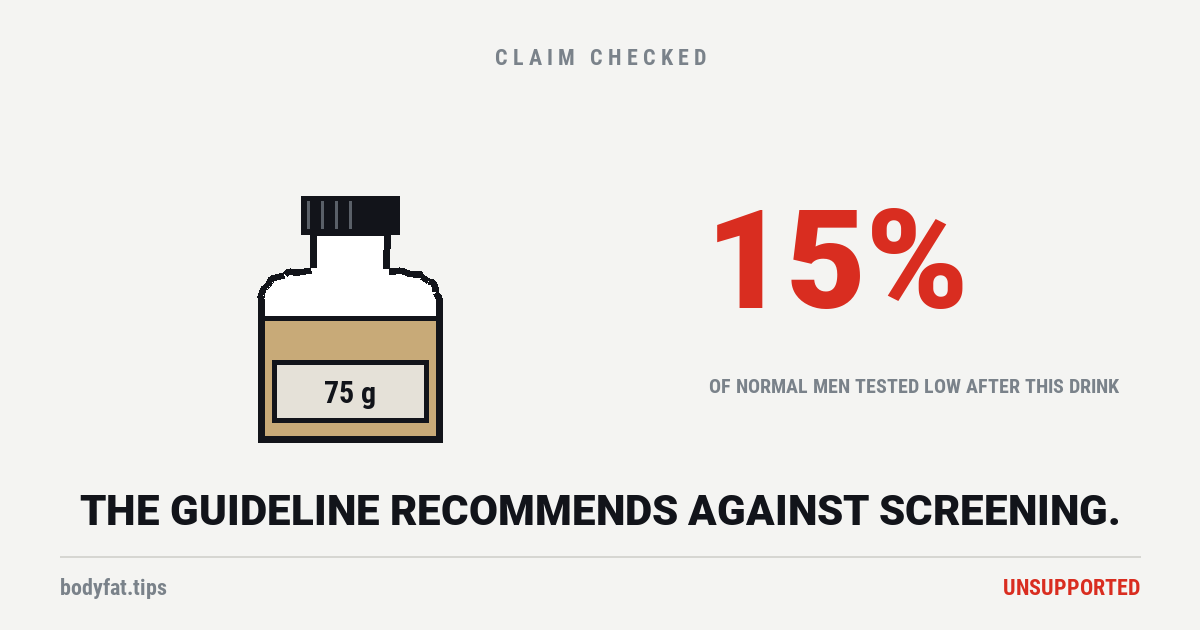
Which is the exact thing the governing clinical guideline recommends against, in one sentence, at its strongest grade.
What the guideline actually says
The Endocrine Society’s clinical practice guideline on testosterone is the reference document American endocrinologists work from. Its recommendation 1.2 reads, in full:
“We recommend against routine screening of men in the general population for hypogonadism.” [1]
That is a Grade 1 recommendation — the category the Society uses for “we recommend” rather than “we suggest”. It is not a hedge or a footnote. It is, though, a strong recommendation resting on thin evidence: the guideline grades the evidence behind it as low quality, the second-lowest of its four grades [1]. In the guideline’s own terms, a strong recommendation means the task force was confident that following it does more good than harm on average. As the lines below show, nobody has run the trial that would test it.
The recommendation immediately before it explains the logic. A diagnosis requires symptoms and signs of testosterone deficiency and unequivocally, consistently low readings. [1] Both. Not a number on its own.
The guideline is blunt about why. Its technical remark: “Low T concentrations occur frequently without symptoms or signs of testosterone deficiency, and these low levels (alone) do not establish a diagnosis of hypogonadism.” [1]
And on screening specifically: “screening for hypogonadism does not fulfill the necessary criteria to justify population-level screening,” followed by the line that ought to end the argument — “No clinical trials have assessed the effectiveness of screening strategies.” [1]
Nobody has tested whether testing helps. That is not an oversight anyone is hiding; it is stated plainly in the document.
Nor has the Society moved. On 16 July 2026, the day after the Pentagon’s announcement, it said: “There is insufficient evidence to support a general recommendation to perform population-level screening for hypogonadism in asymptomatic men with measurement of blood testosterone level.” [13] Hypogonadism is the medical name for testosterone deficiency; asymptomatic means without symptoms.
So why is a blood test controversial?
Because this particular number is far less solid than a number printed on a lab report looks.
| Drinking a glucose drink | −25% |
| … and the share of normal men it pushed into the “low” range | 15% |
| Time of day — why the guideline says morning | varies |
| Day-to-day biological variation in the same man | one draw is not enough |
| Which machine ran the sample | differs by lab and method |
Start with the most striking one. In 2013, researchers gave 74 men a standard glucose drink — the sugary one used for diabetes testing — and measured testosterone repeatedly for two hours. On average, each man’s testosterone fell 25% at its lowest point, and the group’s average was still down at the two-hour mark. [2]
Then the part that matters for screening. Of the 66 men who had normal testosterone before the drink, ten — 15% — fell into the hypogonadal range at one or more points afterwards. [2]
One man in seven can be converted from normal to clinically low by a glass of glucose. Nothing changed about his body. Something changed about when you took the blood.
This is precisely why the guideline specifies a fasting morning sample, and then says to confirm it with a second one. [1] In its own words, the aim is to avoid labelling men based on “transient medical disorders, biological variations in T concentrations, technical variations and inaccuracy in T measurements, or SHBG abnormalities.” [1]
Four separate ways to get a wrong answer, listed by the people who wrote the standard.
The number moves even when you do everything right
A study of 132 men aged 30 to 79 took repeated blood samples — pairs 1 to 3 days apart, then again at three months and six months, up to six samples each. Across the eleven hormone measures it tracked, testosterone among them, it found: “Biological variation generally accounted for more of total intraindividual variation than did assay variation.” Its conclusion is the practical part: “one sample is generally not sufficient to characterize an individual’s hormone levels but collecting more than three is probably not warranted.” [3]
Translated: your hormones genuinely bounce around on their own, and in general the bouncing outweighs the machine’s error. Two readings from the same healthy man on two mornings are not the same reading.
And the machine has its own problem. A review of how well testosterone assays — the lab tests themselves — perform found that “within-assay variability for current assays is generally high, especially at low analyte concentrations.” [4]
Read that twice, because the “low” it means is not a man’s low. The review ties its warning to levels “such as those for testosterone observed in women”: below about 87 ng/dL (3 nmol/L), commercial test kits had a typical spread of 6.1% to 22% between repeat runs of the same sample, depending on the kit [4]. Nearer the roughly 300 ng/dL that clinics commonly use as the line [13], the tests do better, though not uniformly. In a 2004 proficiency survey the review describes, labs running the same test measured the same sample at about 370 ng/dL (12.8 nmol/L), “a concentration level typically observed in men”, and for three of the nine tests their results spread by 10% or more [4]. The Endocrine Society put the practical upshot plainly in July 2026: the same blood sample “can read ‘low’ or ‘normal,’ depending on the lab and method”, while tests certified by the CDC’s hormone standardisation programme give similar results [13]. That programme has made progress: between 2007 and 2011 it halved the average gap between labs using mass spectrometry, a different technology from the commercial kits, and the CDC’s reference method; for the kits, the review says improvement is “anticipated”. [4] But “better” is not “interchangeable”.
What counts as normal, and why your lab’s range might not
Here is the good news, and it is genuinely useful. In 2017 researchers took 9,054 men from four large cohort studies in the US and Europe, cross-calibrated the assays against a CDC reference method, and produced a harmonised range. [5]
For healthy non-obese men aged 19 to 39, the middle 95% runs from 264 to 916 ng/dL, with a median of 531. [5]
Two things follow. First, that range is enormous — the man at the top has roughly three and a half times the testosterone of the man at the bottom, and both are normal. Second, and more awkward: the authors found that “a substantial proportion of intercohort variation in testosterone levels is due to assay differences.” [5]
Some of the apparent difference between groups of men was never about the men. It was about the machines. If your result comes back near a cutoff, the laboratory that ran it is part of the answer.
Who should get tested, then?
The guideline does not say nobody. It gives a list — groups where low testosterone is common enough and treatment plausible enough that measuring makes sense: men with low libido, erectile dysfunction, infertility, HIV-associated weight loss, osteoporosis or a low-trauma fracture, a history of anabolic steroid use, men taking opioids or other drugs that affect testosterone, and men with a mass in, radiation to or another disease of the pituitary, the gland at the base of the brain that signals the testes to make testosterone. [1]
Being over 30 is not on that list.
This is the distinction the whole argument turns on, and it is not a fringe position. A 2019 review compared the guidelines of seven international bodies — urological, endocrine and sexual-medicine societies across the US and Europe — and found them in agreement that clinicians should “consider screening asymptomatic men with certain conditions that increase the risk”. [6]
Conditions. Not ages. A separate international panel took the same line in 2024: the International Consultation on Sexual Medicine says “universal screening for low T levels is not recommended”, rates that a strong recommendation, and advises checking men with conditions such as obesity and type 2 diabetes [17].
What about the men who do turn out to be low?
If you have symptoms and two confirmed low morning readings, testosterone therapy is a real option with real evidence, and one large question about it has been answered well.
TRAVERSE, published in 2023, randomised 5,246 men aged 45 to 80 who already had cardiovascular disease or were at high risk of it, all of whom had symptoms and two fasting testosterone readings under 300 ng/dL. Over a mean 33 months of follow-up, major cardiovascular events occurred in 7.0% on testosterone versus 7.3% on placebo — a hazard ratio of 0.96. A hazard ratio is the rate of events on testosterone divided by the rate on placebo, so 0.96 means about the same. That met the trial’s noninferiority bar — its test that testosterone was not meaningfully worse than placebo, which required the top of the range of plausible answers to stay below 1.5; it came in at 1.17. [7] The trial was funded by a consortium of testosterone manufacturers led by AbbVie, and its protocol was designed by the trial’s executive committee together with the sponsor [7].
That is a genuinely reassuring result on the question people were most worried about. It is worth noticing what it is not. TRAVERSE enrolled men the guideline pathway had already identified — symptoms first, then two confirmed low readings. It tells you that treating those men did not raise their rate of heart attack, stroke or death from cardiovascular causes. It does not tell you that finding more of them by screening would do anybody good, because that trial has never been run.
Nor did treatment come back clean. On testosterone there was more atrial fibrillation, an irregular heartbeat (3.5% against 2.4% on placebo); more heart-rhythm problems serious enough to need treatment (5.2% against 3.3%); and more acute kidney injury (2.3% against 1.5%). Each of those differences fell on the right side of the line researchers use for ‘probably not chance’, though none was the question the trial was built to answer, and the authors write that “these adverse events were not expected” [7]. The trial also counted more clots in the lung, pulmonary embolisms (0.9% against 0.5%), a difference it had no plan to test on its own [7]. And a planned companion analysis of the same men found more fractures on testosterone over a median of about three years: 3.5% against 2.5%, a hazard ratio of 1.43, with a range of plausible answers from 1.04 to 1.97 that leaves ‘no difference’ outside it [11].
In February 2025 the FDA, having reviewed the trial, removed boxed-warning language “related to an increased risk of adverse cardiovascular outcomes” from testosterone labels, a boxed warning being the black-bordered warning at the top of a drug’s label. It added a warning about raised blood pressure to the products that lacked one, after studies it had required “confirmed an increase in blood pressure with use of all testosterone products”. And it kept the line saying that safety and efficacy in “age-related hypogonadism” “have not been established” [12]. That last line bears most directly on screening by age: the Endocrine Society’s July statement says terms like “age-related” hypogonadism “blur the line between treatable disease and normal aging” [13].
And there is a cost that does not show up in a cardiovascular endpoint. All seven guideline bodies agree on it: taking testosterone impairs sperm production. [6] For a 30-year-old who has not finished having children, that is not a footnote.
The verdict
Testing every man over 30 is not supported by the evidence, and the body that writes the standard recommends against it in one sentence.
Not because testosterone does not matter, and not because low testosterone is not real — it is, it has consequences, and men who have symptoms should absolutely get checked. But a screening programme makes a specific promise: that finding the thing early, in people who have not complained of it, leads to better outcomes. For testosterone, nobody has demonstrated that. No trial has even tried.
What screening reliably produces instead is a population of men holding a number they now have to do something about — a number that a sugary drink can move by a quarter, that varies between two ordinary mornings, and that the same blood sample can read as low or normal depending on the lab that ran it.
The guideline says this outright. It “places a high value on avoiding labeling, testing, treating, and monitoring healthy men for whom the benefits and risks are unclear.” [1]
If you are getting tested anyway — because a policy requires it, or because you want to — the practical advice is the same advice the guideline gives a doctor. Go in the morning. Go fasted. Do not accept a diagnosis from a single draw; the standard is two. Ask which assay the lab used. And treat one number as what it is: a snapshot of a moving thing, not a verdict on you.
The most useful question is not “what is my number”. It is “do I have symptoms” — because that is the question the guideline asks first, and the number only means something after it has been answered.
This is the first in a series on testosterone. The rest of it: what a normal level actually is, free versus total, what actually raises it, whether boosters do anything, what lifting does to it and whether testosterone therapy works.
Related: ashwagandha benefits · berberine benefits · does lack of sleep cause weight gain · is creatine safe
An independent editorial review on 18 September 2026 found that this page reported only the reassuring half of the testosterone safety trial, and said its funding was not stated. We wrote that treating men with low testosterone “does not appear to raise cardiovascular risk”. The trial, TRAVERSE, found no rise in heart attack, stroke or cardiovascular death, but more atrial fibrillation, more heart-rhythm problems needing treatment and more acute kidney injury on testosterone, more clots in the lung that it did not test on their own, and, in a planned companion analysis, more fractures. It was funded by a consortium of testosterone manufacturers led by AbbVie, which helped design the protocol; our evidence panel said our sources’ funding was not stated, when the trial’s own report states it, as do the guideline and most of the studies we cite. The page now gives both halves of the trial, the FDA’s 2025 labelling decision, and each source’s funding by role, saying where we could not read it.
Also corrected. We said the lab test is least accurate “in exactly the range where it decides”; the review we cited puts its worst performance at the far lower levels seen in women, and shows smaller but real lab-to-lab differences at levels typical of men. We said seven guideline bodies agree in recommending against population screening; the review’s summary, which is all of it we could read, reports their agreement on testing men with conditions that raise the risk, so the page now says that and cites the two bodies whose own texts recommend against screening everyone. We described the July military order as measuring every service member’s testosterone; it orders screening, and the guideline issued on 17 September makes that screening a symptom and risk-factor checklist, with a blood test when the checklist is positive or a risk factor is present. We promised the rest of this series as “still to come” when all six pages were already published; they are now linked. Smaller fixes: the guideline’s recommendation is strong but rests on low-quality evidence; its testing list includes pituitary disease; the 25% glucose figure is each man’s lowest point, after a sugary drink rather than a breakfast; and the variation study’s quoted line was a finding across eleven hormone measures, not its conclusion. The claim our provenance chain traces is now stated in our words rather than in quotation marks, because we found no one to quote. Our headline said the guideline’s answer was no; its no is to routine screening, and it supports testing men with symptoms or listed conditions, so the headline now says that. The rating is unchanged: Unsupported.
- Tirzepatide vs Semaglutide: Tirzepatide Lost 20.2% to Semaglutide’s 13.7% in the Only Head-to-Head Obesity Trial. Only Semaglutide Has Beaten Placebo on Heart Outcomes.
established - Does TRT Work? Clearly For Sex Drive. Barely For Energy.
supported - Does Lifting Weights Increase Testosterone? Yes — And It Made No Difference
unsupported