How to Increase Testosterone Naturally: If You Carry Extra Weight, Lose It

If you are carrying extra weight, one thing works, it is well evidenced, and it is not sold in a tub.
The rest of the standard list — sleep more, lift heavy, take vitamin D — is a mixture of unresolved, misunderstood, and measured-and-found-to-do-nothing. In that order.
| Lever | Effect on testosterone |
| Weight loss — surgery | +208 ng/dL |
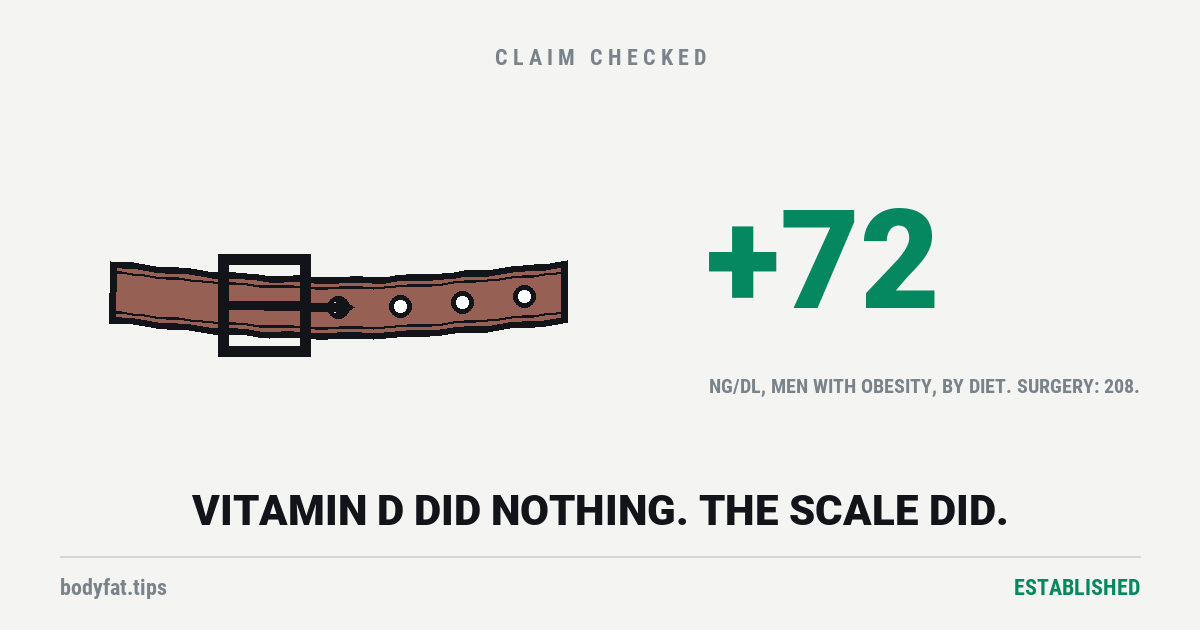
| Weight loss — diet | +72 ng/dL |
| Sleep | short nights: no clear effect; a night without sleep: lower |
| Resistance training | no change over 12 months |
| Vitamin D | no effect |
The lever that works
In 2024, researchers pooled 44 studies covering 1,774 men with overweight or obesity to answer one question: how much testosterone do you get back by losing weight? [1]
Losing weight on a low-calorie diet, a median 8.6% of body weight, raised total testosterone by about 72 ng/dL (2.5 nmol/L), across 19 studies and 735 men. Losing it through bariatric surgery, a median 28.7%, raised it by about 208 (7.2 nmol/L), across 26 studies. Those are averages of how far each group rose from its own starting level, and most of the studies were not randomised trials, the kind where chance decides who gets which treatment. Counting only the eight diet studies that were, the rise was smaller: about 49 ng/dL (1.7 nmol/L). Free testosterone moved in the same pattern. Median follow-up was 26 weeks. [1]
An older meta-analysis of 24 studies found almost exactly the same thing — about 83 ng/dL from diet, 252 from surgery, both at p < 0.0001. [2] Two different teams, a decade apart, same answer — but not two independent checks. Nineteen of the older analysis’s 24 studies are among the newer one’s 44, and the newer one calls itself a meta-analysis of the updated literature. [1][2]
And it is dose-dependent, which is the part that matters if you are not considering surgery. In the older analysis: “Multiple regression analysis shows that the degree of body weight loss is the best determinant of TT rise.” [2] The more you lose, the more you get back. It also found the gain larger in younger men, in men who were heavier to begin with, and in men without diabetes. [2] The newer analysis agrees that heavier men gained more, but reverses the finding on age: older men gained more total testosterone, and younger men more free testosterone, the small share not bound to carrier proteins in the blood. [1]
Why fat lowers testosterone in the first place
Fat tissue is not inert storage. It makes an enzyme called aromatase, which converts testosterone into oestradiol — the main form of oestrogen. More fat means more of that conversion, and the resulting oestradiol signals the brain to dial down the hormones that tell the testes to produce testosterone in the first place.
The older meta-analysis found exactly that footprint. Weight loss decreased oestradiol and increased gonadotropins — the pituitary signals that drive testosterone production. [2] In the newer one, LH, the main gonadotropin, rose after surgery, where men lost a median 28.7% of their weight, but not after dieting, where they lost 8.6%. [1] So the footprint shows most clearly where the weight loss was largest, and the mechanism and the outcome still point the same way, which is part of why this finding is solid rather than merely repeated.
It is also common enough to matter. Among severely obese men presenting for bariatric surgery, 64% had obesity-associated hypogonadism. [3] Not a rare complication. The majority.
Which reframes part of what we covered in the last piece: in the Boston cohort, which followed men aged 40 to 70 for years, a gain of four to five points of body mass index (BMI, weight scaled for height) went with a fall in testosterone about as large as a decade of ageing. [9] That is an association in one group of men, over what its authors call the short to middle term, so on its own it cannot show that the weight did it. The weight-loss studies above come at the same relationship from the other side, on purpose: take weight off, and testosterone rises. And the Endocrine Society, in a July 2026 statement, calls weight loss “typically the first-line therapy” when low testosterone is properly diagnosed, comes with being overweight or obese (a BMI over 27) and has no other identified cause. [10]
Sleep: the advice everyone gives, and the evidence nobody checks
You have read that sleep deprivation tanks your testosterone by 10 to 15%. It is one of the most-repeated facts in men’s health.
Here is where it comes from. A 2011 research letter in JAMA put ten men, average age 24, through three nights of ten-hour bedtimes and then eight nights of five-hour bedtimes. Daytime testosterone came out at 16.5 nmol/L after restriction versus 18.4 rested — roughly 476 against 531 ng/dL. [4]
The p-value was .049.
That is a real result, published in a serious journal, and it is also ten men and a p-value that scraped under the line by a thousandth. Neither of those facts travels with the 10-to-15% figure.
So has anyone checked it since? In 2019 a Columbia University team went back to two randomised sleep-restriction studies it had run for another purpose, energy balance (the calories people take in and burn), and measured testosterone in the blood it had stored. In each, the same men slept short and normal, in random order. In the first, 14 men spent five nights with four hours in bed and five with nine — harsher per night than the original, though for fewer nights. Eleven had enough blood left to measure, and it had sat in a freezer for more than eight years. No significant effect on testosterone. In the second, 13 men spent six weeks sleeping an hour and a half less than usual and six weeks sleeping normally; 11 finished. Testosterone ran slightly lower on short sleep, by a margin unlikely to be chance, but it rose over time relative to normal sleep, and the authors judged the difference too small to matter clinically. [5]
Their conclusion opens: “Sleep restriction does not adversely affect plasma testosterone levels in healthy young men.” [5]
We are not going to tell you that settles it either. Those studies are also small — 11 men analysed in each — and their authors say plainly that neither was designed to assess testosterone, or large enough to be sure of detecting a change in it. The conclusion goes on: “Given prior contradicting evidence, confirmatory studies should be done…” [5]
For short nights, the honest position is still unresolved. A famous small study found an effect; two later ones that measured testosterone as a side question found no meaningful one. A 2021 meta-analysis then pooled 18 studies in 252 healthy men and split the question in two. Sleep cut short had no clear effect: the pooled estimate was −0.22 on a standardised scale where 0.2 counts as small, 0.5 as medium and 0.8 as large, and the range of plausible answers ran from a moderate fall to essentially none. A night or more with no sleep at all did lower testosterone, by −0.64 on the same scale, between medium and large. [11] What you should take from that is not that sleep is unimportant — sleep does a great many measurable things and this page is not about them. It is that the specific, confident number you have been quoted rests on ten people.
Lifting: the spike is real and it is not what you think
Anyone who has trained knows testosterone rises after a heavy session. The inference everyone draws is that training raises your testosterone, and that the rise is why you grow.
A study in 2015 did something unusually careful: it measured not just the level but the production rate and the clearance rate, using stable isotope dilution — tracking a labelled version of the hormone to see how fast the body makes it and how fast it removes it. Men did heavy leg presses before and after twelve months of resistance training. [6]
Two findings. First, the acute post-exercise rise in blood testosterone “appeared to be induced by decreased metabolic clearance rate” — your body was removing it more slowly. The same summary says training may also have had a short-term effect on how fast testosterone was made, so extra production is not ruled out, but it puts the rise in the blood down to the slower exit. [6] The spike looks more like a traffic jam than a surge in production.
Second, after a year of training: “No changes were observed in T metabolism due to RT indicating a homeostatic stability for this hormone in men of different ages.” [6]
The honest caveat, and it is a big one: this study had five younger men and eight older ones. Thirteen people. It is a mechanistic study, not a population one, and its value is in what it measured rather than how many it measured it in.
None of which is an argument against lifting. Resistance training builds muscle, and it does so whether or not your testosterone shifts. The point is narrower: if you are lifting in order to move a number on a blood test, the evidence does not support that as the mechanism.
Vitamin D: measured, and it did nothing
This one has a clean answer, which is rare enough to be worth stating plainly, with one fence around who was tested.
A randomised, double-blind, placebo-controlled trial gave 98 healthy men whose testosterone was normal to begin with (at least 10.4 nmol/L, about 300 ng/dL) 20,000 IU of vitamin D3 a week for twelve weeks, and measured testosterone by mass spectrometry — the accurate method. Result: “no significant treatment effect on TT was found.” The median change was 0.5 nmol/L, p = 0.497. [7]
That is the fence. The trial took only men with normal levels, and its authors say they cannot exclude an effect in men whose testosterone is low. [7] The same trial had a second arm: 100 men who had screened below that line on the standard lab test, given the same dose for the same twelve weeks. It found no effect either. The catch, which its authors point out, is that the more accurate mass-spectrometry measurement put most of those men higher than the screening test had, so an effect in men with genuinely low testosterone still cannot be ruled out. [12]
A meta-analysis of eight trials, with doses ranging from 600 IU a day to 60,000 IU a week and durations from six weeks to three years, agrees: no significant effect on total testosterone (p = 0.336) and none on SHBG (p = 0.204). Splitting the trials by how long they ran, daily or weekly dosing, how often doses came, and the men’s starting vitamin D and testosterone levels found nothing either. [8]
One detail from the trial worth flagging, because it runs opposite to expectation: vitamin D significantly worsened one measure of insulin sensitivity. [7] That is a single secondary outcome in one trial and should not be over-read. It is mentioned here because we would report it if it had gone the other way.
So what about foods?
There is no list. That is the answer to the query, and it is not evasion.
No individual food has been shown in controlled trials to raise testosterone in men who are not deficient in something. What food does is shape your body weight over time, and if you are carrying extra, body weight is the lever with the evidence behind it. Whether the mix of what you eat matters on its own, apart from the weight it helps you lose, is a question this page does not settle.
Which means the honest version of “foods that boost testosterone” is: the ones that leave you carrying less fat a year from now. That is a less satisfying headline and a considerably more useful one.
The verdict
In men carrying excess weight, losing weight raises testosterone. That is Established — 44 studies and 1,774 men in one meta-analysis, which re-pools 19 of the 24 studies in an older one, a rise that holds in the randomised trials alone, a dose-response with the amount lost, and a hormonal footprint that shows most clearly after surgery.
How much should you expect? In the pooled studies, men with obesity who dieted off a median 8.6% of their weight gained about 72 ng/dL on average, and about 49 ng/dL in the randomised trials alone. [1] Europe’s urology guideline calls the rise from diet and exercise small, 1 to 2 nmol/L, which is about 29 to 58 ng/dL, and notes that 60 to 86% of lost weight is regained by three years. [13] Those are averages across groups of men, not a forecast for you; in the pooled studies, heavier men, and men who lost more, gained more. [1][2] It is not a transformation.
Does any supplement do as well? The best one we have checked comes close on paper. Ashwagandha raised testosterone in men by about 57 ng/dL against a dummy pill, pooled from six small trials. [14] But that is a gap between pill and placebo, while the diet figure is a rise from where the men started, so the two cannot be ranked against each other. What weight loss has that ashwagandha does not is depth: dozens of studies, a dose-response with the amount lost, a hormonal footprint, and first place in the advice of both Europe’s urologists and the Endocrine Society for men diagnosed with low testosterone who are overweight or obese. [1][2][10][13]
Short nights had no clear effect on testosterone in the pooled sleep studies, a night or more without sleep lowered it, and the famous 10–15% number rests on ten people. Lifting is excellent for reasons that are not this one. Vitamin D did nothing to testosterone in the men it was tested in, and it was properly measured doing nothing; whether it helps men whose levels are genuinely low is the one question left open.
If your reading came back low and you are carrying extra weight, you already know the intervention with the best evidence behind it. The diet version needs nothing from a shop; the version that moved testosterone most, bariatric surgery, is an operation you pay for. And if your number is low and you have symptoms, the conversation is with a doctor, who can check for the illnesses and medicines that can lower it. [10][13]
Part 4 of a series on testosterone. Earlier: whether to get tested at all, what a normal level actually is and free versus total testosterone. Next: whether testosterone boosters do anything.
Related: normal testosterone levels by age · should you get your testosterone tested · ashwagandha benefits · does lack of sleep cause weight gain
An independent editorial review on 18 September 2026 found that this page gave every reader a figure that comes from men with obesity, and described two sleep studies as tests they were never designed to be. We told you to expect about 72 ng/dL from losing weight by diet. That is an average from 19 studies of men with obesity who dieted off a median 8.6% of their weight, most of them not randomised trials; in the eight that were, the rise was about 49 ng/dL, and Europe’s urology guideline calls the effect of diet and exercise small. The page now says who the finding covers and how much weight it took. We also said a 2019 team “set out to test it properly”; its own paper says neither study was designed to assess testosterone or large enough to be sure of detecting a change, and 11 men were analysed in each, not 14 and 13. A 2021 meta-analysis of 18 studies, now on the page, found no clear effect from short nights and a fall after a night or more without sleep.
Also corrected. We called the two weight-loss meta-analyses independent, with different study pools; 19 of the older one’s 24 studies are in the newer one, which also reversed the older one’s finding on age for total testosterone and found no rise in the pituitary signal LH after dieting. We wrote that gaining four to five BMI points did to testosterone what a decade of ageing does; the Boston cohort behind that line found an association, not a cause. We said no supplement had come close to the diet figure; ashwagandha’s 57 ng/dL in men is in the same range, measured a different way, so the two cannot be ranked. Our funding row said our sources did not state their funding. They do, and two name a company: the maker of the vitamin D drops tested supplied them for the trial, and one author of the 2013 meta-analysis gave the drug company Bayer Schering Pharma as an affiliation. We have also fenced the vitamin D result to the men it was tested in, cut the lifting study’s claim about production back to what its summary says, named where the sleep claim spread, and fixed the order of this series. Our headline said one thing works; the evidence says it works for men carrying excess weight, and the headline now says so. The rating is unchanged: Established, now stated for men carrying excess weight.
- Normal Testosterone Levels by Age: The 300 Cutoff Came From Older Men
unsupported - Should You Get Your Testosterone Tested? Symptoms, Yes. A Birthday, No.
unsupported - Tirzepatide vs Semaglutide: Tirzepatide Lost 20.2% to Semaglutide’s 13.7% in the Only Head-to-Head Obesity Trial. Only Semaglutide Has Beaten Placebo on Heart Outcomes.
established