Does Collagen Help Hair Growth? Small Trials of Collagen Alone Lean Its Way. None Enrolled People Diagnosed With Hair Loss.

“Does collagen help with hair growth” is searched about 6,600 times a month in the United States (from a paid keyword database, pulled 20 October 2026) [1]. The idea is easy to follow. Collagen is a protein, hair is a protein, and both seem to thin out as the years go by.
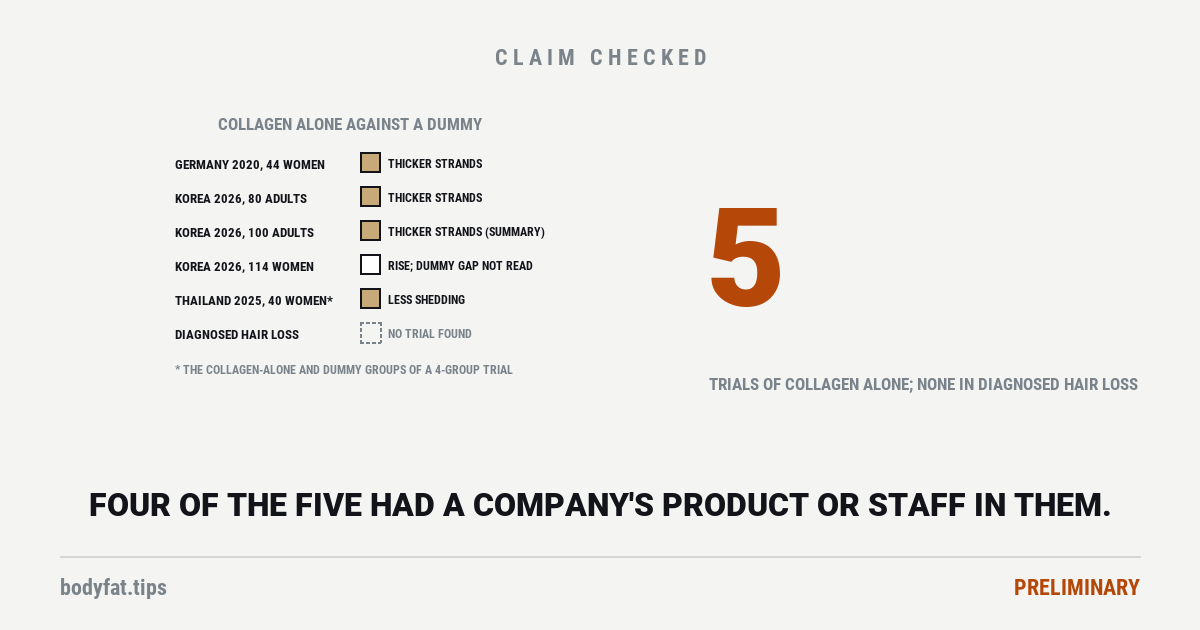
Maybe a little, for the thickness of each strand, and that is as far as the evidence goes. Five small trials have given people collagen on its own against a dummy. Four found some hair measure better than on the dummy, and the fifth reports thicker strands without saying, in the part we could read, whether they beat the dummy [2] [3] [4] [5] [6]. None of the five enrolled people diagnosed with hair loss. They tested people whose hair was healthy, damaged, or thinning by their own account, for 16 weeks to six months, and four of the five had a company’s product, staff or both in them. Most of the other hair trials that contain collagen test a mixture of ingredients, and nothing in them separates collagen from the rest.
This is journalism, not medical advice. If your hair is falling out, the first stop is a doctor, because the cause decides what helps; there is more on that further down.
What happens when people take collagen on its own?
Here are the five. Two terms first. Hair width is measured in micrometres, and a micrometre is a thousandth of a millimetre. And significant is the word researchers use for a difference chance would rarely produce; it is not a word for a big one.
| Trial | Who, how much, how long | What happened to the hair |
|---|---|---|
| Germany, 2020 [2] | 44 healthy women aged 39 to 75; 2.5 g a day or a dummy; 16 weeks | Strands 1.93 micrometres thicker on collagen, 0.99 thinner on the dummy |
| Korea, 2026 [3] | 80 adults aged 19 to 60 with damaged hair, not falling out, 40 per group; 3 g a day; 24 weeks | Diameter up 0.014 mm against 0.001 mm; strength and shine better; an expert’s grade of shine, from photographs, not significantly different |
| Korea, 2026 [4] | 100 adults with damaged hair; 2 g a day; 24 weeks | Shine, strength, diameter and density reported significantly better (summary read) |
| Korea, 2026 [5] | 114 women aged 20 to 50 with cellulite and hair they called thinning; 1 g a day; 24 weeks | Diameter reported as rising significantly by 24 weeks, and a larger share of the collagen group with measurable thickening; the summary gives no test of that share and does not say whether the rise beat the dummy (summary read) |
| Thailand, 2025 [6] | 80 women past menopause in four groups of 20: a dummy, calcium with vitamin D, 5 g collagen, or all three; 6 months | Fewer hairs shed in a combing test than on the dummy in all three active groups; by six months the three were about level, on the paper’s chart |
The oldest of the five is the one its maker announced as the first peer-reviewed study to show “increased hair thickness” [7]. It gave 44 healthy women aged 39 to 75 either 2.5 g a day of a branded collagen powder or a dummy powder of maltodextrin, a starch-based filler, for 16 weeks [2]. At the end the researchers pulled 20 hairs from each woman and measured the same hair twice: close to the root, where it had grown during the trial, and about 1.8 inches (4.5 cm) from the root, where it had grown before. On collagen, the newer part was 1.93 micrometres thicker. On the dummy it was 0.99 micrometres thinner, a change the paper reports as not significant [2]. The gap between the two groups was significant [2].
How big is that? The women’s hair started about 63 micrometres wide, so the collagen group’s strands gained about 3% of their width, by our arithmetic [2]. The paper has no funding or conflict-of-interest statement. Its one author works at a collagen research institute in Germany that is registered as a private company [8], the powder is named as an ingredient maker’s brand, and the maker announced the result on its own website [2] [7]. The same paper reports that hair-follicle cells in a dish became 31% more active after four hours with the collagen; the test it used measures the cells’ chemical activity, which the paper reports as growth [2].
The newest, published in August 2026, took 80 Korean adults aged 19 to 60 whose hair was damaged but not falling out and assigned them by chance: 40 to tablets holding 3 g a day of a fish collagen broken into small fragments, and 40 to dummy tablets of cellulose, for 24 weeks [3]. Seventy-two were analysed, 36 in each group, and most were women. Strand diameter rose 0.014 mm on collagen against 0.001 mm on the dummy, and the hair’s strength when stretched and its shine both rose more on collagen [3]. An expert’s graded score of the hair’s shine, made from standardised photographs, rose in both groups and did not differ significantly between them [3]. That diameter gain is about seven times the 2020 trial’s, by our arithmetic; the two used different collagens, different people and different ways of measuring a hair [2] [3].
Korean government grants paid for that trial. One author is an employee of the company that “developed and provided” the tablets, which the paper declares; another gives a second company’s research institute as the affiliation, which the paper does not declare as a conflict, and both are listed among the authors who obtained the funding [3]. A mouse study of the same kind of collagen, published in July 2026 with the same two company authors, declares both of them as employees of those companies [9].
Two more Korean trials, also from 2026, point the same way, and we could read only their summaries. One gave 100 adults with damaged hair 2 g a day of collagen from tilapia scales or a dummy for 24 weeks and reports shine, strength, diameter and density all significantly better than on the dummy [4]. Eight of its eleven authors work for three companies, one of them a skin-research centre, and it states no outside funding and no competing interests [4]. The other gave 114 women aged 20 to 50, who had cellulite on their thighs and hair they described as thinning, 1 g a day of fish collagen or a dummy for 24 weeks, and reports that hair diameter increased significantly by 24 weeks [5]. Its summary, the only part of it we could read, adds that “a larger proportion of participants” on collagen showed “measurable hair thickening”, but gives no figure or test for that against the dummy group, and does not say whether the rise in diameter was bigger than the dummy group’s. Three of its five authors work for companies, two of them in one company’s health-food research department [5].
The fifth is the only one with no company author, and it is the most interesting. A Thai trial split 80 women past menopause into four groups of 20 for six months: a dummy, calcium with vitamin D, 5 g of collagen made from catfish skin, or all three [6]. Hairs shed in a 60-second combing test fell significantly more than on the dummy in all three active groups [6]. Did the collagen add anything? The paper reports no test of the active groups against each other, so here is what its own chart shows. At three months the group that got no collagen, only calcium and vitamin D, shed the fewest: 5.9 hairs, against 9.0 on collagen alone and 7.7 on all three [6]. But that group had also started with the fewest, about 14 hairs against about 18 in the collagen group, a gap the paper calls not significant, so in hairs the collagen group fell further, by our arithmetic from the chart. By six months, the trial’s last visit, all three active groups were at about 7 hairs, against about 13 on the dummy, figures we read off the paper’s chart [6]. The chart marks collagen alone as significantly below the dummy from three months on, and at two months marks only the two groups that got calcium. (The paper’s text gives its figures at three months; its methods list visits at two and six months, the times its registry record names for hair loss, a secondary outcome there.) A Thai government programme paid for the trial, and the collagen and the calcium, made from the skin and the bone of the same catfish, came from a university centre at which its last-named author works [6]. In that trial, whatever cut the shedding did not need collagen.
What about the hair supplements that contain collagen?
Most hair trials that include collagen test a product with several other active ingredients in it. The newest systematic review of hair supplements, which searched to July 2025, included 14 studies of commercial products, and one of them, the Italian tablet trial below, is on this page [10] [11]. A 2026 review of collagen supplements lists four hair studies in its table, fewer than we found [12].
| Trial | What was in it, against what | What happened to the hair |
|---|---|---|
| UK, 2024 [13] | 8 g marine collagen with vitamin C, or a dummy; 138 people aged 40 to 60 in four groups; 12 weeks | Hair count 27.6% higher than on the dummy, not significant; graded appearance better |
| India, 2024 [14] | 5 g fish collagen with hyaluronic acid, biotin and vitamins C and E, or a dummy; 40 women aged 38 to 50; 56 days | Hairs shed when combed fell 28% from the start, against 7.24% on the dummy |
| Italy, 2023 [11] | 300 mg fish collagen with taurine, cysteine, methionine, iron and selenium, added to hair-loss drugs, against the drugs alone; 83 people; 12 weeks; no dummy | Photographs graded better by assessors who did not know the groups |
| Spain, 2023 [15] | 250 mg collagen with saw palmetto, pumpkin seed, pomegranate, zinc, B vitamins and more, or a dummy; 47 women with early pattern hair loss; 6 months | More of the hairs thick ones at 6 months than on the dummy; neither group’s change from the start was significant |
| Spain, 2022 [16] | 300 mg collagen with B vitamins, cystine, methionine, iron, zinc, selenium and hyaluronic acid, or a dummy; 50 women with shedding; 5 months | Only the supplement group’s before-and-after figures are reported |
| Taiwan, 2025 [17] | Marine collagen with extracts of hibiscus, redcurrant, blueberry and spinach, B vitamins and vitamin C, or a dummy drink; 60 adults, 58 of them women; 12 weeks | Strand width up 14.4% from the start; on the paper’s chart the dummy group’s barely moved. The paper’s “15.2% compared to the placebo group” matches the gap between those two changes, by our arithmetic; read off the chart, the drink group’s strands ended about 9% wider than the dummy group’s, having started about 5% narrower. Hair shed in washing, by weight, down 25.4% from the start, a fall the chart marks against the start, not against the dummy |
Three of them deserve a closer look. The UK trial measured hair with a magnifying scalp camera in only a subset, 11 people on the daily product, and the hair count rose 27.6% more than on the dummy, a difference the paper reports as not significant [13]. What did reach significance was an expert’s grading of how healthy the hair looked, and how many people said it felt thicker: 66.7% on the product, and 44.2% on the dummy [13]. A telehealth company’s article about collagen, cited by Google’s AI answer, describes this trial as finding “an increased hair count” [1].
The 2023 Spanish trial reports that at six months, more of the women’s hairs were thick ones, the pigmented terminal hairs rather than the fine vellus kind, in the supplement group than in the dummy group: 77.6% against 69.8% at the front of the scalp and 77.0% against 64.3% at the side [15]. But neither group’s change from where it started was significant, and at the side the supplement group had started higher, 77.2% against 71.6%, a gap the paper calls not significant [15]. The difference at six months is mostly the dummy group drifting down. Three women on the supplement reported stomach pain and more hair shedding [15]. The tablet also held saw palmetto and pumpkin seed, which its own authors credit with an anti-androgen effect [15].
The 2022 paper from the same maker describes a “randomized, placebo-controlled, double-blind” study of its tablets in 50 women, 25 to each group, and then reports only the supplement group’s before and after figures: hairs in the growing phase rose from 68.63% to 75.68% [16]. The paper’s two mentions of a placebo are both in its methods; we found no result for the placebo group anywhere in it. A before-and-after figure with no comparison cannot separate the tablet from time, season or the shedding settling on its own. The maker’s 2025 study of its collagen drink in 343 people with shedding had no comparison group either, and its authors write that randomised trials are still needed [18].
The maker of one widely sold hair supplement gives a rare glimpse of collagen’s share. In its 2026 open study of four of its own formulas, with no dummy, it describes its original women’s formula as containing “hydrolyzed marine collagen, biotin, and keratin” and its newer formula as excluding them [19]. Hair growth rate rose from the start on both, by 35.1% and 22.4%, and the paper reports no test comparing the two [19]. The formula without collagen improved too.
The trials that finished and that we could not find
Registries show more collagen hair trials than journals do. One, a 24-week trial of a drink with 5 g of fish collagen and other ingredients, against a drink of vitamins and plant extracts and a dummy, in 89 people, finished on 25 October 2024; its record has no results [20]. Two more, each a collagen product against a dummy with hair among the main outcomes, were due to finish by December 2024 and their status is unknown [20]. As registered, one of those two is collagen on its own, bovine or marine, against a dummy, though its hair measure is the women’s own rating; the other adds biotin and vitamin C [20]. We found no paper for any of these three, searching PubMed and Europe PMC for each registry number and running an ordinary web search for each [21]. A fourth shows why the indexes are not enough. Registered as a marine collagen drink against a dummy drink, it did publish, in a journal neither PubMed nor Europe PMC holds, and we found it only through an ordinary web search: it is the Taiwanese mixture trial in the table above [20] [17]. Three of its six authors work for the company that sponsored it, its methods describe only before-and-after tests within each group, and we found no funding or conflict-of-interest statement in it [17]. Unseen results are not known to be negative. But when every published trial we found reports some benefit and some finished trials are missing, the published ones should be read with that gap in mind.
One more has posted results, and they are hard to read either way. In a 90-day trial of a biotin, collagen and keratin capsule against a dummy in 80 people, the main result is listed under a heading that says “shedding not present”, counting 21 of 39 people on the dummy and 10 of 38 on the capsule, while the description above it says the count is of people with one or two shed hairs per follicular unit, the small clusters scalp hair grows in [20]. The record gives no statistical test. We cannot tell from it which group did better.
Does collagen reach your hair?
Hair is not made of collagen. “Hair and nails are composed primarily of keratin rather than collagen,” as a 2026 review of collagen supplements puts it [12]. The pitch on seller pages is that collagen supplies the building blocks for keratin [1]. Proteins are chains of amino acids, and the one that sets hair keratin apart is cysteine, which links the keratin chains together: hair keratins are rich in it, and in proline too [22]. Collagen is short of cysteine. In a 2019 analysis written with collagen-industry authors, a collagen sample held 0.72 g of cysteine and methionine, the two sulphur-containing amino acids, per 100 g of protein, against 3.68 g in the average American diet’s protein mix [8]. One beauty-supplement seller cited by Google’s AI answer tells readers collagen is rich in “proline, glycine, and cysteine” [1]. Proline, yes: collagen is built of repeating three-part units, often glycine, proline and a modified proline [5]. Cysteine, no.
Does any of it get there? Fragments of collagen do reach the blood. In a 2005 study, volunteers who swallowed 9.4 to 23 g of broken-down gelatin had collagen fragments in their blood within one to two hours, half gone by four [23]. What happens after that, at the scalp, is the part nobody on this page has shown: none of the trials we read looked for collagen fragments in the scalp or the follicle. Some measured the scalp itself, its moisture, its stretch or its flaking [3] [13], and some counted how many hairs were in their growing phase [16] [19]; those are readings of the result, not of whether the fragments got there. The evidence that the fragments act on a hair follicle comes from the laboratory: hair-follicle cells in a dish [2], human hair follicles kept growing in a dish for eight days, which grew longer with collagen added, in a study paid for by the collagen’s supplier [24], and mice. In one mouse study, collagen from fish scales given at 1,000 mg per kilogram of body weight a day for six weeks regrew shaved hair about as well as finasteride [25]. By body weight, that is about 68 g, or 2.4 oz, a day for a 150 lb person, by our arithmetic, though mouse doses do not convert to human ones that simply. A supplement seller lists that mouse study among the references for a page that asks “Can collagen prevent hair thinning?” and answers yes [1].
The antioxidant claim, that collagen protects follicles from damage by unstable molecules called free radicals, is on the seller pages and in Google’s answer [1]. The newest trial lists among its limitations that it did not measure markers of that kind of damage [3]. Nothing we read measured it in a human scalp.
Is collagen a complete protein source?
No. Collagen has none of the essential amino acid tryptophan, one the body cannot make, a point made plainly by the 2019 analysis written with collagen-industry authors [8]. That paper’s own argument is that collagen can still make up a good share of the protein in an otherwise normal diet without harming its quality [8]. As food for hair, it is low in the amino acid hair keratin is richest in.
What do biotin and collagen do for hair?
Biotin is a B vitamin, and too little of it can cause hair loss, as can too little iron, protein or zinc [26]. The case for taking it when you are not short is thin. A 2017 review found 18 reported cases in which biotin helped hair or nails, and in every one the person had an underlying condition; ten were an inherited problem with the enzymes that use biotin [27]. Biotin also interferes with some blood tests, including thyroid tests and a test used to diagnose heart attacks, about which the US Food and Drug Administration has issued a warning [28]. We do not rate biotin here. Several of the mixtures above contain it, which is one more reason nothing in them can be pinned on collagen.
What are the 5 signs that collagen is working?
We found no list of five signs in any trial we read. The trials measured things with instruments: micrometres of strand width, a shine meter, how hard a hair is to snap, hairs counted after combing [2] [3] [6]. The largest change in strand width we found reported, 0.014 mm, is about a two-thousandth of an inch, by our arithmetic [3]. What people notice is less reliable: in the UK trial, 44.2% of the people taking the dummy said their hair felt thicker [13].
Collagen for hair: side effects
The trials reported few. The 2020 trial reported no side effects in either group [2]; the newest found none it judged related to the tablets [3]. In the 2023 Spanish trial, three women on the supplement reported stomach pain and more shedding [15], and in the 2026 open study of four formulas, eight or nine women, by the paper’s two counts, stopped because of side effects, and the commonest one reported was an upset stomach [19]. Marine collagen is made from fish; one registered trial watched for allergic reactions for that reason [20].
Can I take a collagen supplement with citalopram?
We did not research drug interactions and cannot answer that. A pharmacist who knows the rest of your medicines can. A 2025 review of hair, skin and nail supplements makes the general point that interactions between supplements and medicines are often overlooked by patients and doctors alike [28].
Does collagen help nails?
The evidence is thinner than for hair. One study gave 25 people with brittle nails 2.5 g a day of collagen for 24 weeks, with no comparison group, and reports nails growing 12% faster and breaking 42% less often; two of its authors work at the German collagen research institute [29]. One controlled trial, in 85 East Asian women, measured nail colour among skin outcomes, and reports the improvement arriving sooner on collagen than on the dummy; four of its five authors work for a collagen maker [30]. That is the whole of it that we found for collagen on its own, and we do not rate it; the Taiwanese drink trial above, a mixture, also reports nail measures [17].
Who these studies were done on
Mostly women. Three of the five collagen-alone trials enrolled only women: healthy women aged 39 to 75 [2], women aged 20 to 50 with cellulite [5] and women past menopause [6]. The Korean damaged-hair trial was more than four-fifths women [3]. Men with pattern hair loss appear in only one trial on this page, a mixture trial in which everyone was also on a hair-loss drug [11]. So if you are a man whose hairline is going back, the collagen-alone trials did not include anyone like you.
When hair loss has a medical cause
Some hair loss runs in families, and some is temporary, from an illness, stress, cancer treatment, weight loss or iron deficiency [31]. Shedding can start a few months after giving birth, an illness or an operation, and thyroid disease can thin hair too [26]. Those causes are treated differently, which is why the dermatologists’ society says the key is “to find out what’s causing the hair loss” [26], and why the NHS advises seeing a GP “before thinking about going to a commercial hair clinic” [31]. Our creatine and hair-loss verdict explains the hormone behind pattern hair loss, and our finasteride verdict checks what one of its drugs does to testosterone.
If hair is made of keratin, how could collagen make it thicker?
This section is the desk’s own reasoning, and it is labelled as such. Collagen is short of the amino acid hair keratin needs most, yet the small trials found slightly thicker strands. Here are three ways those fit together, each rated.
Answer one: the fragments, not the building blocks. Collagen fragments reach the blood in people [23], and in a dish and in mice they make follicle cells more active [2] [25]. If that happens in a human scalp, collagen would be acting as a signal rather than as raw material, and its missing cysteine would not matter. The blood part is measured; the scalp part is a surmise, because none of the trials we read measured it.
Answer two: any protein might do. In the two collagen-alone trials whose papers describe the dummy, it contained no protein at all: maltodextrin in one, cellulose in the other [2] [3]; the Thai trial’s registry record describes its dummy as tablets made of complex carbohydrates [6]. Too little protein is one cause of hair loss [26]. So these trials compared collagen with nothing, not with another protein. What the dummies contained is measured; that a spoonful of any protein might have done as well is a surmise, and these trials cannot settle it.
Answer three: the trials chose people whose hair was not falling out. All five collagen-alone trials enrolled people with healthy, damaged or self-described thinning hair, and none enrolled people diagnosed with hair loss [2] [3] [4] [5] [6]. A strand a few micrometres thicker is a different thing from a follicle that had stopped producing hair starting again. The designs are measured; what they mean for someone losing hair is our inference.
Put the three together and here is what we think is true, stated plainly so you can disagree with it: collagen’s case is a few small trials of slightly thicker strands in people who were not losing hair; for people who are, it has not been tested on its own.
What we could not find, and would like to: a trial of collagen alone, run by people with nothing to sell, in men or women diagnosed with pattern hair loss or long-running shedding, counting hairs for six months or more, against both a dummy and an ordinary protein powder [21]. The registered trials that finished and have not published might hold part of the answer [20]. If you know of the trial we describe, the corrections line on this site is open.
Where “collagen grows hair” came from
We could not trace who first said that eating collagen makes hair grow. The idea is older than the powders. Gelatin, which is collagen cooked down, was being tested on brittle fingernails by 1950 [32], and a 1983 study in rats opened by calling it “well known” that eating gelatin “significantly increases hair diameter” [33].
The modern version got its headline in April 2020, when an ingredient maker announced its 44-woman trial as the first peer-reviewed study to show increased hair thickness [7]: 1.93 micrometres, about 3% of a strand, by our arithmetic [2]. In 2022 a cell-and-mouse study reported fish collagen regrowing mouse hair about as well as finasteride [25], and by 2025 a supplement seller was listing it among the references for a page that answers yes to whether collagen can prevent hair thinning [1].
Today Google’s AI answer to the question opens with a caution, that collagen does not directly make hair grow faster, and then repeats the sellers’ reasoning: amino acids for keratin, support for the skin layer that holds the hair roots, protection from free radicals [1]. It also notes that many of the positive studies tested mixtures, and it says collagen will not fix pattern baldness [1]. The first we agree with. On the second, we found no trial of collagen on its own in pattern hair loss [21]. Two trials on this page gave products containing collagen to people with it, and both report the product’s group ahead of its comparison group at the end: an Italian tablet added to hair-loss drugs, in 83 people, 59 of them with pattern hair loss and the rest with long-running shedding [11], and a Spanish tablet with saw palmetto and pumpkin seed, in 47 women with pattern hair loss [15]. Neither can say what its collagen did, so for collagen itself the evidence does not settle it either way. Among the pages it cites are a collagen seller’s blog that quotes a medical-aesthetics clinic owner calling collagen “a natural antioxidant that regenerates the hair follicle”, a supplement seller, a beauty-supplement seller and a telehealth company, alongside a dermatologist’s short video whose caption says the evidence tells a different story from the marketing [1].
None of this is aimed at anyone who has bought a tub of collagen hoping for thicker hair. Watching your hair thin is upsetting, and the pitch is built to sound like common sense. It is the sellers who turned a few micrometres in a few small trials into “Yes”.
What this is rated, and what the rating covers
Preliminary — for the claim that collagen helps your hair grow thicker and stronger.
It has been tested, and the early results lean its way. Of five small trials of collagen on its own, four found some hair measure better than on a dummy, and the fifth reports thicker strands we could not check against its dummy group [2] [3] [4] [5] [6]. It is not rated higher because those trials are small and short, two of them read only as summaries, four of the five had a company’s product or staff in them, the sizes they report differ several-fold, we found no independent repeat of any of them, in the one trial with a collagen-free active group calcium and vitamin D cut shedding about as much as collagen did, and none enrolled people diagnosed with hair loss [6]. The trials of mixtures cannot say what the collagen in them did, and some finished trials have not been published [20].
Rated alone, in words: that collagen on its own regrows hair in pattern hair loss or long-running shedding would be Unsupported, of the untested kind. We found no trial that gave it on its own to people diagnosed with either [21], and the mixture trials in those conditions, which combined collagen with vitamins, minerals, plant extracts or hair-loss drugs, cannot say what their collagen did [15] [11] [16]. Untested is not the same as disproven.
What is not rated here: nails and biotin, described above in words; collagen for skin, which has its own verdict; and the frame in the section above, which is this desk’s reasoning from the evidence rather than a result the evidence delivered. It is marked as ours so that you can weigh it as ours.
This is journalism, not medical advice. If you are losing hair, a doctor who can find the cause is the place to start. How we read a study, and what each tier means, is set out here.
- Does Low Vitamin D Make You Tired? The Best Trial in Tired, Deficient Adults Found a 2.5-Point Gap at Four Weeks. Genes That Lower It Did Not Clearly Raise Tiredness.
preliminary - When to Take Creatine: Before or After Training, Six Trials Found No Significant Difference in Muscle or Strength
unsupported - Creatine HCl vs Monohydrate: Eight Studies Compared Them, and Only One Put HCl Ahead, on Sprints, Not Muscle
unsupported