Glycine Benefits: Three Sleep Trials, 37 People, the Maker’s Staff on Every Paper. GlyNAC: a Trial of 24, and a Bigger One That Missed.

“GLYCINE: The Cheapest Anti-Aging Supplement That Actually Works.” That is the title of a video posted on 10 November 2025 by a physician’s health-video channel. It had 635,373 views when we read its numbers on 10 October 2026 [1]. Its description promises to go over “the evidence behind Glycine and how it affects your sleep, your metabolism, and your aging,” and when to consider “GlyNAC vs Glycine” [1].
Glycine is the smallest amino acid, one of the building blocks of protein. Your body makes it, and food supplies a few grams a day more [2] [3]. GlyNAC is glycine taken together with N-acetylcysteine, or NAC, a supplement form of another amino acid, cysteine. Two of the video’s chapter titles end in a question mark, “Sleep Benefits?” and “Metabolic / Anti-Inflammatory Benefits?” [1]. The title does not.
Plenty of people are asking. In the United States, “glycine benefits” is searched about 27,100 times a month, “glycine for sleep” about 6,600 times and “glynac” about 3,600 times (from a paid keyword database, pulled 10 October 2026) [4].
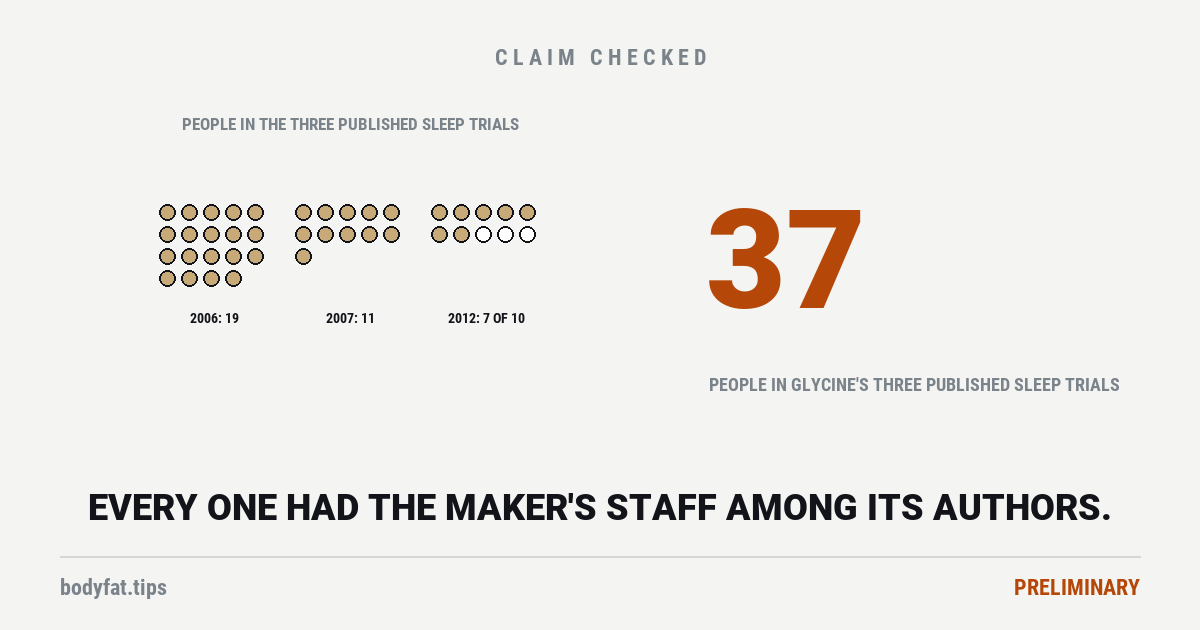
Glycine before bed may help you sleep. The published evidence is three small trials, 37 people in all, each with the maker’s staff among its authors. In the one run in a sleep lab, 11 people with poor sleep fell asleep sooner on glycine than on a dummy powder [5]. The maker’s own patent describes a second sleep-lab trial, in 14 men, in which they reached deep sleep sooner but did not fall asleep significantly faster [6].
“Reverses ageing” rests on one trial of 24 older adults over 16 weeks. GlyNAC raised their glutathione, an antioxidant the body makes, and the paper reports faster walking and a stronger grip than the same people had at the start [7]. A trial by a food company that sells GlyNAC products, in 114 older adults over two weeks at lower doses, found no significant rise in glutathione [3]. Both measured blood and muscle markers; neither followed anyone long enough to see whether they aged more slowly.
The metabolic claim is thinner still. Two small three-month trials in Mexico reported better blood sugar or blood pressure; a two-week study in Singapore found no improvement in insulin resistance, the state in which the body’s cells respond less to insulin, the hormone that moves sugar out of the blood, so more of it is needed to keep blood sugar down [8] [9] [10]. People with more glycine in their blood get diabetes less often, but a genetic study suggests the arrow may point the other way [11].
Does glycine help you sleep?
The story starts with an accident. Researchers at a Japanese amino-acid maker were using glycine as the dummy, the comparison substance, in a trial of other amino acids. In their own words: “The unexpected results of this human trial instigated the study of the effects of glycine on sleep” [2].
A Japanese patent application dated 14 January 2004 sits behind the company’s US patent, titled “Food containing glycine and use thereof”, whose granted claims are methods of shortening the time it takes to reach deep sleep, or of lengthening deep sleep early in the night, with glycine [6]. Then came three small trials.
| Trial | What was given | What happened | Who wrote it |
|---|---|---|---|
| Japan, 2006; 19 women with poor sleep [12] [2] | 3 g or a dummy powder before bed, four nights of each, double-blind [13] | Felt less tired, livelier and clearer-headed the next morning; read as its summary [12] | Four of five authors worked at the maker [12] |
| Japan, 2007; 11 adults with poor sleep, in a sleep lab [5] | 3 g or a dummy within an hour of bed; one night of each measured; single-blind | Fell asleep sooner and reached deep sleep sooner on the recording; rated their sleep better; next-day sleepiness lower on one scale at one time of day, not significantly on another | Three of six authors, the corresponding author among them, worked at the maker |
| Japan, 2012; 10 men, 7 analysed, sleep cut by a quarter [14] | 3 g or a dummy 30 minutes before bed, three nights of each; single-blind | Less fatigued on day 1 by one rating, not by a 25-item questionnaire; nothing significant by day 3 on either; faster on one of four computer tests | Three of five authors worked at the maker; every volunteer was its employee |
The 2007 trial is the one to read, because it measured sleep instead of asking about it. Polysomnography is the overnight sleep-lab recording of brain waves, eye movements and muscle tone. Eleven adults aged 30 to 57 who had been sleeping badly for a while slept two nights in hospital on glycine and two on the dummy; the first night of each pair was for getting used to the wires and was not counted [5]. So each person was measured on one night per powder.
On glycine, they reached the first stage of real sleep sooner, and reached slow-wave sleep, the deepest stage, sooner. The time to dream sleep did not change, and neither did how the night divided between the stages [5]. They also said they were more satisfied with the night and found it easier to drop off [5]. The paper gives the minutes only in a chart, so we do not print them.
The next day was a mixed picture, and it belongs here as much as the good night does. On one sleepiness scale glycine came out ahead with a P value of 0.058, just the wrong side of the line researchers use for “probably not chance”. On a second scale it differed at one of five times tested, 10 in the morning. On a memory test it did better at one of three times, noon; reaction time did not differ [5].
The 2012 trial asked a different question: does glycine help when you are short of sleep? Ten healthy men, every one an employee of the maker, cut their time in bed from about 7.3 to 5.5 hours for three nights; one dropped out and two were excluded for taking medicine, leaving seven [14]. On the first day they rated themselves less fatigued on glycine. Sleepiness on the same rating scale did not differ significantly, nor did any part of a 25-item fatigue questionnaire, and by the third day neither showed a difference. One of four computer tests, a reaction-time test of vigilance, came out faster on both days; the other three did not differ significantly [14].
Who ran them? Read the author lists, because the funding lines will not tell you. The 2007 paper prints no funding statement and no conflict statement; three of its six authors, the corresponding author among them, worked at the maker, and the maker’s own review board approved it with the hospital’s [5]. The 2012 paper declares that it was done “in the absence of any commercial or financial relationships”, with three of five authors at the maker’s laboratory, volunteers on its payroll and approval from its review board [14]. The 2006 trial we could read only as its summary; four of its five authors worked at the maker [12].
The maker’s US patent describes more of its own testing. In one double-blind trial of 14 men worried about snoring, the sleep-lab recording found that “significant difference was not observed” in the time from lights-out to falling asleep, while the time to deep sleep was shortened [6]. We did not find that trial published in a journal [15]. In another, 15 women took 3 g or a dummy an hour before bed for four days of each, double-blind. The patent reports significant benefits on waking only within subgroups, the 6 aged 32 or over and the 7 it describes as having problems with sleep; asked about each week as a whole, 6 said the glycine week had been fine, 1 said the dummy week, and 8 said both were the same [6]. We cannot tell whether that is the 2006 trial, which the maker’s own review counts as 19 women [2]. A third, in 7 men kept short of sleep, matches the 2012 trial’s design down to the dose, the sleep cut and the hours of testing, and may be the same trial. If it is, the two accounts differ: the patent, filed in the US in June 2005, reports daytime sleepiness significantly improved, and the 2012 paper reports that sleepiness did not differ significantly [6] [14].
A 2021 study by a different team gave glycine to 20 urology patients in Japan with an overactive bladder: a dummy, glucose, for four weeks, then 3 g of glycine twice a day for four weeks. Among many measures, the time it took them to fall asleep “improved” [16]. The order was fixed, not random, so glycine was always the second month; we read it as its summary.
Two reviews have gathered this up. A 2024 systematic review from Singapore, which searched to April 2022, said the sleep studies in healthy people “had small sample sizes with a high risk of bias” [13]. A 2026 review, searched to July 2026, counted three trials of glycine on its own and sleep, the 2006 and 2007 trials and the urology study, and found that all three “reported benefits on at least 1 sleep-related outcome” [17]. That review was paid for by an unrestricted educational grant from the health-science arm of a food multinational, the same one whose staff declare that it markets GlyNAC products [17] [3].
Every controlled trial of glycine on its own and sleep that we found, published or described in a patent, had the maker’s staff among its authors or its inventors, and the newest of them is from 2012 [15] [17] [13]. Add the three published ones together and you have 37 people, by our arithmetic: 19, 11, and the 7 who were analysed out of 10 [2] [5] [14].
Does glycine make you groggy the next day?
Not in these trials, but they were short. Feeling tired and foggy the next morning improved in the 2006 trial, by its summary [12], and next-day sleepiness leaned glycine’s way in the 2007 one: short of significance on one scale, and ahead on the other only at one of five times of day [5]. In a separate open study, 12 volunteers took 9 g, three times the sleep dose, after meals, during the day and at bedtime over a week; the authors found no significant effect on daytime sleepiness [18]. All of these come from the maker’s laboratory, and none gave glycine for more than a week. The maker’s own page answers the question “Will taking glycine make me feel groggy in the morning?” with “No, it won’t” [19].
How long does it take glycine to work for sleep?
In the trials it was taken 30 minutes to an hour before bed, and the effects were measured that night and the next day [5] [14]. In nine volunteers in Minnesota who took glycine, the level in the blood peaked about 40 minutes later, by the maker’s laboratory’s reading of that study [18] [20]. The maker’s page says most people feel “the cooling effect within 30-60 minutes” [19]. The longest randomised trial gave it for four nights [13], so whether the effect grows, fades or holds over weeks is not something these trials can tell you.
Is magnesium glycinate best for sleep?
That is a question about magnesium, and this site has a verdict on it. A 2025 trial tested magnesium bisglycinate on people sleeping poorly; our magnesium glycinate verdict sets out what it found. It tested the magnesium compound, not glycine on its own, and the trials above tested glycine, not magnesium, so neither can tell you which is best. The rest of the sleep aisle is in our verdicts on melatonin dosage and sleep hygiene, and ashwagandha, sold for stress, has its own.
What does GlyNAC do, and does it reverse ageing?
Glutathione is an antioxidant your cells make, from amino acids that include glycine and cysteine. The idea behind GlyNAC is that older bodies run short of those two, so supplying them restores the glutathione [21]. Whether swallowing glutathione itself does anything has its own verdict here.
The main test of GlyNAC is a trial at Baylor College of Medicine in Houston, published in 2022. Twenty-four adults aged 61 to 80, all carrying extra weight and none with diabetes, were assigned by chance to GlyNAC or a dummy, alanine, another amino acid, for 16 weeks; neither they nor the researchers knew which [7]. The dose was 100 mg of each per kg of body weight a day: about 9 g of glycine and 9 g of NAC at the GlyNAC group’s average weight, 197 lb (89.5 kg), by our arithmetic. Twelve young adults took GlyNAC for two weeks as a yardstick [7].
In the GlyNAC group, glutathione in muscle more than doubled, from 2.4 to 6.3 mmol per kg, close to the young adults’ 7.0. F2-isoprostanes, chemical traces of oxidative damage to fats in the blood, fell from 216 to about 60. In the dummy group both stayed where they were [7]. Insulin resistance, estimated from fasting blood sugar and insulin, fell; the paper reports “no changes” in fasting blood sugar itself or in a sugar-drink test [7].
Then the part people feel. Walking speed went from 3.7 to 4.4 feet a second (1.13 to 1.34 m/s), grip from 71 to 81 lb (32.3 to 36.7 kg), and a sit-to-stand test got faster, each against the same people’s starting values. The six-minute walk fell short of significance, P = 0.053. Waists shrank by about an inch, from 41.7 to 40.6 in (1.06 to 1.03 m); weight and fat mass did not change significantly [7].
Three things to know before you read those numbers as ageing in reverse.
First, the comparison. A randomised trial exists to compare the treated group with the dummy group. This paper’s methods say that comparison was planned for walking speed, strength and body measures, but its tables print each group against its own starting point and against the young adults, not GlyNAC against the dummy at 16 weeks [7]. We did not read its supplementary file. Changes inside one group can come from things other than the capsule: over the same weeks, grip in the weaker hand of the dummy group fell from 68 to 61 lb (30.7 to 27.8 kg) [7].
Second, the registration. The trial’s registry entry, first submitted in 2013, lists one primary outcome, glutathione in muscle, and no others [22]. Walking speed, grip, waist and the “aging hallmarks” in the title were not registered outcomes. That does not make them wrong. It means they were not the question the trial was set up to answer.
Third, the size and the source. It is 24 people, 23 of whom finished. Patent records name the trial’s lead investigator as an inventor on six granted US patents on glycine and NAC [23]. Three are held by Baylor College of Medicine alone, from a 2008 application, and were granted in January 2013, August 2014 and July 2015; their claims include treating insulin resistance and obesity, preventing diabetes, and “neurodegenerative disease in aging”. The first was granted four months before the trial was registered [23] [22]. The other three come from a family of applications that began in 2015; its international application, published in December 2016, named Baylor and another company. By the time its US version was published, in June 2018, the applicants named on it included a company of a food multinational, and the three patents, granted in March 2021, August 2023 and January 2025, name Baylor and the multinational’s products company as their holders. Their claims cover muscle loss, osteoporosis, heart disease and other conditions and, in the latest, damage that a drug does to the cell’s energy machinery [23]. The paper, published online in August 2022, declares no conflict of interest [7]. That is not an accusation of anything. It is the disclosure we would print about any source.
The other randomised GlyNAC trial we found was run by that food multinational’s research and health-science staff, who declare that the company “holds patents and licenses to patents and markets products for the use of glycine and n-acetylcysteine” [3]. It was bigger: 114 healthy adults aged 60 to 85 finished. It was shorter and gentler: two weeks, at 2.4, 4.8 or 7.2 g a day of the pair combined, against about 18 g a day in the Houston trial by our arithmetic. Its main result was no significant rise in glutathione at any dose, compared with the dummy [3]. Only when the authors went back afterwards and picked out people with high oxidative stress and low glutathione at the start did the higher doses show a rise [3].
Before that, the Houston group’s evidence was open-label, meaning everyone knew what they were taking, with no dummy group: eight older adults for 24 weeks, whose benefits “declined after stopping” [24]; eight people with HIV for 12 weeks [25]; ten people with type 2 diabetes for two weeks [26]; and eight older adults for two weeks in 2011 [21]. A 2026 review of GlyNAC and ageing describes the Houston trials and the company trial [27]. We found no published GlyNAC trial in people from any group other than these two, and the company that sponsored the second trial is named with Baylor on three of the patents above [15] [23] [22]. One trial from outside, at Vanderbilt University, is registered and recruiting, for pain after knee replacement [22].
So what was “ageing” measured as? Glutathione, markers of oxidative damage, inflammation and insulin resistance in blood, how muscle burns fuel, walking speed, grip, waist and blood pressure [7]. Neither randomised trial followed anyone long enough to see whether they lived longer or aged more slowly. Another molecule sold to slow the clock, NAD+, has its own verdict with the same shape: the blood marker moves, and the rest is the hard part.
And glycine on its own? The longevity case has a mouse in it. In a 2019 study across three American laboratories, mice fed a diet that was 8% glycine lived 4 to 6% longer [28]. We read it as its summary; one author’s company sells a glycine supplement [28]. That is a mouse, eating glycine as a large share of its food, for life. The nearest tests in people we found gave glycine in a mix, or with nothing to compare against. A 2025 study of a company’s powder, with 5 g of glycine in each daily serving alongside two other amino acids, calcium alpha-ketoglutarate (a salt of a compound the body makes in burning food), an algae extract and vitamin C, reported a fall of 1.4 years in “biological age”, a score from a saliva DNA test, not a measure of how long anyone will live, in the 45 adults who finished six months. They were healthy adults aged 35 to 68 who bought the powder themselves, and the study was registered in July 2025, about nine months after it ended in October 2024. Everyone took the powder and nobody took a dummy. The company that owns the product paid for that part of the study, three authors are its co-founders or staff, and two co-founded the company that sells the test. The authors write that placebo effects, regression to the mean (people who start with unusual scores drifting back toward the average on their own) and selection bias (the people who joined or stayed differing from those who did not) “cannot be excluded” [29]. And a study in Mexico gave 59 older adults 1 g of glycine a day for six months, with no comparison group; it was registered in June 2026, six months after it finished, and its registry entry posts no results [22].
Does glycine improve blood sugar and metabolic health?
Two Mexican trials from the research units of one social-security institute are the strongest support. In 74 people with type 2 diabetes, three months of glycine taken three times a day lowered A1C, a blood test that gives a rough three-month average of blood sugar, more than a dummy did [8]. Its summary gives the dose as “5 g/d” taken three times a day; two later papers describe it as 15 g a day [13] [3]. In 60 people with metabolic syndrome, a cluster of raised blood pressure, blood sugar and blood fats with a large waist, 15 g a day for three months lowered a marker of oxidative damage by 25% against the dummy, and lowered the top blood-pressure number in the men only [9]. We read both as their summaries, which give no size for the A1C or blood-pressure changes.
A one-meal test in nine healthy volunteers in Minnesota found that glycine taken with a sugar drink cut the rise in blood sugar by more than half [20]. A 2025 study went the other way. In Singapore, 19 adults with severe obesity took 100 mg per kg a day, roughly 11 g at their average weight of 238 lb (108 kg) by our arithmetic, for two weeks, with no comparison group. Glycine in their blood rose 35%. Their weight stayed at 238 lb (108 kg), insulin resistance read 4.56 before and 4.60 after, and glutathione did not improve; blood fats and liver enzymes fell [10].
Why does anyone think glycine matters for diabetes at all? Because people with more glycine in their blood develop it less often. A 2022 review pooled 18 estimates from cohort studies, which measure people and wait to see who becomes ill. For each step up in blood glycine of one standard deviation, the usual yardstick for how spread out a measurement is, diabetes risk was about 21% lower, and the range the true answer probably sits in ran from 10% to 32% lower [30]. Most of the spread between the studies’ results was more than chance would produce: 89% of it, on the measure called I-squared [30].
That design cannot say which way the arrow points. A 2019 study led from Cambridge tried, with Mendelian randomisation: it uses inherited gene variants that nudge blood glycine up or down from birth as a natural experiment, since genes are dealt at random and diet cannot change them [11]. Across 74,124 people with type 2 diabetes and 824,006 without, its main genetic score for higher glycine showed no link with diabetes: an odds ratio of 0.99, where 1 means no difference. Two narrower scores did point to lower risk, 0.85 and 0.82 [11]. And genes that raise insulin resistance lowered glycine. The authors’ reading is that the link “may be driven by a glycine-lowering effect of insulin resistance” [11]: the condition lowers the glycine, rather than low glycine causing the condition. The same study found genetically higher glycine went with slightly less heart disease, an odds ratio of 0.95 [11].
Is it safe to take glycine every day?
At the doses tested, for as long as they were tested, the trials report few problems. Daily glycine has been given for three months at 15 g [9], for four months at 14 g to people on dialysis [31], and with NAC for 16 weeks at about 9 g; in that Houston trial, liver tests and creatinine, a waste product the kidneys clear, did not rise [7]. None of the studies in people on this page gave glycine for longer than six months, so they cannot speak to years of daily use [13] [24] [29].
One regulator’s position is worth knowing, and it is not what most people expect. The US Food and Drug Administration’s regulation on glycine in food, which gave food makers until May 8, 1971 to comply and has sat in its present place in the federal code since 1977, says the agency “no longer regards glycine and its salts as generally recognized as safe for use in human food”, citing harm in animals fed high levels and that people’s daily intake “may be substantially increasing”. It allows glycine to be added to food for two narrow technical jobs, in small amounts, and requires a petition backed by toxicity data to show that any other level would be safe [32]. That regulation is about food additives. Under the US food law’s own definition, an ingredient in a dietary supplement is not a food additive, so the rule covers glycine added to food, not a glycine powder sold as a supplement [32]. The agency’s inventory of notices from companies that judge an ingredient “generally recognized as safe”, which covers notices filed since 1998, lists none for glycine [33]. That is a record of what companies have filed, not a safety finding in either direction.
Can you take too much glycine?
Yes, and the gut tends to say so first. When 12 volunteers took 9 g at bedtime, some had soft stools and stomach pain, which the authors judged not serious [18]. In people on dialysis taking 14 g a day, six had nausea or vomiting while on glycine, though three of them also had it during the gap between supplements [31].
Much higher doses have been given in psychiatric trials: 0.8 g per kg a day, about 60 g for a 165 lb (75 kg) adult by our arithmetic, for six weeks in 22 people with schizophrenia, described as “well tolerated” [34]. The same dose taken once by healthy men impaired a lab measure of how the brain filters incoming sensations [35]. A different hazard belongs to surgery, not supplements: glycine solutions used to rinse during some operations can be absorbed in large volumes, which is the subject of one of the mouse studies listed under the video [36] [1]. The dialysis trial’s authors note that such absorption has been linked to low blood sodium, and none of their patients developed it [31].
Is glycine bad for your kidneys?
We found no trial designed to test what glycine supplements do to the kidneys [15]. What there is: in the Houston trial, creatinine did not rise over 16 weeks [7]; in the dialysis trial, people whose kidneys had already failed took 14 g a day for four months, with side effects that did not differ significantly from those on the comparison supplement [31]; and the 2024 review noted that the kidneys were not assessed in its healthy volunteers [13]. If you have kidney disease, a supplement is a question for your doctor, not for this page.
Why has the company that sells glycine done nearly all the testing?
This section is the desk’s own reasoning, and it is labelled as such. Of the four published sleep studies above, the three randomised ones had the maker’s staff among their authors, and the fourth, from a different team, was not randomised [12] [5] [14] [16]. The trials described in the patent are the maker’s own [6]. The GlyNAC trials show the same shape: a university that patents GlyNAC and a company that sells it [23] [3]. Why? Three answers, each rated.
Answer one: cheap does not mean unowned. The usual explanation for thin evidence on a cheap supplement is that nobody can patent it, so nobody pays for trials. Here the uses were patented: the maker holds a US patent, listed as active until 2029, on glycine for shortening the time to deep sleep [6], and GlyNAC’s uses are patented by the university and the food company [23]. The owners had reason to fund trials, and did. This is measured: the patents are public records. What it implies about the trials is not measured.
Answer two: small, short trials of how people feel tend to come out positive. The sleep trials mostly asked people how they felt, over one to four nights, in 7 to 19 people, two of the three blinded on one side only [12] [5] [14]. The brain-wave result in 11 people is the firmest finding, and it is one night per person. That trials built this way lean positive is a surmise from how they were built, not a measurement of these trials.
Answer three: independent sleep researchers have had little reason to look. They test drugs and therapies, and an amino acid sold as food falls between the two, which leaves the party that sells it as the party with a reason to run the trial. This is a hunch; we have no measurement for it.
Put the three together and here is what we think is true, stated plainly so you can disagree with it: glycine before bed is cheap to try and unproven to believe, because three small trials, each with its maker’s staff among the authors, are not yet a finding.
What we could not find, and would like to. A trial of glycine for sleep run by an independent team, registered in advance, double-blind, in people with diagnosed insomnia, for at least four weeks, with the sleep-lab recording as its main outcome. And a GlyNAC trial at the Houston dose, run by neither the university nor the food company, with walking speed or strength registered as an outcome [15]. If you know of either, the corrections line on this site is open.
Who these studies were done on
The sleep trials: Japanese adults aged 24 to 61, recruited as volunteers. In the first two they had long-standing poor sleep, and most were women; in the third they were seven men with no sleep complaints, kept short of sleep on purpose [12] [5] [14]. None was over 61. The GlyNAC trials: Houston adults aged 61 to 80, all carrying extra weight, none with diabetes [7]; and healthy adults aged 60 to 85 at one research clinic in Neuss, Germany [3] [22]. The metabolic trials: Mexican adults with diabetes or metabolic syndrome, and Singaporean adults with severe obesity [8] [9] [10].
Three things change the answer for a reader. Your sleep: the sleep-lab trial recruited people who slept badly, and the trial in men with normal sleep tested days of short sleep, not ordinary nights [5] [14]. The dose: 3 g for sleep, about 9 g of each for GlyNAC [5] [7]. And how long: nights for sleep, weeks for the rest.
Where “the cheapest anti-aging supplement” came from
The research came from the maker. Its staff turned a surprise in a dummy group into a 2004 patent application and the 2006 and 2007 trials [2] [6] [12] [5].
The framing came from the maker too. Its North American arm’s page, dated May 2021, says “Research by the [maker’s] Group has shown that the amino acid glycine, taken before bedtime, helps the body reach deep sleep more quickly”, and that “People wake up feeling refreshed, without the drowsiness some sleep remedies can cause” [19]. The same page says the company “has developed a range of glycine supplements” [19].
Then the spread. The video of November 2025 put sleep, metabolism and ageing under one title [1]. Of the 14 papers listed under it, two are trials of glycine and sleep in people, both with the maker’s staff among the authors, and four are studies in rats, mice or mouse brain cells [1]. Google’s AI answer for “glycine for sleep” in October 2026 cites the maker’s page in its opening line, and its answer for “glycine benefits” cites the video for its sleep point [4].
The product is the tub and the capsule: glycine powders sold for sleep, the maker’s own range among them [19], and GlyNAC, marketed by the food multinational whose trial found no significant rise in glutathione [3]. Collagen, sold for skin and joints, is rich in glycine: gelatin, made from collagen, is about 30% glycine [20]; our collagen verdict covers what it does for skin.
None of this is aimed at anyone stirring a spoon of glycine into water before bed. The trials say it may help, the doses tested caused little harm, and it costs little to find out for yourself. It is the “actually works” and the “anti-aging” that the evidence does not yet carry.
What this is rated, and what the rating covers
Preliminary — for the claim that taking about 3 g of glycine before bed improves sleep.
It is rated Preliminary because the evidence in its favour is early and small: three randomised crossover trials of 7 to 19 people, one to four nights per powder, each with the maker’s staff among the authors, and one study that was not randomised [12] [5] [14] [16]. The sleep-lab trial found people fell asleep and reached deep sleep sooner. The maker’s own second sleep-lab trial, in 14 men and described in its patent, found deep sleep sooner but no significant difference in the time to fall asleep [6]. The others found people felt better rested by some measures and not by others. It is not Supported because we found no independent trial that repeated it, none of the randomised ones ran longer than four nights, and a systematic review calls the studies small and at high risk of bias [15] [13].
Rated alone, in words. That GlyNAC slows or reverses ageing: Preliminary; one 24-person trial reports better markers and, against the same people’s starting values, better walking speed and grip; a larger company trial at lower doses for two weeks found no significant rise in glutathione; neither followed anyone long enough to see how they aged [7] [3]. That glycine on its own slows ageing: Preliminary; we found no trial in people that tested it, and a 2024 review of glycine trials in people called for studies of whether it can prevent, delay or reverse ageing [15] [13]; a 2019 study found mice fed glycine lived 4 to 6% longer [28], and a six-month study of a glycine-rich powder, with no comparison group, reported a lower score on a DNA test of biological age [29]. That glycine improves metabolic health: Preliminary; two small three-month trials are in its favour, a two-week study found no improvement in insulin resistance, and a genetic study suggests the blood link runs from insulin resistance to glycine [8] [9] [10] [11].
What is not rated here: inflammation beyond the markers named above; collagen for sleep; the video’s dosing chapter, which we did not hear; and the frame above, which is this desk’s reasoning from the evidence rather than a result the evidence delivered. It is marked as ours so that you can weigh it as ours.
This is journalism, not medical advice. Trouble sleeping that lasts, diabetes, kidney disease, or medicines taken alongside a supplement belong with a clinician. How we read a study, and what each tier means, is set out here.
- Turmeric Benefits: Capsules May Take the Edge Off Knee Arthritis Pain. The Biggest Numbers Came From the Smallest Trials.
preliminary - Aged Garlic Extract: Six Small Trials Slowed a Number on a Heart Scan. None Showed an Artery Unclogging.
preliminary - Akkermansia Benefits: The Supplement Trials for Weight and Blood Sugar Are Small and Mixed. The Cancer Link Is a Stool Finding, and More Was Not Better.
preliminary