Akkermansia Benefits: The Supplement Trials for Weight and Blood Sugar Are Small and Mixed. The Cancer Link Is a Stool Finding, and More Was Not Better.

“The Responders Study: The One Microbe That Dictates Cancer Survival.” That is a chapter title in “THIS Gut Bacteria Might Be The Real Cancer Cure”, a video posted on 17 June 2026 by a physician-author’s food-and-health channel. It had 1,803,515 views when we read its listing on 10 October 2026 [1]. The chapter after it is “DIY Ackermansia: The Pomegranate, Cranberry, and Black Vinegar Protocol” [1].
The microbe is Akkermansia muciniphila. A sequel posted on 29 September 2026 (272,926 views) says it “can influence your body’s natural GLP-1 pathway”, GLP-1 being the gut hormone the new weight-loss drugs are built to copy [1]. And five of the channel’s video descriptions promote a company that sells Akkermansia capsules, one of them, and a later copy of it, with a discount code; a short from September 2025 calls it “One gut bacteria you can’t get from food” [1].
People are asking. In the United States, “akkermansia probiotic” and “akkermansia muciniphila” are each searched about 9,900 times a month, and “akkermansia benefits” about 3,600 times a month (from a paid keyword database, pulled 10 October 2026) [2].
So we read the human research: the supplement trials, the cancer studies the “responders” line comes from, and the food studies. The short version first; the rest of the page is the working.
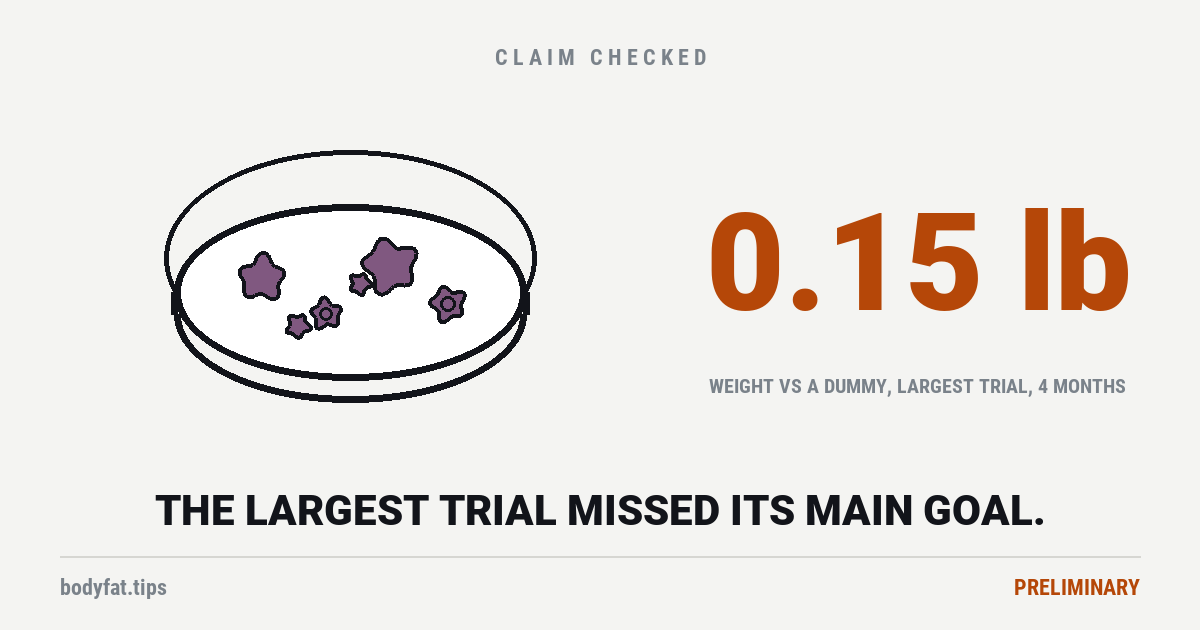
For weight and blood sugar, the supplement trials are small and split. We found eleven randomised trials of Akkermansia products for weight or blood sugar, two of them readable only in summary. The largest, 142 adults over four months, missed the main goal it set itself [3]. The clearest positive result was 4.4 lb (2.0 kg) less weight regained over 24 weeks after a diet, in a trial paid for by the company that makes the product [4]. A bigger figure comes from a smaller, shorter company trial whose numbers we question below.
GLP-1 has been reported in four of the trials we found, and they disagree. One found no change [5], one found a rise at three months that had faded by four [3], one found it higher than on a fibre-only dummy after eight weeks [38], and one reports a “recovery” in GLP-1 without saying what it was compared with [39]. The company promoted on the channel did not measure it in its own published trial [6].
The cancer finding is a stool test, not a treatment. In some studies, people on one kind of cancer immunotherapy did better on average when their stool carried the bacterium [7] [8]. That did not hold as a rule across every group studied [9], and in the largest lung-cancer study the patients with the most of it did worst [8]. We found no trial showing that taking it, or eating to grow it, helps anyone with cancer [10]. The one that has reported results gave a capsule alongside immunotherapy to nine people with kidney cancer and had no comparison group, so it cannot show that [40] [41].
The food list is mostly a mouse story. The pomegranate, cranberry, grape, chili and vinegar findings come largely from mice, and the human studies are small, short and often without a comparison group. Across randomised trials of polyphenol supplements, the plant compounds these foods are rich in, Akkermansia rose in 5 of the 10 that reported it [11].
What is Akkermansia?
A bacterium that lives in the layer of mucus lining your gut and feeds on mucin, the main protein in that mucus [12]. It was first grown from human stool in 2004 and typically makes up 1% to 5% of the gut’s bacteria in healthy people [6]. Plenty of people have none that can be detected: between 38% and 86% depending on the country, by the account of a 2026 trial’s authors [3], and 61% of the 338 lung-cancer patients in a French-led study [8].
Why the excitement? In rodents, giving it reduced obesity, poor blood-sugar control, fatty liver and a leaky gut lining; and in people, lower levels go with overweight, obesity, untreated type 2 diabetes and high blood pressure, as the first human trial’s authors summarised the field [5]. That second half is an association: people with less of it are less healthy on average. It does not say which causes which, and the trials below are what happens when you try to find out.
Two forms are sold. One is the live bacterium in a capsule, which is what the channel’s sponsor sells [1] [13]. The other is pasteurized: heated until the bacteria are dead. That is the form the European food regulator has assessed for safety [12], and the form used in three of the trials below, the largest among them, and in one arm of a fourth.
Does Akkermansia help you lose weight or lower blood sugar?
Here are the trials, one row each. A randomised trial assigns people by chance to the real thing or a comparison, usually a dummy capsule, which is the only way to tell a supplement’s effect from everything else going on in people’s lives. Three terms recur. Insulin resistance means the body responds sluggishly to insulin, the hormone that moves sugar out of the blood. Metabolic syndrome is a cluster of a large waist, high blood pressure, high blood sugar and unhealthy blood fats. HbA1c is the blood test that reflects average blood sugar over about three months [6].
| Trial | Who, what, how long | Main goal | What happened |
|---|---|---|---|
| Belgium, 2019 [5] | 32 adults with overweight or obesity and insulin resistance; live or pasteurized bacteria, 10 billion a day, or a dummy; 3 months | Safety and a set of metabolic measures | Pasteurized: insulin sensitivity up about 29% against the dummy; weight 5.0 lb (2.27 kg) lower, a gap chance could explain |
| United States, 2020; the capsule maker’s own trial [6] | 76 adults with type 2 diabetes; a five-strain capsule with Akkermansia and inulin, a three-strain capsule without it, or a dummy; 12 weeks | Blood sugar after a test meal | Lower than on the dummy, p = 0.05 on a one-sided test, counting 58 who stayed on the capsules; weight unchanged |
| Shanghai, 2025 [14] | 58 adults with type 2 diabetes and overweight; a live strain or a dummy; 12 weeks | Weight and fasting blood sugar | Weight and HbA1c fell in both groups, with no clear difference between them |
| Ireland and Germany, 2026; the largest [3] | 142 adults with metabolic syndrome; 30 billion pasteurized bacteria a day or a dummy; 4 months | Insulin sensitivity | Missed: no difference; weight differed by 0.15 lb (0.07 kg) |
| Netherlands, 2026 [4] | 84 adults with overweight or obesity who had just lost weight on an 8-week diet; pasteurized bacteria or a dummy; 24 weeks | Weight regained | Met: 2.6 lb (1.2 kg) regained against 7.1 lb (3.2 kg) on the dummy |
| China, 2026 (read as a summary) [15] | 100 women with polycystic ovary syndrome and obesity, all on the pill; dead bacteria (a postbiotic) or a dummy | Weight and hormone measures (the summary does not name one main goal) | 4.2 lb (1.92 kg) lost against 0.8 lb (0.37 kg) on the dummy |
| Iran, 2025 (read as a summary) [16] | 66 adults with overweight or obesity; yogurt with an Akkermansia postbiotic, yogurt with another bacterium’s, or plain low-fat yogurt; 8 weeks | Body measures, blood tests, appetite (the summary does not name one main goal) | Waist and body-fat percentage fell more than on plain yogurt |
| United States, 2021; the capsule maker’s six-person pilot [42] | 6 volunteers; the five-strain capsule and a dummy, two weeks each, in turn | Blood sugar after meals, by a sensor worn on the skin | No clear difference; weight no different either |
| China, 2025 [39] | 130 young adults with overweight, average age about 20; a live strain, a dead preparation of it, or a dummy; 8 weeks | Body measurements | The summary says weight fell more than on the dummy; the discussion says the difference was not significant |
| China, 2026 [38] | 110 adults aged 18 to 45 with overweight or obesity; a live strain with two plant fibres, or the fibres alone; 8 weeks | GLP-1 and two other appetite hormones | GLP-1 and PYY, another appetite hormone, higher than on the fibres alone; waist-to-hip ratio lower; BMI, body fat and blood sugar no different |
| India, 2026; the seller’s own trial (described below) | 60 adults aged 31 to 60 with prediabetes; a live strain or a dummy; 60 days | Fasting blood sugar and blood fats | Reports HbA1c 4.78% against 5.55% on the dummy, from a starting average of 5.48% in both groups, below the prediabetes range |
The first human trial, Belgium, 2019. Forty adults with overweight or obesity and insulin resistance took live bacteria, pasteurized bacteria or a dummy for three months; 32 finished [5]. On the pasteurized form, insulin sensitivity improved by about 29% against the dummy, and weight came out 5.0 lb (2.27 kg) lower, with p = 0.09: not the kind of gap researchers count as “probably not chance” [5]. Two things temper it. The dummy group got worse over the three months, so part of each gap is the comparison sliding. And by the luck of the draw, the pasteurized group started with higher insulin and lower insulin sensitivity than the dummy group, which left it more room to improve [5].
Five of its authors are named on patent applications for the bacterium’s use against obesity, and two of them co-founded a company [5]: the one that later asked the European regulator to approve the pasteurized form [12].
The maker’s own trial, United States, 2020. The company whose capsules the channel promotes tested a five-strain capsule, Akkermansia plus four other bacteria and inulin, a plant fiber, in 76 adults with type 2 diabetes, most on metformin, for 12 weeks [6]. The main measure was blood sugar over three hours after a standard drink meal. It fell by 14.9 on the capsule and rose by 21.2 on the dummy, a gap of 36.1 in the paper’s units (mg/dL over 180 minutes), with p = 0.05 [6].
Three details sit behind that number. The test was one-sided: it asked only whether the capsule did better than the dummy, never whether it did worse, which makes a given gap easier to call significant. The count included only the 58 people who stuck to the capsules; 10 of the 26 on the dummy dropped out or stopped taking it, against 2 of the 23 on the five-strain capsule. And the gap came as much from the dummy group getting worse as from the capsule group getting better [6].
HbA1c came out 0.6 points lower than on the dummy, p = 0.054 on the same one-sided test: the wrong side of the line researchers use for “probably not chance” even on the easier test, and about twice that, 0.11, on an ordinary two-sided one, by our arithmetic [6]. Weight did not change. All the authors were employees and shareholders of the company, and the trial was registered in March 2019, seventeen months after it began [6].
We found no published trial of the single-strain live capsule the channel promotes [10]. Its product page says “Take 1 capsule daily” and gives 100 million per capsule, counted in a unit it calls AFU [13]. The live arm of the Belgian trial gave 10 billion bacteria a day [5]: a hundred times as many, by our arithmetic, though the two counts are not made the same way.
Ireland and Germany, 2026: the largest. 142 adults with metabolic syndrome, average age 61, took 30 billion pasteurized bacteria a day or a dummy for four months [3]. The main measure, insulin sensitivity, did not differ between the groups, and the authors call the primary outcome negative [3]. Weight differed by 0.15 lb (0.07 kg); hip circumference rose about 0.4 inch (1.0 cm) more on the supplement than on the dummy [3]. Gut complaints were reported by 36% on the supplement and 24% on the dummy, a gap that could be chance [3].
After the main result came back negative, the authors split the volunteers by how much Akkermansia they started with, and report that the half with the least did better on several measures; they describe these analyses as exploratory and post hoc, run after the fact [3]. The company that makes the pasteurized product sponsored the trial, and its authors include that company’s employees, consultants and two of its co-founders [3] [17]. It was registered in October 2021, fifteen months after it began [3].
Shanghai, 2025. 58 adults with type 2 diabetes and overweight took a live strain or a dummy for 12 weeks; both groups’ weight and HbA1c fell, with no clear difference between them [14]. The headline the paper chose is a split: in people who started with little Akkermansia, weight, fat and HbA1c fell significantly on the strain and not on the dummy; in people who started with plenty, the strain barely took hold and brought no clear improvement [14]. That split is written into the trial’s final statistical analysis plan, dated 22 November 2022, thirteen days after the date its registry record gives for the trial’s primary completion, the last volunteer’s main measurement; the two approved versions of the protocol before it do not mention the split [14].
The trial’s own chart shows something its title does not. Among the people who started with plenty, the dummy group’s weight, fasting blood sugar and HbA1c fell over the 12 weeks, measured against their own starting point, and the supplement group’s did not change clearly [14]. The strain was isolated and supplied by a pharmaceutical company [14].
The Netherlands, 2026: the clearest result. 90 adults with overweight or obesity began an eight-week low-calorie diet; 84 were then assigned to 30 billion pasteurized bacteria a day or a dummy for 24 weeks of eating normally, the two groups having lost 25.3 lb (11.48 kg) and 23.0 lb (10.42 kg) on average on the diet [4] [17]. The supplement group regained 2.6 lb (1.2 kg) and the dummy group 7.1 lb (3.2 kg): 4.4 lb (2.0 kg) less regain, the trial’s main measure, and it was met [4].
Three things to know. The summary also reports a 6.8 lb (3.1 kg) bigger net loss from the start of the diet; in the trial’s published data, 2.3 lb (1.06 kg) of that gap was already there at week 8, before anyone had taken a capsule, by our arithmetic [4]. The authors told the journal’s reviewers that the differences in body fat and BMI were not statistically significant, that the weight kept off was lean tissue as well as fat, and that the gain in insulin sensitivity was no longer significant once weight was taken into account [4]. And the company that makes the product funded the trial and supplied the capsules; its co-founder and technology chief, its medical chief, an employee and a scientific adviser are among the authors [4].
Two smaller trials, read as summaries. In China, 100 women with polycystic ovary syndrome and obesity, all on the contraceptive pill, lost 4.2 lb (1.92 kg) on an Akkermansia postbiotic, a preparation of dead bacteria, against 0.8 lb (0.37 kg) on a dummy [15]. In Iran, 66 adults with overweight or obesity ate yogurt with an Akkermansia postbiotic, yogurt with a different bacterium’s postbiotic, or plain low-fat yogurt for eight weeks; waist and body-fat percentage fell more on the Akkermansia yogurt than on the plain [16]. Two of its authors work in research and development at a dairy company, and the paper declares no conflict of interest [16].
India, 2026: the seller’s own trial. Sixty adults aged 31 to 60 with prediabetes took one capsule of a live strain, or a dummy capsule of maltodextrin, a starch, every day for 60 days; all four authors work for the Indian company that sells the strain [18]. The paper reports HbA1c of 4.78% on the strain against 5.55% on the dummy at the end, and weight down 9.7 lb (4.40 kg) on the strain against up 1.5 lb (0.69 kg) on the dummy, by our arithmetic from the figures it prints [18]. We would want those numbers checked before anyone leaned on them. Both groups started with an average HbA1c of 5.48%, below the 5.7% to 6.4% range the paper itself gives for prediabetes, the condition the trial says it enrolled. The paper says 50 people finished and 10 chose not to continue, and also that no dropouts were reported. And it gives no trial registration number and no funding or conflict-of-interest statement [18].
Three more, each short. In China in 2025, 130 young adults with overweight, average age about 20, took a live strain, a dead preparation of the same strain, or a dummy for eight weeks; 124 were analysed [39]. The paper’s summary says both preparations brought significantly more weight loss than the dummy; its discussion says the falls in weight, fat and BMI came “without significant difference compared with placebo group”, and the paper does not reconcile the two [39]. In China in 2026, 110 adults aged 18 to 45 with overweight or obesity took capsules of a live strain with two plant fibres, inulin and fructo-oligosaccharides, or capsules of the same fibres alone, for eight weeks; 106 finished [38]. BMI, body fat and blood sugar did not differ between the groups; the ratio of waist to hip came out lower on the bacterium [38]. And in 2021 the capsule maker reported a six-person pilot in which each person took its five-strain capsule for two weeks and a dummy for two weeks, in turn: neither blood sugar after meals nor weight differed clearly [42].
We did not count a 2020 study of 40 people with obesity in Baghdad that reports more weight lost on Akkermansia capsules than on dummy capsules: it does not say how people were assigned to the groups, how long they took the capsules or whether anyone was blinded [43]. And two completed randomised trials have posted no results that we could find. One gave 110 adults with obesity and prediabetes in China Akkermansia, berberine or a dummy for 12 weeks and finished in June 2025; the other gave 75 adults with overweight or obesity in Texas the capsule maker’s five-strain product or a dummy for three months, after a three-day course of an antibiotic, with the maker as a collaborator, and finished in May 2025 [44].
Has anyone pooled these trials into one answer? We found no meta-analysis, a method that combines trials into a single estimate, of Akkermansia supplements in people [10]; one was registered on 4 October 2026 and has not yet reported [45]. The newest review we found, from September 2026, tabulates the three completed trials of the pasteurized form and marks the largest one’s subgroup benefits as post hoc, found after the fact [17]. A review published in April 2026, not indexed in PubMed, called the evidence “substantial” while its results section counts one randomised trial in people among its 43 reports; it describes a second, the Shanghai trial, as showing “significant improvements in glycemic control and insulin sensitivity compared with placebo”, where that trial’s own summary reports no difference between the groups in weight or HbA1c [19] [14]. It says it used generative AI to grade the reports for bias and to pull quotations from them, and that the authors checked all the results by hand [19].
Does Akkermansia increase GLP-1?
GLP-1 is a hormone your gut releases after you eat. It tells the pancreas to release insulin and tells the brain you have had enough. The weight-loss drugs semaglutide and tirzepatide are manufactured copies built to act like it; the site’s verdict on the two drugs weighs what they do.
Does Akkermansia raise it? In mice, a protein the live bacterium makes, called P9, raised GLP-1; whether that protein survives pasteurization is unknown, by the account of the researchers behind the pasteurized product [3]. In people, here is what we found [10].
The Belgian trial measured GLP-1 and found no significant change [5]. The Irish-German trial measured it as an exploratory outcome, one the trial was not designed to judge itself by: after three months, GLP-1 rose more in response to a sugar drink on the supplement than on the dummy; by four months, the end of the trial, the gap had shrunk and was no longer significant [3]. A 2026 Chinese trial made GLP-1 one of its three registered main measures: 110 adults aged 18 to 45 took a live strain with two plant fibres, or the fibres alone, for eight weeks, and at the end GLP-1 was higher on the bacterium [38]. Because both groups took the same fibres, the bacterium is what differed, though the authors caution that its effect may depend on the fibres being there. The trial measured GLP-1 with commercial test kits, is not in PubMed, and got its capsules from a probiotics company that is its registered sponsor; the authors declare no conflicts [38]. A 2025 Chinese trial of a live strain and of a dead preparation of it reports a “statistically significant recovery in serum GLP-1” after eight weeks, without saying in its text what that was compared with [39]. The Shanghai trial planned to measure it; its summary and supplementary tables, which we read, give no GLP-1 result, and we could not read its main text [14]. The Dutch trial’s protocol listed it among the blood tests; the parts of that paper we could read report no result [4]. And the maker promoted on the channel says in its own paper that “GLP-1 levels were not directly measured” [6].
So the line that Akkermansia “can influence your body’s natural GLP-1 pathway” [1] rests on a mouse protein and, in people, four trials that disagree: one rise against a dummy in a single eight-week trial, one rise that faded, one null result and one that is unclear. Google’s AI answer for “akkermansia benefits” says the bacterium “helps stimulate the body’s natural production of GLP-1”, and among the pages it cites is a video on the same physician-author’s Facebook page, titled “How Akkermansia Gut Bacteria Supports Natural GLP-1 Production” [2].
Rated alone, that Akkermansia raises your own GLP-1: Preliminary: one short trial found it higher than on a fibre-only dummy, and the others found no lasting rise or did not say what they compared. That it works like the drugs: Unsupported, of the untested kind; we found no trial that compared them [10]. The largest weight difference from a dummy in the supplement trials we read is 11.2 lb (5.09 kg), by our arithmetic, in the Indian company’s trial whose figures we question above [18]; the next is the Dutch trial’s 6.8 lb (3.1 kg), about a third of which was there before the capsules started [4]. The site’s berberine verdict traces how the last “natural GLP-1” supplement fared when someone measured.
Akkermansia and cancer: what “the responders study” found
The drugs in question are checkpoint inhibitors, also called PD-1 drugs: immunotherapy that releases a brake tumours put on the immune system, so its cells can attack the cancer. They work well for some people and not for others, and in 2018 a team at a cancer centre outside Paris asked whether gut bacteria had anything to do with which. In 100 people with lung or kidney cancer on these drugs, Akkermansia turned up in the stool of 61% of those whose cancer shrank or held steady, against 34% of those whose cancer grew [7] [8]. In mice given stool from patients whose cancer had not responded, adding Akkermansia restored the drug’s effect [7].
That is a real finding, and it is an association: the bacterium was more common among people who did well. It is not what a January 2026 video on the channel describes, that responders “all shared one thing in common” and non-responders “were missing it” [1]. By the study’s own figures, 39% of the people whose cancer shrank or held steady had no Akkermansia found, and about a third of those whose cancer grew did have it, by our arithmetic [8].
The same year, two other teams studying melanoma found different bacteria linked to response [9]. A 2022 analysis of 312 stool samples from people with advanced melanoma, across several countries, found Akkermansia among a panel of species linked to responders, and concluded that no single species was a consistent marker across studies [9].
The biggest test came in 2022: 338 people with advanced lung cancer, stool sampled before treatment [8]. Akkermansia was detectable in 39%. Tumours shrank, by the study’s standard, in 28% of those with it and 18% of those without [8]. Then the twist. The patients with the most Akkermansia, above about 4.8% of their stool bacteria and 9% of the whole group, had the shortest survival: a median of 7.8 months, meaning half had died by then, against 27.2 months for patients with some but less, and 15.5 months for patients with none [8]. That 4.8% line was not set in advance: the authors found it by testing many possible cut-offs in these same patients’ data for the one that best separated survival, and the paper reports no test of it in another group [8]. Among the patients with any Akkermansia, high levels were about twice as common in those who had taken antibiotics in the two months before treatment: 40% against 19% [8]. The authors read normal levels as a sign of a healthy gut, in their words “a surrogate of host intestinal fitness” [8].
A 2025 review in the Journal of Clinical Oncology puts it plainly: both low and excessively high levels appear less than ideal [20]. So more is not the goal, and none of these studies says how much is right for a given person.
Has anyone given it to people with cancer? Yes. Several trials are giving it now; one has reported results, and it had nine patients and no comparison group. A company developing a live Akkermansia product registered a trial for people with advanced lung or kidney cancer whose stool tested negative for the bacterium; the registry record was posted in May 2023 and has not been updated since, its status reads unknown, and no results are posted there [21]. But the trial’s first nine patients, eight men and one woman with advanced kidney cancer, are reported in two 2025 meeting abstracts. Each took one capsule a day for a week, then kept taking it alongside two immunotherapy drugs, nivolumab and ipilimumab [40] [41]. After a median of 14.9 months of follow-up, all nine were alive. The cancer shrank for more than six months in four, held steady in one and grew in three; one could not be assessed. The abstracts report no serious side effects from the capsule; one patient stopped treatment after a serious side effect of the immunotherapy [40] [41].
What can that tell you? Not whether the capsule helps. With no group given the same drugs without it, the trial cannot say whether the capsule added anything, and it was not designed to test survival: its main measures were safety, what the product does in the body, and how many tumours shrank [40] [41]. The company is the trial’s registered sponsor and is listed among the authors of one abstract; of the seven authors of the other, the first reports an advisory role with the company, held through the author’s institution, and another reports a leadership role, shares, research funding and patents with it [21] [40] [41]. The abstracts say a group on six times the dose, and patients with lung cancer, are now being enrolled [40] [41].
Other trials are under way, none with results: the 22-person safety study in China adding Akkermansia probiotics to immunotherapy for bowel cancer, listed as active and not recruiting [22]; a randomised, placebo-controlled trial of the capsule maker’s five-strain product, which contains Akkermansia, planned for 124 women with ovarian cancer on chemotherapy and opened in February 2026, with recurrence-free and overall survival among its secondary measures [46]; two single-group studies of the same product, for bone loss in breast cancer and during pelvic radiation; and one of a dead Akkermansia preparation applied to irradiated skin [47]. No trial we found has compared survival in people with cancer given Akkermansia against people not given it [10].
And the foods? A 2025 systematic review of diet and immunotherapy outcomes, covering seven studies in people and twelve in mice, mentions no study of pomegranate, cranberries, grapes, chili or vinegar; the clearest dietary signal it found in people was fiber, in observational studies, which follow what people eat rather than assigning it [23].
Rated alone: that people whose stool carries Akkermansia respond better to these drugs, Preliminary, an association seen in several groups, not consistent across them, and worse at the highest levels. That taking it alongside immunotherapy improves survival: Preliminary, and not something to act on: in mice it restored the drugs’ effect on tumours; in people, no trial we found has compared survival with and without it, one cohort found the highest stool levels went with the worst survival, and the one trial to report gave it to nine people with no comparison group. For scale, in the large trial that made those two drugs a standard treatment, 42% of people in that risk group responded and 75% were alive at 18 months on the drugs alone [48]; setting one trial beside another cannot show whether the capsule added anything. That eating these foods improves anyone’s cancer survival: Unsupported. We found no test of it for pomegranate, cranberries, grapes or chili. For vinegar, one 2025 questionnaire study of 32 people in Japan on these drugs, which checked 331 foods, linked more vinegar to a better response, the only food to hold up in its final analysis, and found no clear difference in survival [49]. An untested claim is not a disproven one, but it is not a treatment either. The channel’s own description says “no single food can cure cancer” [1]. If you are being treated for cancer, what you add to your diet or take as a supplement is a conversation for your oncologist.
Can you grow Akkermansia with pomegranate, cranberries and grapes?
Some of these foods do seem to feed it, mostly in mice. Here is what each claim rests on.
Pomegranate. In 2015, 20 healthy volunteers took 1,000 mg of pomegranate extract a day for four weeks [24]. People whose gut bacteria turn the fruit’s compounds into urolithin A, which some people’s microbes can do and others’ cannot, had 33 times as much Akkermansia as those who could not at the start, and 47 times as much at the end [24]. That is a difference between kinds of people, present before the extract. The same lab’s follow-up is titled “Pomegranate ellagitannins stimulate the growth of Akkermansia muciniphila in vivo”, meaning in the living body, yet its experiment in a dish found the extract slowed the bacterium’s growth; its summary does not give the volunteers’ before-and-after counts, and we could not read its text [25]. A 2024 randomised trial gave 68 adults with overweight 6.8 fl oz (200 mL) of pomegranate juice a day, with or without inulin, or a dummy drink, for three weeks: their gut bacteria shifted, and their body measurements and blood tests did not change significantly [26].
Cranberries. In mice on a fattening diet, a cranberry extract cut weight gain and raised Akkermansia [27]. In people, 10 healthy adults ate 1.5 oz (42 g) of sweetened dried cranberries a day for two weeks; Akkermansia rose “in most subjects”, there was no comparison group, and the Cranberry Institute paid for the study [28].
Concord grapes. The Concord-grape evidence is a 2015 mouse study using an extract of grape pomace, the leftover skins and seeds; government grants to a company partly paid for it, and two of the authors held equity in that company while a third worked for it [29]. In people, 19 healthy adults on a low-polyphenol diet added 1.6 oz (46 g) of California table-grape powder a day for four weeks; Akkermansia rose, there was no comparison group, and the California Table Grape Commission funded the study [30].
Chili peppers. In mice on a high-fat diet, capsaicin, the compound that makes chili hot, raised Akkermansia [31]. In people, a 29-person crossover trial, in which each person tried both ways, found that adding cayenne to tomato juice for five days “minimally influenced” gut bacteria; a spice company’s science institute co-funded it [32]. A 10-person study feeding habanero for four days saw a rise in the wider bacterial group Akkermansia belongs to [33].
Chinese black vinegar. The study we found gave Shanxi aged vinegar to mice; a provincial vinegar-fermentation laboratory, based at a vinegar company, paid for it together with two public funds, and two of its authors, the first among them, list that laboratory as an affiliation [34]. The site’s apple cider vinegar verdict covers what vinegar does for blood sugar in people. We did not check walnuts, the fourth food in the September video [1].
Pooled: a 2026 meta-analysis of randomised trials of polyphenol supplements found that Akkermansia rose in 5 of the 10 trials that reported it, and its authors warn that trials reported favoured bacteria more often than others, which flatters the count [11]. A 2019 systematic review, searching to April that year, found 11 papers that had measured Akkermansia in human diet trials of any kind [35]. Rated alone, that these foods grow Akkermansia in people: Preliminary, mostly mice.
If people with more Akkermansia are healthier, why does adding it do so little?
This section is the desk’s own reasoning, and it is labelled as such. The association is real: in people, less Akkermansia goes with more weight and worse blood sugar [5]. The trials that added it found small effects, or none, apart from one company trial whose figures we question. Three answers, each rated.
Answer one: it may be a reading, not a cause. A gut that is well fed with fiber and plant compounds, and not recently hit with antibiotics, may simply grow more Akkermansia, the way a well-kept lawn grows clover. The largest cancer study’s authors lean the same way, reading normal levels as a sign of a fit gut and finding the highest levels more common after antibiotics [8], and plant compounds raised it in half the trials that looked [11]. That the association runs mostly from gut health to Akkermansia, rather than the other way, is a surmise; no study we read was built to settle it.
Answer two: more is not better, and many people already had plenty. In the lung-cancer study, the highest levels went with the worst survival [8]. The Irish-German volunteers had, if anything, more Akkermansia than matched healthy people [3], and in Shanghai the strain barely took hold in people who already carried a lot [14]. The low-start halves did better in three trials [14] [3] [4]. All of that is measured. That it explains why the overall results were small is a surmise, and the subgroup results are the weakest kind of evidence a trial produces: none of these trials enrolled people by their starting level; each divided its own volunteers into low and high groups after enrolling them.
Answer three: the capsule is not the gut. The pasteurized product is dead and cannot settle in; the researchers behind it think it acts on the gut lining directly [3]. The maker’s live strains largely vanished from stool once people stopped: detection fell by 80% to 95% within four weeks [6]. Having Akkermansia means a population that lives in your mucus and grows there; taking it means a daily dose that passes through. Whether that difference matters, no trial we read was designed to tell. This is a surmise, built on two measured facts.
Put the three together and here is what we think is true, stated plainly so you can disagree with it: Akkermansia behaves more like a gauge on a healthy gut than a part you can buy and bolt on. The trials that bolted it on moved the needle a little, in some people, for a while.
What we could not find, and would like to. A trial that enrols people by a stool test for low Akkermansia, gives the supplement or a dummy for a year, and judges itself by weight or HbA1c, decided in advance. And for cancer, a randomised trial in people on immunotherapy; the nearest is the trial above, whose first nine patients have been reported with no comparison group [21] [41]. If you know of either, the corrections line on this site is open.
Who shouldn’t take Akkermansia?
The European food regulator judged the pasteurized form safe for adults at up to 34 billion bacteria a day, provided no live ones can be detected in it, and left out pregnant and breastfeeding women [12]. In 2025 it judged it safe for adolescents from 12 too, at up to 21 billion a day for ages 12 and 13 and 30 billion for ages 14 to 17, and said that safety in pregnancy and breastfeeding “has not been established” [36]. The opinion covers the pasteurized product only, not the live capsules sold in the United States [12]. A safety opinion is not evidence of benefit: it says the regulator found no safety concern at that dose.
None of the trials we read included children under 12, and those that stated it left out pregnant women [5] [4]. The top Google result for “akkermansia benefits” when we pulled it [2] is a 2023 opinion article warning that too much may not suit every gut, and noting that people with Parkinson’s disease and multiple sclerosis carry more of it [37]; those are associations, not evidence that the bacterium causes either. People being treated for cancer have a specific reason to ask their oncologist first: in the lung-cancer study, the highest levels went with the worst survival [8].
Is Akkermansia hard on the liver?
Not in the trials. In the Belgian trial, the pasteurized form lowered two liver-enzyme readings, markers that rise when the liver is under strain, and the live form left them unchanged [5]. In the Irish-German trial, liver tests did not differ from the dummy [3]. The European regulator found the pasteurized form safe at its dose [12]. These were short trials in adults recruited for weight or blood sugar, not liver disease; whether it helps a fatty liver is a separate question, and the newest review says the human evidence does not establish that it does [17].
How do I know if I need Akkermansia?
The evidence cannot tell you yet. The trials that split volunteers by starting level found the low half did better on some measures [14] [3] [4], but none enrolled people by a stool test, and in the lung-cancer study the people with the most were the ones who did worst [8]. The one trial we found that picks people by a stool test is the cancer trial above, which has reported only its first nine patients, in meeting abstracts [21] [41]. A test result that says “low” is a reading, not a diagnosis; what it means for you is a question for a clinician.
Who these trials were done on
Adults from their late teens to their seventies, mostly with overweight, obesity, prediabetes or type 2 diabetes. The Belgian volunteers had metabolic syndrome and insulin resistance and were taking no diabetes drugs [5]; most of the maker’s volunteers were Hispanic adults with type 2 diabetes, most on metformin [6]; the Irish-German volunteers averaged 61 and were 56% women [3]; the Dutch volunteers were Dutch residents aged 20 to 70 who had just lost weight on a strict diet [4]; the Shanghai volunteers had type 2 diabetes [14]; one trial was all women with polycystic ovary syndrome [15]; two Chinese trials took young adults, averaging about 20 [39] and 24 [38]; and the Indian trial took adults aged 31 to 60 with prediabetes [18]. The cancer studies were of people with advanced lung, kidney or skin cancer starting immunotherapy [7] [8] [9], and the one cancer trial to report gave the capsule to eight men and one woman with advanced kidney cancer [41].
None of it tells you what happens in a healthy, lean adult taking a capsule to stay that way. And the capsule on the channel’s sponsor’s page is live, at 100 million a day [13], while the trials of the pasteurized form gave 10 to 30 billion dead bacteria a day and the Belgian trial’s live arm gave 10 billion [17] [5].
Where “the one microbe that dictates cancer survival” came from
The research came first, in two streams. The metabolic one runs from mice to a 2019 Belgian trial of 32 people, the first to give the bacterium to humans, two of whose authors had co-founded the company that later sought European approval for the pasteurized form [5] [12]. The cancer one runs from a 2018 study of 100 patients’ stool [7] to a 2022 study of 338, in which the patients with the most did worst [8].
Then the framing. A maker of live Akkermansia capsules published its own trial in 2020 and did not measure GLP-1 [6]. Its product page now describes its capsule as “clinically shown to fortify the gut lining”, while the page’s own footnote attributes the gut-lining claims to “preclinical studies” and its 91% figure for reduced cravings to “a consumer survey of 80 people over 3 months” [13]. The site’s colostrum verdict weighs another product sold on the gut lining. A review published in April 2026 calls Akkermansia “a promising ‘natural’ alternative” to GLP-1 medications [19].
Then the spread. The channel put the cancer finding in a chapter title, the foods in a “protocol”, and the GLP-1 line in a description, across videos with more than two million views between them [1]. Five of its descriptions promote the capsule maker, two of them saying the bacterium cannot be got from food, while its most-watched video on the subject is titled “EAT THIS To Get Them” [1]. Google’s AI answer repeats the GLP-1 line and cites the same physician-author’s Facebook video [2].
None of this is aimed at anyone who has bought a capsule or a pomegranate. Nothing here says the fruit is bad for you. It is the line from a stool sample to a cure, and from a mouse protein to a weight-loss drug, that the evidence does not carry.
What this is rated, and what the rating covers
Preliminary — for the claim that Akkermansia supplements help with weight and blood sugar.
It is rated Preliminary because the trials point in different directions and are small and short: eleven that we found [10]. One met its main weight goal, 4.4 lb less regain over 24 weeks [4], and one its blood-sugar goal, on a one-sided test counting only the people who stayed [6]. The largest missed its goal [3], the Shanghai trial found no difference between groups [14], the first trial’s weight gap could have been chance [5], and the capsule maker’s six-person pilot found no clear difference [42]. The other five, each about two months long or of unstated length, report smaller waists, less weight or lower blood sugar than on a dummy, and each has a limit: one found a lower waist-to-hip ratio but no difference in BMI, body fat or blood sugar [38]; one’s summary and discussion disagree about weight [39]; one reports HbA1c figures below the range it enrolled [18]; and two we could read only as summaries [15] [16]. Six of the eleven were sponsored, paid for or written by a company that makes or supplied the product, and the first had two co-founders of one such company among its authors [6] [42] [3] [4] [38] [18] [5]. The trials used several different strains and forms, and the encouraging subgroups were carved out after enrolment. We found no pooled analysis [10]. It is not Unsupported, because some of the tested evidence leans the claim’s way; on this site, Unsupported means the evidence does not back the claim, and here it partly does.
Rated alone, in words. That Akkermansia raises your own GLP-1: Preliminary. That it works like the GLP-1 drugs: Unsupported, untested. That pomegranate, cranberries, grapes, chili and black vinegar grow it in people: Preliminary, mostly mice. That people whose stool carries it respond better to immunotherapy: Preliminary, an association, and worse at the highest levels. That eating to grow it, or taking it, improves cancer survival: Unsupported, of the untested kind; no trial we found has compared survival with and without it. An untested claim is not a disproven one.
What is not rated here: the line that you cannot get the bacterium from food, a statement about where it lives rather than about health; muscle strength, gut comfort and the other uses some products are sold for; and the frame above, which is this desk’s reasoning from the evidence rather than a result the evidence delivered. It is marked as ours so that you can weigh it as ours. This is journalism, not medical advice. The site’s fiber verdict, psyllium verdict and ranking of gut-health supplements cover better-tested options, and how we read a study, and what each tier means, is set out here.
- Do Parasite Cleanses Work? One Seller Told Buyers 90% of Americans Have Parasites. In 129,732 Rounds of Lab Tests Doctors Ordered, 1.7% Found One That Causes Disease.
unsupported - Caffeine Before a Workout Works. Does a Coffee Habit Blunt It? Not Settled.
established - Lion’s Mane: 11 Small Trials. Two Beat Placebo on a Dementia Screening Test.
preliminary