Sleep Hygiene: The Insomnia Guideline Advises Doctors Not to Use It Alone.

Keep the room cool. No screens before bed. Same bedtime every night. No caffeine after two. You know the list. Americans search Google for “sleep hygiene” well over 100,000 times a month.
Here is a sentence from the American Academy of Sleep Medicine’s clinical guideline, written for doctors, about that list:
“We suggest that clinicians not use sleep hygiene as a single-component therapy for the treatment of chronic insomnia disorder in adults.” [1]
The checklist everybody already knows is the one treatment this guideline advises doctors against using on its own. It says so in its weaker, “conditional” grade of advice, the kind that leaves room for a clinician’s judgement, and on evidence it rated low quality. [1]
So what happened? And more usefully — what are you supposed to do instead?
Somebody took the real treatment apart
The recommended treatment for chronic insomnia is not a pill. It is CBT-I — cognitive behavioural therapy for insomnia — and the same guideline recommends it at their strongest level, the one meaning clinicians should follow it under most circumstances. [1]
CBT-I is a bundle. It contains several different techniques, and sleep hygiene advice is usually one of them, which is where the confusion comes from. In 2024 a team did something clever: they pooled 241 trials covering 31,452 people and pulled the bundle apart, estimating what each individual ingredient contributes. [2]
| Ingredient | What it adds |
| Cognitive restructuring | 1.68 |
| Sleep restriction | 1.49 |
| Mindfulness and acceptance | 1.49 — newer, may be overestimated |
| Stimulus control | 1.43 |
| Sleep hygiene education | 1.01 — nothing |
| Relaxation | 0.81 — possibly worse than nothing |
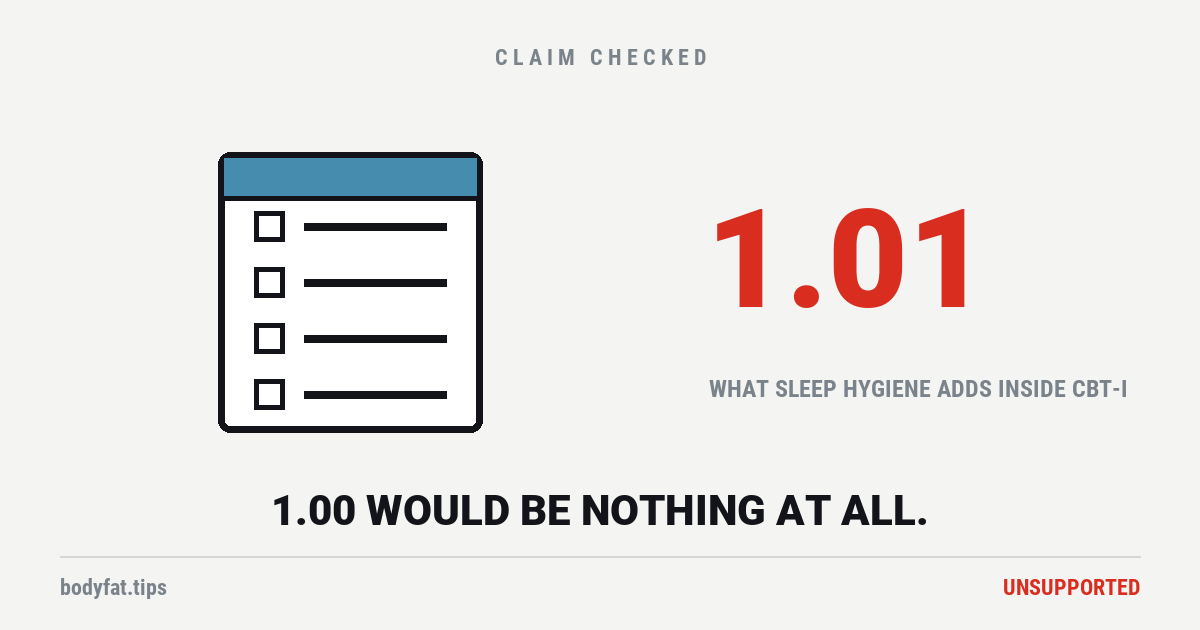
Read the sleep hygiene row again. 1.01.
That number is an odds ratio for what the ingredient adds, and 1.00 means it adds nothing at all. Sleep hygiene education scored 1.01, with a range running from 0.77 to 1.32 — comfortably including “no effect”. The researchers’ own word for it was not essential. [2] A separate team ran its own component analysis on 80 randomised trials, this time only in people with a diagnosis, and could not tell sleep hygiene education’s effect apart from chance either. [4]
What the working parts actually are
Since the whole point of a page like this is to be useful, here is what the ingredients that did score are, in plain English.
Sleep restriction (1.49). Deliberately spending less time in bed for a while, so that the time you do spend is densely slept rather than spent lying awake. Counterintuitive, unpleasant for a week or two, and one of the strongest things on the list.
It is also the one that comes with a warning. In the first weeks it can make you sleepier and less able to concentrate during the day. The guideline says it may be contraindicated — unsafe to use — for people in high-risk jobs, naming heavy machinery operators and drivers, and for people predisposed to mania or hypomania, with poorly controlled seizure disorders, or with excessive daytime sleepiness. Its recommendation assumes a clinician explains the method and monitors you through it. [1] If you are thinking of trying it, that is the conversation to have first.
Stimulus control (1.43). Retraining the association between your bed and being awake — the bed is for sleeping, and if you are lying there awake you get up. It attacks the thing that turns a bad night into a habit.
Cognitive restructuring (1.68), the strongest of the lot. Working on the thoughts about sleep itself — the catastrophising at 3am about how ruined tomorrow will be, which is itself keeping you awake.
Mindfulness and acceptance (1.49). What the researchers call “third-wave” components: mindfulness, and acceptance and commitment therapy, which teach you to notice the thoughts and feelings that come with a bad night without judging or fighting them. It scored as high as sleep restriction, with two warnings from the authors: these are newer treatments, tested only in recent trials, so the effect may be overestimated, and including them may be linked to more people dropping out. [2]
Notice what those four have in common. They are all things you do, repeatedly, and most of them are somewhat unpleasant at first. Sleep hygiene is a list you read.
The number worth remembering
The best combination the analysis found had four ingredients: cognitive restructuring, mindfulness or acceptance work, sleep restriction and stimulus control, delivered in person by a therapist. Measured against sleep hygiene education, also delivered in person, it had a number needed to treat of 3. [2]
A number needed to treat is how many people have to get the better treatment for one more of them to benefit. So: give three people the package instead of the sleep hygiene sessions, and one more of them reaches remission — a satisfactory score on a sleep questionnaire by the end of treatment. That assumes 14% would have got there on sleep hygiene anyway, the typical rate in those groups; at 6% the number is 5.3, and at 26% it is 2.6. [2] Either way, the thing the package beat was sleep hygiene itself. For comparison, plenty of accepted medical treatments have a number needed to treat in the dozens. Three is a very good number.
The authors add their own caveat, and it belongs here: undetected interactions between components could undermine the conclusions. [2] Pulling apart a bundle statistically is not the same as testing each piece alone.
The statistical trick this topic is full of
A 2025 review gathered 42 trials and 4,245 adults on sleep hygiene on its own, 39 of them with enough data to pool. [3] It found two numbers that look comparable and are not, and understanding the difference between them is worth more than anything else on this page.
Number one: people given sleep hygiene education improved by 3.4 points on an insomnia questionnaire from before to after.
Number two: in head-to-head comparisons, CBT-I beat sleep hygiene by 3.8 points.
The first number is uncontrolled. It is just what happened to a group of bad sleepers over the course of a study — which includes getting attention, expecting to improve, and the plain fact that insomnia comes and goes on its own. Every one of those would have happened without the advice. And the advice was often more than a leaflet: of the 38 trials that said how they delivered it, 20 did so face to face. [3]
The second number is a comparison against another group, so it isolates the actual difference the treatment makes.
And it is bigger. The amount by which real treatment beats sleep hygiene exceeds the entire before-and-after change that sleep hygiene shows in the first place.
Any time you see a health claim built on a before-and-after number with no comparison group, that is the question to ask: compared to what?
Two things we are not going to overstate
Sleep hygiene also lost to acupressure in that review, by 1.9 points. [3] That is a real result and we are not going to turn it into an endorsement of acupressure — 85.7% of the trials in that pool were at high risk of bias, and not one was at low risk. What it tells you is how weak a comparator sleep hygiene is, not how strong anything else is.
And the experts disagree about relaxation. The 2021 guideline suggests clinicians may use relaxation therapy on its own. [1] The 2024 component analysis found relaxation potentially counterproductive, at 0.81 — though its range runs from 0.64 to 1.02, just past 1.00, so “no effect” is still on the table. [2]
We are not going to resolve that for you, because it is not resolved. If you find relaxation helps you sleep, nothing here says stop.
The verdict
Sleep hygiene as a fix for chronic insomnia is Unsupported. The clinical guideline advises against using it alone, and when somebody isolated it inside the treatment that works, it contributed nothing measurable.
That is not the same as saying it is bad for you. A cool dark room and less caffeine are perfectly sensible. They are just not a treatment, and handing someone with a real sleep disorder a list of tips is closer to doing nothing than it looks.
Everything above is about insomnia that has settled in. The guideline covers diagnosed chronic insomnia disorder; the reviews also counted people with no formal diagnosis but a high score on an insomnia questionnaire, or bad nights at least three times a week for a month or more. [2] [3] Not a rough fortnight. If that is you, the thing worth asking a clinician about by name is CBT-I.
No CBT-I therapist near you? The 2021 guideline admits that finding one can be hard: patients can struggle with “locating a skilled provider in their geographic region”, so it tells clinicians to discuss group treatment and “internet-based programs” as well as one-to-one sessions. [1] And the 2024 analysis found no evidence that in-person treatment beat a self-help programme with a person sending reminders to keep going. [2] We report the research here; we are not your doctor.
Related: all the habits we have checked · box breathing · does lack of sleep cause weight gain · magnesium benefits · how many steps a day
This page was corrected on 18 September 2026 after an independent editorial review. Three things were wrong. The evidence panel said the funding of its sources was not stated; two of the three name their funders, neither of them a company, and all three declare their conflicts. The panel now reports both, including an author of the component analysis who writes and teaches CBT-I and is a founder of Hypknowledge, LLC. The number needed to treat of 3 read as if it were measured against no treatment; it was measured against sleep hygiene education delivered in person, assuming 14% of those people would have reached remission anyway, and the winning package had a fourth ingredient the page left out, mindfulness or acceptance work, which now has its own row. And sleep restriction was presented with no warning; it now carries the guideline’s own caution about who it may be unsafe for, and why to do it with a clinician.
Also changed: the headline and opening now say the guideline advises doctors against using sleep hygiene alone, in its weaker, conditional grade, rather than telling them not to; the evidence panel no longer credits the guideline with a finding about sleep hygiene inside CBT-I, which it did not rule on, and cites a second, independent analysis that did, with that paper’s own correction notice; the population note now includes insomnia measured by questionnaire as well as diagnosed, and the next step covers group and online CBT-I; the search figure now reads “well over 100,000 times a month”, because “nearly half a million people every month” was a yearly average lifted by two unusual months, and it counted searches, not people; the chain now starts with the 1977 monograph that turned sleep hygiene into a set of rules; and the 2025 review’s trial count, how its sleep hygiene was delivered, and the relaxation range are stated more precisely. The rating is unchanged.