NAD+ Supplements: The NAD in Blood Goes Up. Nothing Else Moved Reliably.

Let us start with the part that is true, because it is unusual for a supplement and it deserves saying first.
NAD+ boosters raise NAD+. NAD+ is a molecule every cell uses to turn food into energy, and the pitch is that it drains away as you age and that topping it up slows the clock. Across the human trials, the two capsules sold to top it up, nicotinamide riboside (NR) and nicotinamide mononucleotide (NMN), “consistently demonstrated biochemical target engagement” — the NAD+ in blood goes up, reliably. They were also “generally well tolerated over weeks to months”; the longest trial in the review ran 26 weeks. [1]
Whether it drains away in the first place is less settled than the ads let on. The review itself says reported falls depend on the tissue and on how the molecule is measured. [1] A 2025 review found a decline with age seen consistently in only a limited number of human studies. [26] And in May 2026 a Dutch-led team measured NAD+ in the blood of seven separate groups of people and reported it “remarkably stable with age”; it did change when people took NR. [27]
Then the review gets to what happened to the people. Effects on function, metabolism, blood vessels and other healthspan-relevant outcomes were “heterogeneous and often null or endpoint-specific”. [1]
A number moved. Nothing else moved reliably.
Some things did move, in some trials: a longer six-minute walk here, a quicker sit-to-stand there. Peak fitness and grip strength mostly did not. [1] In all four of the trials the review names for those gains, a company paid for the work or supplied the NMN. And the rise itself is a blood result. The review calls what happens in tissue “more variable”, and three trials that looked inside muscle (40 men on NR, 25 women on NMN, 30 adults on 2,000 mg of NMN a day) found the NAD+ there unchanged. [1][5][6]
| What was measured | Result |
| NAD levels in blood | consistently up |
| Healthspan outcomes in humans | often null |
| Blood sugar and blood fats · 3 pooled analyses of NMN | no significant benefit |
| Body weight on NMN · 6 trials, 215 people | 0.7 lb lower, range includes zero |
| NAD+ drips · published randomised trials with a wellness or ageing outcome | none found |
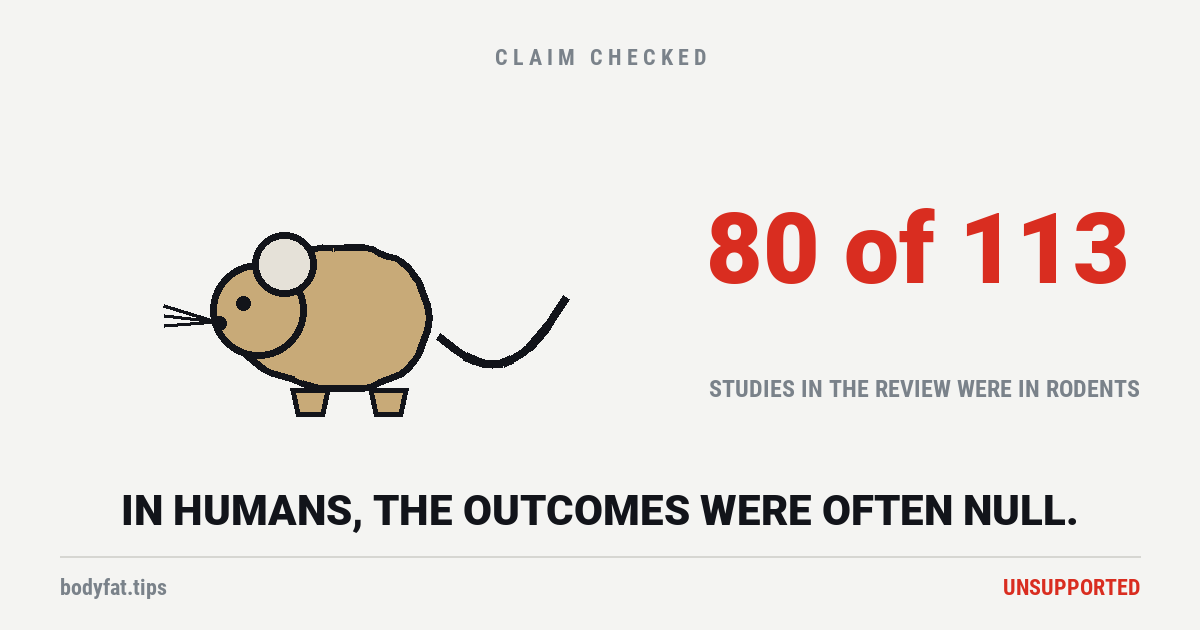
Eighty of the 113 studies were in rodents
The review ran from January 2010 to October 2025 and found 113 eligible studies. Thirty-three were human reports, 28 of them randomised. Those 28 describe 25 separate trials, because one trial was written up twice and another three times. The other eighty were rodent studies. [1]
And in rodents it looks great. NAD+ augmentation was “frequently associated with improvements in metabolic, mitochondrial, inflammatory, and functional outcomes”, though even there the reviewers note effects varied across models. [1]
On the thing the sales page is really about, living longer, even the rodents are split. The review quotes a 2016 paper in Science: old mice given NR lived a mean of 868 days against 829. [1][19] It also lists two studies that found longer survival in particular models, and three that found no clear effect on lifespan. One of those three is the US National Institute on Aging’s testing programme, which runs each compound at three laboratories at once, and which reported in 2021 that NR did “not affect lifespan in either sex”. [1][20]
This is the oldest story in supplement marketing and it never stops working: the mouse data is promising, the human data is a shrug, and only one of those makes it onto the label.
Two of the early human trials were paid for by the companies selling the capsules, and what they measured was the molecule. One maker’s 2017 trial of its own capsule in 120 adults: blood NAD+ up about 40% on one dose and about 90% on a double dose. [21] A second maker’s 2019 trial of its ingredient in 140 adults: up 22%, 51% and 142% across three doses. [22] Each ran eight weeks. When we read the first maker’s product page on 30 September 2026, its search description said “clinically proven to raise NAD+ levels by 40%” and its list of benefits included “Fight aging at the cellular level”. [24] The first of those was tested. The second is the claim.
On blood sugar, cholesterol and weight, the pooled trials found no significant benefit
Because this is a body composition site, the metabolic question is the one we care most about. There are three meta-analyses for it (a meta-analysis pools separate trials into one estimate), and they agree.
The first pooled eight randomised trials of NMN: 342 middle-aged and older adults, 250 mg to 2,000 mg a day, for two to twelve weeks. No single marker drew on all eight. Fasting glucose pooled six of them, insulin three, insulin resistance three, and glycated haemoglobin two, with 45 people between them. [2]
Fasting glucose: no significant benefit. Fasting insulin: none. Glycated haemoglobin, which reflects blood sugar over months: none. Insulin resistance: a small difference that landed just the wrong side of the line researchers use for “probably not chance” (p = 0.06), and went away when the authors set aside one trial, whose only author worked for a company in the NMN business, in which the supplement group did not improve and the placebo group got worse. Cholesterol and triglycerides: none. [2]
Nothing reached significance on any marker. The authors are careful about who that covers: a small number of small trials, mostly in people whose blood sugar and blood fats were normal to start with. They say it cannot be carried over to people who have diabetes or high blood fats, or are at risk of them. [2]
One of the eight did find something. In 25 postmenopausal women with prediabetes, ten weeks of NMN at 250 mg a day left muscle 25% more responsive to insulin than it had been at the start, with no change on placebo. That was the trial’s registered main outcome. Insulin sensitivity in the liver and in fat tissue, fasting glucose, insulin, body fat and fat-free mass (everything that isn’t fat) did not change in either group. [5][23] It is one small trial, and the newest pooled analysis says of it that replication “is still needed”. [3]
Two larger analyses have pooled NMN trials since: 12 trials and 513 people, then 15 trials. [4][3] Same answer on fasting glucose, glycated haemoglobin and every blood fat: no significant effect. The 12-trial paper rated seven of its trials as raising some concerns about bias and the other five as high risk, and drew a conclusion worth quoting: “an exaggeration of the benefits of NMN supplementation may exist in the field”. [4] The 15-trial paper, from July 2026, also graded how far each of its results can be trusted: moderate for fasting glucose and body weight, low for blood pressure, very low for insulin resistance. [3]
It did turn up one signal. Diastolic blood pressure, the lower of the two numbers, averaged 2.4 mmHg lower on NMN across 339 people (the range the true average probably sits in: 0.7 to 4.2 lower). The authors grade that low certainty, note that most of the trials were not built to measure blood pressure, and say it is not yet evidence that NMN treats high blood pressure. [3]
And weight? The newest analysis pooled six trials and 215 people. The average difference was 0.7 lb (0.32 kg) in NMN’s favour, and the range the true average probably sits in runs from 2.6 lb lower to 1.2 lb higher (95% CI −1.19 to 0.54 kg). No difference at all sits comfortably inside that. [3] The 12-trial analysis got 0.04 lb (0.02 kg). [4] Body mass index did not move in either. [3][4]
Look inside that pooled number, because it is mostly one trial. About three-quarters of what counts toward it comes from 48 recreational runners in China who all kept up an exercise programme for six weeks; NMN did not change their weight. The only trial in the pool whose result stood clear of zero was paid for by the company that makes the NMN it tested: 30 overweight or obese adults aged 45 and over, 2,000 mg a day for 28 days. The 21 on NMN lost weight while the nine on placebo gained, a gap of 4.2 lb (1.9 kg; 95% CI 0.5 to 3.3 kg). Liver fat and belly fat did not differ between the groups, and thigh muscle fell by about 2.5 oz (70 g) on NMN, which the authors call clinically insignificant. They also call their own p-values “nominal” and say the result needs confirming in larger, longer trials. [3][6]
NR has been weighed too. In 13 overweight or obese adults, six weeks at 1,000 mg a day left body weight unchanged, with fat-free mass 1.3 percentage points higher than on placebo (62.65% against 61.32%). [7] In 40 men with obesity, twelve weeks at 2,000 mg a day improved neither insulin sensitivity nor body composition. [28]
And muscle, the other half of body composition? A 2025 meta-analysis covered ten randomised trials in adults whose average age was 60 or more. NMN made no significant difference to muscle mass for height (three trials), grip strength (five) or walking speed (four), and the authors conclude that the evidence “does not support NMN and NR supplementation for preserving muscle mass and function” at that age. [25]
One more thing about who paid for these trials. Of the eight in the first analysis, six were paid for by a company and a seventh was written by a company’s employee. The eighth had US government grants, with one author declaring patent-licensing fees from two NMN companies. [2][5] Companies paid for most of these trials, and the pooled result was still null.
Now the drip, which is the expensive end
NAD+ is also sold as an intravenous infusion in wellness clinics, at a price that makes a tub of powder look like pocket change.
Here is what the review found on that, in full: “No eligible outcomes trials evaluated intravenous or intramuscular NAD+ itself for anti-aging or wellness indications.” [1]
Read the fence around that sentence before leaning on it. It covers NAD+ itself, for anti-ageing or wellness, in peer-reviewed English-language papers published up to October 2025. Preprints were left out, and the review reports no records from trial registries. [1] Inside that fence it is right.
There was one non-randomised intravenous NMN study, which the reviewers say “primarily contributed short-term safety and biomarker information”, and one intravenous NAD+ pharmacokinetic pilot with no eligible clinical outcomes, counted as context only. [1] That is what the review had.
So on 30 September 2026 we looked outside the fence: two differently worded PubMed searches, the newest published review of NAD+ drips, and ClinicalTrials.gov. We found no published randomised trial of an NAD+ drip that measured ageing, energy, fitness, weight or any other wellness outcome. What we did find is this.
We found two published randomised trials of injected NAD+, both in Chinese hospitals, both in heart-failure patients. In 180 patients, 10 mg a day by drip for seven days left the share of blood the heart pumps out with each beat three points higher a month later (45.4% against 42.4%; p = 0.024, which clears the usual bar for “probably not chance”). Deaths, heart attacks, strokes and readmissions over six months did not differ significantly. [9] In 60 patients over 60, 50 mg a day for seven days produced improvements the authors report as “not statistically significant”. [10] Both trials declare a grant from the company that makes the injection. Neither tested a wellness claim, and their doses are a fiftieth and a tenth of the 500 mg a clinic hangs. [9][10][11] An older trial used NADH, the same molecule carrying an extra hydrogen. In 1994, in a double-blind study of nine people with Parkinson’s disease, five were given NADH by drip and then by injection and four were given salt water, and nothing changed significantly in either group. [29]
For the clinic dose, the published record is mostly about how the drip feels. Staff of a chain that sells these drips went through the records of 14 of its own clients. All six who were given 500 mg of NAD+ on four straight days reported moderate to severe reactions during the infusion (the paper lists abdominal cramping, diarrhoea, nausea, vomiting, a faster heart rate and chest pressure), which stopped when the drip did. A month later their body composition, measured on a bioimpedance machine, had not changed significantly. The authors say themselves that a study designed and run by the company that employs them “may have resulted in implicit bias”, and it had no placebo group. [11] On the day we read it, the same chain’s website offered an NAD+ add-on for “enhancing your metabolism, energy and cellular health”. [24]
The most favourable report we found has no comparison group either. Fifty people in addiction treatment were given infusions of NAD+ combined with an amino-acid mixture, and rated their cravings, anxiety and depression lower afterwards than before. One of its authors holds patents on the amino-acid therapy, and the paper itself asks for a randomised, placebo-controlled trial. [30]
The one randomised, placebo-controlled trial of the clinic dose we found was paid for by the maker of a rival product, an injectable form of NR: 53 healthy adults aged 40 and over, in two parts, one infusion each. It was posted in June 2024 as a preprint (a paper not yet checked by other scientists), and we found no journal version of it. A single 500 mg NAD+ drip brought more, and more severe, reactions than an NR drip, and a rise in white blood cells three hours later that the authors read as a sign of an inflammatory response. [12] The trial’s registry entry lists a sleep scale and an energy scale among its outcomes. The preprint mentions them once, in its statistics section, and gives no result for either. [12][23]
What the regulator has said is about safety, and it is not reassuring. On 30 October 2024 the US Food and Drug Administration told compounding pharmacies that it “has received adverse event reports following use of NAD+ injectable drugs, including severe chills, shaking, vomiting and fatigue with some requiring medical treatment”, reactions it called consistent with excessive levels of endotoxins (toxins from bacteria), and that it knew of compounders making intravenous products from food-grade NAD+. [13] A warning letter dated 20 January 2026 describes three patients sent to the emergency room after NAD+ drawn from one vial made by a Florida compounding facility; an unopened vial from the same lot was found to hold excessive endotoxins. [14] The agency’s recall database, searched under the molecule’s full name and as NAD+ and NADH, returned 19 recall records for injectable products from 11 firms between 2012 and 2025: 14 of them for lack of sterility assurance and one, the most serious class, for elevated endotoxin levels. [13] None of this is evidence on whether the drip works. It is evidence about what has been in some of the vials.
A trial that would test a version of the ageing claim is on the books. A hospital in Shanghai had a randomised, blinded pilot posted on the registry in January 2026: 60 adults aged 40 to 70 with stiff arteries and raised blood pressure, seven days of NAD+ drips or salt water, and a measure of how well an artery widens afterwards. When its record was last updated it had not started recruiting. [23]
What regulators have ruled on, which is not whether it works
Europe’s food-safety agency has judged NR safe as a supplement at up to 300 mg a day for healthy adults, and up to 230 mg a day in pregnancy and breastfeeding (2019), and NMN safe at up to 300 mg a day for adults other than pregnant and breastfeeding women (2026). [15][17] Those are safety opinions at those doses. The NMN opinion says in so many words that it “is not an assessment of the efficacy” of the product. [17] In 2021 the same agency noted experimental data pointing to several ways that intakes of nicotinamide or its precursors far above what the body needs “might cause adverse effects”, and said the upper limit for nicotinamide may need re-evaluating. [16]
The trials on this page went up to 2,000 mg a day, several times the dose that agency assessed. The first meta-analysis saw what looked like more side effects, related to the capsule or not, in the groups taking 1,000 mg or more, and called the long-term safety of higher doses “uncertain”. [2] The newest found no excess of side effects across ten trials and 383 people, and added that trials this short cannot rule out rare, delayed or high-dose harms. [3]
In the United States the argument has been over what NMN legally is. The FDA told a manufacturer in 2022 that NMN “may not be marketed as or in a dietary supplement”, because it had been authorised for study as a drug first, and reversed that on 29 September 2025 after concluding that NMN had been sold as a supplement “as early as 2017”, before the drug studies. [18] Both letters are about the legal definition of a supplement, not about whether NMN does anything.
The verdict
Unsupported — for the benefit, not for the biochemistry.
Be precise about that, because the distinction is the whole page. In blood, the capsules do the molecular thing they claim to do, and do it consistently. In muscle, the trials that looked mostly saw no change. That is still more than most supplements can say.
What has not been shown is that raising the number slows ageing, and that is the claim this rating is for. None of the review’s 33 human reports followed anyone for longer than 26 weeks, and none measured whether people lived longer or fell ill later. [1] What the trials offer instead are stand-ins. The nearest one in the review is a “biological age” score that a calculator works out from 19 routine blood-test values. In one 60-day trial of 80 people, paid for by the company that made the NMN, the score rose in the placebo group and stayed level on NMN. [8] That is a blood panel, not ageing.
The reviewers’ own word for the clinical effectiveness is “inconclusive”. [1] It fits the walking tests and blood markers, where 28 randomised reports from 25 trials came out mixed and often null. On blood sugar, cholesterol and body weight, three pooled analyses of NMN agree that there is no significant effect. [2][3][4] On ageing itself the trials in the review did not look. That is why the rating is Unsupported: the claim is about ageing, and these trials do not show it.
This is not a case of nobody having looked. People looked.
And if you are considering the intravenous version: we found no published randomised trial of it for ageing or wellness, and the published record of the clinic dose is mostly a record of reactions. This is journalism about research, not medical advice. Anything that goes into a vein is a conversation to have with a doctor who knows your history, not a wellness purchase.
Related: colostrum benefits · does zinc help with colds · beetroot juice benefits · fish oil vs krill oil · every claim we’ve checked
An independent editorial review found errors across this page, and they were ours. We said both of our sources were paywalled and that we had worked from their abstracts. Both are open access. We have now read them in full, with their supplements, and several lines here did not survive that. “Eight trials found nothing” and “nothing on any of them”: no marker pooled all eight trials, insulin resistance missed significance narrowly (p = 0.06), and one of the eight, in 25 women with prediabetes, found muscle responding better to insulin. “The one meta-analysis”: there are three, of 8, 12 and 15 trials, and they agree. “Twenty-eight randomised human trials” are 28 reports of 25 trials. “Does it consistently” is true of blood; in muscle, the trials that looked mostly saw no change. The funding row said “Not stated in the sources read”. Both sources state it, and the meta-analysis’s own table puts a company behind seven of its eight trials.
The intravenous section turned a scoped sentence into “None” and “the entire evidence base”. The review’s sentence covers NAD+ drips for anti-ageing or wellness in peer-reviewed papers to October 2025. Outside that scope there are two randomised trials of injected NAD+ in heart-failure patients, a 1994 trial of injected NADH in Parkinson’s disease, a preprint, a seller’s review of its own clients’ records, an uncontrolled report from addiction treatment, and two US regulator documents about reactions to NAD+ injections. All are now on the page, with what each does and does not show. The page also took the products’ premise on trust, that NAD+ falls as you age; a 2026 study of seven groups of people did not find that in blood, and the page now opens with it. We also added the body-weight results this page never reported, the European and US regulators’ positions, and how each source was read; rebuilt the provenance chain from dated studies and sellers’ own pages; and removed a search-volume figure (“90,500 searches a month at $3.19 a click”) that we could not trace to any saved keyword pull. The headline used to end “Almost Nothing Else Did”. The rating is unchanged.